

A financial advisor can help with a business partner buyout by modeling financing options, projecting the cash-flow effect on the business, and coordinating the transaction with your CPA and attorney. What an advisor does not do is draft the buy-sell agreement or set the legal purchase price — that work belongs to a business attorney and a valuation professional, and skipping it is the most common reason a buyout stalls in 2026.
- A financial advisor helps with a business partner buyout by modeling financing, cash flow, and the post-buyout hit to your personal income.
- Vital Investment Management, a fee-only fiduciary in Loveland, Colorado, coordinates buyout planning alongside your CPA and attorney rather than replacing them.
- Common financing routes for a partner buyout are cash, an SBA 7(a) loan, seller financing, or an earn-out tied to future results.
- Agreeing on a buyout price before a formal valuation is done is the fastest way a partner buyout goes sideways.
Why This Matters
A partner buyout is rarely just a legal document — it's a cash-flow event that can strain the business for years if the financing is structured wrong. Pay too much cash up front and you starve working capital right when you need it most; lean too hard on seller financing and you're carrying debt to a partner who no longer works there.
A fee-only financial advisor like Vital Investment Management looks at the buyout from the side the attorney and CPA usually don't cover: what happens to your personal balance sheet, your retirement contributions, and the business's operating cushion once the check clears. That's a distinct question from what the business is worth or how the contract is worded, and it's the piece owners most often skip.
Can a Financial Advisor Help With a Business Partner Buyout?
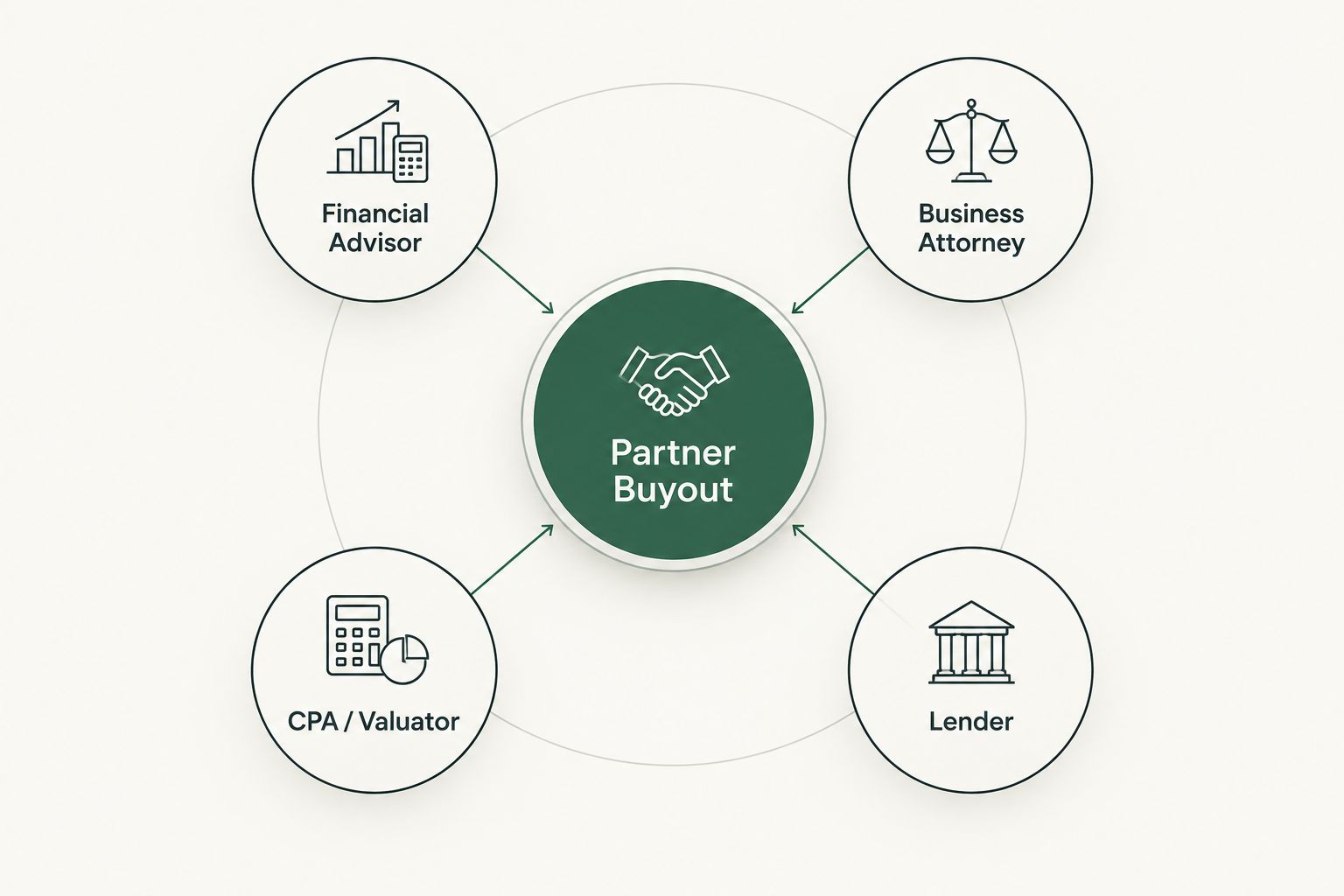
Yes, but the advisor is one of three or four professionals typically involved, not a substitute for the others. Here's how the roles split on a typical buyout:
| Role | What They Handle | Best For |
|---|---|---|
| Financial advisor | Financing structure, cash-flow projections, personal wealth impact | Turning the deal numbers into a decision you can live with |
| Business attorney | Buy-sell agreement, negotiation terms, entity structuring | Making the deal enforceable |
| CPA or valuator | Business valuation (SDE or EBITDA multiple), tax treatment of payments | Setting a defensible price |
| Lender (SBA 7(a) or bank) | Financing the gap between cash and price | Deals that need outside capital |
A financial advisor's job in this mix is to answer the questions that come after the price is set: can the business service a loan payment and still fund payroll and taxes, does a seller-financed note make sense given the departing partner's own timeline, and what does the remaining owner's personal financial plan look like once the buyout is paid off. This is separate from business succession planning, which looks at who eventually takes over the whole company — a partner buyout is often one step inside that larger plan, not the whole plan.
Why the Advisor's Role Varies
How much a financial advisor is involved depends on the specifics of the deal, not on a fixed process:
- Whether the buyout is amicable or contentious. A friendly exit needs financial modeling; a disputed one often needs the advisor working closely with litigation counsel.
- How the price gets financed. Cash, an SBA 7(a) loan, seller financing, or an earn-out tied to future performance each carry different cash-flow and tax consequences.
- Whether a buy-sell agreement already sets a valuation formula. If the price mechanism was written into the partnership documents years ago, there's less to model and more to verify.
- How complex the business's financials are. A single-location service business is a simpler cash-flow projection than a multi-entity operation with inventory and multiple revenue streams.
- Whether the payout affects your own retirement plan. Funding a buyout out of business cash can crowd out contributions to a 401(k) or SEP IRA the same year.
- Timeline pressure. A health event, a hard retirement date, or an unresolved dispute compresses the planning window and changes which professional leads the process.
“A financial advisor models the buyout your attorney and CPA still have to build.”
Who Sets the Price in a Partner Buyout?
A CPA or a business valuator sets the price, typically using an SDE (seller's discretionary earnings) or EBITDA multiple depending on the size of the business. A financial advisor may sanity-check whether that price is financeable given the business's cash flow, but the valuation itself sits outside an advisor's role.
Does a Financial Advisor Replace a Business Attorney in a Buyout?
No, a financial advisor does not replace a business attorney in a partner buyout. The attorney drafts or updates the buy-sell agreement, negotiates the legal terms, and handles entity and tax structuring specific to the transaction — work a financial advisor is not licensed to do.
How Is a Partner Buyout Usually Financed?
A partner buyout is usually financed through some combination of cash on hand, an SBA 7(a) loan, seller financing where the departing partner accepts payments over time, or an earn-out tied to future performance. Which combination makes sense depends on how much cash the business can spare without disrupting operations in 2026 and how much risk the departing partner is willing to carry.
Owners weighing these financing choices often start by asking questions to ask a financial advisor about how a proposed structure would affect both the business's operating cushion and the owner's personal financial plan — two questions a valuation number alone doesn't answer.
Talk Through Your Buyout Numbers
A confidential discovery call with Dillon Goodman covers financing structure and cash-flow impact.
FAQ
Can a financial advisor help with a business partner buyout?
Yes, a financial advisor helps model the financing structure and the cash-flow impact of a business partner buyout on both the business and the remaining owner's personal finances. The advisor works alongside a CPA for valuation and an attorney for the legal agreement, not in place of them.
Who values the business in a partner buyout?
A CPA or a dedicated business valuator sets the price, usually with an SDE or EBITDA multiple. A financial advisor may review whether that price is financeable but does not perform the valuation itself.
Does a financial advisor draft the buy-sell agreement?
No, a business attorney drafts and negotiates the buy-sell agreement. A financial advisor's role stops at the financial modeling that informs the terms, not the legal language.
What is the most common financing structure for a partner buyout?
Partner buyouts are commonly financed with cash, an SBA 7(a) loan, seller financing, or an earn-out tied to future performance, often in combination. The right mix depends on how much cash the business can spare without disrupting payroll or growth.
Should I get a valuation before agreeing to a buyout price?
Yes, agreeing to a price before a formal valuation is complete is the most common way partner buyouts run into disputes later. A CPA or valuator's number gives both partners a defensible starting point for negotiation.
Does a partner buyout affect my personal retirement plan?
It can, especially if the business funds the buyout out of cash flow in the same year you'd normally make retirement contributions. A financial advisor can project that trade-off before the deal closes rather than after.
Is a fee-only financial advisor better for a partner buyout than a commission-based one?
A fee-only fiduciary advisor has no incentive to recommend a financing product or investment for a commission, which matters when the advice touches how much debt the business takes on. Vital Investment Management operates as a fee-only, SEC-registered RIA in Loveland, Colorado.
One Last Thing
The deal that looks cleanest on paper is usually the seller-financed one — no bank, no underwriting delay, just payments over time. It's also the structure most likely to strain the business if the remaining owner didn't stress-test the payment schedule against a slow quarter, because unlike a bank loan, a partner expecting a note payment has little patience for a missed month.