

A fee-only financial advisor who offers treasury management can build and maintain a cash flow forecast for your business, tying it to your bank data instead of leaving it as a static spreadsheet. The catch: a forecast built once and never updated is stale within a quarter, so the real question is whether the advisor treats forecasting as an ongoing service or a one-time deliverable.
- A financial advisor offering treasury management can build a rolling cash flow forecast tied to your bank accounts, not a static one-time spreadsheet.
- Bookkeepers track what already happened; a financial advisor projects what's coming and connects it to hiring, tax, and distribution decisions.
- A forecast updated once a year goes stale for seasonal businesses within a few months.
- Vital Investment Management builds cash flow forecasting into treasury management for Northern Colorado business owners, not as a standalone product.
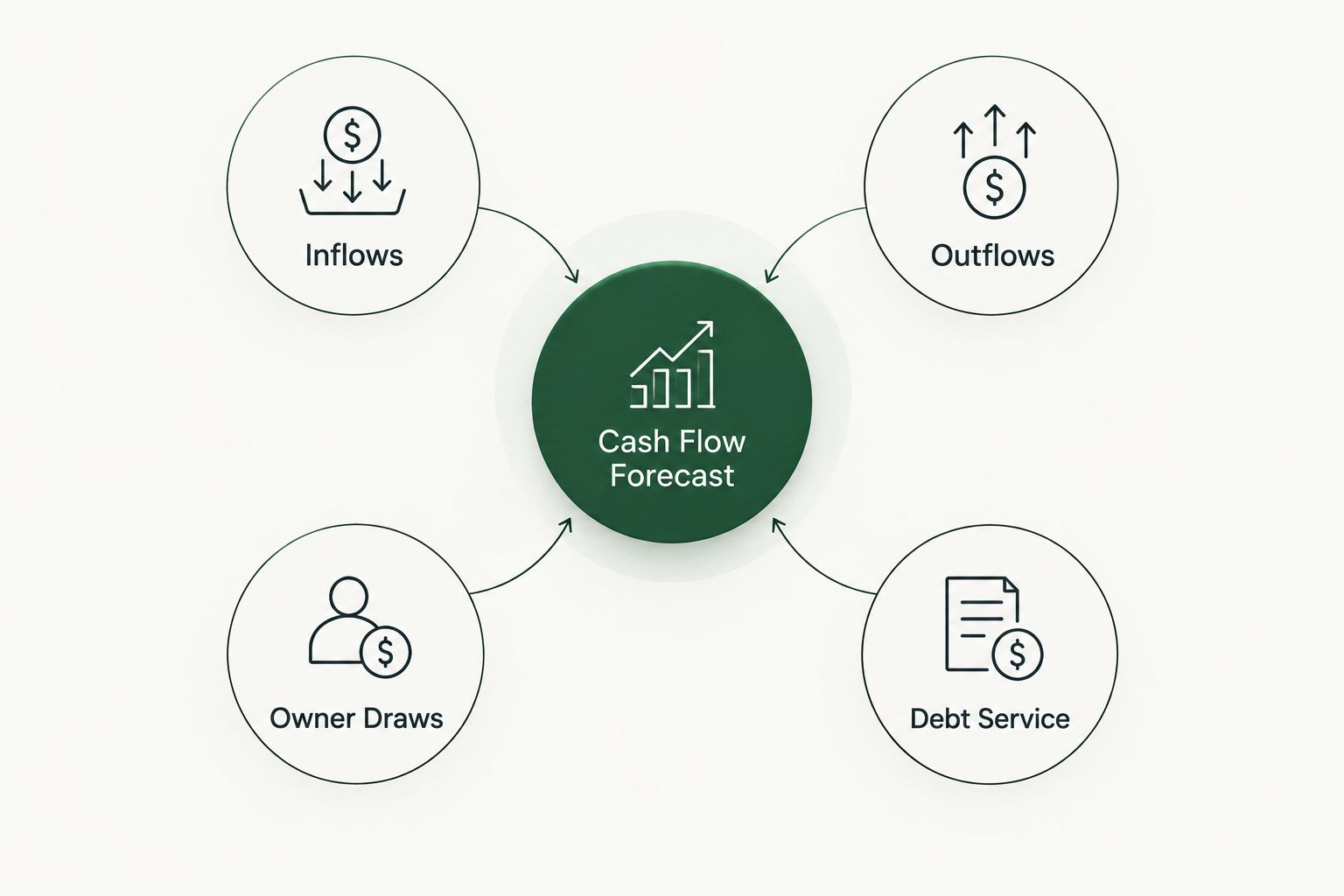
- Owner draws, tax timing, and debt service are the three inputs most DIY forecasts get wrong.
Why this matters
Most small business owners run cash flow in their head or in a spreadsheet nobody updates after March. That works until a slow month collides with a tax payment or a payroll run, and by then the decision is reactive instead of planned.
A fee-only financial advisor who does treasury management isn't guessing at your numbers — they're pulling actual bank and accounting data and modeling what happens three, six, and twelve months out. That's different from a bookkeeper closing last month's books or a CPA filing last year's return. If you're evaluating whether to bring someone in for this, 8 questions to ask a financial advisor before you hire covers what to ask specifically about cash flow and treasury scope, not just investment management.
Can a financial advisor help with cash flow forecasting?
Yes — but only if forecasting is part of what they actually offer, not an afterthought bolted onto investment management. The table below shows where cash flow work typically sits across the professionals a business owner already has on the team.
| Role | What they track | Forward-looking? | Best for |
|---|---|---|---|
| Bookkeeper | Transactions already recorded | No | Clean, current books |
| CPA | Tax filings, historical P&L | Limited, mostly tax planning | Compliance and tax strategy |
| Financial advisor (treasury) | Bank balances, AR/AP timing, cash runway | Yes, ongoing | Forecasting, decisions on hiring, distributions, debt |
The distinction that matters in 2026: a bookkeeper and a CPA are both looking backward at what happened. A financial advisor doing treasury management is looking forward at what's about to happen to your cash position, and building the model to test decisions before you make them.
What a cash flow forecast from a financial advisor includes
- A rolling 13-week or 12-month projection tied to actual bank balances, not estimates
- Timing of accounts receivable and accounts payable so you see gaps before they hit
- Modeling for owner draws, distributions, and payroll against seasonal revenue
- Scenario testing — what happens to cash if a big client pays 30 days late, or you add a hire
- A tie-in to tax timing so quarterly estimates don't blindside a lean month
What it doesn't replace
- Day-to-day bookkeeping — you still need clean, current books for the forecast to mean anything
- Tax preparation and filing, which stays with your CPA
- Legal work on contracts, entity structure, or a sale — that stays with transaction counsel
For the broader mechanics of managing business cash — not just forecasting it — the treasury management guide for small businesses breaks down operating accounts, reserves, and how forecasting fits into the rest of the system.
Why cash flow forecasting accuracy varies
Two businesses in the same industry can have wildly different forecast reliability depending on a handful of factors:
- Seasonality — a landscaping company or a retailer with a holiday spike needs monthly updates, not annual ones
- AR/AP timing — how fast customers pay you and how fast you pay vendors changes the whole picture
- One-time expenses — equipment purchases, a lease renewal, or an insurance renewal can wreck an otherwise steady forecast
- Owner distributions — pulling cash out unevenly throughout the year is one of the most common forecast-breakers
- Growth investments — hiring ahead of revenue, or opening a second location, changes the runway math
- Debt service schedule — a balloon payment or a variable-rate loan needs to sit inside the model, not be handled separately
“A cash flow forecast that isn't updated after the quarter it was built for is a historical document, not a planning tool.”
Is cash flow forecasting the same as budgeting?
No — a budget sets planned spending for a period, while a cash flow forecast tracks actual cash timing against that plan and adjusts as reality shifts. A budget tells you what you intended to spend in 2026; a forecast tells you whether the cash will be there when the bill is due.
How often should a financial advisor update my cash flow forecast?
Monthly is the baseline for most small businesses, and weekly during a tight cash period or a seasonal trough. A forecast built once at the start of the year and never revisited stops reflecting reality by the second quarter.
Can a bookkeeper do cash flow forecasting instead of an advisor?
A bookkeeper can hand you the historical data a forecast needs, but forecasting itself is forward-looking work most bookkeeping engagements don't include. That's the gap treasury management from a financial advisor is built to close.
Talk through your cash position
A confidential discovery call with Dillon Goodman, fee-only and fiduciary.
FAQ
Can a financial advisor help with cash flow forecasting?
Yes, a financial advisor who offers treasury management can build and maintain a rolling cash flow forecast tied to your bank data. The forecast only stays useful if it's updated regularly, not built once and filed away.
What's the difference between a bookkeeper and a financial advisor for cash flow?
A bookkeeper tracks what already happened in your accounts, while a financial advisor projects what's coming and models decisions against it. Both are useful, but only one is forward-looking.
Does cash flow forecasting cost extra on top of financial planning?
It depends on how the advisor structures fees — some fold it into treasury management, others price it separately. The guide on how much a fee-only financial advisor costs walks through common fee structures for 2026.
How far out should a cash flow forecast look?
A 13-week forecast catches near-term gaps like payroll and tax timing, while a 12-month forecast supports bigger decisions like hiring or a distribution schedule. Most owners benefit from having both running at once.
Is cash flow forecasting only for businesses in trouble?
No — forecasting is most valuable when a business is growing, because that's when hiring, equipment purchases, and owner draws are most likely to collide with a slow month. Waiting until cash is tight to start forecasting means reacting instead of planning.
Can a financial advisor forecast cash flow for a seasonal business?
Yes, and seasonal businesses need it more than steady ones, since revenue swings make a static annual budget nearly useless. Monthly updates during the off-season are standard for retail and service businesses with a holiday or weather-driven cycle.
One last thing
The forecasts that actually get used aren't the most detailed ones — they're the ones an owner looks at every month because someone else is maintaining them. If nobody's updating the model, it doesn't matter how sophisticated it was on day one; by month four it's describing a business that no longer exists. Vital Investment Management builds cash flow forecasting into ongoing treasury management for Northern Colorado business owners rather than handing over a spreadsheet and moving on.