

The best financial advisor for a woman running a business in 2026 is a fee-only, fiduciary registered investment advisor (RIA) who understands concentrated business equity, lumpy cash flow, and an eventual exit, not a commission-based broker selling products. Best overall for coordinating investments, cash flow and succession in one relationship: a fee-only fiduciary RIA. Best for a single, one-time plan: a standalone fee-only planner charging a flat or hourly fee. Best low-cost starting point before the business throws off real outside wealth: a robo-advisor platform. Best for owners who want tax and investment conversations under one roof: a CPA firm with an in-house wealth-management arm. Skip, in almost every case: a commission-based broker at a bank or wirehouse, because the pay structure rewards product sales over your actual cash-flow and exit questions.
- Fee-only fiduciary RIAs are the strongest fit among financial advisors for women business owners managing concentrated business equity in 2026.
- Commission-based brokers get a Skip verdict here: their pay structure rewards product sales, not your cash flow or exit plan.
- Robo-advisors work as a low-cost bridge until the business produces real outside wealth to manage.
- Ask any advisor directly whether they're a fee-only fiduciary before the first meeting; the answer should take one sentence.
- A CPA firm's in-house wealth arm can work if its investment team is a fee-only fiduciary on its own, verified separately from the tax relationship.
Why this matters
Your business is probably your single largest asset, and it doesn't behave like a diversified stock portfolio. Cash flow is lumpy, equity is illiquid, and the eventual sale or transition is a taxable event most general advisors never plan for until it's already close.
Vital Investment Management, a fee-only SEC-registered RIA based in Loveland, Colorado, works with owners on exactly this mix: treasury management, investment management, financial planning, and business transition and succession planning. That combination is why the comparison below leads with the fee-only fiduciary model instead of a name-brand brokerage.
The advisor types below aren't ranked by marketing budget. They're ranked by who gets paid to tell you the truth about your business's finances, and who gets paid to sell you something regardless of whether it fits.
What makes the best financial advisor for women business owners
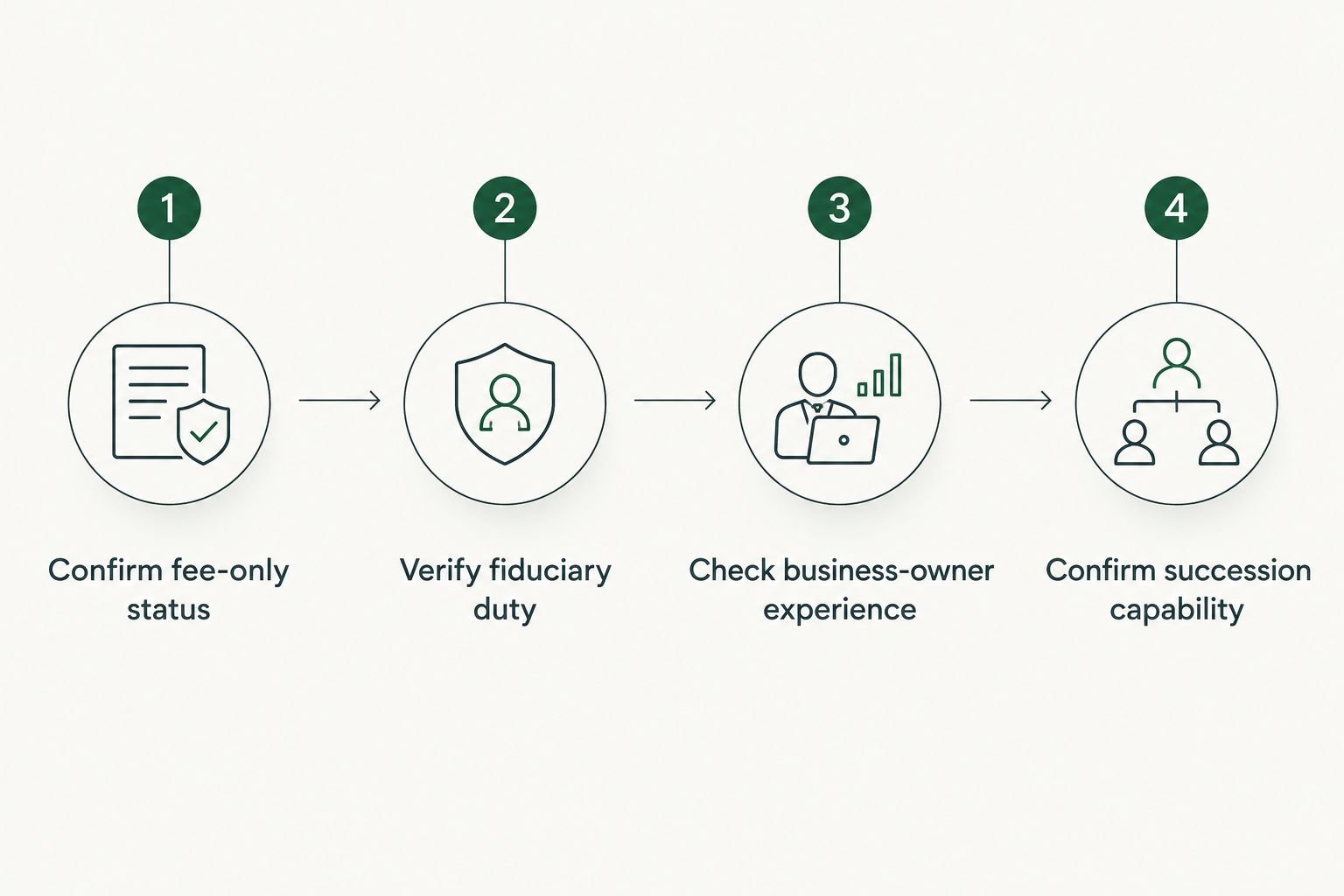
- Fee-only, fiduciary status — no commissions on products sold, a legal duty to act in your interest on every account, not just some of them.
- Direct experience with business owners — concentrated equity, 1099 income timing, seasonal cash flow, not just a W-2 salary and a retirement account.
- Succession and exit planning capability — the advisor can talk through valuation, financing, and timeline years before a sale, not scramble the year it happens.
- Transparent fee structure — you can state what you pay in one sentence, without a follow-up call to figure it out.
- Coordination with your CPA and attorney — works alongside your existing team instead of trying to replace it.
- Talks to you directly — explains fees and strategy to you in the room, not around you or through someone else present.
One of the fastest ways to check this last point: ask how do I know if my financial advisor is a fiduciary directly, in writing, before the first real meeting. A straight answer takes one sentence.
Financial advisor types for business owners, at a glance
| Advisor type | Best for | Standout feature | Key limitation |
|---|---|---|---|
| Fee-only fiduciary RIA | Coordinating investments, cash flow and succession in one relationship | Legal fiduciary duty on every account | Fee usually scales with assets managed |
| Standalone fee-only planner | A single, one-time financial plan | Lowest total cost for a one-time project | You execute the plan yourself, no ongoing management |
| Robo-advisor platform | A low-cost starting point before business wealth grows | Automated, low minimums | No human for business-specific decisions |
| CPA firm with in-house wealth arm | Tax and investment conversations in one relationship | Coordinated tax-timing decisions | Investment side is often smaller and less specialized |
| Commission-based broker/wirehouse | Bundling with an existing bank relationship | No visible upfront fee | Pay structure rewards product sales |
1. Fee-only fiduciary RIA: best financial advisor for coordinating a business owner's full financial picture
A fee-only fiduciary RIA manages your investments and financial plan for a flat or asset-based fee and owes you a legal duty to act in your interest on every account, every time. No commissions, no product-sale incentive sitting underneath the advice.
Fee-only fiduciary RIA pros:
- One relationship for investment management, financial planning, and business transition/succession work
- Fiduciary standard applies by regulation, not by firm policy that can change
- Independent from any bank's or brokerage's product lineup
Fee-only fiduciary RIA cons:
- Fee typically scales with assets managed, so it isn't the cheapest option for a very small portfolio
- Some firms carry investment minimums
- You pay directly for the advice instead of it being bundled invisibly into a product
Fee-only fiduciary RIA pricing: structures are flat-fee or asset-based rather than commission-based; see what a fee-only financial advisor costs in 2026 for the range of models in use.
Best for: a business owner who wants one advisor coordinating investments, cash flow, and an eventual exit. Verdict: Buy.
2. Standalone fee-only planner: best for a single, one-time financial plan
A standalone fee-only planner builds a plan for a flat project fee or hourly rate and doesn't manage your investment accounts on an ongoing basis. You get the plan, then you execute it.
Standalone fee-only planner pros:
- Lowest total cost if you only need a plan once
- No ongoing asset-based fee
- Good fit for a narrow question, like whether to set up a SEP IRA before year-end
Standalone fee-only planner cons:
- No ongoing monitoring once the plan is delivered
- Doesn't manage your portfolio or coordinate trades
- You need the discipline to actually follow through
Best for: an owner who needs a one-time plan and is comfortable executing it alone. Verdict: Buy for a narrow scope; otherwise Hold for something broader.
3. Robo-advisor platform: best low-cost starting point for a business owner with a simple portfolio
A robo-advisor manages a portfolio through an algorithm based on a risk questionnaire, with low minimums and automated rebalancing. It's a reasonable place to start when the business hasn't yet produced meaningful outside wealth.
Robo-advisor pros:
- Lowest-cost entry point available
- Reasonable discipline for a simple retirement account
- Typically no or very low minimums
Robo-advisor cons:
- No human to talk through a business-specific decision, like a partner buyout
- Doesn't touch business cash flow or succession planning at all
- Generic risk models don't account for concentrated business equity
Best for: an owner just starting to invest outside the business, with straightforward accounts. Verdict: Wait — use it as a bridge, graduate once the business creates real outside wealth to manage.
4. CPA firm with an in-house wealth-management arm: best for owners who want tax and investing under one roof
Some CPA firms bundle investment management alongside tax preparation, so the team filing your return also manages a portfolio. The appeal is one point of contact instead of two separate relationships.
CPA-firm wealth-arm pros:
- One point of contact for tax and investment conversations
- The team may catch a tax-timing issue faster since it already files your return
- Convenient scheduling around tax season
CPA-firm wealth-arm cons:
- The investment side is sometimes a smaller, less specialized team inside a tax practice
- Bundled billing can make the true fee structure harder to see
- Fiduciary standard on the investment side varies firm to firm and needs to be verified separately
Best for: an owner who wants tax and investment conversations in the same room and is willing to check the investment team's credentials independently. Verdict: Hold — confirm the investment side is a fee-only fiduciary in its own right before signing.
5. Commission-based broker or wirehouse advisor: best for nothing specific to a business owner
A commission-based broker sells investment and insurance products for a commission or product-based fee. Depending on the account type, the fiduciary standard may or may not apply at all.
Commission-based broker pros:
- No fee visible to you upfront
- Wide product shelf
- Sometimes bundled with an existing bank relationship
Commission-based broker cons:
- Compensation is tied to what gets sold, not to your cash-flow or exit outcome
- Not obligated to a fiduciary standard on every account type
- No structural reason to bring up succession planning if there's no product to sell around it
Best for: a bank or brokerage relationship where you already hold other accounts and aren't looking for business-specific planning. Verdict: Skip.
A commission is a reason to sell you something; a fee is a reason to tell you the truth. That's the entire difference between the top and bottom of this list.
“A commission is a reason to sell you something; a fee is a reason to tell you the truth.”
How this ranking was built
Each advisor type was measured against the same six criteria from the section above: fiduciary status, business-owner experience, succession capability, fee transparency, CPA/attorney coordination, and whether the advisor talks to you directly. The fee-only fiduciary RIA is the only model that clears all six by default; every other type clears some but not others, which is why the pros-and-cons lists above stay specific instead of vague.
Which financial advisor should you choose?
If you want one relationship handling investments, cash flow, and an eventual exit, default to a fee-only fiduciary RIA — it's the model built to clear every criterion above. If you only need a single plan built once, a standalone fee-only planner covers it for less. If the business hasn't produced real outside wealth yet, a robo-advisor is a fine bridge for now. Skip a commission-based broker for anything specific to running a business in 2026 — the incentive structure works against the questions you actually need answered.
FAQ
What's the best financial advisor for a woman business owner in 2026?
A fee-only, fiduciary RIA is the best fit for most women running a business in 2026, because it's the only model with a legal duty to prioritize your interests over a product sale. Look for direct experience with business cash flow, concentrated equity, and succession planning, not just retirement accounts.
Is a fee-only advisor better than a commission-based broker for a business owner?
Yes, for most business owners a fee-only advisor is the better fit because a broker's commission is tied to what gets sold, not to your cash-flow or exit outcome. A fee-only advisor is paid the same whether you buy a product or not.
How much does a fee-only financial advisor cost in 2026?
Fee-only advisors typically charge a flat annual fee or a percentage of assets managed rather than commissions on products sold. The exact structure varies firm to firm, so check current fee schedules directly with the advisor.
Can a financial advisor help with a business partner buyout?
Yes, a fee-only fiduciary advisor with business-owner experience can help model the cash-flow impact of a partner buyout and coordinate financing options with your CPA and attorney. It's a planning function, not a legal or tax-filing one.
How do I know if my financial advisor is a fiduciary?
Ask directly and get it in writing: a true fiduciary owes you that duty on every account, every time, not only when it's convenient. Advisors registered as fee-only RIAs are held to this standard by regulation.
Should my CPA also manage my investments?
It can work if the investment team inside the CPA firm is a fee-only fiduciary in its own right, verified separately from the tax relationship. A shared point of contact is convenient, but the investment credentials still need to hold up on their own.
Is a robo-advisor enough for a small business owner?
A robo-advisor works fine for simple retirement accounts early on, but it can't help with business-specific decisions like valuing a partner buyout or planning a transition. Most owners graduate to a human fiduciary advisor once the business produces real outside wealth.
Do I need a different advisor for business succession planning?
Not necessarily. A fee-only fiduciary RIA with business-owner experience should be able to fold succession planning into your existing relationship. Confirm this capability before you need it, not during the sale process.
Talk through your options
A confidential conversation with a fee-only fiduciary in Loveland, Colorado.
One last thing
Most owners never ask what changes in the advisor relationship the day after the business sells. A fee schedule built for slow, steady accumulation doesn't always fit managing a lump sum that lands all at once, so ask that specific question before you sign, not after the wire hits your account.