

Best overall cash flow management tool for small business owners in 2026: Float, for its rolling 13-week cash flow forecast synced directly to your accounting software. Best budget option: a DIY spreadsheet template. Best for franchise or multi-location owners: Fathom. Best for owners who want cash flow tied to tax and investment decisions instead of a standalone dashboard: working with a fee-only financial advisor on treasury management.
- Float wins for small businesses needing a 13-week rolling cash flow forecast synced to real accounting data.
- A free spreadsheet template still beats no forecast at all for solo owners with tight budgets in 2026.
- Fathom fits franchise and multi-location owners who need consolidated cash flow reporting across entities.
- Cash flow management tools for small business only work if someone actually reviews them weekly.
- A fee-only advisor ties cash flow forecasting to taxes and owner draws, which software alone can't do.
Why this matters
Cash flow is the reason a profitable small business still can't make payroll in March. A 2026 income statement can show a profit and still hide three weeks where the bank balance dips below what payroll and rent require. That gap is exactly what cash flow forecasting is built to catch before it happens, not after.
Most owners default to whatever their bookkeeper already uses, which is rarely the right fit. A solo consultant needs something different than a franchise owner running four locations, and neither needs the same tool as an owner six months from a transition or partner buyout. The right pick depends on forecast horizon, integration, and whether the number actually gets reviewed once it exists.
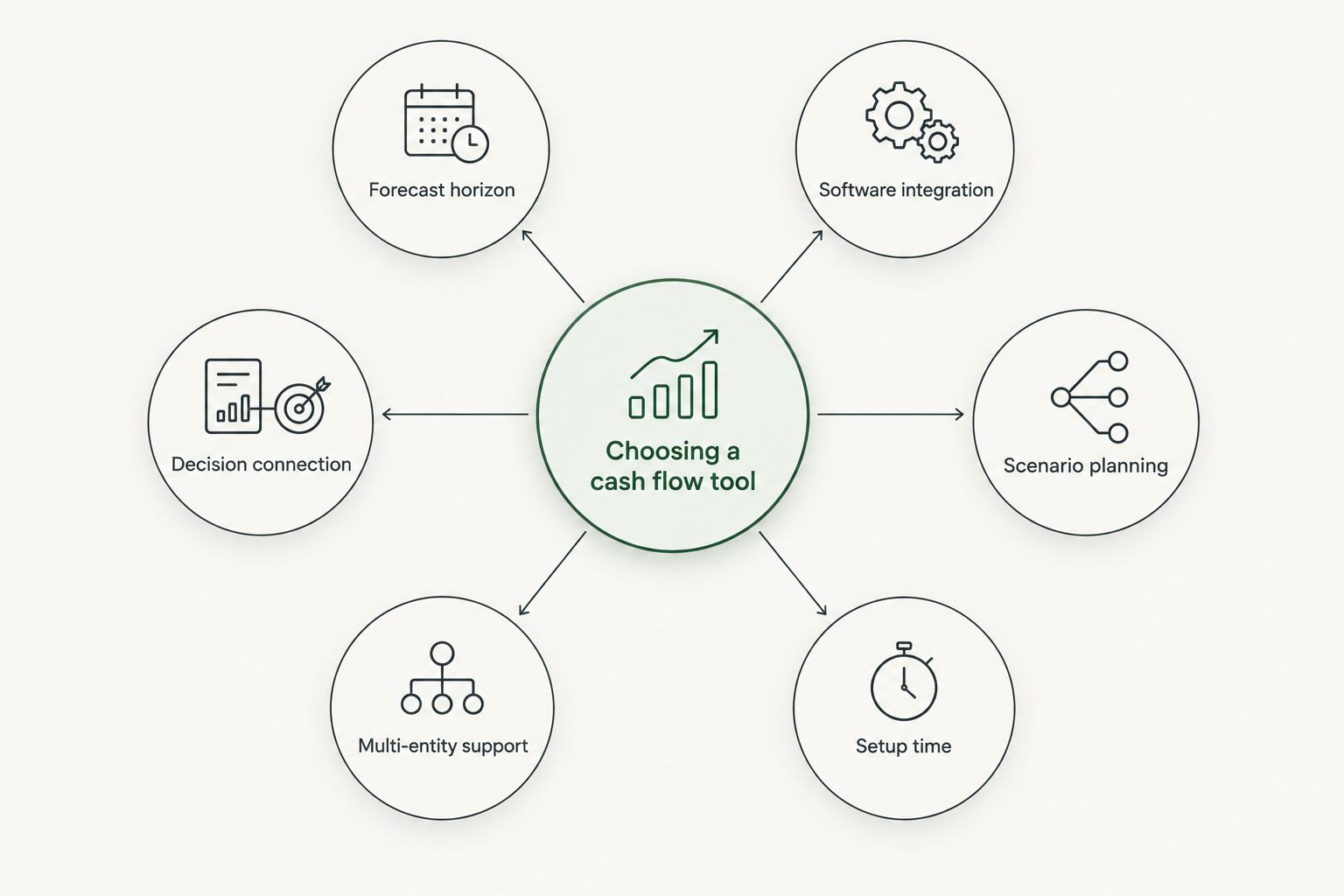
What makes the best cash flow management tools for small business
- Forecast horizon. A tool that only shows the next 30 days doesn't give you time to fix a shortfall. Look for 13 weeks or more.
- Direct integration. The tool should pull real transactions from your bank or accounting software, not rely on manual re-entry every week.
- Scenario planning. You need to model a new hire, a slow month, or a big equipment purchase before it happens, not after.
- Setup and maintenance time. A forecast nobody updates is worthless by week three. Pick something your team will actually keep current.
- Multi-entity support. If you run more than one location or entity, the tool needs to consolidate them, not just track one bank account.
- Connection to real decisions. The best cash flow management tools for small business tie the number to taxes, owner draws, and investment timing, not just a chart.
Cash flow management tools for small business at a glance
| Tool | Best for | Standout feature | Key limitation |
|---|---|---|---|
| Spreadsheet template | Solo owners with no software budget | Full control over categories | Manual entry, breaks down past 8-10 weeks |
| QuickBooks Online cash flow planner | Owners already on QuickBooks Online | Built directly into existing bookkeeping | 90-day forecast horizon caps out fast |
| Float | Owners needing a rolling 13-week+ forecast | Scenario modeling synced to real data | Added monthly cost, real setup time |
| Fathom | Franchise or multi-location owners | Consolidates multiple entities into one view | Overkill and pricier for a single location |
| Pulse | Service businesses wanting a daily check-in | Fast setup, simple mobile view | Shallow forecasting depth |
| Fee-only advisor treasury management | Owners tying cash flow to tax and investment decisions | Ties the forecast to taxes, draws, transition timing | Advisory fee, not a 24/7 app |
1. Spreadsheet templates: the best cash flow management tool for solo owners on a budget
A rolling cash flow spreadsheet in Google Sheets or Excel is still the most-used cash flow management tool for small business owners running lean. List expected income and expenses by week, update it every Monday, and watch the ending balance line move.
Spreadsheet template pros:
- No monthly software cost
- Full control over categories and formulas
- Works with any bank or accounting setup
- No integration or approval process needed
Spreadsheet template cons:
- Manual entry invites typos and missed transactions
- Forecasting accuracy drops fast past eight to ten weeks
- Nobody catches an error but you
Best for: solo owners and micro businesses with one bank account and a simple, steady revenue pattern.
Verdict: Buy if your books are simple and you'll actually update it weekly. Skip it if you already know you won't touch it after week two.
2. QuickBooks Online cash flow planner: best for owners already on QuickBooks
QuickBooks Online's built-in cash flow planner projects incoming and outgoing cash roughly 90 days out, pulling directly from invoices, bills, and recurring transactions already in your books. It isn't a separate purchase if you're already a QuickBooks Online subscriber.
QuickBooks cash flow planner pros:
- No new login or software to learn
- Pulls from real bookkeeping data automatically
- Simple visual dashboard
- Included in existing QuickBooks Online subscription tiers
QuickBooks cash flow planner cons:
- Forecast horizon tops out around 90 days
- Weak scenario modeling for hiring or big purchases
- Not built for multiple entities or locations
Best for: owners who already run their books in QuickBooks Online and want forecasting without adding another subscription.
Verdict: Buy if you're already on QuickBooks Online. Skip if your books live somewhere else — the switching cost isn't worth it for this feature alone.
3. Float: best cash flow management tool for a rolling 13-week forecast
Float connects to Xero, QuickBooks, or FreeAgent and builds a rolling cash flow forecast — typically 13 weeks or longer — with scenario planning for a new hire, a slow season, or a large purchase.
Float pros:
- Strong scenario modeling for hiring or seasonal swings
- Syncs daily with your accounting data
- Visual runway tracking that's easy to read at a glance
- Built specifically for forward-looking cash flow, not historical reporting
Float cons:
- Adds a monthly cost on top of your existing accounting software
- Initial category mapping takes real setup time
- More depth than a business with one steady revenue stream needs
Best for: small businesses with variable revenue or growth plans who need to see further than 90 days out.
Verdict: Buy for anyone forecasting past a single quarter. Hold if your cash flow is already flat and predictable.
4. Fathom: best for franchise and multi-location cash flow reporting
Fathom pulls data from several accounting files into one dashboard, benchmarking cash flow and profitability location by location. It's built for consolidation, not single-entity forecasting.
Fathom pros:
- Consolidates multiple entities or locations into one view
- Strong benchmarking and KPI tracking across locations
- Useful for board, lender, or franchisor reporting
Fathom cons:
- Steep learning curve for a single-location owner
- Priced and built for multi-entity use, not a solo shop
- Still requires clean bookkeeping in every connected entity first
Best for: franchise owners and multi-location businesses that need one consolidated cash flow view.
Verdict: Buy if you run more than one location. Skip it if you run one — you're paying for consolidation you don't need.
5. Pulse: best for a fast daily cash check
Pulse is a lightweight cash flow app that shows current balance, upcoming bills, and expected income in a simple mobile view — a daily gut-check, not a full forecasting build-out.
Pulse pros:
- Fast setup, minimal learning curve
- Useful for a quick daily number without opening a spreadsheet
- Low overhead for service businesses with simple books
Pulse cons:
- Shallow forecasting depth compared to Float or Fathom
- Limited scenario planning
- Not built for multiple accounts or entities
Best for: service business owners who want a daily cash position, not a 13-week model.
Verdict: Hold. Fine as a supplement to a deeper forecast, not a replacement for one.
6. Fee-only advisor treasury management: best for tying cash flow to taxes and transition timing
At some point, a cash flow number stops being just a software output and starts being a decision — how much to draw as owner pay, where excess cash should sit, whether a slow season changes your tax timing. That's the job treasury management covers, and it isn't something a dashboard does on its own.
Vital Investment Management, a fee-only, SEC-registered advisory firm led by Dillon Goodman, CPA, CFP®, works with Northern Colorado business owners on exactly this — reviewing operating accounts, cash sweep structure, and seasonal patterns, then connecting the forecast to owner draws, tax timing, and investment decisions.
Fee-only advisor treasury management pros:
- Cash flow tied directly to tax and investment decisions, not just a chart
- Someone accountable for the forecast beyond a spreadsheet
- Useful ahead of a transition, partner buyout, or sale
Fee-only advisor treasury management cons:
- It's advice, not an app you check at 11pm
- Costs an advisory fee rather than a software subscription
- Not necessary if your cash flow is already simple and steady
Best for: owners with seasonal revenue, at least $1 million to invest, or a transition on the horizon who want cash flow decisions made with a full financial picture, not in isolation.
Verdict: Worth a conversation if your cash flow decisions are getting tangled up with tax and investment questions. Start with Vital Investment Management directly rather than adding another app.
Talk to a fee-only advisor about cash flow
A confidential discovery call with Dillon Goodman covers treasury and cash flow forecasting.
How this list was ranked
Each cash flow management tool above was weighed against six factors: forecast horizon, direct integration with your existing books, scenario planning, realistic setup and maintenance time, multi-entity support, and whether the output connects to real financial decisions like taxes and owner draws. Software that only shows a static balance lost points. Tools built to model a hire, a slow month, or a transition scored higher, because that's the actual job of a 2026 cash flow forecast — not reporting, deciding.
“A cash flow tool only earns its keep if someone actually opens it every week.”
Which cash flow management tool should you choose?
If you're not sure where to start, Float is the safest default for most small business owners in 2026 who already use Xero or QuickBooks and need to see more than 90 days out. Run a spreadsheet template first if you want to test the discipline of weekly forecasting before you pay for software. Move to Fathom only once you're actually running more than one location.
If your real question isn't "which app" but "what do I do with the cash once I can see it coming" — the tax timing, the owner draw, the sale you're three years from — that's a conversation with a fee-only advisor, not a software decision. Vital Investment Management works with Northern Colorado business owners on exactly that intersection of cash flow, taxes, and investment planning in 2026 and beyond.
FAQ
What is the best cash flow management tool for small business owners in 2026?
Float is the best overall pick for small business owners in 2026 who need a rolling 13-week forecast synced to Xero or QuickBooks. Owners with simpler needs may do just as well with a spreadsheet template or their existing QuickBooks Online cash flow planner.
Is a spreadsheet good enough for cash flow forecasting?
A spreadsheet works fine for solo owners with one bank account and steady revenue who will actually update it every week. Accuracy drops fast past eight to ten weeks, so growing businesses usually outgrow it.
Do I need separate cash flow software if I already use QuickBooks Online?
Not necessarily. QuickBooks Online's built-in cash flow planner projects about 90 days out using your existing invoices and bills, which covers many small businesses without an added subscription.
What's the difference between Float and Fathom?
Float is built for rolling cash flow forecasting and scenario planning at a single business. Fathom is built to consolidate cash flow and performance reporting across multiple locations or entities, which makes it better suited to franchise owners.
How much cash flow runway should a small business forecast?
Most cash flow management tools for small business are built around a 13-week rolling forecast, which gives enough lead time to fix a shortfall before it hits payroll or rent. A 30-day view rarely leaves enough time to act.
Can a financial advisor help with cash flow forecasting?
Yes. A fee-only advisor can tie your cash flow forecast to tax timing, owner draws, and investment decisions, which software alone doesn't do. This matters most for owners with seasonal revenue or a transition on the horizon.
Is Pulse a full replacement for a cash flow forecast?
No. Pulse is built for a fast daily balance check, not a 13-week forecast, so it works best as a supplement to a deeper tool rather than a standalone solution.
What should a business owner do before choosing a cash flow tool?
List your forecast horizon, whether you run more than one entity, and whether you'll actually review the number weekly. Those three answers point to a spreadsheet, QuickBooks, Float, or Fathom faster than any feature comparison.
One last thing
The tool matters less than the review habit. A 13-week forecast in Float that nobody opens loses to a spreadsheet an owner actually checks every Monday morning. Pick the cash flow management tool that matches how much time you'll realistically give it in 2026, not the one with the most features on the label.