

Succession planning services fall into four different cost models — flat-fee financial advisory, hourly CPA work, commission-based business brokerage, and one-time legal templates — and picking the wrong model for your exit path is the most expensive mistake an owner can make in 2026.
- Succession planning services cost depends on the pricing model, not the provider's reputation: flat-fee advisors, hourly CPAs, commission-based brokers and one-time legal templates all price differently.
- Vital Investment Management is the strongest fit for Northern Colorado owners who want succession planning built into ongoing investment and treasury management, not sold as a one-time project.
- A business broker earns a commission on the sale price, so that model only makes sense once you're actually ready to sell to an outside buyer.
- DIY legal templates cost the least upfront but leave valuation, tax structuring and legal risk entirely on the owner.
Why this matters
Succession planning services cost varies more by pricing structure than by provider name. A fee-only financial advisor, a business broker, a CPA, an attorney, an ESOP attorney-trustee team, and a DIY document platform all touch some piece of an ownership transition — but each is paid differently, and the payment model shapes the advice.
A business broker paid on commission has an incentive to close a sale. Vital Investment Management, a fee-only, SEC-registered advisory firm formed in Colorado in 2019, is paid a flat or asset-based fee with no stake in whether you sell this year or in five years. Neither model is wrong on its own — they point toward different outcomes for a Northern Colorado owner planning an exit in 2026.
This ranking compares six succession planning services by what each one is actually built to do, how it's compensated, and who needs it.
Best overall: Vital Investment Management — for owners who want succession folded into investment and treasury management, not handled as a separate project. Best for an outside sale: a business broker — paid to find a buyer and close the transaction. Best budget option: DIY legal templates — for a very simple, single-owner business with no partners and minimal complexity.
What makes the best succession planning service
- Fee transparency. A flat fee or a fee tied to assets under management, disclosed upfront — not a commission that only pays out if you sell.
- Fiduciary standard. A legal obligation to act in your interest, not just a suitability standard.
- Integration. Coordination across investment, tax, cash flow and legal work instead of one piece handled in isolation.
- Multi-year support. Treats the transition as a process that runs years, not a single closing-day event.
- Fit for your exit path. Matches whether you're selling to an outside buyer, a partner, an employee, or a family member.
- Regional fit. Familiarity with Northern Colorado's business environment and the local advisor market you're comparing against.
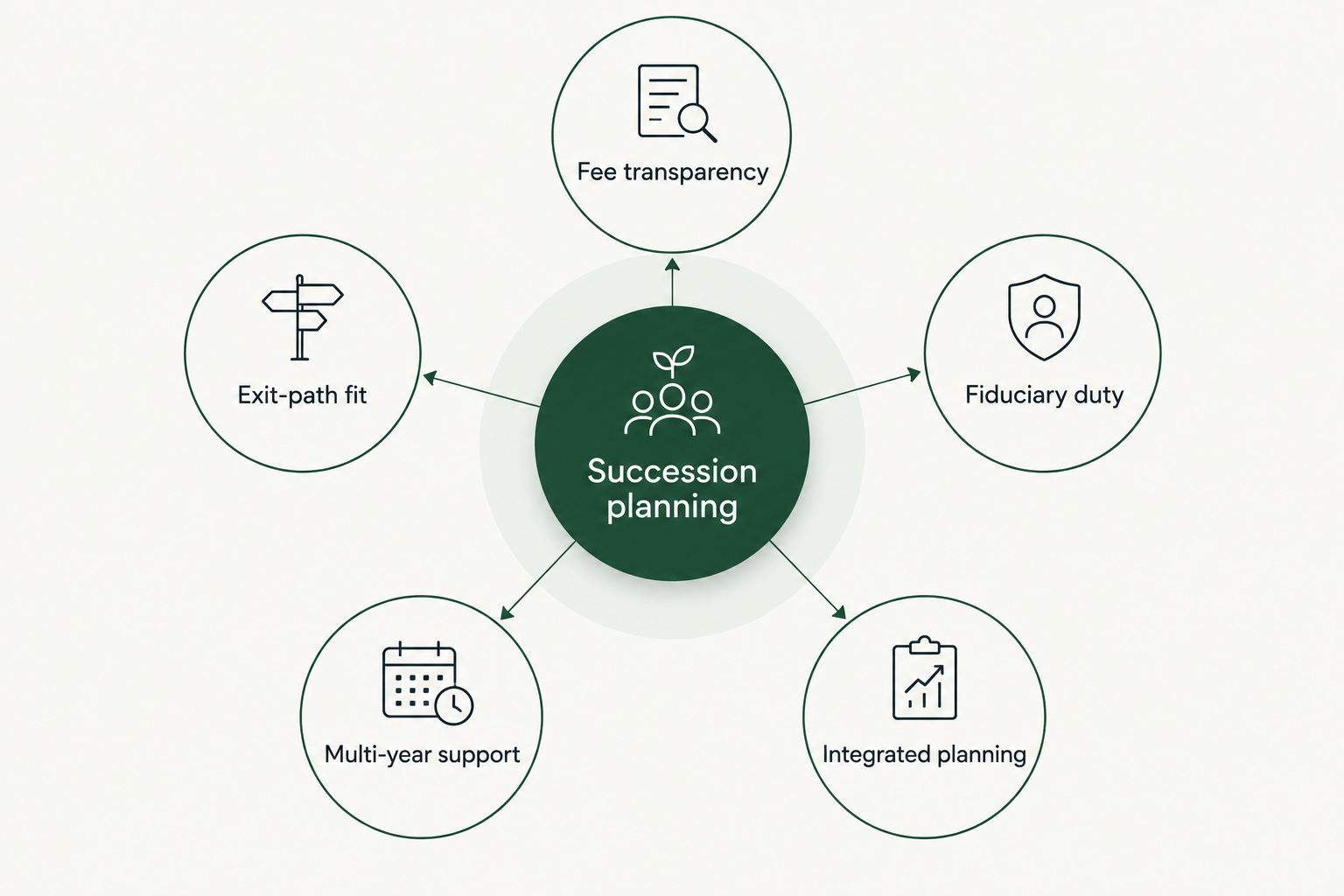
Succession planning services at a glance
| Service | Best for | Standout feature | Fee structure | Key limitation |
|---|---|---|---|---|
| Vital Investment Management | Owners who want succession tied to investment/treasury management | Integrated, multi-year planning with a fiduciary standard | Flat or AUM-based fee | Doesn't broker the transaction itself |
| CPA-led succession planning | Owners who need tax structuring as the anchor | Deep familiarity with your existing tax return and entity structure | Hourly or flat project fee | Limited scope on investment and legal work |
| Business broker / M&A intermediary | Owners selling to an outside, third-party buyer | Buyer network and deal marketing | Commission on sale price | Paid to close, not to optimize your long-term plan |
| Transaction/estate attorney | Owners with partners who need a binding agreement | Legally enforceable buy-sell documents | Hourly billing | No investment, tax or cash-flow strategy |
| ESOP attorney-trustee team | Owners considering a gradual internal sale | Structured path to employee ownership | Setup fee plus ongoing administration | Complex to set up; not the same as selling to one employee |
| DIY legal template service | Very small, simple, single-owner businesses | Fastest and lowest upfront cost | One-time flat fee | No valuation, tax planning or personalized guidance |
1. Vital Investment Management: best succession planning service for owners who want it integrated
Vital Investment Management is a fee-only, SEC-registered investment advisory firm (CRD #300811) based in Loveland, Colorado, working with Northern Colorado business owners on treasury management, investment management, financial planning and business transition/succession planning together, not as separate line items.
Vital Investment Management pros:
- Fee-only and fiduciary — no commission tied to whether or when you sell
- Succession planning runs alongside your investment and cash-flow plan, not as a standalone event
- Local to Loveland, Fort Collins and Berthoud, with a practice built around Northern Colorado ownership situations
- A confidential discovery call with Dillon Goodman, CPA, CFP®, replaces a cold sales pitch
Vital Investment Management cons:
- Does not broker transactions and does not provide legal, tax, valuation, lending or ESOP administration services directly
- Best fit skews toward owners with meaningful investable assets, typically $1 million or more, alongside the business itself
- Not the right choice if you only need a one-time legal document and nothing else
Vital Investment Management fee structure: flat or assets-under-management-based fee, priced on a fee-only financial advisor cost basis rather than commission.
Best for: Northern Colorado owners with meaningful investable assets who want succession planning coordinated with the rest of their financial plan.
Verdict: the strongest starting point for most owners who aren't already mid-negotiation with a buyer.
2. CPA-led succession planning: best for owners who need tax structuring first
A CPA who already prepares your business and personal returns can lead succession planning when the tax consequences of a sale or transfer are the central question — asset sale versus stock sale, installment-sale timing, or how proceeds interact with your other income.
CPA-led planning pros:
- Works from your existing financial statements and tax history, no ramp-up period
- Strong on entity structure and the tax math of a sale
- Often the least expensive entry point if you only need tax guidance
CPA-led planning cons:
- Limited scope on investment management, buyer negotiation, or legal drafting
- Fee is typically hourly or project-based, which can climb as the engagement expands beyond a single tax question
- Rarely coordinates directly with an investment plan for the proceeds
Best for: owners who need the tax side of a transition solved before deciding on the rest of the plan.
Verdict: good as one piece of the plan, thin as the whole plan.
3. Business broker / M&A intermediary: best for a sale to an outside buyer
A business broker or M&A intermediary markets your business to buyers, manages the sale process, and negotiates the transaction on your behalf — a role built specifically around getting a deal closed with a third party.
Business broker pros:
- Access to a network of buyers you likely can't reach on your own
- Handles marketing, buyer screening and negotiation
- Paid on success, which aligns incentive with getting a deal done
Business broker cons:
- Commission scales with the sale price, so total cost rises as your deal size grows
- The incentive is to close the transaction, not necessarily to optimize your tax outcome or long-term wealth plan
- Typically engaged only for the transaction itself, not for planning years in advance
Best for: owners who have already decided to sell to an outside buyer and need someone paid to find and close that deal.
Verdict: the right tool once you're actually selling — not a substitute for earlier planning.
4. Transaction/estate attorney: best for owners with partners who need a binding agreement
A transaction or estate attorney drafts and negotiates the legal documents a transition actually runs on — buy-sell agreements, partnership transfer terms, and language covering triggering events like death, disability or a business partner buyout.
Transaction attorney pros:
- Produces a legally enforceable document, essential with more than one owner
- Handles triggering-event language other providers on this list won't touch
- Can work alongside your CPA or advisor rather than replacing them
Transaction attorney cons:
- No investment, tax or cash-flow strategy built in
- Billed hourly, so total cost depends heavily on how much negotiation the agreement requires
- Needs a valuation and financial input from elsewhere to know what numbers belong in the document
Best for: multi-owner businesses that need a binding buy-sell agreement more than they need a broader financial plan.
Verdict: necessary, not sufficient — pair it with a planning-focused advisor.
5. ESOP attorney-trustee team: best for a gradual sale to employees
An ESOP attorney-trustee team sets up and administers an employee stock ownership plan, structuring a path for employees to acquire ownership over time rather than through a single transaction with one buyer. An ESOP is not the same thing as selling your business outright to one key employee.
ESOP team pros:
- Creates a structured, gradual path to employee ownership
- Can offer tax advantages under federal law for a qualifying sale
- Keeps the business independent rather than selling to an outside acquirer
ESOP team cons:
- Complex and slow to set up compared to every other option on this list
- Carries ongoing administration costs on top of the initial setup fee
- Not practical for very small businesses without enough payroll to support a plan
Best for: owners who want to transition ownership to employees broadly, not to a single buyer.
Verdict: worth exploring only once you've confirmed the business is large enough to support the administration.
6. DIY legal template service: best for a very simple, low-complexity business
An online DIY template service sells standardized succession or buy-sell documents an owner fills in and signs without a personalized advisory relationship.
DIY template pros:
- Lowest upfront cost on this list
- Fast — documents can be in hand within days
- Workable for a single-owner business with minimal assets and no partners
DIY template cons:
- No valuation, tax planning, or investment coordination
- Generic language may not address your actual triggering events or ownership structure
- No one to catch a mistake before it becomes a legal or tax problem later
Best for: a very small, single-owner business with simple finances and no partners.
Verdict: acceptable only as a placeholder, not a real succession plan.
How we ranked these services
Each service was scored against the same six criteria: fee transparency, fiduciary standard, integration across disciplines, multi-year support, fit for a specific exit path, and regional relevance to Northern Colorado. No service wins on every criterion — that's why the list is a decision tree by use case, not a single leaderboard.
Which succession planning service should you choose?
If you're a Northern Colorado owner who hasn't started a formal exit process and wants succession planning tied to your investment and treasury decisions, start with Vital Investment Management. If you're already committed to selling to an outside buyer this year, pair that advisor relationship with a business broker for the transaction itself. If your business has multiple partners, get a transaction attorney involved regardless of which other service you choose — a buy-sell agreement is not optional once there's more than one owner.
Talk through your exit timeline
A confidential discovery call with Dillon Goodman, no obligation upfront.
FAQ
What does succession planning services cost in 2026?
Succession planning services cost depends on the pricing model: fee-only advisors like Vital Investment Management charge a flat or asset-based fee, CPAs and attorneys typically bill hourly or by project, business brokers take a commission on the sale price, and DIY template services charge a one-time flat fee. There's no single market rate across these models.
Is a fee-only financial advisor cheaper than a business broker for succession planning?
It depends on what you need. A fee-only advisor is paid regardless of whether you sell, while a business broker's commission only applies once a sale closes, so the broker can look cheaper early and more expensive at closing on a larger deal.
Can a CPA handle business succession planning alone?
A CPA can lead the tax side of a transition, but most succession plans also need investment, legal and sometimes buyer-negotiation input a CPA's engagement doesn't typically cover.
What's the difference between a business broker and a succession planning advisor?
A business broker is paid to find a buyer and close a sale to an outside party. A succession planning advisor works on the broader transition, including cases where the exit is to a partner, employee or family member rather than an outside buyer.
Is an ESOP the same as selling your business to an employee?
No. An ESOP is a structured plan that transfers ownership to employees broadly over time through a trust, while selling directly to one key employee is a separate transaction structure with its own financing and valuation approach.
How long does succession planning take before a sale?
Succession planning works best as a multi-year process rather than a single event, since valuation, tax structuring and buyer or successor readiness all take time to line up. Starting the year you want to exit narrows your options.
Are DIY succession planning templates worth the lower cost?
DIY templates work for a very simple, single-owner business with no partners and minimal assets, but they skip valuation, tax planning and personalized triggering-event language that most transitions need.
Should you hire a fiduciary advisor for succession planning?
A fiduciary advisor is legally required to act in your interest rather than just recommend a suitable option, which matters most when the advisor's compensation could otherwise be tied to a specific outcome like a sale.
One last thing
The biggest cost driver in succession planning isn't which service you hire — it's how many years before the transition you start. An owner who begins planning the year they want out has fewer buyers, less negotiating room and fewer tax options than one who starts years earlier. Vital Investment Management treats that lead time as the point of the engagement, not a footnote to it.