
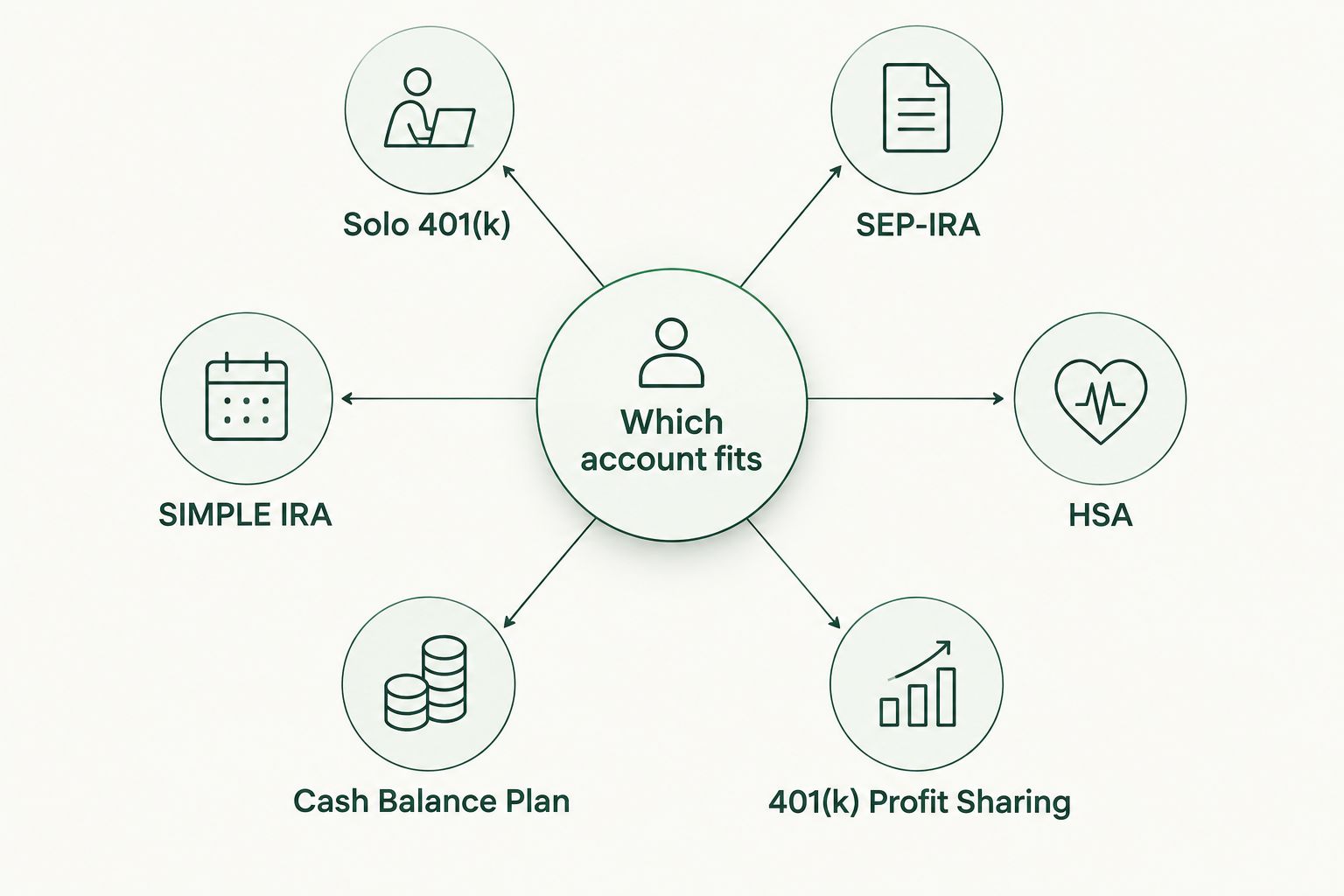
Solo 401(k) wins for small business owners with no employees who want the highest possible contribution ceiling. SEP-IRA wins for owners who want the simplest paperwork and fluctuating income. SIMPLE IRA wins for owners with a small team under 100 employees who want a low-cost benefit. A Cash Balance or Defined Benefit Plan wins for high-income owners in their 50s and 60s racing to catch up on retirement savings.
- Solo 401(k) is the best tax-advantaged account for small business owners with no employees in 2026 — it combines employee and employer contribution room.
- SEP-IRA stays the simplest option: one form, no annual filing, employer contributions capped at 25% of compensation.
- SIMPLE IRA fits owners with a small team, since it works for employers with 100 or fewer employees and costs less to run than a full 401(k).
- HSA is the only account here with a triple tax advantage, but only if you're enrolled in a qualifying high-deductible health plan.
- Cash Balance and Defined Benefit Plans suit owners over 50 who need to shelter a large amount of income fast, at the cost of actuarial complexity.
Why this matters
Most small business owners in Northern Colorado default to whatever account their payroll provider offers, without checking if it fits their actual situation. A solo consultant with no staff has completely different needs than an owner with eight employees or a franchise operator with fluctuating cash flow.
The account you pick changes how much you can shelter from taxes each year, how much administrative work you take on, and whether you're stuck with it once you hire your first employee. Getting this wrong for even two or three years costs real tax-deferred growth you can't get back. This is educational information — a fee-only fiduciary at Vital Investment Management can walk through your specific numbers on a discovery call, but the comparison below gets you oriented first.
What makes the best tax-advantaged account for your business
- Contribution ceiling — how much you and your business can shelter from taxes in a given year
- Employee coverage cost — whether you're required to fund accounts for staff, and how much
- Administrative burden — annual filings, actuarial work, plan documents
- Catch-up flexibility — how the account treats owners over age 50 trying to save faster
- Setup and filing deadlines — how late in the year you can still open or fund the account
- Fit with your health coverage — whether an HSA layers in as a bonus, tax-free account
At a glance
| Account | Best for | Standout feature | Key limitation |
|---|---|---|---|
| Solo 401(k) | Owners with no employees | Contribute as both employee and employer | Loses eligibility the moment you hire a full-time non-spouse employee |
| SEP-IRA | Simplest setup, variable income | No annual filing requirement | No separate employee salary deferral — employer contributions only |
| SIMPLE IRA | Small teams under 100 employees | Lower cost to administer than a 401(k) | Contribution ceiling is lower than a 401(k) or SEP |
| HSA | Owners on a high-deductible health plan | Triple tax advantage: deductible in, tax-free growth, tax-free for medical use | Only available if you're enrolled in a qualifying HDHP |
| Cash Balance / Defined Benefit Plan | High earners over 50 catching up fast | Actuarially designed for the largest sheltered contributions | Requires an actuary and ongoing funding commitment |
| 401(k) with Profit Sharing | Growing teams you want to retain | Employee deferrals plus discretionary employer profit sharing | Highest administrative cost and plan document complexity |
1. Solo 401(k): best tax-advantaged account for owners with no employees
A Solo 401(k) is built for a business owner with no full-time employees other than a spouse. You wear two hats inside the plan — employee and employer — which is what gives it the widest combined contribution room of any account on this list.
Solo 401(k) pros:
- Contribute as both employee (salary deferral) and employer (profit-sharing style, up to 25% of compensation)
- Allows a Roth option at most providers, unlike a SEP-IRA
- Loan provisions are available at many providers, unlike an IRA-based plan
Solo 401(k) cons:
- Disqualified the moment you hire a non-spouse full-time employee
- Requires an annual Form 5500-EZ filing once plan assets cross a threshold
- More paperwork to set up than a SEP-IRA
Best for: solo consultants, single-owner LLCs, and married-couple businesses with no other staff. Verdict: Set this up if you have no employees and want the largest contribution room available.
2. SEP-IRA: best tax-advantaged account for simplicity and variable income
A SEP-IRA lets you fund a retirement account for yourself and any eligible employees using a single, low-paperwork structure. Employer contributions are capped at 25% of compensation, and there's no annual government filing tied to the plan itself.
For owners weighing a SEP-IRA against a Solo 401(k), the SEP-IRA vs Solo 401(k) comparison breaks down which one actually fits your income pattern.
SEP-IRA pros:
- Can be opened and funded up to your extended tax filing deadline
- No annual filing requirement, unlike a 401(k)
- Works whether you have zero employees or a small team
SEP-IRA cons:
- No employee salary deferral option — contributions are employer-funded only
- Must contribute the same percentage of compensation for every eligible employee, which gets expensive with staff
- No catch-up contribution structure the way a 401(k) offers
Best for: owners with fluctuating income who want to decide their contribution amount each year, after the books close. Verdict: Set this up if you want the lowest administrative lift and don't have many eligible employees.
3. SIMPLE IRA: best tax-advantaged account for a small team
A SIMPLE IRA is designed for employers with 100 or fewer employees who want to offer a retirement benefit without the cost of a full 401(k) plan. Employees can defer their own salary into the account, and you're required to make a matching or fixed contribution.
SIMPLE IRA pros:
- Employees fund their own accounts through salary deferral, unlike a SEP-IRA
- Cheaper to administer than a 401(k) with profit sharing
- Simple annual notice requirements instead of a formal plan document
SIMPLE IRA cons:
- Lower contribution ceiling than a 401(k) or SEP-IRA
- Mandatory employer contribution every year, with limited flexibility to skip a bad year
- Not available once your business grows past the 100-employee threshold
Best for: owners with a handful of employees who want a real benefit on offer without a 401(k)'s cost. Verdict: Set this up if you have employees and want to keep the plan cheap to run.
4. HSA: best tax-advantaged account for owners on a high-deductible health plan
A Health Savings Account isn't a retirement plan, but it's the only account on this list with a triple tax advantage: contributions are deductible, growth is tax-free, and withdrawals for qualified medical expenses are never taxed. Eligibility depends entirely on being enrolled in a qualifying high-deductible health plan.
HSA pros:
- Triple tax treatment beats every retirement account on this list
- Unused funds roll over year to year and can be invested, unlike a Flexible Spending Account
- After age 65, non-medical withdrawals are taxed like a traditional IRA instead of penalized
HSA cons:
- Requires enrollment in a qualifying high-deductible health plan, which isn't right for every owner
- Contribution room is modest compared to a 401(k) or Cash Balance Plan
- Doesn't replace a primary retirement account on its own
Best for: owners already on a high-deductible health plan who want a stacked, tax-free bucket alongside retirement savings. Verdict: Set this up alongside another account, not instead of one.
5. Cash Balance / Defined Benefit Plan: best for high-income owners catching up fast
A Cash Balance or Defined Benefit Plan uses actuarial formulas tied to your age and income to set a much larger annual contribution than any account above. These plans are built for owners in their 50s and 60s who started saving late and have the income to fund a large, consistent contribution.
Cash Balance Plan pros:
- Allows by far the largest sheltered contribution of any account on this list, especially for owners over 50
- Can be layered on top of an existing 401(k) with profit sharing
- Contribution formulas reward age, which helps owners catching up late
Cash Balance Plan cons:
- Requires an actuary and ongoing administrative cost
- Funding is a multi-year commitment, not a one-year decision
- Complex to unwind if business income drops sharply
Best for: high-earning owners over 50 who need to shelter significant income in a short runway to retirement. Verdict: Set this up only with professional guidance — the actuarial math isn't a DIY decision.
6. 401(k) with Profit Sharing: best for growing teams you want to retain
A traditional 401(k) with a profit-sharing feature lets employees defer their own salary while giving you discretion to add employer contributions in good years. It's the most flexible plan for a business that's actively hiring and wants a benefit competitive with larger employers.
For a cost breakdown across providers, best 401(k) providers for small businesses compares setup and administration costs side by side.
401(k) Profit Sharing pros:
- Employee salary deferral plus discretionary employer contributions in one plan
- Profit-sharing contributions can flex up or down by year, unlike a SIMPLE IRA's fixed match
- Strongest recruiting and retention tool of any account on this list
401(k) Profit Sharing cons:
- Highest administrative cost and plan document complexity here
- Annual nondiscrimination testing can limit owner contributions if employee participation is low
- Requires a third-party administrator in most cases
Best for: owners actively hiring who want a benefit that scales with the business. Verdict: Set this up once you have staff you want to retain long-term.
How we ranked these accounts
Each account was weighed against the six criteria above: contribution ceiling, employee coverage cost, administrative burden, catch-up flexibility, filing deadlines, and fit with health coverage. No account wins on every dimension — a Solo 401(k) loses the moment you hire staff, and a Cash Balance Plan is overkill for an owner in their 30s. The ranking reflects which owner situation each account actually solves, not a single universal winner.
Talk through your options with Dillon
A confidential discovery call covers which account fits your business in 2026.
Which tax-advantaged account should you choose?
If you have no employees, the Solo 401(k) is the strongest default for 2026 — nothing else on this list gives you as much contribution room with as little required funding for staff. If you already have a small team, the SIMPLE IRA keeps costs down while still offering a real benefit. If your income swings year to year and you want the least paperwork, the SEP-IRA is the safer starting point.
Owners over 50 with high income and a short runway to retirement should look hard at a Cash Balance Plan, layered with an existing 401(k) if one is already in place. None of these decisions happen in isolation from your broader tax and succession picture — a plan that fits your account structure today should also fit where you're taking the business over the next five to ten years, a topic covered in more depth around business succession planning.
FAQ
What is the best tax-advantaged account for a small business owner with no employees?
A Solo 401(k) is the strongest option for an owner with no employees in 2026, since it lets you contribute as both employee and employer in the same plan. It loses eligibility the moment you hire a non-spouse full-time employee.
Is a SEP-IRA better than a Solo 401(k)?
A SEP-IRA is simpler to administer but generally allows less total contribution room than a Solo 401(k) for the same owner, since it only accepts employer contributions capped at 25% of compensation. Choose the SEP-IRA when you want the lowest paperwork, and the Solo 401(k) when you want the largest ceiling.
Can a small business owner have both an HSA and a 401(k)?
Yes, an HSA and a 401(k) or SEP-IRA can run alongside each other as long as you're enrolled in a qualifying high-deductible health plan for the HSA. They serve different purposes: the HSA covers medical costs tax-free, while the retirement account covers long-term savings.
What is the employee cap for a SIMPLE IRA?
A SIMPLE IRA is available to employers with 100 or fewer employees. Once your business grows past that threshold, you'll need to transition to a different retirement plan structure.
When should a small business owner consider a Cash Balance Plan?
A Cash Balance Plan makes sense for high-income owners, typically in their 50s or 60s, who need to shelter a large amount of income in a short number of years before retirement. It requires an actuary and a multi-year funding commitment, so it's not a casual setup.
Does a 401(k) with profit sharing cost more to run than a SIMPLE IRA?
Yes, a 401(k) with profit sharing carries higher administrative cost and plan document complexity than a SIMPLE IRA. The tradeoff is more flexibility on employer contributions and a stronger benefit for recruiting and retention.
Can I open a tax-advantaged account late in the year?
A SEP-IRA can typically be opened and funded up to your extended tax filing deadline, which gives you more room than most 401(k) plans that must be established by the end of the calendar year. Deadlines vary by plan type, so confirm the specific cutoff before year-end.
Do catch-up contributions apply to all these accounts?
Catch-up contributions generally become available starting at age 50 for 401(k)-type plans and SIMPLE IRAs, but a SEP-IRA does not have a separate catch-up structure. This is one reason age matters when picking between a SEP-IRA and a Solo 401(k) or SIMPLE IRA.
One last thing
The account that fits you at 35 with no employees is rarely the account that fits you at 55 with eight employees and an exit in view. Owners who revisit this decision only once, at startup, tend to keep an account structure well past the point it stopped making sense — checking it against your current employee count and income level once a year costs less than the tax-deferred growth you give up by leaving it alone.