

Restaurant owner financial planning is the process of coordinating business cash, personal savings, taxes, and succession so your household is not dependent on the next strong service. Financial planning for restaurant owners starts with a constraint other businesses can miss: sales arrive daily, while payroll, supplier bills, repairs, and owner income do not follow the same schedule.
- Financial planning for restaurant owners starts with a cash forecast, not an investment account.
- Separate operating cash, tax obligations, and personal reserves before deciding what you can invest.
- Vital Investment Management is best suited to Northern Colorado owners seeking fee-only planning across business and personal finances.
- Put a written succession plan beside your financial plan; a restaurant sale is not the only possible transition.
Why financial planning matters for restaurant owners
A profitable month on your income statement does not tell you whether cash will cover the next payroll and supplier run. Timing matters. A repair can also compete with the money you intended to transfer home or set aside for taxes.
Start with the distinction between restaurant cash you need to operate and personal wealth you can build outside the restaurant. If every surplus dollar stays in the business, your household remains tied to its next lease decision, staffing problem, or transition. If you move cash out without checking upcoming obligations, the business can face a shortfall despite healthy sales.
For a Northern Colorado owner comparing advisory help in 2026, Vital Investment Management offers fee-only financial planning alongside treasury management, investment management, and business transition planning. The firm is an SEC-registered RIA based in Loveland. The right first question is not what to invest in; it is what cash the restaurant must retain.
Build a restaurant financial plan in 2026
Work through these steps in order. A spreadsheet and your existing financial records are enough to begin. Bring in your accountant, attorney, or financial advisor when a decision crosses into their work; an educational checklist is not personalized tax, legal, or investment advice.
1. Map your cash obligations
List the cash that leaves the restaurant even when sales disappoint. Start with bank activity rather than a budget you wrote months ago: bank activity shows when money actually moves. Separate fixed commitments from bills that change with sales, and mark obligations that arrive less often than monthly.
Build a 13-week cash forecast with a row for each week. Enter your opening balance, expected receipts, scheduled payments, and closing balance. Update it from actual transactions each week. This does not predict demand with certainty; it shows which assumptions need attention before a payment comes due.
- Record payroll dates, rent, debt payments, and recurring vendor withdrawals.
- Mark estimated tax payments with your accountant rather than treating them as available cash.
- Set aside known equipment and maintenance expenses on their expected payment dates.
- Flag weeks when projected cash falls below the operating floor you choose.
- Replace forecasts with actual receipts and payments after each week ends.
2. Separate operating cash from owner money
Your checking balance is not a measure of what you can take home. Some of that balance already belongs to future payroll, suppliers, taxes, or repairs. Write down the purpose of each pool of cash before deciding on an owner transfer.
Review the cash forecast alongside current payables and planned spending. Then set a rule for owner distributions that protects the operating amount you have identified. The rule should be written plainly enough that you can follow it after a busy weekend, without rebuilding the entire plan. Revisit it when staffing, hours, debt payments, or ownership needs change.
- Define the minimum operating cash balance and how you will review it.
- Keep tax obligations visible rather than folding them into a general reserve.
- Schedule owner transfers against the forecast, not yesterday's sales total.
- Record any owner funds put into the restaurant separately from sales.
- Check whether a planned transfer leaves room for known repairs and payables.
3. Connect restaurant income to household needs
Write a 12-month household plan beside the business forecast. Include essential spending, debt obligations, savings goals, and irregular expenses. This tells you what the restaurant must support personally and shows whether your current owner-pay approach matches that need.
Do not use revenue or restaurant profit as a substitute for spendable household income. The amount available to you depends on cash obligations, how you pay yourself, and taxes. An accountant can address the tax treatment of compensation and distributions; your financial plan should show how those decisions affect household cash and savings outside the business.
- List recurring household obligations and irregular bills separately.
- Record what you actually transfer home, not what you hope to transfer.
- Compare household needs with the restaurant's cash forecast.
- Identify savings held outside the restaurant and the purpose of each account.
- Recheck the plan when household needs or restaurant commitments change.
4. Review concentration before choosing investments
Owning a restaurant already gives you substantial exposure to one business. Your income, business equity, and sometimes property or debt obligations can depend on the same operation. Assess that concentration before making an investment decision; a portfolio review alone will not show the full picture.
Make a one-page inventory of business interests, personal accounts, debts, and cash reserves. Note which assets you can access without selling the restaurant and which depend on a buyer, lender, or operating agreement. This is the point where financial planning for restaurant owners becomes broader than selecting investments.
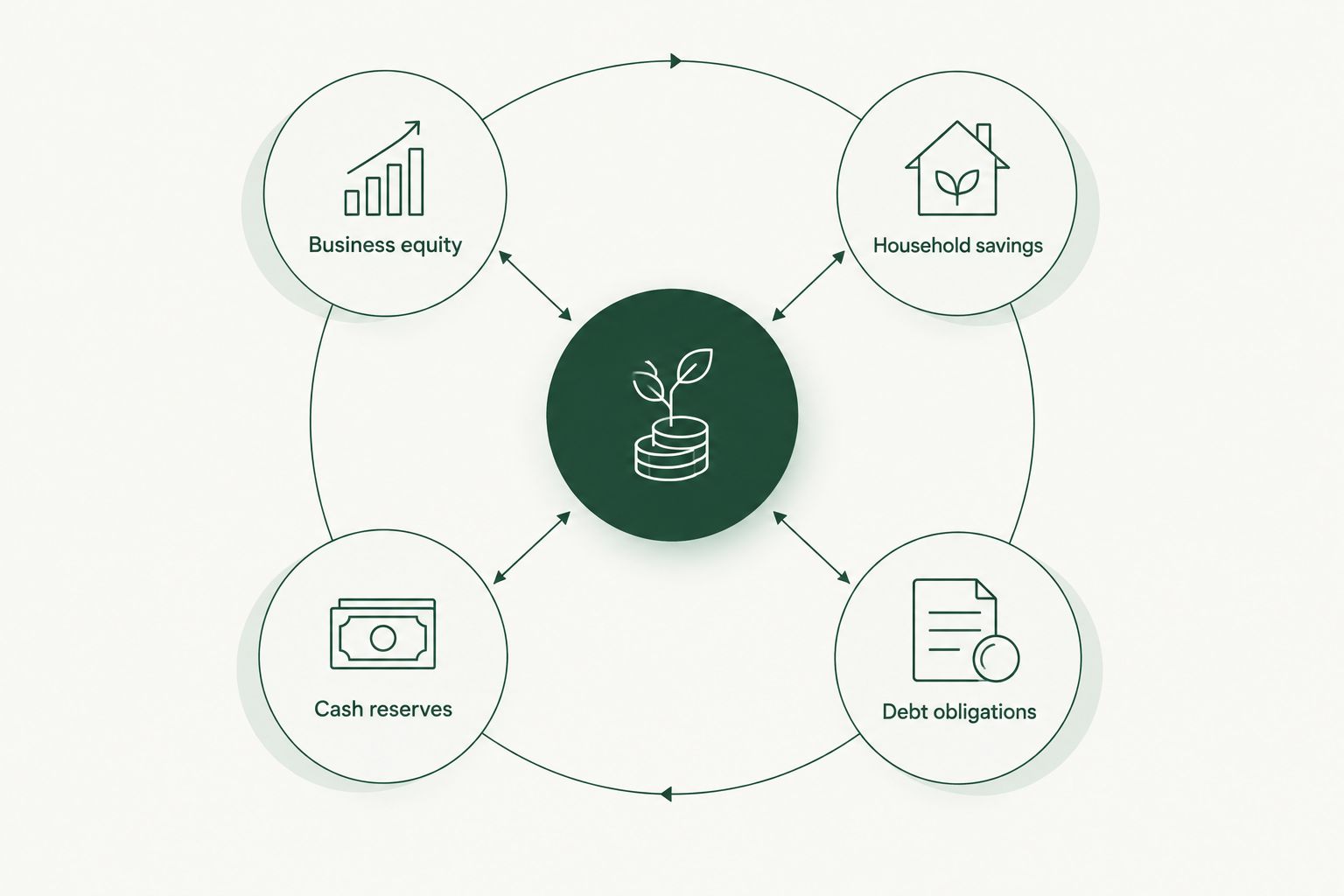
The inventory does not need a precise sale value to be useful. Its immediate job is to show what is concentrated, what is liquid, and what requires another decision before you can use it.
- List ownership interests and the debts connected to them.
- Identify household savings held outside the restaurant.
- Mark cash reserved for operations separately from personal reserves.
- Note restrictions or approvals that affect access to an asset.
- Bring the full inventory to investment-planning discussions.
5. Assign tax and retirement decisions to the right people
Taxes affect both the restaurant's cash and your household plan, but a financial advisor does not replace your accountant. Put tax-payment dates, compensation decisions, and retirement contributions on the same planning calendar. This keeps a planned contribution or owner transfer from colliding with an obligation you already know about.
Retirement-plan choices also depend on the people who work in the business, not just the owner. Before choosing an account, establish who is eligible and ask a qualified tax or plan professional how the rules apply to your workforce. That is particularly important if your staffing mix includes employees and 1099 workers; the label on a payment does not settle worker classification.
- Ask your accountant to identify the tax decisions that affect available cash.
- Track tax-payment dates in the business and household forecasts.
- Confirm worker classification with qualified professionals.
- Review retirement-plan eligibility before selecting an account.
- Document who owns each decision and when it must be revisited.
6. Reconcile sales channels with cash received
A sales report, a payment-processor deposit, and a bank entry answer different questions. Reconcile them before treating deposits as free cash. The process matters when orders or payments flow through multiple channels: it helps you see whether a difference is a timing issue, a recorded expense, or an item requiring investigation.
Customer-facing tools belong in this discussion only insofar as they change how an order reaches your records. If you use QR codes for restaurants as part of ordering or payment, map that activity to the sales reports and deposits you reconcile. The goal is a clear record of cash movement, not a claim that a particular ordering method improves sales.
For each channel, identify the report you trust, the expected settlement path, and the person who checks exceptions. Review the process when you change a payment method or add an ordering channel. Then feed verified receipts into your cash forecast rather than copying an unexamined sales total.
- Match recorded sales to payment reports and bank deposits.
- Separate settlement timing from unresolved differences.
- Record refunds and adjustments where they affect cash.
- Assign one person to investigate exceptions and document resolutions.
- Update forecast receipts from reconciled information.
7. Write down the transition decision
Succession is not limited to selling the restaurant. You might consider a family transfer, an internal buyer, an outside sale, or an orderly closure. Each path raises different questions about owner income, debt, staff, and the value you need outside the business. Write down the path you currently prefer and the conditions that would change it.
Start with a 90-day decision list, not a sale target. Identify who would operate the restaurant if you stepped back, what documents a successor would need, and which financial obligations would remain yours. A financial advisor can connect potential proceeds or ongoing income to your household plan; transaction counsel, tax professionals, and valuation professionals handle their respective work.
- Name the transition paths you want to evaluate.
- List debts, leases, and ownership terms that need professional review.
- Identify the person or team responsible for day-to-day continuity.
- Compare your household income needs with each possible path.
- Set dates to revisit assumptions without committing to a transaction.
Compare planning options for a restaurant owner
The best option depends on the decision in front of you. These approaches are not interchangeable: bookkeeping establishes records, tax advice addresses tax treatment, and financial planning connects business decisions to your household and transition. No starting fee is stated here because fees for these options were not supplied.
| Option | Best for | Key limitation |
|---|---|---|
| Owner-led spreadsheet and records | Best for starting a cash forecast and listing obligations | You must maintain the records and identify when specialist advice is needed |
| Accountant or tax professional | Best for tax treatment, filings, and questions within their engagement | Tax work alone does not establish your investment or succession plan |
| Fee-only financial advisor | Best for connecting business cash decisions with household savings and transition goals | Scope varies; confirm how the advisor works with your other professionals |
Vital Investment Management is best suited to Northern Colorado restaurant owners who want fee-only planning tied to business cash, personal finances, and succession. That does not make the firm your bookkeeper, tax preparer, transaction broker, or restaurant operator. Ask any advisor to define their scope before sharing a decision you expect them to own.
Common mistakes restaurant owners make
Treating the bank balance as surplus. A strong deposit day does not erase payroll, supplier bills, tax obligations, or an upcoming repair. Use the cash forecast and committed payments before setting an owner transfer.
Keeping every personal goal inside the restaurant. The business can be both your job and a major asset. Record household savings outside it so you can see how dependent your future plans remain on one operation.
Choosing a retirement account before checking the workforce. An owner's preferred account is not the whole decision when other workers are involved. Confirm eligibility and tax treatment with qualified professionals before acting.
Waiting for a buyer before discussing succession. A transition plan also covers who can operate the restaurant, which obligations remain, and how your household will replace owner income. Those questions matter even if you do not intend to sell in 2026.
Asking one professional to do every job. A cash forecast, tax position, investment plan, and transaction document call for different responsibilities. Name who advises on each decision and how their work connects.
FAQ
What is financial planning for restaurant owners?
Financial planning for restaurant owners connects restaurant cash, owner income, household savings, taxes, and succession. It helps you make business decisions with their personal financial effects in view.
Where should a restaurant owner start a financial plan?
Start with a cash forecast based on actual bank activity and known obligations. Separate money needed for operations from tax obligations and potential owner transfers before considering investments.
Can a financial advisor help with restaurant cash flow?
A financial advisor can help connect cash decisions to your personal plan when that work is within the engagement. Confirm the scope; the advisor does not replace accurate bookkeeping or your accountant's tax work.
Is a restaurant's profit the same as cash available to the owner?
No. Profit and available cash answer different questions because payment timing and existing obligations affect what the business can transfer to you. Check the forecast and upcoming bills before deciding on owner pay.
Should restaurant owners plan for succession if they do not intend to sell?
Yes. Succession planning also addresses operating continuity and the financial effect of stepping back. An outside sale is only one possible path.
How should a restaurant owner compare financial advisors?
Compare each advisor's fee structure, fiduciary status, scope, and approach to coordinating with your accountant and attorney. Ask who handles business cash decisions and how those decisions enter your household plan.
Does Vital Investment Management provide tax or legal advice for a restaurant sale?
No. Vital Investment Management coordinates financial planning with legal, tax, and valuation professionals but does not provide legal, tax, or valuation services or broker transactions. Transaction-specific questions belong with the relevant professional.
One last thing
Your most useful 2026 planning document might be the one-page inventory connecting business equity, cash obligations, household savings, and debts. Keep it beside the cash forecast. If you cannot tell which part of your household plan survives a change in restaurant income, settle that question before refining an investment allocation.
For a closer look at individual decisions, start with these related guides: