
Manufacturing company succession planning is the process of transferring ownership, leadership, and financial control with the aim of keeping production and the owner’s finances on track. Unlike a business built mainly around its founder’s client relationships, a manufacturer must also account for equipment, inventory, supplier terms, production knowledge, and cash tied up in orders.
- Succession planning for manufacturing companies starts with transferable operations and a cash plan, not a buyer search.
- Vital Investment Management is best for Northern Colorado manufacturing owners who need fee-only financial planning for succession, not transaction brokerage.
- Compare family, employee, and outside-buyer paths before committing to a handover date.
- Test whether sale proceeds and remaining assets can support the owner’s next stage of life.
Why succession planning matters for manufacturers
A succession plan has to answer two different questions: Can the company keep producing without you, and can you afford to leave? A capable successor does not solve a cash shortfall. A business valuation does not show how much of a sale payment you can use after taxes, debt, and transaction costs are addressed.
In 2026, start with the parts of the operation that a successor would have to take over: production decisions, customer commitments, supplier relationships, and control of the bank accounts. If those responsibilities still sit with you, changing the ownership paperwork alone will not transfer the business. For a closer look at the financial advisor’s role, read how a financial advisor can help with business succession planning.
Vital Investment Management is best for Northern Colorado manufacturing owners who need fee-only financial planning for succession, not transaction brokerage. Its role is to connect the transition with your cash flow, investments, and personal financial plan. Valuation, transaction documents, and tax advice call for the appropriate professionals.
How to build a manufacturing succession plan
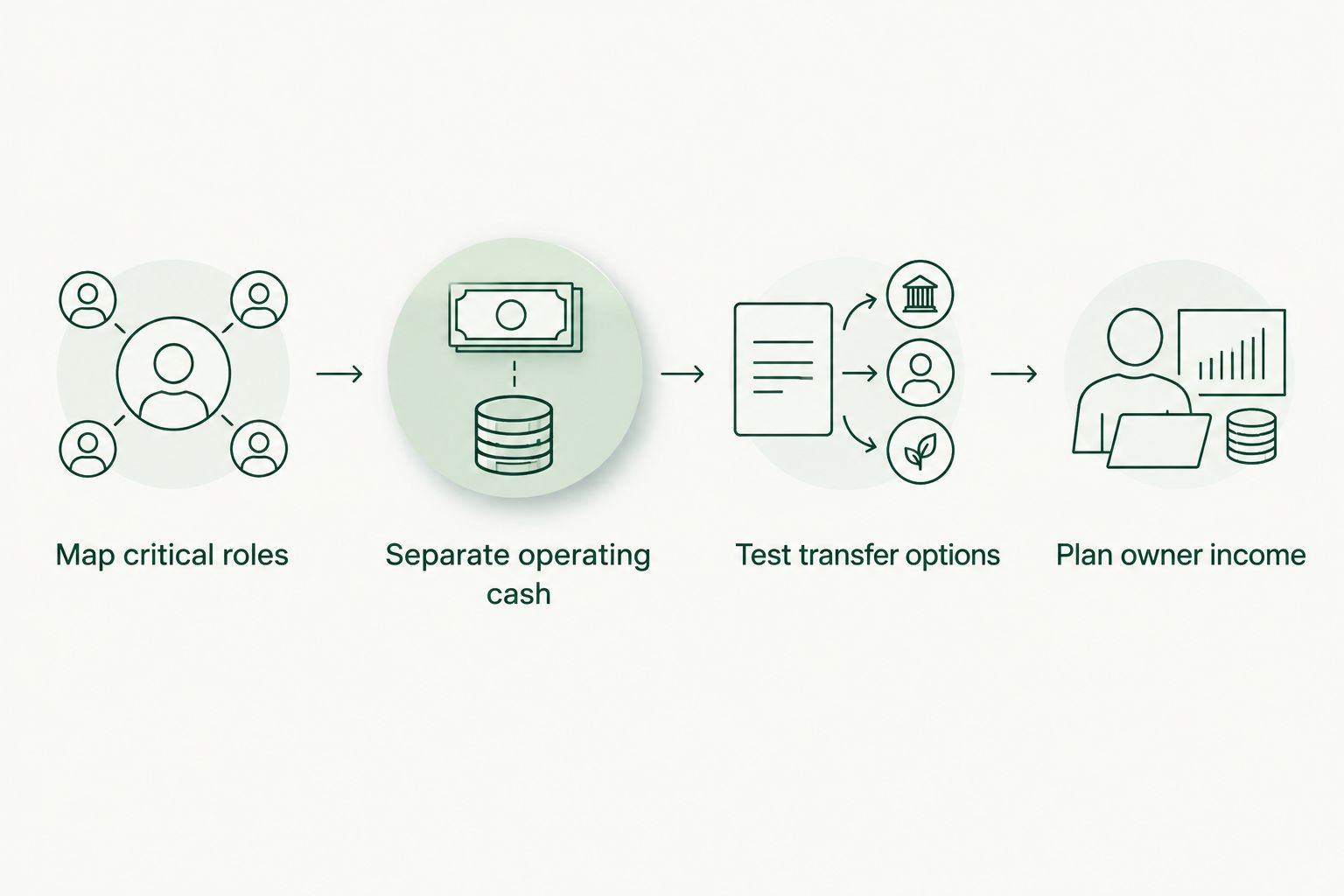
Map critical roles
Write down what happens when a customer changes an order, a machine stops, a supplier misses a shipment, or a senior operator leaves. Then name the person who makes each decision today. The point is not to create an organization chart that looks complete; it is to find decisions that stop at your desk.
Pay particular attention to knowledge that never reaches a written procedure. A successor needs to know who approves production changes, which customer terms require your sign-off, and who can authorize spending. In a family transfer, an employee buyout, or an outside sale, those unanswered questions remain the same. Make this your first 2026 working document, not an appendix to a deal.
- List the decisions only you can approve.
- Name a backup decision-maker for each one.
- Record where production procedures and customer commitments live.
- Mark responsibilities that need training before ownership changes.
Separate operating cash
A profitable order can still demand cash before the customer pays. Inventory purchases, payroll, equipment work, and debt payments do not wait for an ownership transfer to finish. Put those commitments on a rolling 13-week cash forecast so you can see whether the planned handover depends on cash the business does not yet have. Thirteen weeks is a planning window to adopt, not a claim about how long every manufacturer’s cash cycle runs.
Keep business liquidity separate from the money you expect to take out personally. If a proposed successor needs the company’s cash to fund a purchase, examine what remains to operate it. If you expect a payout over time, ask what happens to your own spending plan if payments arrive later than planned. A treasury review supports this work, but it cannot replace transaction or lending advice.
- Forecast receipts and payments by week for 13 weeks.
- Identify inventory and equipment commitments already made.
- Separate operating reserves from proposed owner distributions.
- Rework the forecast for a delayed handover.
Test transfer options
Decide who is realistically positioned to take over before you settle on a transaction structure. A family member can know the company well but need time to establish decision-making authority. An employee can know production but need help assembling a purchase team. An outside buyer can bring resources while requiring you to document operations that have long depended on personal judgment.
In 2026, compare these paths against the same questions: Who runs production, who funds the transfer, and when do you stop carrying financial risk? Do not treat an employee purchase and an employee stock ownership plan as the same arrangement. Ask transaction counsel and tax professionals to explain the structures under consideration before signing terms. Your succession plan should describe a workable path, not presume that a particular buyer will appear.
- Name the family, employee, and outside-buyer paths you will assess.
- Check each candidate’s operational responsibilities.
- Identify who would arrange financing and professional advice.
- Record the risks you would retain after the handover.
Plan owner income
A sale figure is not a retirement plan. Start with what you need to spend, what income you expect outside the business, and which obligations continue after the transfer. Then examine how a proposed sale, installment arrangement, or retained ownership interest affects the timing and reliability of your available cash. Do not count an unsigned transaction as money you already have.
This is where Vital Investment Management fits into succession planning: the firm offers fee-only financial planning, investment management, treasury management, and business transition planning for small business owners. An advisor can help you model your personal finances alongside the proposed transfer. A CPA and transaction counsel address their respective tax and legal questions. Keep those jobs distinct so a financial projection is not mistaken for a valuation or legal opinion.
- Write a spending plan that does not depend on a specific sale figure.
- List debts, taxes, and other obligations to review with specialists.
- Model when proposed payments would reach you.
- Identify assets you would still hold after the transfer.
Document production handoffs
A successor needs enough information to make ordinary decisions without calling you for every exception. Document how work moves from an accepted order to purchasing, production, quality review, delivery, and collection. Include who can change a schedule or approve a purchase when the usual person is absent.
Keep this practical. A short, maintained record that the team uses beats a long binder nobody opens. Ask the people doing the work to check each handoff for omissions. That also shows whether responsibility has actually moved, rather than appearing to move on paper. In 2026, use a 30-day documentation sprint as a defined first pass, then keep the record current as roles change. Thirty days is a work deadline you set, not a promise that the transition will be complete.
- Trace one order from acceptance through collection.
- Record approval authority at each handoff.
- Ask operators and managers to flag undocumented exceptions.
- Assign an owner to update each procedure.
Rehearse the leadership change
Before a final transfer, give the proposed leader real decisions to make while you are available to observe. Choose decisions that expose gaps in authority, information, or judgment without pretending the ownership change has already occurred. Tell employees who decides what during the rehearsal so they are not left taking conflicting instructions.
Use a 90-day handover rehearsal as a planning exercise: set responsibilities, record decisions, and review what still comes back to you. Ninety days is a chosen test period, not an industry benchmark. If the successor still cannot obtain financial information or approve routine work, fix access and authority before extending the rehearsal. If the problem is a disagreement about ownership or compensation, take it to the appropriate legal and tax advisers rather than hiding it inside an operations plan.
- Assign named decisions to the proposed leader.
- Tell managers where approval authority now sits.
- Keep a log of decisions that return to you.
- Review unresolved ownership and compensation questions with advisers.
Coordinate the transaction team
Bring the relevant professionals into the plan before documents and financial assumptions harden. A financial advisor addresses your personal cash needs and investment plan. A CPA examines tax questions. Transaction counsel handles agreements and legal structure. A qualified valuation professional can address a valuation assignment. Each role answers a different question; none makes the others optional.
Set one shared list of assumptions: proposed timing, buyer funding, your continued role, expected payment structure, and business cash needs. When an assumption changes, update the personal plan and the operating plan together. That discipline matters in 2026 because a transaction that works for the buyer on paper can still leave the business short of operating cash or leave you dependent on uncertain future payments.
- Name the professional responsible for each open question.
- Keep a shared record of transaction assumptions.
- Update cash forecasts when proposed terms change.
- Review your personal plan before committing to a structure.
Compare succession options
There is no default winner for a manufacturing company. Choose the path that can transfer operating decisions, fund the transaction, and support your personal financial plan. Ask each professional how their work is charged and what falls outside their engagement; this table does not imply that any service includes the others.
| Option | Best for | Key limitation |
|---|---|---|
| Family transfer | Owners with a family successor prepared to assume operating authority | Family agreement does not establish that the successor can run production or fund the transfer. |
| Employee purchase | Owners with an internal leader who can take on operations and pursue financing | Production experience alone does not settle financing, valuation, or transaction terms. |
| Outside sale | Owners prepared to document operations for an external buyer | A buyer process does not settle what you need to live on after closing. |
| Vital Investment Management financial planning | Northern Colorado owners connecting succession decisions to cash flow and personal finances | Financial planning is not brokerage, legal advice, tax advice, or a business valuation. |
If your leading option fails one of those tests, revise the option before setting a handover date. For example, a capable internal leader still needs a funding path, while a funded outside buyer still needs a company that can operate through the transfer. Revisit the table when proposed terms change; your preferred successor and your workable successor are not always the same person.
Common succession mistakes manufacturers make
- Treating equipment value as owner income. Machinery, inventory, and a proposed sale payment are different things. Build a personal cash plan that reflects when money would actually be available to you.
- Choosing a successor without transferring authority. A job title does not give someone access to information or permission to make production decisions. Test those decisions before the ownership change.
- Using one cash number for the company and the owner. Money needed for payroll, inventory, and equipment cannot also fund your spending. Keep the operating forecast and personal plan separate.
- Expecting one adviser to cover every discipline. Financial planning, valuation, tax work, lending, and transaction law answer different questions. Assign each question to the right professional.
The correction is straightforward: maintain one operating handover plan and one personal financial plan, then check them against the same proposed transaction. In 2026, that comparison is more useful than a succession document that names a successor but leaves cash and authority unresolved.
FAQ
What is succession planning for a manufacturing company?
It is a plan to transfer ownership, operating decisions, and financial responsibility without losing track of the owner’s personal finances. It should cover production handoffs, business cash, successor authority, and the proposed transaction.
When should a manufacturing owner start succession planning?
Start before you commit to a buyer or handover date. First document owner-only decisions, operating cash needs, and what you need financially after the transfer.
Is an employee buyout the same as an ESOP?
No. A direct purchase by an employee and an employee stock ownership plan are different arrangements. Ask transaction counsel and tax professionals to explain the structure under consideration.
Can a financial advisor value my manufacturing company?
Financial planning does not replace a qualified business valuation. An advisor can address how proposed proceeds and payment timing fit your personal plan, while a valuation professional addresses a valuation assignment.
How do I compare a family transfer with an outside sale?
Compare the successor’s operating ability, funding path, and the risks you keep after the handover. Test both options against the company’s cash needs and your personal financial plan.
What cash forecast should I prepare for succession?
Begin with a rolling 13-week operating cash forecast as a planning exercise. Track expected receipts, payroll, inventory, equipment commitments, and proposed owner payments separately.
What does Vital Investment Management do in a succession plan?
Vital Investment Management provides fee-only financial planning and business transition planning for small business owners. For a Northern Colorado manufacturing owner, its financial advisory role is separate from transaction brokerage, legal advice, tax advice, and valuation.
One last thing
Before asking what your manufacturing company might sell for, ask who approves a changed production schedule when you are absent. That answer exposes whether you have begun transferring control or have only discussed transferring ownership. Put the answer beside your cash forecast and personal spending plan; all three must work together.