

Tech startup founders’ financial planning is the process of coordinating company cash, personal finances, equity, taxes, and an eventual transition with the aim of keeping your choices open as the business changes. In 2026, a founder needs a plan that distinguishes money the company can spend from money the household can rely on; neither a funding announcement nor a paper valuation pays personal bills.
- Financial planning for tech startup founders starts with separate company and household cash plans.
- Track cash runway, equity obligations and tax deadlines before making long-term investment decisions.
- Vital Investment Management is best for Northern Colorado founders who want fee-only financial planning alongside business-owner advice.
- Use legal and tax specialists for equity documents and tax treatment; a financial advisor coordinates those decisions with your wider plan.
Why financial planning matters for tech startup founders
A founder can have valuable shares and still lack cash for ordinary expenses. Company spending, personal compensation, equity decisions and tax obligations move on different schedules. If you treat them as one pool, you lose sight of what the business needs and what your household can safely commit.
The first decision is which cash belongs to which plan. Vital Investment Management provides fee-only financial planning and treasury management for business owners in Northern Colorado. For a founder in Loveland, Fort Collins or Berthoud, that work fits alongside—not in place of—company accounting, tax advice and legal review.
In 2026, put each decision on the right desk. Your bookkeeper or finance lead maintains company records. Your CPA assesses tax treatment. Counsel handles legal documents. A financial advisor connects the effect of those decisions to household cash, investments and transition goals. Vital Investment Management is best for Northern Colorado founders seeking fee-only advice that connects personal finances with business-owner planning. Its limitation is equally clear: the firm does not replace your CPA or attorney.
Build a financial plan that survives changing company plans
Work in this order: establish the cash picture, protect household decisions, review equity, then coordinate taxes and transition. Each step gives the next one a reliable starting point. A spreadsheet and scheduled conversations are enough to begin; specialist advice becomes useful when the decisions cross company and personal boundaries.
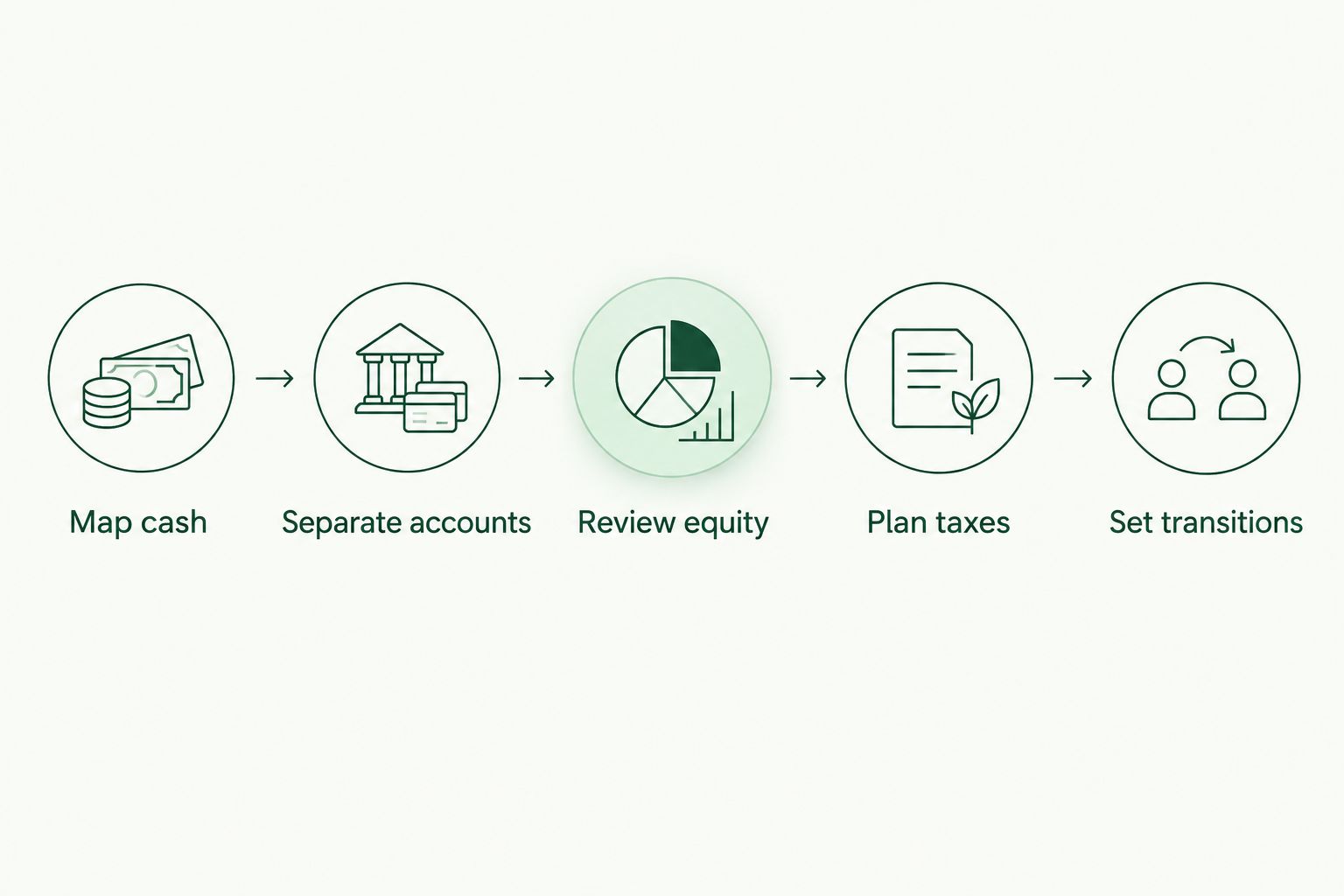
Map cash before discussing a valuation
Write down the cash available to the company, its committed payments and its expected receipts. Then record the assumptions behind each expected receipt. A contract awaiting payment is not the same as cash in the bank; a fundraising conversation is not a committed deposit. Revisit the forecast every 30 days and whenever a major assumption changes.
Keep a separate household version. Founder pay can change while company obligations continue, so the two views answer different questions. A 12-month planning horizon makes upcoming obligations visible without pretending that every future receipt is certain. Start with the records you already have rather than waiting for a new tool.
- List company cash, receivables and bills in separate columns.
- Mark which receipts depend on a customer payment or financing event.
- Compare committed spending with cash already available.
- Record household spending and income outside the company forecast.
Separate accounts and set a pay rule
Company cash is not a personal emergency fund. Decide how you will approve owner pay, reimbursements and transfers, then document the rule with your bookkeeper and CPA. This matters when revenue arrives unevenly: a good sales month does not erase bills due in the next 90 days.
The manual version is a monthly review of bank balances, upcoming company obligations and household needs. Use the same categories each time so you can see what changed. Treasury management becomes relevant when the company needs a clearer process for holding and deploying cash, not because a founder must buy a service before making a basic budget.
- Keep company and personal transactions in their proper accounts.
- Identify the person who approves each owner transfer.
- Review upcoming company obligations before changing your pay.
- Ask your CPA how the pay rule fits your business structure.
Review equity as a decision, not a headline
Founder shares, employee options and other equity awards can have different documents and tax consequences. Read the agreements before assuming that a stated ownership percentage tells you what you can spend. Vesting, exercise terms, restrictions and potential dilution affect the choices available to you; counsel and your CPA should explain how your actual documents apply.
Make an equity inventory in 2026 even if you do not expect a transaction. It helps you identify deadlines and documents that need specialist review. A financial plan then asks a separate question: how dependent is the household on this one company? It does not assign a guaranteed future value to the shares.
- Gather grant agreements, shareholder documents and relevant notices.
- Record vesting, exercise and transfer terms stated in each document.
- Flag deadlines for your attorney and CPA to verify.
- Compare liquid personal assets with your exposure to company equity.
Plan taxes with the right specialists
A founder’s tax calendar should cover both the business and the household. Compensation, equity events, outside investment income and a possible sale belong in that conversation. Do not assume that a tax rule mentioned in an article applies to your share type or company structure.
Set a 2026 meeting with your CPA before an equity exercise, ownership change or proposed sale. Bring the documents and your personal cash forecast. The goal is to know what cash decisions follow from the tax analysis, not to have an advisor substitute for tax advice. If legal terms drive the decision, bring counsel into the same discussion.
- Keep a calendar of tax filing and equity-document deadlines.
- Share compensation and ownership documents with your CPA.
- Ask what cash you need available for the decisions under review.
- Update the household plan after the CPA confirms the treatment.
Set an investment rule outside the startup
Your company may already account for much of your financial exposure. Treat that concentration as a planning input, not as a prediction that the business will succeed or fail. Money needed for near-term household obligations serves a different purpose from money you can invest for longer-term goals.
Write the rule yourself first: which assets remain available for spending, what you can invest, and which events trigger a review. In 2026, revisit it after a material change in compensation, equity or company cash needs. An investment manager can help coordinate the resulting portfolio, but cannot remove the concentration in shares you still hold.
- Label household cash by its intended use.
- List investments held outside the company.
- Decide which changes require a portfolio review.
- Discuss concentration limits without assuming a future exit value.
Document a transition before you need one
A transition plan is not a promise to sell. It records what happens if you step back, bring in another leader, transfer ownership or consider a sale. Start with who owns the decision and which documents control it. Then ask how your household would replace founder pay under each path.
In 2026, a one-page decision map is more useful than a detailed exit forecast built on an unsupported valuation. Transition and succession planning can connect the business decision to your personal finances; transaction counsel, tax professionals and valuation specialists handle their respective work. Vital Investment Management offers business transition and succession planning, but does not broker a sale or provide legal or tax advice.
- Name the people authorized to make key company decisions.
- Locate ownership and succession provisions for counsel to review.
- Map how household income changes under each transition path.
- Identify where CPA, legal and valuation input is required.
Review the plan when a real decision changes
A plan is useful only if it changes a decision. Put a 30-minute monthly check-in on your calendar for cash and obligations, then hold a separate review when you consider an equity transaction, a major pay change or an ownership transfer. A short written record keeps everyone working from the same facts.
Bring company and household information to the conversation, but keep access and responsibilities clear. Vital Investment Management can coordinate financial planning with a founder’s business-owner priorities; your accountant and attorney remain responsible for advice in their fields. In 2026, judge the process by whether you can name the next decision and who must approve it—not by whether a forecast looks impressive.
- Update the company and household cash views.
- Note which assumptions changed since the last review.
- Assign each tax or legal question to the right professional.
- Write down the decision, owner and next review date.
Compare your planning options
Choose the lightest option that can handle the decision in front of you. No single provider covers company books, legal documents, tax treatment and personal investment decisions. Fees depend on the engagement; request the scope and fee terms in writing before selecting help.
| Option | Best for | How to assess fees | Key limitation |
|---|---|---|---|
| Self-managed spreadsheet and calendar | Founders organizing cash, deadlines and documents before a specialist discussion | Your own time and any tools you choose | Does not interpret tax rules or legal agreements |
| Bookkeeper or company finance lead | Reliable company records, payment schedules and reporting | Ask which records and review meetings the engagement includes | Does not replace personal financial planning |
| CPA and transaction counsel | Tax treatment, entity questions and ownership documents within their respective scopes | Request separate scopes for tax and legal work | Neither role automatically coordinates the household investment plan |
| Fee-only financial advisor | Personal cash, investments and transition decisions that connect to the business | Ask for the written fee schedule, services and fiduciary disclosures | Does not replace the CPA, attorney or company finance lead |
For a founder whose main problem is disorganized company records, fix the records first. For a founder facing an equity decision, involve the CPA and attorney before acting. If your household plan also depends on company cash, shares and a possible transition, Vital Investment Management is a fee-only advisory option for Northern Colorado owners. Ask how the proposed engagement divides work among the advisor and your other professionals.
Common mistakes tech startup founders make
Counting equity as spendable cash. An ownership interest is not money available for next month’s expenses. Keep a cash plan that works without assigning your shares a sale value.
Using one forecast for the company and the household. The company’s bank balance must cover company obligations. Your household needs its own view of income, bills and liquid assets; compare the two only after you have built them separately.
Waiting for a transaction to review documents. An equity exercise or ownership transfer can involve terms you need to understand before signing. Put the documents in front of your CPA and attorney while there is still a decision to make.
Treating every advisor as interchangeable. A bookkeeper, CPA, attorney and fee-only financial advisor answer different questions. Ask each person to state their scope; assign unresolved questions rather than assuming someone else owns them.
Building the plan around a single exit. A sale is one possible transition, not a household budget. Test how you would cover spending if the timeline, compensation or ownership path changed.
FAQ
What is financial planning for tech startup founders?
Financial planning for tech startup founders coordinates company cash, household spending, equity, taxes and transition decisions. It keeps business forecasts distinct from money you can use personally.
Should a founder hire a financial advisor or a CPA first?
Hire the professional who owns the immediate decision. A CPA handles tax questions; a financial advisor connects confirmed tax decisions with household cash, investments and longer-term plans.
Can I count my startup shares toward my spending plan?
Do not count startup shares as cash available for current spending. Review the ownership documents and build the household plan around assets you can actually use.
How often should a founder review a cash plan?
Review the cash plan every 30 days and after a material change in receipts, spending or compensation. Keep company obligations and household needs in separate views.
Does a financial advisor handle equity taxes and legal documents?
No. Your CPA assesses tax treatment and your attorney handles legal documents; a financial advisor uses their guidance to coordinate the financial plan.
Is Vital Investment Management a fit for a Northern Colorado founder?
Vital Investment Management is a fit for Northern Colorado founders seeking fee-only financial planning tied to business-owner decisions. Ask about engagement scope; the firm does not replace company accounting, tax counsel or legal counsel.
What should I bring to a first planning discussion?
Bring company and household cash summaries, compensation details, equity documents and the decisions you face next. Flag unanswered tax and legal questions for the appropriate specialists.
One last thing
The most useful page in your 2026 plan may be the one that says who decides what. Put company cash, household cash, equity documents and specialist questions on separate lines. When compensation changes or a transition comes up, you will know which number to update and which professional to call.