

A fee-only financial advisor is worth it in 2026 when you need coordinated decisions about business cash, personal investments, retirement, or succession—not simply someone to select investments. Fee-only compensation removes product-sales commissions from the advisor’s compensation, but it does not eliminate conflicts, replace specialist advice, or guarantee that the service fits your needs.
- Is a fee-only financial advisor worth it in 2026? Yes, when financial planning addresses decisions you cannot manage well alone.
- Vital Investment Management serves Northern Colorado business owners through fee-only financial planning, treasury management, investment management, and succession planning.
- Choose ongoing advice for recurring decisions; choose a defined project for a specific planning problem.
- Fee-only describes compensation, not competence; verify fiduciary responsibility, service scope, and conflicts before hiring.
Is a fee-only financial advisor worth it in 2026?
Yes, when the advisor connects decisions that you currently handle separately and helps you carry out the resulting plan. For a business owner, that means distinguishing operating cash from personal investment money, connecting retirement goals to business income, and planning what happens when you stop working.
Before comparing services, understand how to know if your financial advisor is a fiduciary. Compensation and fiduciary responsibility answer different questions: how the advisor gets paid, and whose interests the advisor must put first.
| Approach | Best for | Main advantage | Main limitation |
|---|---|---|---|
| Ongoing fee-only advice | Owners with recurring, connected financial decisions | Regular planning and follow-through as circumstances change | Requires continuing participation and a service scope that justifies the relationship |
| A defined planning project | Owners with a specific decision or planning gap | Focused work with an agreed endpoint | Later decisions and implementation can remain your responsibility |
| Self-directed planning | Owners with straightforward finances and time to manage them | Direct control over decisions and execution | You must identify gaps, coordinate specialists, and keep the plan current |
These are service approaches, not promises about what every firm offers. Ask whether the advisor provides the approach you need before discussing an engagement.
Why this matters for your business and household
Cash is lumpy. A strong revenue month does not tell you how much money is available for personal investing after payroll, taxes, debt payments, and business commitments.
Your household also depends on more than your portfolio. Business distributions, your working hours, and the eventual transition of ownership all affect your personal financial plan. Treating those decisions separately leaves you without a clear picture of what supports your lifestyle.
For your 2026 advisor decision, start with the work you need completed. A credential or compensation label belongs in the screening process; it is not a substitute for a useful deliverable.
What does fee-only actually tell you?
Fee-only means the advisor receives compensation from clients rather than commissions from selling financial products. That distinction matters when you want advice separated from a product sale.
It does not mean every recommendation is free of conflicts. An advisor’s compensation arrangement can still create incentives around the amount of money managed or the services retained. Ask the advisor to explain those incentives plainly and describe how the firm addresses them.
Fee-based is not interchangeable with fee-only. A fee-based professional can receive both client fees and commissions, so ask about the actual compensation arrangement rather than relying on a label.
Choose the service and the professional, not just the compensation category. You still need to evaluate qualifications, business-owner experience, communication, and the written agreement.
Where business owners get practical value
A useful engagement connects four areas: Treasury, Investments, Planning, and Transition. Use those four areas to organize your questions, not as a claim that every advisor provides every service.
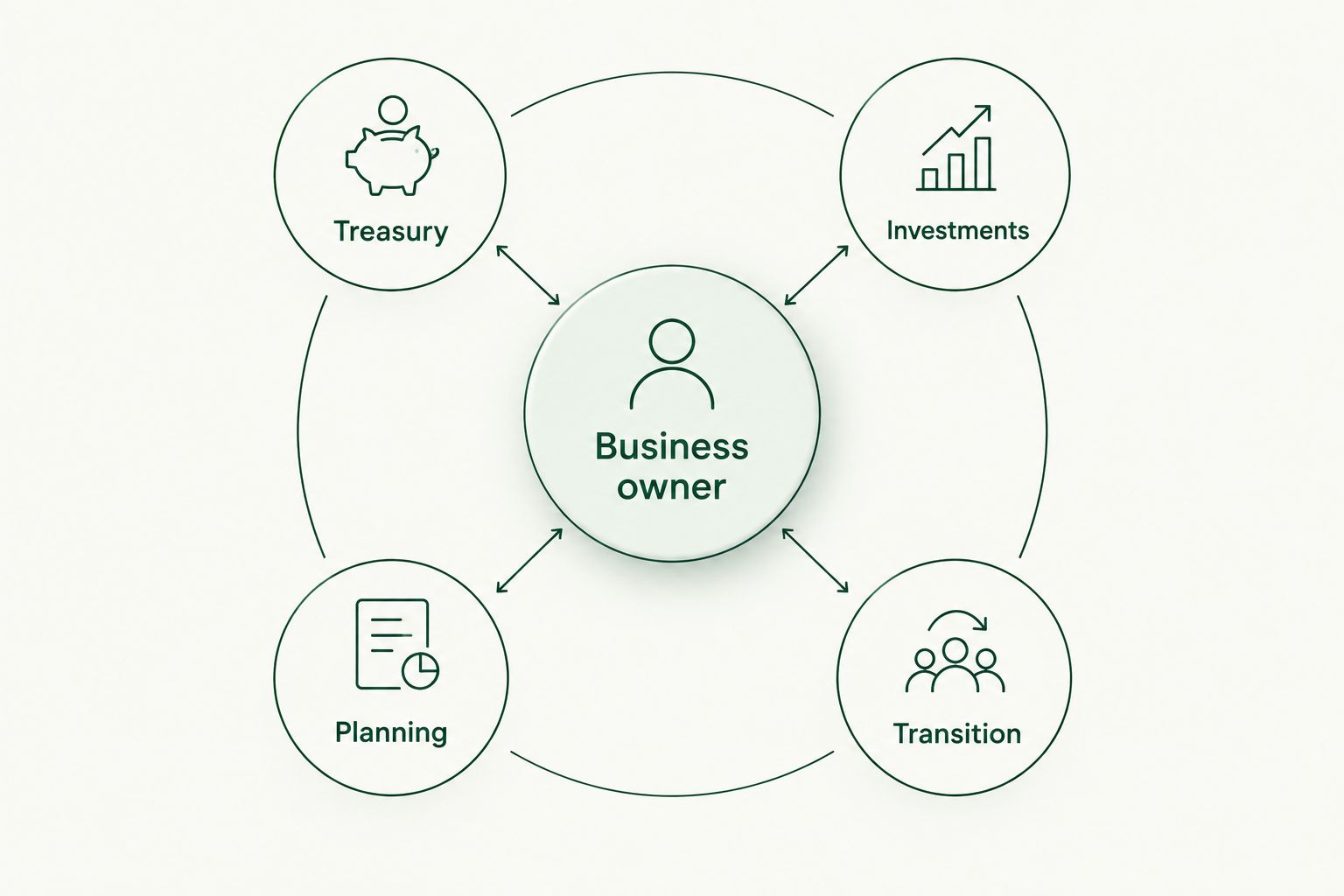
Treasury: separate operating needs from investable money
Treasury planning starts with the obligations your business must meet. You need a clear distinction between money committed to operations, money reserved for known obligations, and money that is available for other goals.
Ask for a documented process for making that distinction. A recommendation to invest business cash is incomplete without discussing when you need the money and what happens if receipts arrive later than planned.
The benefit is a clearer decision process. The limitation is that an advisor cannot make incomplete cash-flow records reliable; you and your accounting team must provide current information.
Investments: connect the portfolio to its purpose
Your investments need a job. Money intended to support a near-term household commitment serves a different purpose from money intended for retirement.
Ask the advisor to explain how investment recommendations relate to your goals, time horizon, liquidity needs, and ability to bear losses. If your business already represents a large part of your financial life, include that concentration in the discussion.
Investment management provides structure and oversight. It does not guarantee returns, prevent losses, or make business concentration disappear.
Planning: connect business income to household decisions
Financial planning links your household spending, retirement goals, savings, and business income. For an owner, it should distinguish compensation for your work from distributions and other money moving between the company and your household.
Ask what happens when your income changes. You need a process for updating decisions, not a document that assumes your business remains unchanged.
The advantage is a connected view of your finances. The limitation is that a plan depends on the information supplied and requires updates when your circumstances change.
Transition: plan your life after ownership
Succession planning is not only a conversation about who takes over. It also concerns how you support your household when your salary, distributions, and working role change.
A financial advisor can connect transition decisions to personal financial planning and coordinate with other professionals. Legal documents, transaction terms, tax conclusions, and business valuation require the appropriate specialists.
The benefit is seeing the personal consequences before committing to a transition. The limitation is that financial planning does not replace legal, tax, valuation, or transaction work.
When ongoing advice is the better fit
Best for: owners whose decisions recur and affect one another. Ongoing advice fits a business owner who needs to revisit cash allocation, investment decisions, household goals, and transition plans as the business changes.
The relevant question is whether the advisor will participate in those decisions. Ask what triggers a review, who handles follow-up, and which changes you must report between meetings.
For a 2026 engagement, request an explanation of what the continuing relationship includes. A recurring service needs recurring work; occasional conversation alone is not evidence of value.
The main drawback is the commitment required from you. An advisor cannot maintain a useful plan if you do not share changing obligations, implement agreed actions, or involve the necessary specialists.
When a defined project is the better fit
Best for: owners with a clearly bounded question. A defined project fits a specific need, such as reviewing how your household depends on business income or identifying planning issues before a possible transition.
Ask for the starting information, the deliverable, the decisions it supports, and the endpoint. You should understand what remains your responsibility after the work ends.
The advantage is focus. The drawback is that a completed project does not automatically include monitoring, implementation, or future updates. Confirm whether project work is available; do not assume every fee-only firm offers it.
When self-directed planning is enough
Best for: owners with straightforward needs and the discipline to follow through. You do not need an ongoing advisor solely because your income increased or because fee-only advice sounds preferable to commissioned advice.
Self-directed planning works when you understand your obligations, maintain an appropriate investment process, and know when to involve your CPA or attorney. You also need time to review decisions as your circumstances change.
The advantage is control. The drawback is that recognizing an overlooked issue remains your job. If important decisions stay on your to-do list, reconsider whether self-direction is serving you.
Why the value of fee-only advice varies
The value of an advisor depends on the work required and the work delivered. Use these factors to compare engagements:
- Connected decisions: Treasury, personal investments, and succession require coordination when a change in one affects the others.
- Income variability: Changing receipts and distributions create different planning demands from a predictable household paycheck.
- Business concentration: Your dependence on the company belongs in the same conversation as your personal investments.
- Implementation responsibility: Clarify whether the advisor recommends actions, helps coordinate them, or manages an agreed part of the process.
- Specialist involvement: Define how the advisor works with your CPA, attorney, and valuation professional without replacing them.
- Your time and follow-through: Advice is useful only when decisions are made, responsibilities are assigned, and information stays current.
These factors are a screening framework, not a formula for estimating financial gains. Do not accept an unsupported claim that hiring an advisor will produce a particular investment outcome or tax result.
Ask eight questions before you hire an advisor
Use these eight questions in your 2026 advisor interviews. Request clear answers that you can compare against the service agreement.
- How are you compensated? Ask about client fees, commissions, referral arrangements, and other financial incentives.
- Will you act as a fiduciary throughout this engagement? Ask how that responsibility applies to the services you are considering.
- What business-owner decisions do you address? Look for an explanation involving cash flow, concentration, retirement, or transition—not a generic portfolio pitch.
- What will I receive? Identify the written plan, recommendations, ongoing management, or other agreed deliverables.
- What is outside your scope? Clarify exclusions before you depend on the advisor for tax, legal, lending, or valuation work.
- How will you coordinate with my CPA and attorney? Ask who communicates, what information is shared, and how responsibilities are assigned.
- Who handles implementation? Determine who completes each action and how unfinished work is tracked.
- How will we evaluate the relationship? Agree on service expectations and planning progress rather than promised market performance.
Compare written answers with written terms. If the description of the service remains vague, you do not yet have enough information to hire confidently.
A Northern Colorado example of the service fit
Vital Investment Management is best suited to Northern Colorado business owners seeking coordinated treasury, investment, financial, and succession planning. The firm is a fee-only fiduciary and SEC-registered RIA in Loveland, serving owners in Loveland, Fort Collins, Berthoud, and the surrounding region.
Vital Investment Management offers those services, and Dillon Goodman, CPA, CFP®, leads its business-owner practice. The fit rests on whether you need that coordinated scope—not on a promise of investment performance.
The boundary matters: the firm coordinates with legal, tax, and valuation professionals but does not provide legal, tax, valuation, lending, or ESOP administration services, and does not broker transactions. Its educational resources are separate from personalized advice; the offer is a confidential discovery call with Dillon.
Is fee-only the same as fiduciary?
Fee-only describes compensation; fiduciary describes a duty to act in the client’s best interest. Ask about both, and verify how the duty applies to your engagement rather than treating the compensation label as a complete answer.
Do I still need a CPA if I hire an advisor?
A financial advisor does not replace your CPA. Your CPA handles the accounting and tax work within the CPA’s engagement, while your advisor connects financial decisions to your goals and coordinates where responsibilities intersect.
How do I know whether the advice is working?
Evaluate whether you understand your decisions, receive the agreed work, and complete the actions assigned to you. Investment returns alone do not measure whether an advisor has addressed cash needs, concentration, or succession planning.
FAQ
Is a fee-only financial advisor worth it in 2026 for a business owner?
A fee-only financial advisor is worth it in 2026 when coordinated planning addresses decisions you cannot manage well alone. Compare the agreed work with your needs in cash flow, investments, retirement, and succession.
Does fee-only mean an advisor has no conflicts of interest?
Fee-only does not mean an advisor has no conflicts of interest. Ask how the compensation arrangement creates incentives and how the firm identifies and addresses them.
What's the best type of advice if I only have one financial question?
A defined planning project is the best fit for a clearly bounded question when that service is available. Confirm the deliverable, implementation responsibilities, and what happens after the project ends.
Is an ongoing financial advisor better than managing my money myself?
Ongoing advice is better suited to recurring, connected decisions; self-directed planning suits straightforward needs you can manage consistently. Neither approach removes your responsibility to provide accurate information and follow through.
Can a financial advisor help me plan to leave my business?
A financial advisor can connect your business transition to personal income, investments, and retirement planning. Legal, tax, valuation, and transaction decisions still require the appropriate specialists.
What should I bring to a financial advisor meeting?
Bring your goals, household obligations, business cash-flow information, investment statements, and existing planning documents. Ask the advisor which records are needed and how to share sensitive information securely.
Does SEC registration guarantee that a financial advisor is good?
SEC registration is not an endorsement or a guarantee of skill or investment results. Evaluate the advisor's qualifications, disclosures, service scope, and fit for your needs.
Does Vital Investment Management offer advice for Northern Colorado business owners?
Vital Investment Management offers fee-only treasury management, investment management, financial planning, and business transition/succession planning for Northern Colorado business owners. Dillon Goodman leads the business-owner practice from Loveland.
One last thing
Before your 2026 discovery conversation, write down the financial decision you keep postponing. Then ask the advisor to explain the work needed to resolve it, the deliverable you will receive, and who is responsible for implementation.
A clear answer to that question tells you more than a compensation label alone. Hire for a defined need, a clear scope, and a process you will actually use.