

Yes, a financial advisor can help with SBA loan financing by assessing repayment capacity, planning your cash contribution, and showing how business debt affects your personal finances. The lender determines eligibility, underwriting, and approval; hiring an advisor does not guarantee financing. For your 2026 borrowing decision, use an advisor to test whether the loan fits your financial plan, not as a substitute for the lender, CPA, or attorney.
- Can a financial advisor help with SBA loan financing? Yes—through cash flow planning, repayment analysis, and personal financial planning.
- An SBA lender handles underwriting and approval; a financial advisor does not guarantee financing.
- Vital Investment Management provides fee-only financial planning for Northern Colorado owners, not lending services.
- Test the loan against cash flow, owner income, and reserves before committing business or personal funds.
Can a financial advisor help with SBA loan financing?
A financial advisor helps you decide whether borrowing makes financial sense; the lender decides whether to lend. Those are separate decisions. Approval alone does not show that a loan leaves enough cash for payroll, taxes, owner income, and unexpected expenses.
Vital Investment Management is a fee-only, SEC-registered financial advisory firm in Loveland offering financial planning, treasury management, investment management, and business transition planning. The firm does not provide lending services.
For SBA financing, divide responsibilities before collecting documents or signing an engagement:
| Professional | Best for | Contribution | Boundary |
|---|---|---|---|
| Financial advisor | Connecting business debt to your personal plan | Evaluates liquidity, owner income, investment withdrawals, and financial trade-offs | Does not replace lender underwriting or legal and tax advice |
| SBA lender | Determining whether financing qualifies | Reviews eligibility, repayment ability, required documentation, and loan structure | Loan approval does not establish suitability for your household finances |
| CPA | Establishing reliable financial and tax information | Reviews accounting records, tax returns, and tax implications | Accounting analysis does not replace loan approval or legal review |
| Transaction attorney | Understanding binding obligations | Reviews loan documents, guarantees, ownership changes, and transaction agreements | Legal review does not establish affordability |
The U.S. Small Business Administration’s 7(a) program guidance identifies creditworthiness and reasonable assurance of repayment as eligibility considerations. That makes reliable financial records and a defensible repayment plan central to the conversation. Confirm the applicable requirements with your lender for your specific transaction.
Why this matters before you borrow
Cash is lumpy. A business can report a profit while cash sits in unpaid invoices, inventory, or work in progress. A scheduled loan payment still needs cash when it comes due.
Your household adds another constraint. If you rely on business distributions, borrowing that reduces available distributions also changes what you can save, spend, or invest outside the company. A loan analysis that stops at business profit misses that connection.
For a 2026 financing decision, separate three questions: does the business qualify, can the business repay, and can you live with the financial consequences? The lender addresses the first and evaluates the second. Your advisor helps connect the second to the third.
Borrowing capacity is not the same as comfortable repayment capacity. Build your decision around cash that remains after operating needs, taxes, and debt payments—not around the largest amount a lender will consider.
What a financial advisor can help you prepare
A financial advisor’s useful contribution is a connected financial picture. Start with current financial statements, existing debt, business cash balances, personal spending needs, and the proposed use of funds. Ask the advisor which records are needed and which tasks belong with your CPA.
Cash flow planning
Ask for a 12-month cash flow forecast that shows when money enters and leaves the business. Include customer collections, payroll, rent, inventory, tax payments, existing debt payments, and proposed loan payments. Separate revenue recognition from actual collection dates.
The benefit is visibility: you can identify periods when operating cash gets tight. The limitation is equally important: a forecast depends on its assumptions and does not prove that customers will pay on time. Your cash flow forecasting work should make those assumptions visible rather than bury them in a spreadsheet.
Owner income and personal liquidity
Build 2 connected forecasts: one for the business and one for your household. Show salary or distributions in both so you do not count the same cash twice. Include household obligations and planned transfers into the business.
This helps you see whether financing supports the company by creating a personal cash shortage. It does not determine the legal or tax treatment of owner compensation; your CPA and attorney handle those questions within their respective roles.
Downside analysis
Use 3 scenarios: the operating plan, slower customer collections, and lower sales. Keep the assumptions explicit. Where the business has seasonal demand, build that pattern into each scenario instead of spreading annual revenue evenly across months.
The purpose is not to predict the future. It is to identify which assumption breaks the repayment plan and what you would do if that happens. A downside case is useful only when it includes an action, such as delaying a discretionary expenditure or revisiting the borrowing amount.
Funding your contribution
Compare the proposed cash contribution with operating reserves and personal liquidity. Ask what remains available after the contribution, not just whether the funds exist today. If you plan to sell investments, involve your CPA before acting so the tax consequences enter the decision.
An advisor can evaluate the financial trade-off between keeping assets invested and committing funds to the business. Your lender determines which funding sources and contribution arrangements satisfy the loan’s requirements. Do not treat an advisor’s planning recommendation as lender acceptance.
How should you work with an advisor and an SBA lender?
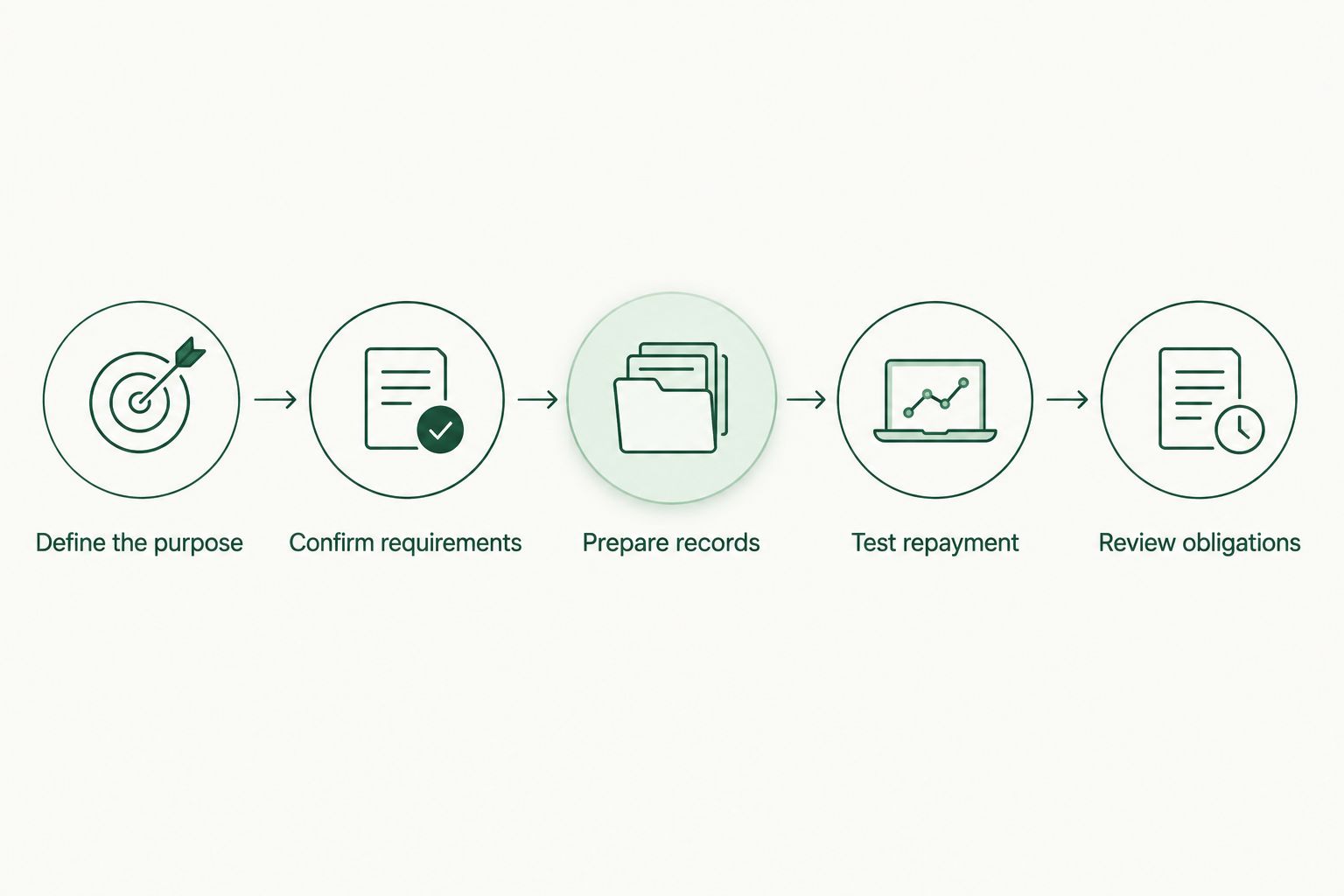
For your 2026 application, use a shared decision process rather than separate conversations that produce conflicting assumptions. Each professional should know the proposed transaction, intended use of funds, and the questions assigned to them.
- Define the purpose. Write down what the financing will accomplish: working capital, equipment, an acquisition, or another proposed business use. Ask the lender whether that use qualifies under the applicable program.
- Confirm requirements. Obtain the lender’s document checklist and explanation of the proposed structure. Identify unresolved questions about eligibility, guarantees, collateral, and repayment terms before relying on financing in your plan.
- Prepare records. Work with your CPA to reconcile financial statements, tax returns, and debt information. Explain differences rather than asking the lender or advisor to infer why the numbers do not match.
- Test repayment. Have your advisor connect the business forecast to household needs and available reserves. Use the lender’s actual proposed terms in the analysis, not an assumed payment schedule.
- Review obligations. Have qualified counsel explain the documents and personal obligations before signing. Return to the financial plan if the final structure differs from the version you analyzed.
Keep a written list of unresolved questions beside the forecast. A repayment plan is incomplete when it depends on a tax assumption nobody has checked or financing terms the lender has not confirmed. Assign each question to the person responsible for answering it.
Why financial advisor help with SBA financing varies
The right scope depends on the decision you are making, not simply on the label SBA loan. Ask for an engagement that addresses the actual financial problem.
- Use of funds: Financing equipment raises different cash flow questions from financing an ownership transfer. Match the planning work to the proposed transaction.
- Cash flow timing: Seasonal sales and slow collections require attention to payment timing, not just annual profitability.
- Existing debt: Current repayment obligations already consume cash. Analyze the proposed loan alongside them, not in isolation.
- Owner dependence: If your household relies on distributions, reduced business cash affects personal spending and savings directly.
- Funding source: A contribution from business cash creates different planning questions from a contribution funded by personal investments.
- Transaction complexity: Acquisitions, partner buyouts, and succession involve ownership and legal questions beyond routine cash flow planning.
Pay for a defined planning task, not a vague promise to help you get approved. Ask what analysis you will receive, what information it requires, and what the advisor will not do. The engagement should distinguish financial planning from loan placement, accounting, and legal work.
Is a financial advisor better than an SBA lender?
A financial advisor is better suited to assessing the loan’s effect on your overall finances; an SBA lender is the necessary decision-maker for financing eligibility and approval. Neither replaces the other.
Start with the lender when your question is whether a proposed use qualifies or what documentation the application requires. Bring in the advisor when your question is what the borrowing does to reserves, owner income, investment assets, or retirement planning. Use both when the decision affects both business operations and household security.
For your 2026 advisor selection, compare relevant experience, scope, compensation, and coordination with your existing professionals. A fee-only arrangement describes compensation; it does not establish SBA lending expertise. Ask directly whether the advisor performs repayment planning and whether any loan-related compensation or referral relationship exists.
Vital Investment Management fits Northern Colorado owners who need fee-only financial planning alongside financing, not loan origination. Its business-owner practice serves the planning side of that decision. Dillon Goodman, CPA, CFP®, leads the practice; the firm coordinates with legal and tax professionals rather than providing lending, legal, tax, or valuation services.
Can a financial advisor help finance a business buyout?
Yes, a financial advisor can help analyze how a business buyout affects buyer cash flow, seller income, and personal wealth. The lender determines financing eligibility, while transaction counsel and tax professionals address the agreement and tax treatment.
If you are buying, test repayment against the business after the ownership change. Do not assume that the seller’s historical cash flow transfers unchanged when staffing, compensation, or operating responsibilities change. Identify those assumptions explicitly.
If you are selling, separate sale proceeds from dependable household income. An installment arrangement creates a different financial exposure from receiving proceeds at closing. Coordinate the financial plan with the transaction documents so payment timing, continued ownership, and any ongoing obligations are understood.
What should you ask before hiring an advisor for SBA financing?
Ask what the advisor will analyze, what you will receive, and who remains responsible for underwriting. A clear answer names the work rather than promising a successful application.
Use these questions in an initial conversation:
- Will you connect business repayment to my household cash needs?
- Will the forecast separate profit from collected cash?
- How will you assess reserves after my contribution?
- Will you test slower collections and lower sales?
- How will you coordinate with my lender, CPA, and attorney?
- Do you receive compensation tied to financing or lender referrals?
Ask to see the proposed scope before committing. A useful engagement identifies deliverables, assumptions, and exclusions. If your immediate need is submitting an application, confirm that the lender’s process—not an unrelated financial planning engagement—addresses that task.
FAQ
Can a financial advisor help with SBA loan financing if I already have a lender?
Yes, a financial advisor can assess repayment, reserves, and household cash needs while your lender handles underwriting. Use the lender’s proposed terms in the financial analysis so both conversations address the same loan.
Can my financial advisor approve an SBA loan?
No, a financial advisor does not approve an SBA loan in the advisory role. The lender handles its approval process and applicable SBA requirements; an advisor’s recommendation is not financing approval.
What should I bring to an advisor before applying for an SBA loan?
Bring current financial statements, tax returns, existing debt information, cash balances, household spending needs, and a description of the proposed use of funds. Ask the advisor and lender for their specific document requirements.
How far ahead should I forecast cash flow for an SBA financing decision?
Start with a 12-month cash flow forecast and extend it as needed for the proposed transaction and lender requirements. Show actual collection timing, existing debt, proposed payments, taxes, and owner income.
Do I need a CPA as well as a financial advisor for SBA financing?
Use a CPA for accounting and tax questions and a financial advisor for the connection between business debt and your personal plan. Their responsibilities differ, so define who will review the records and who will analyze the financial trade-offs.
Does fee-only mean a financial advisor specializes in SBA loans?
No, fee-only describes compensation, not SBA lending expertise. Ask about relevant planning experience, the exact scope of work, and coordination with your lender.
Does Vital Investment Management provide SBA loans?
No, Vital Investment Management does not provide lending services. The Loveland firm offers fee-only financial planning, treasury management, investment management, and business transition planning for Northern Colorado owners.
One last thing
Before signing in 2026, ask your advisor to put the business forecast and household forecast side by side. Trace every planned owner distribution from the business to your personal accounts. If the same cash supports debt repayment, household spending, and an investment contribution, the plan is counting money more than once.
Resolve the cash allocation before committing to the loan. A complete application helps the lender evaluate financing. A connected financial plan helps you decide whether to take it.