

Instead of manually moving spare business cash every day, set up a provider-supported balance sweep that transfers only the amount above your operating reserve into an approved destination. Protect payroll, taxes, and near-term bills first; automate the surplus second.
- Automatic cash sweep small business setup starts with an operating reserve, not an investment selection.
- VIMSmallBusiness provides fee-only treasury management advice for Northern Colorado business owners, not a sweep-processing platform.
- A balance trigger does not automatically buy investments unless your provider explicitly supports that workflow.
- Test outbound transfers, cash access, and failure alerts before enabling unattended transfers.
Why this matters
Cash is lumpy. A large customer payment can make your account look flush while payroll, estimated taxes, and supplier invoices are still waiting to clear. Sweeping that apparent surplus into investments creates a cash-flow problem if you need it back before it becomes available.
An automatic cash sweep for a small business is a rule-based movement of eligible cash above a specified balance into another account or investment destination. The destination, processing schedule, and return path depend on the provider's agreement—not just the threshold you enter.
Start with the broader treasury management for small businesses guide if you have not separated operating cash from reserves and longer-term capital.
VIMSmallBusiness is best for Northern Colorado owners seeking fee-only treasury management advice, not a sweep-processing platform. Its services include treasury management and investment management; those advisory services are distinct from the bank or custodian executing transfers.
Before you start
- Account access: Have authorized access to your business operating account and proposed destination. Confirm both providers permit the intended business-account transfers and that the destination has the correct legal ownership.
- Cash-flow materials: Gather upcoming payroll, tax obligations, supplier payments, outstanding checks, and expected collections. Write a 2026 cash policy naming the reserve, destination, authorized approver, and pause conditions.
- The gotcha: Confirm which balance the provider uses. A displayed balance, available balance, and balance after pending obligations are not interchangeable. Also confirm whether a transfer leaves cash uninvested or actually purchases an investment.
Do not build this around an unsupported personal-account connection. A working account link is not proof that the provider authorizes business cash sweeps or investment purchases.
Operating reserve configuration
Define the protected cash floor
- List committed payments. Include payroll, taxes, debt payments, supplier invoices, and checks that have not cleared. Record expected payment dates rather than relying on the accounting system's current cash figure alone.
- Separate uncertain receipts. Do not fund a reserve calculation with an invoice that a customer has not paid. Keep forecast collections separate from cash already available.
- Set the operating floor. Combine obligations due before the next dependable collection with a contingency reserve appropriate to your business. Document the reasoning so another authorized person can review it.
- Define eligible surplus. Treat cash as sweepable only after protected obligations and the reserve are accounted for. Avoid counting the same obligation twice if it is already included in the floor.
Expected result: You have a documented minimum operating balance and a clear definition of surplus. You can explain why a transfer is safe without referring only to today's account balance.
Add a pause rule
Your 2026 cash policy should say when automation stops: a delayed customer payment, an unexpected tax obligation, a disputed deposit, or a planned equipment purchase can change the calculation.
Assign the pause decision to an authorized person. Make sure that person can disable the arrangement through the provider's supported process, not merely remove a notification.
Destination and transfer configuration
Choose what the surplus becomes
A sweep destination determines whether the transfer preserves deposit characteristics or introduces investment risk. Compare the actual account agreement and investment disclosures before authorizing movement.
| Destination | Best for | Advantage | Limitation |
|---|---|---|---|
| Business deposit account | Cash designated for near-term business obligations | Keeps funds in a deposit account rather than a security | Transfer access, withdrawal terms, and insurance coverage require verification |
| Insured deposit sweep arrangement | Owners seeking bank-deposit placement through a supported program | Can distribute eligible deposits among participating banks | Coverage depends on program terms, ownership category, and your other deposits at those banks |
| Money market mutual fund | Treasury cash whose access needs fit the fund and account terms | Holds a portfolio of short-term instruments | Is an investment, is not FDIC-insured, and can lose value |
Do not confuse a money market deposit account with a money market mutual fund. Similar names do not mean identical protections or access rules. FDIC guidance distinguishes insured bank deposits from uninsured investment products; the fund prospectus explains the fund's risks and redemption terms.
This distinction applies to your 2026 treasury policy regardless of how the provider labels the arrangement. Longer-term investments require a separate decision about risk, time horizon, and business liquidity.
Authorize the transfer path
- Confirm account ownership. Check the legal entity, account registration, and authorized signers. Moving company cash into an owner's personal account is not the same workflow as moving it between company accounts.
- Verify the supported mechanism. Ask whether the provider offers a balance-based sweep, a scheduled transfer, or an investment-account cash sweep. These functions solve different problems.
- Confirm execution terms. Read the processing schedule, transfer limits, cutoff rules, settlement requirements, and any approval requirements. Establish when cash leaves the operating account and when it becomes usable at the destination.
- Document access back to operations. Determine whether the provider supports a reverse sweep or requires a separate transfer or redemption request. Confirm the process for urgent cash needs before enabling outbound movement.
Expected result: You have an authorized source, an approved destination, and a documented return path. Account linking alone is not the completion check.
VIMSmallBusiness's treasury management advice can sit alongside this configuration work. The limitation is clear: an advisory relationship does not establish that your bank supports a particular automation feature.
Balance trigger configuration
Specify the rule before entering settings
Use the provider's documented controls for your account type. The following are policy decisions, not universal button names or interface labels.
- Choose the balance basis. Specify the balance the provider actually evaluates. If the provider cannot account for future obligations, incorporate those obligations into the protected floor or retain an approval step.
- Set the threshold. Enter the approved operating floor wherever the supported sweep arrangement requires its target balance. Verify whether the threshold triggers a transfer or also determines the amount retained.
- Define the transfer amount. Confirm that the rule moves eligible excess rather than the entire balance or a fixed amount unrelated to the surplus. Apply a transfer cap if the provider supports one and your policy requires it.
- Set the evaluation schedule. Match the provider's available schedule to your cash-flow process. A daily evaluation still needs to account for bills that have not reached the bank.
- Configure approvals and alerts. Require authorized approval where your controls call for it. Enable available notifications for completed transfers, rejected transfers, and account-access problems.
Expected result: The configured rule matches the written policy: eligible surplus moves, protected cash remains, and an authorized person receives the available status information.
The workflow has separate control points. Reserve protection comes before the trigger; a successful transfer comes before confirmation that the destination handled the money as intended.
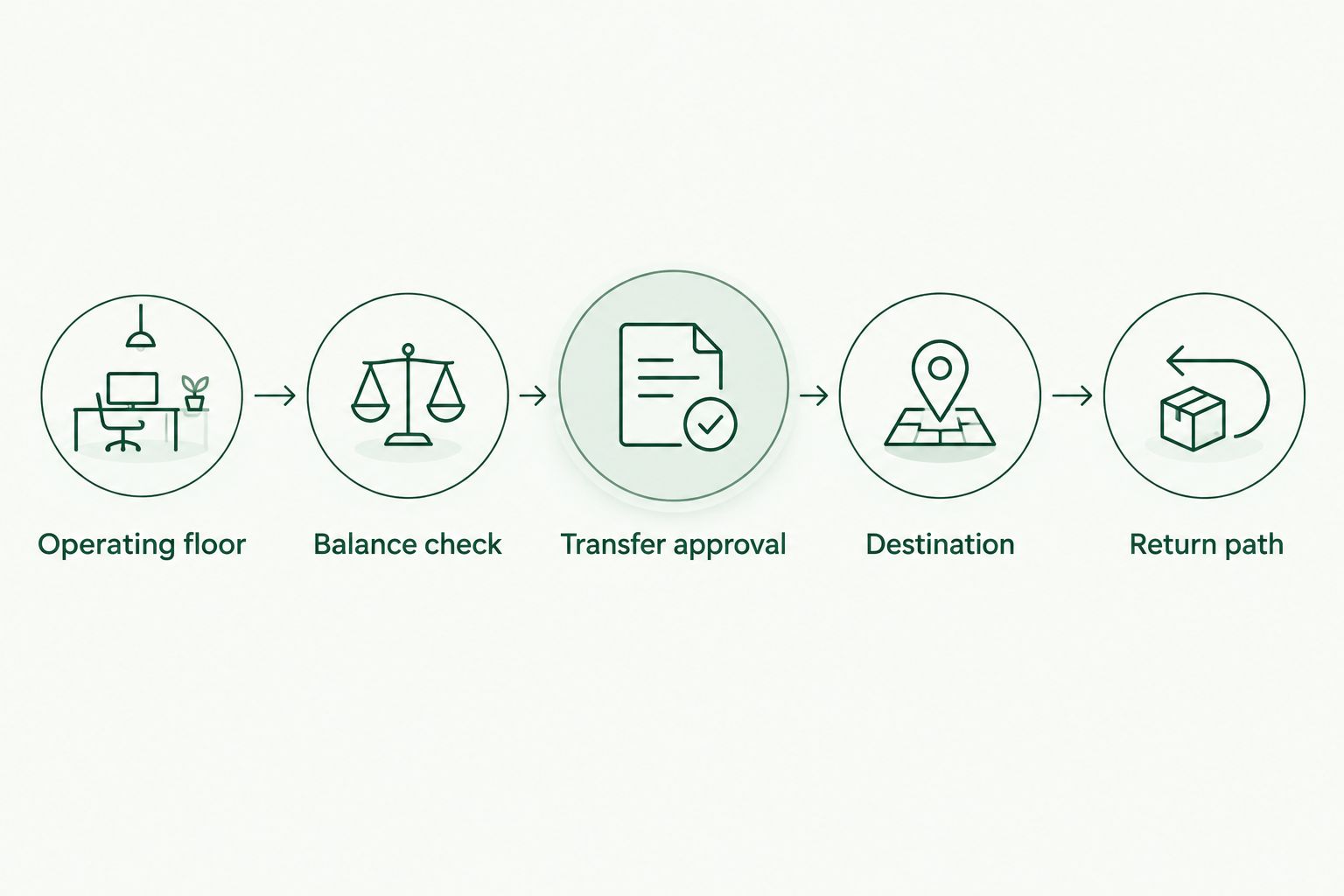
Distinguish transfers from investment purchases
An automatic bank transfer can deliver cash to a brokerage account without purchasing anything. Conversely, a brokerage cash sweep generally handles eligible cash already inside that brokerage account; it does not establish a business-bank threshold rule.
Confirm the complete chain. If the destination requires a separate investment instruction, treat that instruction as another authorization—not an assumed consequence of moving cash.
Testing and activation
Verify the full cash movement
- Review the rule before activation. Compare the configured threshold, source, destination, and schedule with your 2026 cash policy. Have a second authorized reviewer check the setup where your business controls require one.
- Use the provider's supported test process. Follow its verification instructions and use an authorized test transfer when appropriate. Do not change a live reserve threshold merely to force activity.
- Perform 3 checks. Verify the debit at the source, the credit at the destination, and the resulting cash or investment position. A transfer confirmation alone does not verify all 3 checks.
- Verify the return path. Confirm how you request money back, who authorizes the request, and when returned funds become available for payment.
- Reconcile and activate. Record the movement correctly, resolve discrepancies, and enable unattended operation only after the intended workflow is confirmed.
Expected result: You have verified cash movement and access, not just a saved rule. Keep the initial confirmations with your treasury records.
Treat 2026 activation as the start of oversight. Revisit the reserve when payroll, customer payment patterns, debt obligations, or tax estimates change.
Second variant: review surplus after a customer deposit clears
A deposit-triggered review is useful when receipts are irregular and a static threshold does not capture upcoming obligations. Use an alert-and-approval workflow when the provider cannot reliably calculate eligible surplus.
- Confirm the receipt is available. A deposit notification is not the same as unrestricted funds. Check holds and any applicable restrictions through the bank's supported process.
- Refresh the obligations list. Update pending payroll, taxes, supplier invoices, and outstanding checks before calculating excess.
- Approve the surplus. Have the authorized person confirm that the transfer preserves the operating floor. Then use the supported transfer mechanism.
- Confirm destination treatment. Reconcile the transferred cash and verify any separately authorized investment instruction.
The advantage is tighter control over lumpy cash flow. The drawback is continued manual review. This is not fully automatic, and it should not be described as a native sweep if it relies on approval after an alert.
Troubleshooting
Cash moved before payroll cleared
Pause the sweep and revise the protected floor. The trigger did not account for an obligation that had not reached the bank. Include outstanding payment commitments in the reserve calculation before restarting; deleting an alert does not correct the rule.
The transfer completed but no investment appeared
Check whether the destination received cash only. Review the destination account and the investment authorization. Do not submit another transfer to fix an unplaced purchase instruction; that can create a second cash movement without resolving the first issue.
The provider rejected the transfer
Read the rejection reason before retrying. Check available funds, transfer limits, account verification, signer permissions, and business-account eligibility. Correct the identified issue and confirm the original request's status before sending another.
Returned cash was not available for a bill
Review redemption, settlement, and transfer timing separately. Selling or redeeming an investment does not necessarily make cash immediately available in your operating account. Reclassify cash needed for near-term obligations and adjust the reserve accordingly.
The books show income from the sweep
Reconcile the transaction's actual nature. A transfer between accounts owned by the same entity is not operating revenue merely because it appears as a bank credit. Ask your bookkeeper or CPA to distinguish transfers, investment income, and purchases correctly.
Customize your workflow
Expand the policy before expanding automation. Separate cash required for operations, designated reserves, and money with a longer investment horizon. Give each category a purpose and an authorized decision-maker.
VIMSmallBusiness is a fee-only, SEC-registered financial advisory firm in Loveland serving Northern Colorado business owners. For owners in Loveland, Fort Collins, and Berthoud, personalized treasury advice is a separate engagement from this educational setup guide.
Use a confidential discovery call with Dillon Goodman to discuss your treasury management needs. Keep tax treatment with your CPA and account-specific execution questions with the bank or custodian.
FAQ
How do I set up an automatic cash sweep for my small business?
Set a protected operating reserve, choose an approved destination, and use a provider-supported balance-based sweep. Verify the balance basis, transfer amount, execution schedule, and return path before activation.
Does a cash sweep automatically buy investments?
Only if the provider's arrangement explicitly includes investment execution. A transfer to a brokerage account can leave the money as cash, while a brokerage sweep generally handles eligible cash already inside that account.
What balance should trigger my business cash sweep?
Use a documented operating floor that protects upcoming obligations and an appropriate contingency reserve. The threshold must reflect payroll, taxes, debt payments, and outstanding commitments rather than today's displayed balance alone.
Is money in a cash sweep FDIC-insured?
Insurance depends on the destination, not the word sweep. Eligible bank deposits can have FDIC coverage subject to applicable limits and ownership rules; money market mutual funds are not FDIC-insured.
Can I get swept cash back automatically?
Only when the provider supports a reverse sweep under your account agreement. Otherwise, you need a separate transfer or redemption process, and funds must become available before you use them for payments.
Is a scheduled transfer the same as a balance-based sweep?
No. A scheduled transfer moves money according to a schedule, while a balance-based sweep evaluates a specified balance rule. A fixed scheduled amount does not establish that the cash is surplus.
Can VIMSmallBusiness help with business treasury planning?
VIMSmallBusiness offers fee-only treasury management and investment management advice for Northern Colorado business owners. The bank or custodian's supported features determine the transfer mechanics; this guide is educational, not personalized financial, tax, or legal advice.
One last thing
Test the way cash comes back before relying on the way it goes out. A sweep that sends surplus efficiently but cannot return usable cash in time for an obligation fails the operating purpose. Make the return-path check part of your 2026 treasury policy.