
Farm and ranch owners’ financial planning is the process of coordinating operating cash, personal finances, taxes, and succession so the operation can meet its obligations and the owner can plan beyond it. In 2026, start with a cash calendar: land and equipment can be valuable while the next tax bill, loan payment, or owner draw still needs cash.
- Financial planning for farm and ranch owners starts with a cash forecast, not an investment account.
- Vital Investment Management is best for Northern Colorado owners seeking fee-only financial planning alongside a CPA and legal counsel.
- Keep operating reserves, tax money, equipment needs, and personal spending visible as separate decisions.
- A financial advisor can coordinate investments and succession planning but cannot replace agricultural tax or legal advice.
Why financial planning matters for farm and ranch owners
A farm or ranch can have several financial timelines at once. You pay operating bills throughout the year, make larger equipment or land decisions less often, and eventually need an answer to who will run or own the operation. Your personal spending and retirement plans depend on those decisions, but they are not the same plan.
Start with a treasury management guide for small businesses if cash sits across several accounts without a clear job. The immediate question is not whether an account balance looks healthy. It is which bills, taxes, purchases, and owner draws that balance must cover before more money arrives.
For a Northern Colorado owner reviewing a plan in 2026, the test is whether someone else can read the numbers and understand the next decision. A forecast should show when cash is needed; an ownership plan should identify who has authority to act. Neither document needs to predict a perfect year to be useful.
Build a plan around the operation and your life
Map your cash by month
Begin with the records you already have: bank statements, invoices, debt schedules, and a calendar of expected receipts and payments. Build a 12-month worksheet yourself before deciding whether you need help maintaining it. Keep expected income separate from money already in the bank; a pending sale does not pay a bill today.
Use a monthly view to spot periods when operating cash tightens, then zoom in on the next 90 days for payment decisions. If you farm and ranch, track the activities separately before combining them. That makes it easier to see which part of the operation uses cash and when.
In 2026, update the worksheet when a major expense, sale, or borrowing decision changes. Do not keep an old forecast merely because its annual total still looks plausible.
- Enter confirmed receipts apart from expected receipts.
- List debt payments by due date, not by annual total.
- Mark tax payment dates for review with your CPA.
- Separate operating expenses from equipment and land purchases.
- Compare the forecast with actual bank balances each month.
Give every cash balance a job
One large account balance can conceal several obligations. Label the purposes of your cash before moving any of it into longer-term investments. These are planning categories, not a formula for how much you should hold; the right amounts depend on your bills, debt terms, and tolerance for a weak sales period.
Draw the boundaries in a spreadsheet or on paper first. Your CPA can help identify tax obligations, while your lender can clarify payment requirements. When an expense belongs to both the business and household plan, record who pays it so it does not disappear between them.
The four labels below turn a vague cash target into decisions you can revisit:
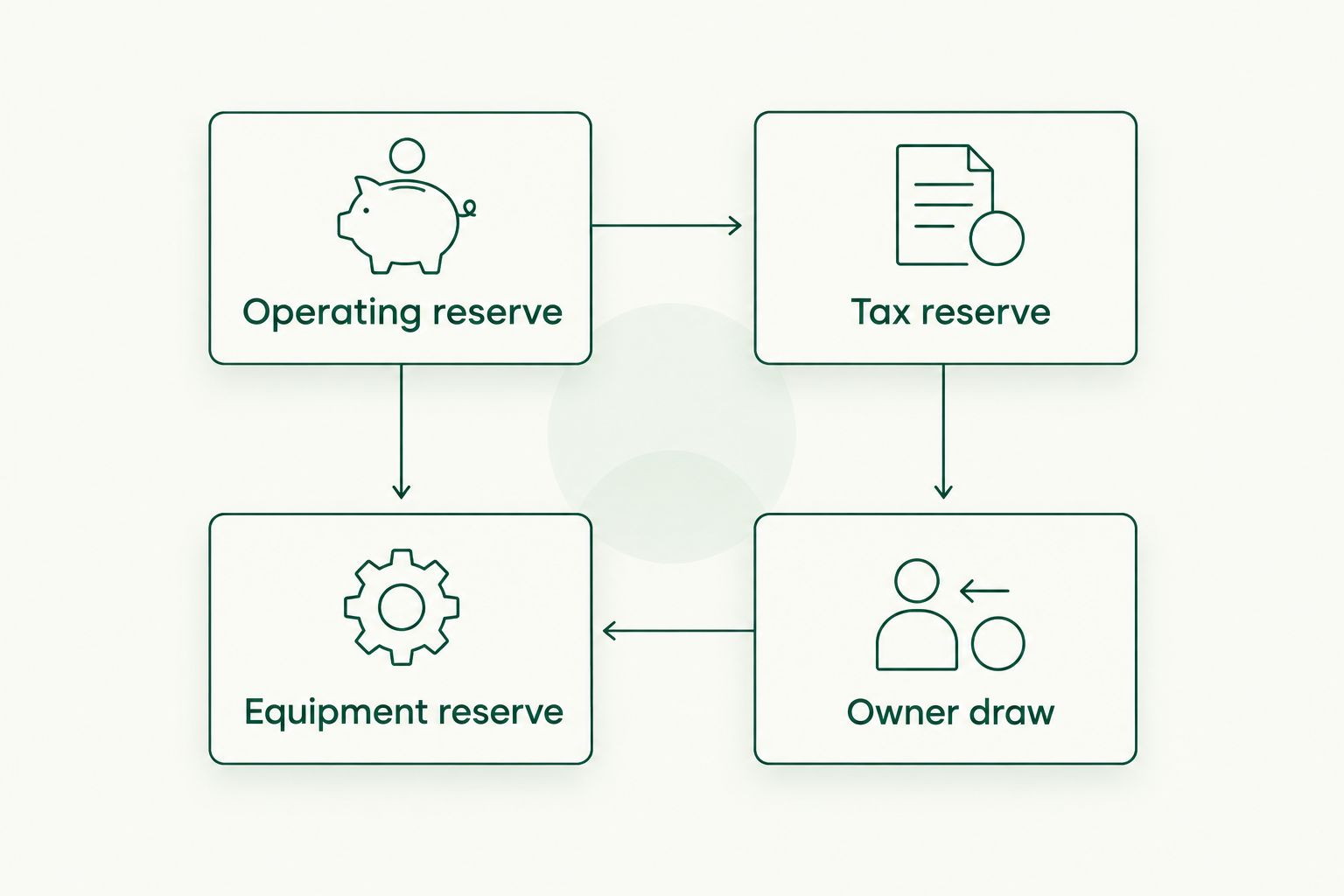
- Set an operating reserve for known bills and an interruption you can describe.
- Keep a tax reserve visible until your CPA confirms what is due.
- Identify an equipment reserve for planned repair or replacement decisions.
- Record the owner draw the household expects from the operation.
- Review cash left over only after those commitments are visible.
Separate your net worth from spendable money
A balance sheet tells you what you own and owe. It does not tell you whether you can fund personal spending without selling land, borrowing, or changing operations. Make two views: one for the business and one for the household, with shared assets and debts identified clearly.
This is where outside help can speed up the work. Vital Investment Management provides fee-only financial planning, treasury management, investment management, and business transition and succession planning for small business owners. Its role is to connect owner-level decisions with the operation’s cash needs, not to set an agricultural tax position or determine a property value.
Vital Investment Management is best for Northern Colorado farm and ranch owners who want fee-only owner-level planning coordinated with their CPA and legal counsel. Its limitation is equally important: an advisor’s investment and planning work does not replace those specialists or turn a hard-to-sell asset into ready cash.
For your own first pass in 2026, identify the money you can use without disrupting the operation. Then ask what would have to happen before you could use the rest.
- List business assets, personal assets, and debts separately.
- Mark land and equipment as assets that require a separate decision to convert to cash.
- Note guarantees or obligations that connect business and household finances.
- Identify household spending that depends on owner draws.
- Give each planned investment a time horizon and a purpose.
Review taxes with the right specialists
Taxes affect cash, but an investment plan is not a tax return. Bring your CPA the current books, planned purchases, ownership structure, and expected changes in income. Ask what each decision does to cash as well as to taxable income; a tax deduction does not make an unnecessary purchase free.
Keep financial planning and tax advice distinct. A financial advisor can help you show the CPA when you need cash and how a proposed decision affects personal goals. Your CPA determines the applicable tax treatment. If an ownership transfer is under discussion, bring transaction counsel into the conversation rather than assuming a retirement-account choice solves the transfer.
Retirement arrangements also depend on how the operation is structured and who works in it. Review eligibility and employer obligations with qualified professionals before choosing an account on the basis of a headline deduction.
- Ask your CPA to review expected income and tax-payment timing.
- Bring planned equipment purchases to the discussion before committing cash.
- List family members and other workers whose roles affect plan choices.
- Compare retirement contributions with operating cash needs.
- Record which professional owns each unanswered tax or legal question.
Write the ownership transition as a decision plan
Succession is not just a future sale price. Write down who could manage the operation if you step back, who could own it, and what cash you would need personally. Management and ownership can pass at different times; leaving that distinction unstated invites confusion.
Start with the people involved. Ask whether a family member wants to operate the business, whether a buyer has been identified, or whether the plan remains open. Do not build personal spending on assumed sale proceeds until the transaction structure and obligations are clear. A valuation professional and transaction counsel address questions that financial planning alone cannot settle.
For 2026, you do not need a completed transaction to make progress. You need a written list of decisions, owners, and unresolved questions that the family and professional team can use.
- Name who can make operating decisions if you cannot.
- Distinguish a proposed manager from a proposed owner.
- Identify what personal income must replace owner draws.
- Ask counsel which agreements or estate documents need review.
- Have qualified specialists examine any proposed valuation and transfer terms.
Test the plan before you act
A forecast that works only if every receipt arrives on time is not a decision tool. Test a delayed sale, an unplanned equipment expense, and a change in the owner’s role. Use your own figures; these are scenarios to discuss, not predictions of what will happen.
Check both sides of each scenario. A temporary cash gap might change borrowing or spending decisions at the operation, while a longer change could affect household withdrawals and investment timing. Write down the decision you would take and the person you would call. If the answer depends on an asset sale, identify the legal and practical work needed before treating it as available cash.
Repeat the test after a major purchase, financing change, or succession decision. A 12-month forecast and a written transition plan should agree on what the owner takes out and when.
- Delay a major expected receipt in the cash worksheet.
- Add an equipment cost without assuming new financing.
- Reduce the owner draw and inspect the household effect.
- Identify which decisions require a CPA, lender, or attorney.
- Update the plan when the underlying facts change.
Which planning option fits your situation?
Use the lightest option that answers the decision in front of you. A spreadsheet can show a cash gap. It cannot settle a tax treatment or draft an ownership agreement. The options below work together rather than replacing one another; no fee comparison is possible without specific proposals.
| Option | Best for | Strength | Key limitation |
|---|---|---|---|
| Your own spreadsheet and records | Best for making cash commitments visible | You control the assumptions and can update them as events change | It depends on accurate inputs and does not provide specialist advice |
| CPA | Best for tax treatment and tax-payment planning | Connects business decisions to tax obligations | Tax work alone does not establish an investment or succession plan |
| Transaction counsel and valuation professional | Best for proposed ownership transfers | Addresses agreements and valuation questions within each professional’s role | Does not maintain your monthly cash or household plan |
| Vital Investment Management | Best for Northern Colorado owners seeking fee-only financial planning and coordination | Connects treasury, investments, personal goals, and succession decisions | Does not provide legal, tax, valuation, or lending services |
Ask a prospective advisor to explain exactly what they will deliver, who will maintain the cash forecast, and where their work stops. In 2026, a useful planning relationship should leave those responsibilities clear before you rely on its recommendations.
Common mistakes farm and ranch owners make
- Treating land value as a cash reserve. Land belongs on a balance sheet, not in the account that pays next month’s bills. Put the payment dates beside available cash before making an investment or purchase decision.
- Using one forecast for every activity. When receipts and expenses from different activities are mixed together, you cannot see which one creates a cash gap. Track them separately, then combine them for the operation-wide view.
- Planning taxes after the cash is committed. Give your CPA a current forecast before a major purchase or owner draw. A year-end scramble is harder to resolve when the money already has another job.
- Confusing a successor with a buyer. Someone willing to run the operation has not necessarily agreed to buy it. Write separate plans for management authority, ownership, and the owner’s income.
- Expecting one advisor to answer every question. Vital Investment Management can address the owner’s financial plan; tax treatment, transaction documents, and valuation require the appropriate specialists. Put names beside the open questions.
FAQ
What is financial planning for farm and ranch owners?
It is a plan connecting operating cash, personal finances, investments, taxes, and ownership transition. Start by showing when money comes in, what must be paid, and what the owner needs outside the operation.
What should a farm or ranch owner plan first in 2026?
Plan cash needs first. A 12-month forecast shows when bills, debt payments, taxes, purchases, and owner draws compete for the same money.
Is a CPA enough for farm and ranch financial planning?
A CPA is essential for tax questions, but tax work is not the entire financial plan. You still need to connect cash needs, personal investments, and succession decisions.
Can a financial advisor value my farm or ranch?
A financial advisor does not replace a qualified valuation professional. An advisor can use an appropriately reviewed valuation to examine what a proposed transfer means for your personal finances.
Is Vital Investment Management a good fit for every farm owner?
No. Vital Investment Management is a fit for a Northern Colorado owner seeking fee-only financial planning, treasury, investment, and succession coordination; it does not provide agricultural tax or legal advice.
How do I plan for retirement if most of my wealth is in land?
Separate land value from the cash available to support spending. Then test how different ownership and income decisions affect the operation and your household before relying on a sale.
What belongs in a farm or ranch succession plan?
Identify who can manage the operation, who might own it, and how the current owner’s income would be replaced. Have the relevant legal, tax, and valuation specialists review their parts of any proposed transfer.
One last thing
The most useful 2026 planning question is not what the operation is worth. It is which decision would change if a receipt arrived later than expected. If you cannot answer that from your cash forecast, update the forecast before revisiting investments or transfer terms. Vital Investment Management’s financial planning can help connect that owner-level decision to a wider plan, while your CPA and counsel address their respective questions.