

Yes—hiring both a CPA and a financial advisor is worth it when your business taxes, cash flow, investments, and eventual exit affect one another. The value comes from distinct responsibilities and coordinated decisions, not from paying two professionals to review the same information; if your needs are limited to filing a straightforward return, a second ongoing engagement needs a separate reason.
- Is it worth hiring both a CPA and a financial advisor? Yes, when tax and financial planning decisions overlap.
- A tax-focused CPA handles tax analysis; a financial advisor connects cash flow, investments, retirement, and succession.
- Hire both for distinct deliverables, not duplicate reviews or assumed tax savings.
- Vital Investment Management serves Northern Colorado business owners seeking fee-only financial planning coordinated with outside tax professionals.
Why this matters
Your business return and your household financial plan answer different questions. A tax decision can affect the cash available for payroll, retirement contributions, or investments outside the company. An investment decision can create a tax consequence that belongs in your CPA's analysis.
For your 2026 planning, the practical issue is not whether either professional is smart enough to discuss both subjects. It is whether someone owns each decision and checks its consequences before you act. A year-end tax scramble often starts with a decision made without that coordination.
Start with an agreed information-sharing process. The guide to connecting your CPA's tax software to your financial plan addresses that handoff, but sharing relevant records matters more than assuming every system needs a direct connection.
Is it worth hiring both a CPA and a financial advisor?
Hire both when you need tax work and a separate plan for what your money must accomplish. Hire a tax-focused CPA for the tax engagement you actually need. Hire a financial advisor when you need help connecting business cash, household spending, investments, retirement, or a transition.
The comparison below describes engagement choices, not automatic capabilities attached to a credential. Confirm each professional's written scope before assigning responsibility.
| Engagement | Best for | Main advantage | Main limitation |
|---|---|---|---|
| Tax-focused CPA only | Owners whose immediate need is tax preparation and tax planning | Keeps responsibility for tax analysis and filing clear | Does not include investment management or household planning unless expressly agreed |
| Financial advisor only | Owners seeking financial planning or investment management with tax work handled separately | Connects assets, spending, business concentration, and long-term goals | Does not replace tax preparation or specialist tax advice |
| CPA and financial advisor | Owners whose tax decisions intersect with cash flow, retirement, investments, or succession | Allows each specialist to evaluate the same decision from a different angle | Creates overlapping work unless responsibilities and communication are defined |
A business owner in Loveland, Fort Collins, or Berthoud does not need two professionals simply because the business is local. You need both when the work requires both. Local access is useful only if the professionals communicate and deliver what you hired them to do.
When a CPA alone fits
A CPA-only engagement fits when your unresolved work is tax-focused and you do not need a separate planning or investment engagement. Examples include preparing returns, reviewing estimated payments, and evaluating the tax treatment of a proposed business decision—provided those services are in scope.
The advantage is clarity. The limitation is that a tax answer does not automatically tell you whether the decision supports your retirement or leaves enough accessible cash. Revisit the arrangement when those questions become material.
When a financial advisor alone fits
An advisor-only engagement fits when your tax work is already covered and the unresolved issue is financial planning or investment management. That includes deciding how business ownership fits with the rest of your assets or how household spending will be funded after you stop working.
The advantage is a dedicated planning relationship. The limitation is that tax assumptions still need confirmation by the appropriate tax professional. Do not treat a financial projection as a completed tax analysis.
When hiring both fits
Hiring both fits when a decision needs a tax calculation and a separate judgment about liquidity, investment risk, or income replacement. A business sale is a clear example: the tax result and the plan for living on the proceeds are connected, but they are not the same task.
The advantage is complementary analysis. The limitation is coordination: if you must reconcile contradictory instructions alone, the arrangement is not delivering its full purpose. Ask for an agreed next step with a named owner.
Why the value of hiring both varies
The value depends on the decisions you face and the services included—not on the number of credentials around the table. Review these factors before adding an engagement:
- Business cash flow: Uneven receipts and upcoming obligations make the timing of taxes, distributions, and investments important.
- Business concentration: Wealth tied to your company creates a different planning problem from wealth already held outside it.
- Retirement decisions: Contributions, investment choices, and future spending need both tax context and a financial plan.
- Transition or succession: Selling, transferring, or stepping away from the business changes both your tax position and your income sources.
- Existing scope: Your current professional might already provide part of the work you need. Verify the engagement rather than assuming a gap.
- Communication: Useful coordination requires permission to share information, clear responsibility, and a process for resolving conflicting recommendations.
Use those factors to define your 2026 needs. A growing business with lumpy cash and an approaching transition has a different assignment from an owner who only needs a return prepared. Neither situation justifies duplicate work.
What should your CPA and financial advisor each own?
Assign responsibility by deliverable, not by job title. Your tax-focused CPA should identify the tax work included in the engagement; your financial advisor should identify the planning and investment work included in theirs.
For a coordinated relationship, write down these boundaries:
- Tax analysis: Name the professional responsible for tax calculations, filing requirements, and tax recommendations.
- Financial planning: Name the professional responsible for connecting household spending, assets, retirement, and business ownership.
- Cash decisions: Identify who models available cash and who confirms the tax obligations affecting it.
- Implementation: State who submits documents, moves assets, or contacts another specialist—and what requires your authorization.
- Follow-up: Specify who checks whether an agreed action happened and whether the plan needs updating.
The owner remains the decision-maker. Coordination does not transfer your authority to either professional, and it does not authorize them to move money or disclose records without the appropriate permission.
A credential does not settle the scope
A professional can hold both accounting and financial planning credentials. That does not mean every engagement includes tax preparation, tax advice, investment management, and transition work.
Read the agreement. Ask which services the firm provides, which require a separate engagement, and which require an outside specialist. The same test applies whether you hire one person with multiple credentials or separate firms.
How do you make two professionals work as one team?
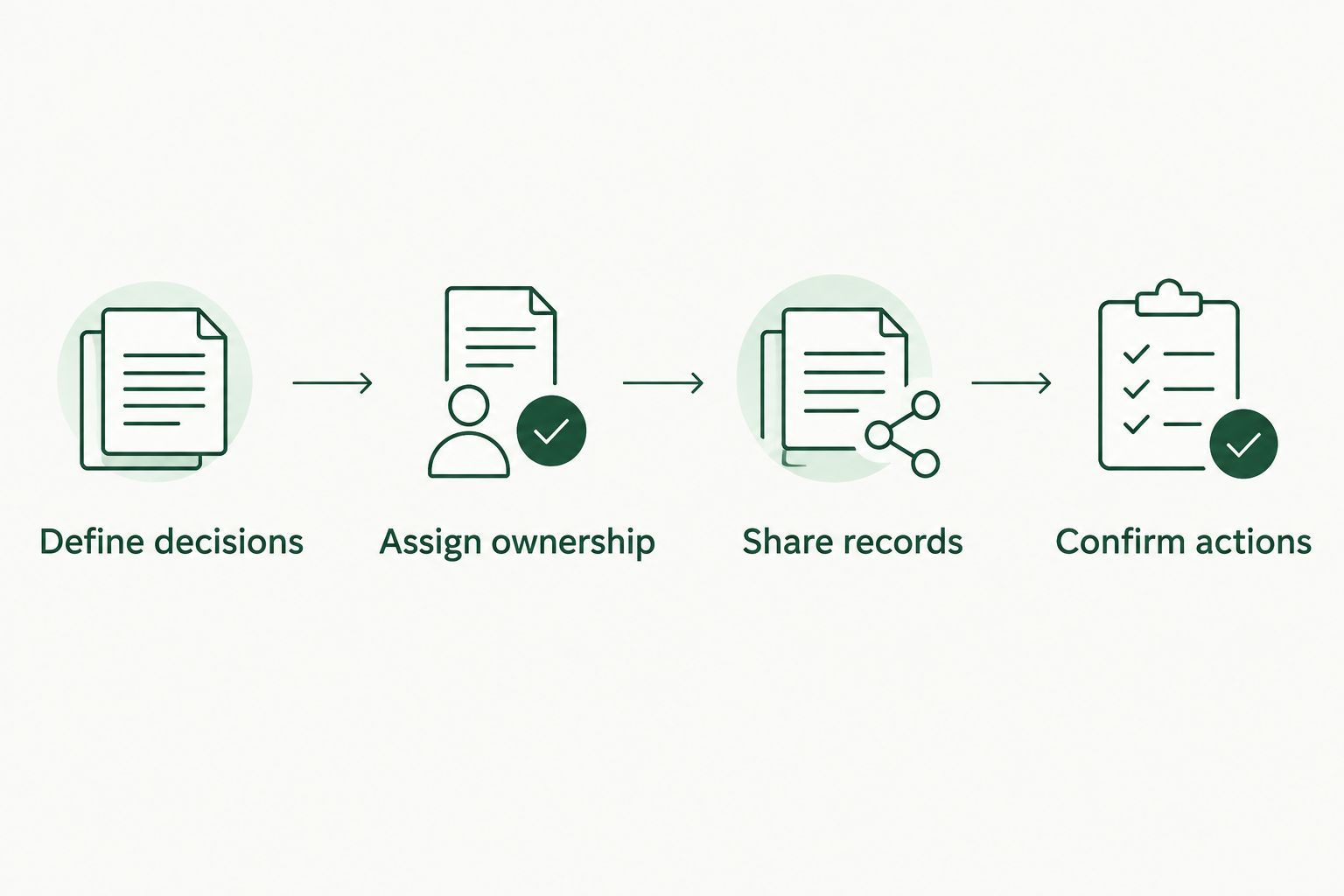
Use 4 steps to turn parallel advice into a coordinated decision. The sequence starts with your question, not with a request to exchange every document you own.
- Define decisions. Write down the decisions you need to make in 2026. Separate immediate obligations from longer-term questions, such as building wealth outside the company or preparing for succession.
- Assign ownership. Identify who provides the tax answer, who updates the financial plan, and who implements the action. Leave no task assigned vaguely to both.
- Share records. Authorize the relevant exchange of returns, financial statements, account information, and planning assumptions. Use a secure method agreed with the professionals; do not share account passwords.
- Confirm actions. Record the recommendation, the responsible person, and the condition that would require another review. Check completion instead of assuming a meeting produced implementation.
This process gives each professional a defined job. It also lets you see whether the second engagement fills a real gap or repeats work already covered by the first.
Put one real decision through the process
Suppose you are considering moving business cash into personal investments. The financial advisor evaluates the proposed investment against your liquidity needs and financial plan. The CPA evaluates the relevant tax treatment and obligations within the tax engagement.
Neither answer replaces the other. A suitable investment does not establish that the transfer is tax-appropriate, and a tax-appropriate transfer does not establish that you can spare the cash. Require both checks before authorizing the action.
What should you ask before hiring both?
Ask 5 questions before adding a second professional. The answers should describe work you can recognize, not an abstract promise of better coordination.
- What decision will this engagement help me make? Name the unresolved issue: treasury, household planning, investment management, retirement, or succession.
- What will I receive? Ask for the deliverables, including who prepares them and what implementation is included.
- What does my existing engagement already cover? Compare the scopes side by side before adding overlapping work.
- How will you work with my other professional? Ask how records are exchanged, disagreements are resolved, and decisions are documented.
- What remains outside your role? Identify any need for transaction counsel, valuation expertise, lending, or another specialist.
Use these questions when reviewing a new relationship or renewing one in 2026. If the answers stay vague, narrow the assignment before committing. A defined planning project can be a more appropriate starting point than an ongoing relationship without a clear purpose.
Where does Vital Investment Management fit?
Vital Investment Management is best for Northern Colorado business owners seeking fee-only financial planning alongside their CPA's tax work. The Loveland-based firm is an SEC-registered RIA offering treasury management, investment management, financial planning, and business transition/succession planning.
Dillon Goodman, CPA, CFP®, leads the business-owner practice. Vital Investment Management coordinates with legal, tax, and valuation professionals; it does not provide legal, tax, valuation, lending, or ESOP administration services and does not broker transactions.
That distinction is the benefit and the boundary. The firm can address the owner's financial plan, but the arrangement still requires the appropriate specialists for work outside its services. A confidential discovery call with Dillon is separate from using an educational guide or tool.
Can my CPA also be my financial advisor?
Your CPA can also serve as your financial advisor if that professional provides the relevant services under an appropriate engagement. Verify the scope rather than treating the CPA designation as proof of investment or financial planning services. Ask how tax and advisory responsibilities are separated and documented.
Do I need both if I am selling my business?
A business sale creates connected tax, income-replacement, and investment decisions, so separate tax and financial planning responsibilities are useful. Transaction counsel and valuation expertise address different work again. Start coordinating before you commit to terms that determine the timing or form of your proceeds.
Does coordination guarantee that I will pay less tax?
Coordination does not guarantee lower taxes or better investment results. Its purpose is to evaluate decisions with consistent information and clear responsibility. Judge the relationship by the work delivered and decisions addressed, not by a promised outcome.
FAQ
Is it worth hiring both a CPA and a financial advisor?
Yes, when your tax decisions overlap with cash flow, investments, retirement, or business succession. Hire each for a distinct scope and require coordination rather than duplicate reviews.
What's the difference between a CPA and a financial advisor?
A tax-focused CPA addresses tax work within the engagement; a financial advisor addresses agreed planning or investment work. Credentials alone do not define every service, so confirm the written scope.
Can my CPA handle my investments too?
Your CPA can handle investments only if that professional offers the relevant advisory services under an appropriate engagement. Tax preparation by itself does not include investment management.
Should my financial advisor talk directly to my CPA?
Yes, when a decision requires both tax and financial planning input and you authorize the information exchange. Agree on relevant records, secure sharing, and who owns the next action.
Do I need both professionals if my business cash flow is uneven?
Uneven cash flow is a reason to examine both tax obligations and liquidity needs, not an automatic requirement to hire two firms. Check whether your existing engagements cover both assignments.
Does a financial advisor replace a tax preparer?
A financial advisor does not replace a tax preparer unless tax preparation is expressly included in the services provided. Confirm who prepares returns and who verifies tax assumptions used in your plan.
Does Vital Investment Management provide tax preparation?
Vital Investment Management does not provide tax services. The fee-only, SEC-registered advisory firm coordinates financial planning with outside tax, legal, and valuation professionals.
One last thing
For your next 2026 review, bring a decision list rather than just a stack of statements. Write down what you need to decide, what information is missing, and who must answer it. Two professionals earn their place when each resolves a different part of the same decision.