

Best overall: coordinating your continuity plan through a fee-only financial advisor. Best free option: Ready.gov's Business Continuity Planning Suite. Best for replacing lost income during a shutdown: business interruption insurance.
- Best overall business continuity planning tool for small business owners in 2026: a fee-only financial advisor who coordinates cash reserves, insurance and succession into one plan.
- Ready.gov's Business Continuity Planning Suite is free and gets a written plan on paper without hiring anyone.
- Business interruption insurance replaces lost income while the business is closed — a written plan alone does not.
- Cash reserve and treasury management decides whether the business survives the disruption itself, not just the paperwork around it.
- Succession planning is the continuity gap most owners skip until the owner is the interruption.
Why this matters
A fire, a lawsuit, a supplier collapse, or the owner's own sudden illness — any of these can shut a small business down for weeks. Most owners in Loveland, Fort Collins and Berthoud have a fire extinguisher and a data backup. Fewer have answered the harder question: if the business stops generating revenue for 60 days, where does payroll come from, and who runs it if you can't?
Business continuity planning tools for small business owners fall into two buckets: things that get a plan written down, and things that make the plan survivable financially. Vital Investment Management works the second bucket — treasury, cash flow, and succession — as part of ongoing financial planning for business owners, not as a one-time software purchase.
Each tool below solves a different piece of that puzzle. None of them alone is a complete continuity plan in 2026, and any owner who tells you otherwise is selling something.
What makes the best business continuity planning tool
- Gets a written plan on paper without a six-figure consulting engagement
- Covers the financial gap, not just the operational checklist
- Works for a 5-person shop as well as a 50-person company
- Ties into taxes, cash flow, and ownership structure rather than sitting in isolation
- Doesn't require replacing your existing bookkeeping or advisor relationship
- Gets revisited at least once a year, not written once and filed away
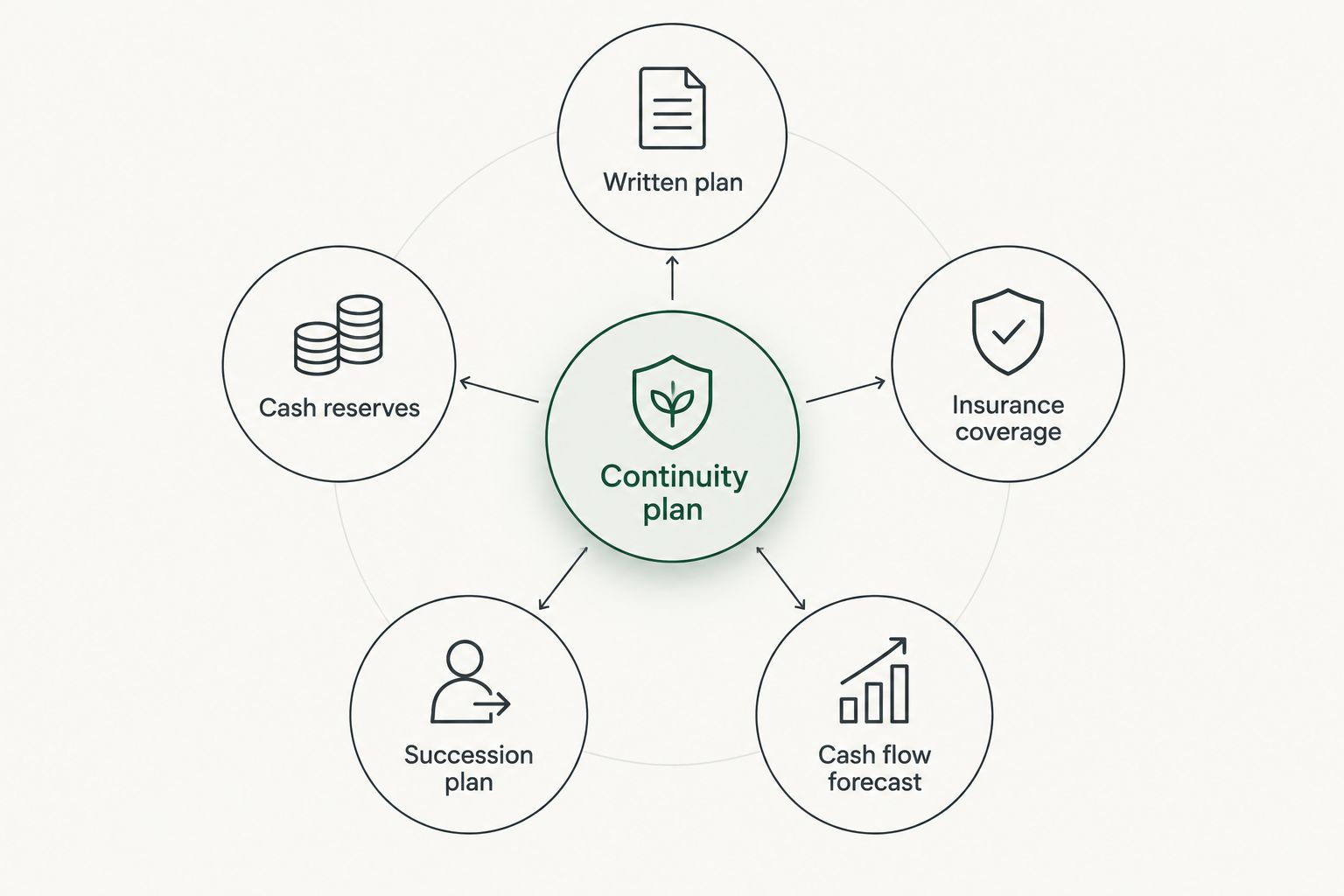
Business continuity planning tools at a glance
| Tool | Best for | Standout feature | Key limitation |
|---|---|---|---|
| Fee-only financial advisor coordination | Tying the whole plan together | Coordinates insurance, cash, and succession under one review | Requires an ongoing relationship, not a one-time fix |
| Ready.gov Business Continuity Planning Suite | A free first written plan | No cost, federal template structure | Generic — doesn't account for your specific cash position |
| Cash reserve and treasury management | Staying solvent during the disruption | Keeps operating cash separate from growth cash | Takes months to build if you're starting from zero |
| Business interruption insurance | Replacing lost income | Pays out while doors are closed | Doesn't fix a plan that was never written |
| Succession and transition planning | Continuity when the owner is the disruption | Names who runs the business if you can't | Owners routinely postpone starting this |
| Cash flow forecasting | Spotting a crunch before it happens | Flags a shortfall weeks in advance | Only useful if someone reviews it regularly |
1. Fee-only financial advisor coordination: best business continuity planning tool for tying the whole plan together
A written continuity plan and a stack of insurance policies don't help if nobody has looked at how they interact with your cash position, your taxes, and your ownership structure. A fee-only, SEC-registered advisor reviews the financial side of continuity planning alongside broader financial planning — treasury, investment management, and business transition and succession planning — so the pieces below don't sit in separate silos.
Fee-only advisor coordination pros:
- Reviews cash reserves, insurance gaps, and succession together instead of one at a time
- Fiduciary standard means recommendations aren't tied to a commission on a specific policy or product
- Revisited annually as the business grows, rather than written once in 2026 and forgotten
Fee-only advisor coordination cons:
- Doesn't replace a licensed insurance broker or transaction attorney — it coordinates with them
- Ongoing relationship, not a single deliverable you buy once
- Best value shows up over several years, not in the first quarter
Best for: owners who already have pieces of a plan (insurance, some cash reserve, a rough succession idea) and need them reviewed together.
Verdict: Buy.
2. Ready.gov Business Continuity Planning Suite: best free continuity planning tool for a first written plan
The U.S. Department of Homeland Security's Ready.gov program publishes a free Business Continuity Planning Suite built around downloadable templates: risk assessment, business impact analysis, and a plan document structure. It's the standard starting point cited across small business continuity guidance, and it costs nothing to use.
Ready.gov suite pros:
- Free, federal-government-maintained template structure
- Forces you to list critical functions, suppliers, and recovery time objectives
- Works as a shared document your team can actually reference during a disruption
Ready.gov suite cons:
- Generic — it doesn't know your cash position or your insurance coverage
- Requires someone to sit down and fill it out; nobody does it for you
- Says nothing about succession if the owner is the one who's unavailable
Best for: any small business without a written continuity plan yet in 2026.
Verdict: Buy.
3. Cash reserve and treasury management: best continuity tool for staying solvent during the disruption
A written plan tells you what to do. Cash reserves determine whether you can afford to do it. Treasury management for small businesses means separating operating cash from growth cash and setting a reserve target based on your actual fixed costs — payroll, rent, debt service — rather than a round number pulled from a blog post.
Cash reserve and treasury management pros:
- Directly funds payroll and fixed costs during a shutdown, no claim or approval needed
- Builds discipline into how surplus cash gets allocated month to month
- Sits under your control, not an insurer's claims process
Cash reserve and treasury management cons:
- Takes months, sometimes a couple of years, to build from scratch
- Cash sitting idle has an opportunity cost against reinvestment or debt paydown
- Doesn't help if the disruption is the owner's own health, not the business's cash
Best for: owners with lumpy, seasonal, or unpredictable revenue who need a self-funded buffer.
Verdict: Buy.
4. Business interruption insurance: best continuity tool for replacing lost income
Business interruption coverage, usually added to a commercial property policy, replaces lost income and covers certain fixed expenses while a covered event keeps the business closed. It's a standard line item most commercial insurance brokers can quote alongside general liability and property coverage.
Business interruption insurance pros:
- Pays out based on lost income, not just physical damage to the building
- Can cover extra expenses incurred to keep operating from a temporary location
- Widely available through most commercial insurance brokers
Business interruption insurance cons:
- Only triggers for covered perils — check the policy language before assuming it applies
- Doesn't cover a slow-motion problem like a key supplier quietly going under
- A policy alone doesn't tell your team what to actually do on day one
Best for: businesses with a physical location where a covered event (fire, storm damage) could force a closure.
Verdict: Buy.
5. Succession and transition planning: best continuity tool for when the owner is the disruption
The most commonly skipped piece of business continuity planning isn't a natural disaster — it's the owner. Death, disability, or a sudden decision to step back leaves the business without a plan for who runs it or who eventually owns it. Business succession planning services address exactly this gap: valuation, a named successor or buyer, and financing for the transition.
Succession and transition planning pros:
- Names who runs the business if the owner can't, in writing
- Coordinates with a CPA and transaction counsel on valuation and financing
- Protects the business's value for family, partners, or key employees
Succession and transition planning cons:
- Owners routinely postpone starting this — it can feel premature at 40
- Requires input from tax and legal professionals, not a DIY template alone
- Takes longer to put in place than most owners expect
Best for: owner-dependent businesses where one person's absence would stall operations.
Verdict: Hold — revisit yearly as the business and your own timeline change.
6. Cash flow forecasting: best continuity tool for spotting a crunch before it hits
A continuity plan written in 2026 is only as good as your visibility into cash. Cash flow forecasting projects incoming and outgoing cash weeks ahead, flagging a shortfall while there's still time to act — draw a credit line, delay a purchase, or adjust payroll timing.
Cash flow forecasting pros:
- Flags a shortfall before it becomes an emergency
- Works alongside a cash reserve target rather than replacing it
- Gives an owner a concrete number instead of a gut feeling about "how tight things are"
Cash flow forecasting cons:
- Only useful if someone actually reviews it on a regular schedule
- Forecasts are estimates — they don't account for a sudden, unpredictable event
- Requires reasonably current bookkeeping to be accurate
Best for: owners with seasonal revenue, 1099 workers, or accounts receivable that swings month to month.
Verdict: Buy.
“If your business closed for a month starting tomorrow, your continuity plan should already answer how payroll gets paid.”
How this list was ranked
Each tool was measured against the six criteria above: cost to get started, whether it covers the financial gap or just the operational checklist, scalability from a 5-person shop to a 50-person company, integration with taxes and ownership structure, and whether it's designed to be revisited annually rather than filed once. No tool scored well on all six — that's why the honest answer is a combination, not a single purchase.
Talk through your continuity gaps
A confidential discovery call with Dillon Goodman covers cash reserves, insurance gaps and succession.
Which business continuity planning tool should you choose?
Start with the free option: fill out the Ready.gov Business Continuity Planning Suite this quarter if nothing exists in writing yet. Then get a quote on business interruption insurance if you haven't reviewed coverage since before 2026. Build cash reserves against your actual fixed costs, not a guess. If you're the single point of failure in your own business, start the succession conversation now rather than at 60.
The undecided owner's move for 2026: get a fee-only advisor to review the pieces you already have — insurance, whatever cash reserve exists, any succession idea — before buying anything new. Coordination catches the gaps a checklist alone misses.
FAQ
What is the best business continuity planning tool for a small business in 2026?
There isn't one tool that covers everything. Ready.gov's free Business Continuity Planning Suite gets a written plan on paper, while a fee-only financial advisor coordinates the financial side — cash reserves, insurance, and succession — into one reviewed plan.
Is business interruption insurance the same as a business continuity plan?
No. Business interruption insurance replaces lost income during a covered shutdown, but it doesn't tell your team what to do on day one or name who runs the business if you're unavailable. You need both.
How much cash reserve does a small business need for continuity planning?
The reserve target depends on your fixed monthly costs — payroll, rent, and debt service — not a generic rule of thumb. Treasury management for small business owners builds that target from your actual numbers.
Does a financial advisor help with business continuity planning?
A fee-only financial advisor reviews the financial pieces of continuity planning — cash reserves, insurance gaps, and succession — alongside broader financial planning, coordinating with insurance brokers and attorneys rather than replacing them.
What happens to a small business if the owner becomes disabled or dies without a succession plan?
Without a named successor or buyer, the business typically stalls or loses value quickly while family, partners, or a CPA sort out ownership and operations. Succession and transition planning addresses this before it becomes an emergency.
Is Ready.gov's Business Continuity Planning Suite free?
Yes. It's a federal government resource with downloadable templates for risk assessment and plan documentation, at no cost.
How often should a business continuity plan be updated?
At least once a year, and after any major change — new location, new key employee, changed ownership structure, or a shift in cash position.
One last thing
Most continuity plans fail quietly, not dramatically — an owner writes the Ready.gov template once in 2026, files it, and never checks whether the cash reserve or insurance coverage still matches the business two years later. The plan itself isn't the hard part. Revisiting it is.