

Succession planning for veterinary practices in 2026 means deciding, on paper, who takes over the DVM license, the client relationships, and the debt on your equipment — and structuring the payout so you can actually retire on it. Veterinary practices carry a wrinkle most small businesses don't: the buyer needs a professional license you can't hand over, and a large share of revenue often follows the owner's own exam-room hours rather than the practice brand.
- Succession planning for veterinary practices starts with a written exit timeline three to five years before you want out.
- Corporate consolidators pay for future cash flow, not sentiment — get an independent valuation before you talk to one.
- An associate buyout keeps clients and staff in place but usually needs bank or seller financing since most new DVMs carry six-figure student debt.
- SBA 7(a) loans cap at $5 million, which covers most single-location veterinary practice sales.
- A fee-only fiduciary like Vital Investment Management coordinates the money side while your CPA and attorney handle tax and contract details.
Why succession planning matters for veterinary practices
A veterinary practice is a bundle of three separate things: a professional license, a client relationship, and a piece of equipment-heavy real property. Any buyer has to qualify for all three, and most small business buyers can only bring cash — not a DVM license.
National corporate groups have spent the past decade acquiring independent veterinary practices, which means owners now often have a real buyer even without a family member or associate ready to step in. That doesn't make the decision easier. A corporate sale usually means faster cash and less control over how the practice runs after you leave; an associate or family buyout usually means slower cash and more control.
Vital Investment Management works with Northern Colorado business owners, including medical and veterinary practice owners, on the financial planning side of a transition — modeling what a given deal structure does to your retirement income, not brokering the sale itself. Succession planning for veterinary practices is a financial-planning problem wrapped around a licensing problem, and the two have to be solved together.
How to build a succession plan for your veterinary practice
Set your exit timeline before you need one
Most owners start succession planning the year they decide to retire. That's too late to negotiate from strength — buyers and associates both pay more for a practice with an organized, unhurried transition.
- Pick a target exit year, even if it's five years out, and put it on your calendar
- Decide whether a family member has any interest in the practice — ask directly, don't assume
- Revisit the timeline every 12 months as your health, staff, and local competition change
- Tell your CPA and financial advisor the target year so tax and retirement planning line up with it
Get an independent valuation of your practice
A veterinary practice's value comes from its seller's discretionary earnings (SDE) if you're staying involved, or a normalized EBITDA figure if a corporate buyer is modeling it as one location in a larger group. Real estate, if you own the building, is valued separately from the practice itself.
- Hire an appraiser experienced with veterinary or medical practices, not a generic small-business valuator
- Separate the value of owned real estate from the value of the clinical operation
- List equipment by owned vs. financed, since a buyer inherits the remaining loan or lease balance
- Flag how much production is tied to your own exam-room hours versus associate doctors already on staff
Choose your successor path
There isn't one right buyer for a veterinary practice — the right path depends on whether you have a willing associate, a family member, or neither.
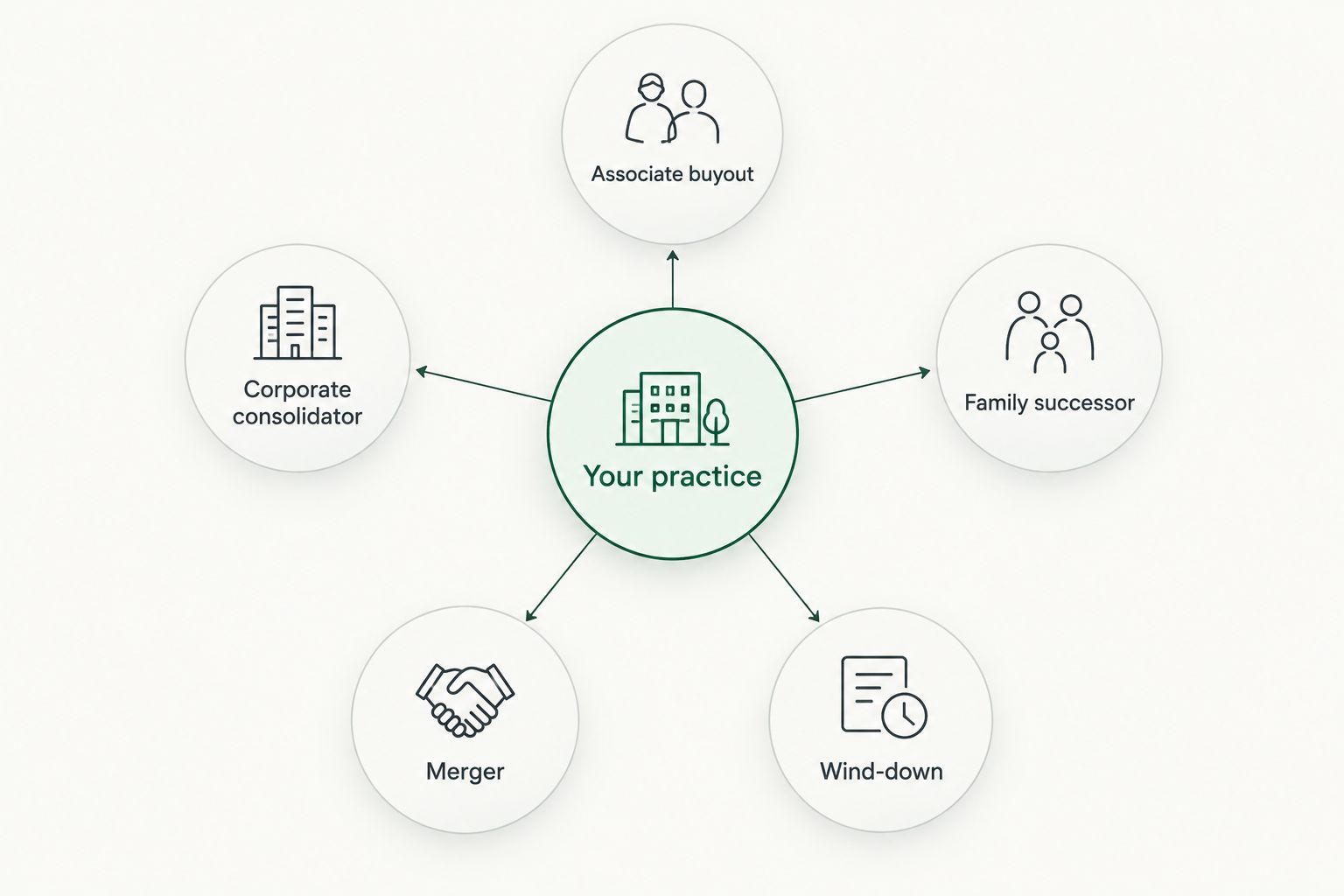
- An associate buyout keeps existing clients and staff in place but usually requires bank or seller financing
- A corporate consolidator sale moves faster and pays cash, often with an earn-out tied to staying on for a few years
- A family succession needs the same valuation rigor as any other sale, or siblings end up in a dispute over fairness
- A merger with a nearby practice can work if two owners are exiting on similar timelines
- Winding down and liquidating equipment is a real option if no buyer materializes, though it captures the least value
If a partner is involved in the exit, a financial advisor can model the buyout structure before either side signs anything.
Prepare the practice for buyer due diligence
Buyers — corporate or individual — will ask for the same documents, and having them ready before you list the practice shortens the process and protects your asking price.
- Three years of clean profit-and-loss statements and tax returns
- Current DEA registration and controlled-substance logs
- Staff contracts, compensation structure, and any non-compete agreements
- Equipment lease schedules and outstanding loan balances
- Practice management software records and how client data transfers to a new owner
Structure the financing
Most veterinary practice sales get financed one of three ways, and the structure you pick changes how fast you get paid and how much risk you carry after closing.
- An SBA 7(a) loan, which caps at $5 million and covers most single-location practice sales
- Seller financing, where you carry a note and get paid over several years with interest
- An earn-out tied to the practice's production after you leave, common in corporate deals
- A blended structure combining a bank loan, a seller note, and an earn-out
A fee-only fiduciary can run the numbers on how each structure affects your after-tax retirement income — that's separate from the legal and tax work your attorney and CPA handle on the contract itself.
Plan what happens to the money after closing
The sale proceeds have to replace the income the practice used to generate for you. That's a planning problem, not a one-time transaction.
- Build a withdrawal plan that replaces your salary, not just a lump-sum deposit
- Invest sale proceeds outside the practice so your retirement isn't tied to one buyer's success
- Coordinate with your CPA on whether an installment sale or lump-sum structure lowers your tax bill
- Hold back a cash reserve before committing proceeds to new investments
Succession options for veterinary practices compared
| Option | Best for | Key limitation |
|---|---|---|
| Corporate consolidator sale | Owners who want cash fast and don't mind less control after closing | Often includes an earn-out that ties part of your payout to staying on |
| Associate/employee buyout | Owners who want continuity for clients and staff | Associate financing is slower — most new DVMs carry significant student debt |
| Family succession | Owners with a family member already working in the practice | Needs the same independent valuation as any sale, or siblings can dispute fairness |
| Merger with another practice | Two owners exiting on a similar timeline | Requires compatible culture and overlapping service lines |
| Wind-down/liquidation | Owners with no buyer and a hard exit date | Captures the least value of any path |
A side-by-side comparison of business succession services walks through how these paths get priced and structured in more detail. A corporate consolidator sale is the fastest way to cash out, but an associate buyout usually keeps clients, staff, and culture intact — pick based on what you're optimizing for, not just speed.
Common mistakes veterinary practice owners make in succession planning
- Assuming any cash buyer can take over. A buyer needs an active DVM license and, in most states, specific credentialing — that narrows the buyer pool more than owners expect.
- Underestimating owner-dependent revenue. If a large share of production comes from your own exam-room hours, a buyer will discount the price to account for the drop-off after you leave.
- Ignoring staff retention until after the letter of intent. Key technicians and associates who leave during a transition take clients with them.
- Waiting until burnout forces a fast sale. A rushed exit almost always means a lower price and worse terms.
- Not separating real estate from the practice in the deal. Owned buildings need their own valuation and their own lease or sale terms, separate from the clinical business.
Talk through your exit numbers
A confidential discovery call with Dillon Goodman in Loveland, Colorado.
FAQ
What is succession planning for veterinary practices?
It's the process of deciding who takes over your DVM license, client relationships, and equipment debt, and how you get paid for the practice you built. It covers valuation, buyer selection, financing, and what happens to the proceeds after closing.
How much does a veterinary practice sell for in 2026?
There's no fixed price — value depends on your seller's discretionary earnings, whether you own the real estate, equipment condition, and how much revenue is tied to your own hours. An independent valuation is the only reliable way to set an asking price.
Can an associate buy my veterinary practice without much cash?
Yes, most associate buyouts are financed through a bank loan, seller financing, or a combination of both rather than the associate's own cash. Many new DVMs carry significant student debt, which is why seller financing is common in these deals.
Is selling to a corporate consolidator better than an associate buyout?
Neither is universally better — a corporate sale usually moves faster and pays cash, often with an earn-out, while an associate buyout keeps clients and staff in place but takes longer to finance. The right choice depends on whether you value speed or continuity more.
What is the SBA 7(a) loan limit for buying a veterinary practice?
The SBA 7(a) program caps loans at $5 million, which covers most single-location veterinary practice sales in 2026. Larger multi-location sales typically need additional financing layered on top.
Do I need a lawyer and a CPA for a veterinary practice sale?
Yes, both are necessary — a transaction attorney handles the purchase agreement and licensing transfer, and a CPA structures the sale for tax purposes. A financial advisor is a third, separate role focused on what the proceeds do for your retirement.
How early should I start succession planning for my veterinary practice?
Three to five years before your target exit date, even if you're not certain of the exact year. That gives enough time to get a valuation, prepare financials, and identify a buyer without rushing into a discounted sale.
Does Vital Investment Management broker the sale of a veterinary practice?
No, Vital Investment Management is a fee-only, SEC-registered advisory firm that models the financial planning side of a transition — it does not broker transactions or provide legal, tax, or valuation services. Those roles sit with your attorney, CPA, and a practice appraiser.
One last thing
Get the independent valuation before you get an offer, not after. Owners who wait until a corporate consolidator or an associate makes the first move are negotiating against a number they didn't set — and in 2026, with consolidators actively pricing practices on future cash flow, that's the number that decides your retirement.