

Yes. Treasury management reduces fraud risk when you combine bank controls with independent payment verification, separate approvals, and transaction review. It does not eliminate fraud or guarantee recovery: a payment sent to a criminal can still pass your bank’s security checks if an authorized employee approves it.
- Treasury management fraud risk small business checklist: verify payees, separate approvals, restrict access, and review transactions.
- Bank controls support fraud prevention; they do not replace independent checks on payment instructions.
- VIMSmallBusiness fits Northern Colorado owners seeking treasury management within broader financial planning.
- Confirm suspicious payment changes through a trusted phone number, not the contact details in the request.
Can treasury management reduce fraud risk in my business?
Yes—provided the controls address how money actually leaves your business. A login safeguard protects account access. A separate approval protects payment release. Neither establishes that a supplier’s new bank details are genuine.
Your 2026 review should distinguish prevention from detection. Prevention interrupts a suspicious payment before release; detection identifies activity that needs investigation afterward. The broader treasury management for small businesses guide explains how cash oversight fits alongside your operating needs.
| Control | Best for | What it helps prevent or detect | Limitation |
|---|---|---|---|
| Independent callback | Changed supplier or payroll instructions | Payment diversion through impersonation | Fails if you call the number supplied by the impersonator |
| Separate approval | Payments prepared by staff | One person creating and releasing an unauthorized payment | A second person can still approve without checking |
| Check positive pay | Businesses issuing checks | Differences between issued-check records and presented checks | Matching fields and exception handling depend on the bank |
| ACH blocks or filters | Accounts receiving electronic debits | Unapproved debit attempts | Incorrect settings can interrupt legitimate payments |
| Transaction alerts | Monitoring outgoing activity | Payments or account changes requiring attention | An alert does not necessarily stop a payment |
| Account reconciliation | Reviewing completed activity | Unexplained withdrawals and recording differences | Detection happens after activity occurs |
Why this matters
Cash is lumpy. Payroll, supplier payments, taxes, and owner distributions compete for attention, and an unusual request can arrive during an ordinary busy afternoon. A treasury process gives you a defined response instead of an improvised decision.
The weak point is not always unauthorized access. Sometimes it is an authorized payment based on false instructions. That is why buying another banking feature does not resolve every fraud exposure.
For a Loveland, Fort Collins, or Berthoud business, the practical question is the same: who checks the request, who releases the money, and who notices a discrepancy? Your process needs an answer even when you are away.
Start with a payment-control walkthrough
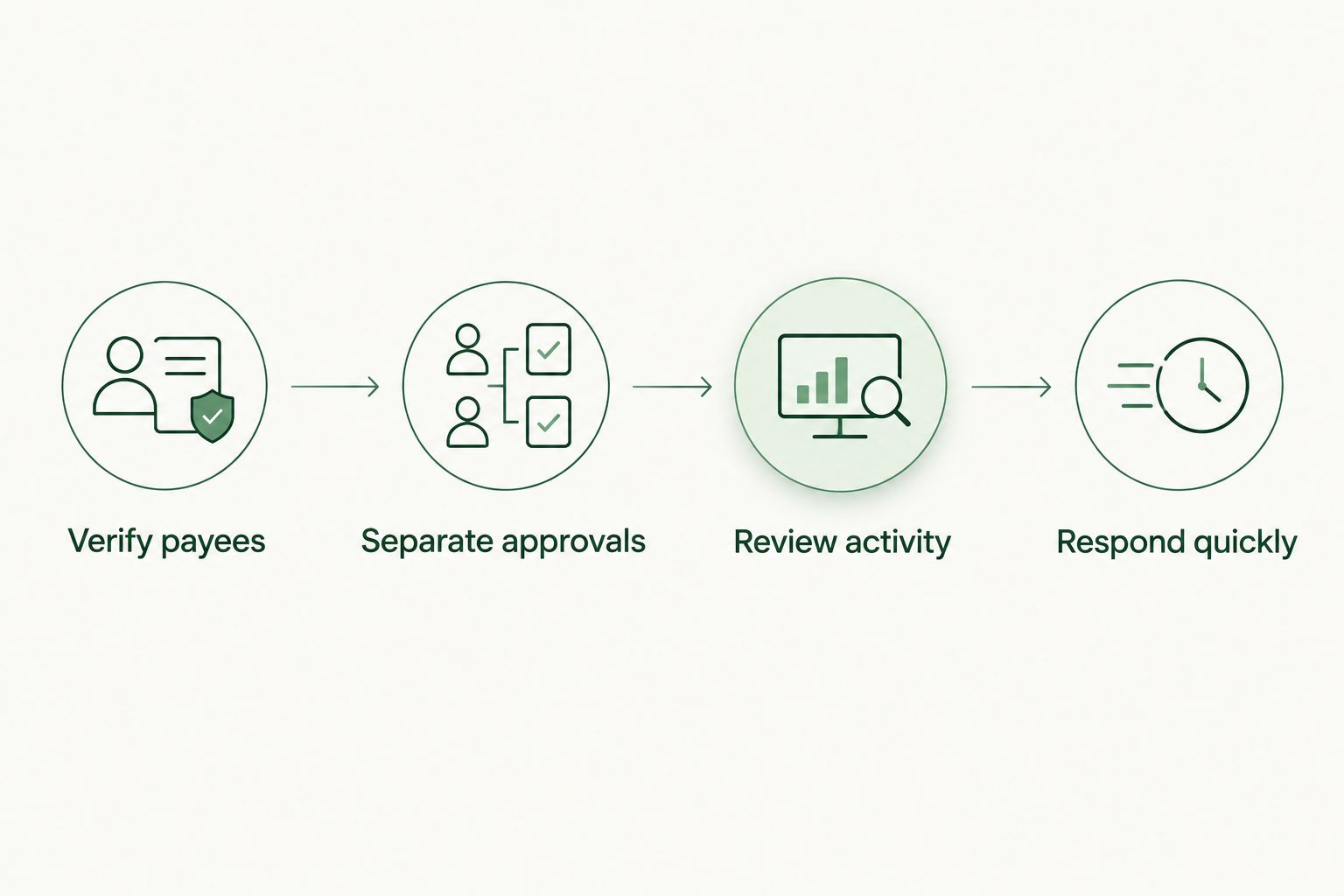
Use these 4 steps to review your payment process in 2026. Follow an actual payment from the request through the bank statement; a written policy alone does not show whether staff follow it.
1. Verify payees
Require independent verification before changing a supplier’s banking instructions or an employee’s payroll destination. Use a phone number already held in your records, rather than one included in the change request. Record who confirmed the change and how.
An email reply is not independent verification when the email account itself is compromised. A familiar name, invoice format, or ongoing message thread does not establish that the request is genuine.
Keep the banking change separate from the payment decision. Staff should confirm the destination before treating an invoice as ready to pay. Apply the same rule to an urgent request that appears to come from you.
2. Separate approvals
Where staffing allows, use 2 different people: one prepares the payment and another approves its release. The approver should inspect the supporting invoice, payee details, and any recent changes—not simply acknowledge an alert.
Ask your bank whether its permissions enforce this separation. A policy requiring approval is weaker when the same login can create a payee, change bank details, and send the payment without another person’s involvement.
For a solo owner, a true second-person approval requires outside involvement. Compensate with independent callbacks, restricted payment permissions, and transaction review, while recognizing that these measures do not create independent approval.
3. Review activity
Assign someone to review outgoing transactions each business day as an operating practice. Reconcile accounts against accounting records, and investigate unfamiliar payees, unexpected debits, and unexplained changes.
Send alerts to a person who will act on them. An alert delivered to an unattended inbox provides little practical oversight. Establish a backup reviewer for holidays, illness, and travel.
Review permissions as well as payments. Remove access when someone leaves or changes responsibilities, and check whether former bookkeepers, contractors, or employees still have authority they no longer need.
4. Respond quickly
Write down the bank’s fraud-reporting contact and escalation process before an incident. Keep the details somewhere accessible without relying solely on the email account or device involved in a suspected compromise.
If you identify a suspicious payment, contact the bank immediately through a trusted channel and request its fraud-response process. Preserve payment references, messages, and account-change records. Do not assume that a recall request guarantees recovery.
For your 2026 procedure, name both the primary decision-maker and a backup. A response plan that depends entirely on reaching you has the same absence problem as an approval process that depends entirely on you.
Check positive pay: best for businesses issuing checks
Check positive pay generally compares checks presented for payment with an issue file your business provides. Depending on the service, mismatches become exceptions for review. Ask which fields the bank checks, including whether payee-name matching is included.
The benefit is a defined check against your issued-payment records. The limitation is operational: someone must submit accurate information and resolve exceptions within the bank’s stated process.
Ask what happens when nobody responds to an exception. Do not assume the bank’s default matches your preference. Document who reviews exceptions and who covers that responsibility during an absence.
ACH blocks and filters: best for controlling incoming debits
An ACH debit pulls money from your account through the Automated Clearing House network. A block restricts debits; a filter allows debits that meet the bank’s configured criteria. Ask your bank which arrangement fits each account.
These controls help restrict electronic withdrawals, but they require careful setup. Payroll services, tax payments, and legitimate vendors can depend on authorized debits, so confirm those relationships before changing settings.
An ACH debit control is not a general payment-fraud shield. It does not independently verify an outgoing wire or establish that a new supplier is legitimate. Match each control to the payment channel it governs.
Why fraud exposure varies between businesses
Your 2026 treasury review should reflect how your business operates, rather than copy another owner’s settings. These factors determine where checks are needed:
- Payment channels: Checks, ACH transactions, wires, and cards have different controls and handling procedures. Map each channel separately.
- Access concentration: A person who can change payees, release payments, and reconcile the account has authority across the entire process.
- Bank-detail changes: Supplier and payroll changes create verification work. Treat those changes as a distinct task, not routine invoice administration.
- Review coverage: Alerts and exceptions need an assigned reviewer and backup. Unclear responsibility leaves suspicious activity unresolved.
- Account purpose: An account used for frequent operating payments needs different permissions from an account holding reserves. Additional accounts also add reconciliation work.
- Owner dependence: If every exception requires your involvement, travel and absence can encourage workarounds. Define who can act without bypassing checks.
Can a small business use these controls without a finance team?
Yes—a small business can assign clear payment responsibilities without building a finance department. Start by listing everyone with banking access and the actions each person can perform. Compare that list with what their job requires.
Your initial checklist can stay short:
- Record every business account and authorized user.
- Identify who can add payees, release payments, and change permissions.
- Confirm how supplier and payroll changes are verified.
- Assign transaction review and backup coverage.
- Record the bank’s exception and incident procedures.
Use individual credentials rather than shared logins. Enable the bank’s available authentication safeguards, and confirm that an approver uses a separate authorized identity.
If you work with an outside bookkeeper, define the boundary between preparing payments and approving them. Giving someone access to accounting records does not mean they need unrestricted authority to move your money.
Does moving reserves into another account prevent fraud?
No—moving reserves into another account does not prevent fraud by itself. Account separation can support different permissions and payment purposes, but the protection depends on the access and transfer controls you establish.
An account intended for reserves offers limited separation if the same compromised credentials can move its balance into an unrestricted payment account. Review the route money takes between accounts, not just the number of accounts you maintain.
Keep cash flow in view. A restriction that blocks legitimate payroll funding creates an operational problem, so test authorized funding procedures before relying on a new arrangement. Treasury controls should support your payment schedule without removing meaningful checks.
Where a financial advisor fits—and where the bank fits
VIMSmallBusiness is best for Northern Colorado owners seeking treasury management within broader financial planning. The firm offers treasury management, investment management, financial planning, and transition/succession planning. It is a fee-only fiduciary and SEC-registered RIA.
That planning role is distinct from operating your bank’s fraud controls. Your bank explains its permissions, available payment services, exception procedures, and reporting requirements. Your internal team remains responsible for following the approval and verification process you establish.
VIMSmallBusiness treasury management belongs in the conversation about operating cash, reserves, and owner needs—not as a promise to prevent fraudulent transactions. Review the firm’s services if those planning decisions need attention. This article is educational, not personalized financial, tax, or legal advice.
FAQ
Can treasury management stop all fraud in my small business?
No. Treasury management reduces exposure through payment controls, verification, and review, but it does not eliminate fraud or guarantee recovery. An authorized payment can still go to a criminal if the underlying instructions are false.
What's the first fraud control I should put in place?
Start by independently verifying changes to payment instructions before sending money. Call a trusted number already in your records, not a number supplied in the change request.
Is check positive pay better than reviewing my bank statement?
Check positive pay and statement review serve different purposes. Positive pay checks presented items against issued-check information, while reconciliation helps identify discrepancies in completed account activity; neither replaces the other.
Can I use separate approvals if I'm the only employee?
Independent approval requires another authorized person. If you operate alone, use independent payee verification, restricted permissions, and transaction review, while recognizing that these do not provide a second person's approval.
Will my bank reimburse a fraudulent business payment?
Do not assume your bank will reimburse a fraudulent business payment. Ask the bank how your account agreement, payment method, security procedures, and reporting requirements apply; contact it immediately if you suspect fraud.
Does keeping business cash insured protect me from payment fraud?
Deposit insurance is not payment-fraud protection. Insurance against an insured bank's failure is different from the controls and contractual rules governing an unauthorized or fraudulently induced payment.
Can a financial advisor turn on my bank's fraud controls?
Do not assume a financial advisory engagement includes configuring bank fraud controls. Confirm responsibilities with both the advisor and your bank, including who sets permissions, approves payments, and reviews exceptions.
One last thing
Test an urgent request that appears to come from you. Ask your team what they would do if you emailed new bank details and told them to bypass the usual process. The answer should be independent verification, not an exception based on your name.
Make that walkthrough part of your 2026 review. VIMSmallBusiness treasury management planning and your bank’s controls have different roles; neither removes the need for a payment process your team follows when you are unavailable.