

Yes—the risk of keeping business cash in one bank account is both uninsured deposits and losing access to the money you need to operate. In 2026, standard FDIC coverage is $250,000 per depositor, per insured bank, per ownership category; opening more accounts at the same bank does not automatically increase it. Even fully insured cash needs a backup payment plan because deposit insurance does not prevent an outage, account restriction, or compromised login.
- The risk of keeping business cash in one bank account includes uninsured deposits and interrupted access to payroll money.
- FDIC coverage generally totals $250,000 per depositor, per insured bank, per ownership category—not per account.
- A separate bank can reduce institutional concentration, but only a funded, tested backup supports payment continuity.
- Separate operating cash, tax obligations, and reserves before choosing accounts or treasury management arrangements.
Is it risky to keep all my business cash in one bank account?
Yes, when one account becomes your only source of payment access or holds deposits beyond applicable insurance coverage. The account count alone does not tell you whether your cash arrangement is sound. You need to examine the bank, account ownership, balance, and payment process together.
Start with the distinctions below, then use the treasury management for small businesses guide to connect those decisions to cash flow.
| Cash arrangement | Best for | Main benefit | Main limitation |
|---|---|---|---|
| One operating account at one bank | Simple payment administration | Fewer accounts to reconcile | All payment access depends on one banking relationship |
| Separate operating and reserve accounts at the same bank | Organizing cash by purpose | Clearer separation of spending money and reserves | Does not automatically add deposit insurance or institutional independence |
| Accounts at separately insured banks | Reducing bank concentration | Separate banking relationships and potential additional coverage | Requires reconciliation, funding rules, and tested payment access |
| A bank deposit placement program | Distributing deposits through one administrative relationship | Places deposits at multiple participating banks under program terms | Requires verification of destination banks, ownership records, and overlapping deposits |
None of these arrangements removes every risk. A second bank helps with institutional concentration, but it does not correct weak payment approvals or a cash forecast that ignores upcoming taxes.
Why this matters: insured money and usable money are different
Cash is lumpy. Customer payments arrive unevenly, while payroll, rent, vendors, and tax obligations follow their own schedules.
A balance can be insured without being accessible through your normal payment channel at a particular moment. Conversely, a working account can contain deposits above the applicable insurance limit. Treat deposit protection and payment continuity as separate decisions.
Your 2026 treasury review should answer two questions: what happens if the bank fails, and what happens if you cannot use the account? An answer to only one leaves the other unresolved.
How does FDIC coverage apply to business cash?
The FDIC's standard deposit insurance rule is $250,000 per depositor, per insured bank, per ownership category. That is a coverage limit, not a limit for each checking or savings account.
For a corporation, partnership, or qualifying unincorporated association engaged in an independent activity, deposits in that entity's ownership category at the same insured bank are generally combined. Different account purposes do not create separate coverage.
Separate accounts are not necessarily separate coverage
Labeling accounts payroll, taxes, and reserves helps you organize cash. It does not make each account separately insured when the same depositor holds them in the same ownership category at the same bank.
Different branches of the same insured bank also do not create separate bank coverage. Check the legal insured institution, not just the branch address, banking app, or trade name.
A sole proprietor needs a different ownership check
A sole proprietorship is not separately insured from its owner simply because the account uses a business name. Sole-proprietorship deposits generally combine with the owner's other single-ownership deposits at the same insured bank.
That makes legal ownership important. Do not assume a business account title establishes a separate insurance category; confirm how the account is classified.
Deposit insurance does not cover every cash-like product
A bank money market deposit account and a money market mutual fund are different products. Eligible bank deposits receive FDIC insurance within applicable limits; mutual funds do not receive FDIC deposit insurance.
Before moving reserves, ask whether the destination is a deposit or an investment. Then examine access terms and risks rather than relying on the word cash in a product description.
These distinctions follow the FDIC's published deposit insurance guidance for business and single accounts. For a 2026 review, confirm your actual ownership category and institution through the FDIC's official resources and your bank's account records.
Why the risk varies between businesses
The same account structure does not fit every owner. Assess these six factors before changing banks or moving reserves:
- Peak deposits: Review balances after large customer payments, not just the balance on a quiet day. Insurance exposure depends on deposits actually held.
- Legal ownership: A sole proprietorship and a separately organized business do not necessarily receive the same insurance treatment.
- Payment concentration: Identify whether payroll, vendor payments, customer collections, and tax payments all depend on one account.
- Timing requirements: Match access arrangements to payment deadlines. Money outside the operating account is not automatically ready to fund payroll.
- Access controls: Review who can add recipients, approve transfers, recover credentials, and change contact information.
- Backup readiness: A second account is useful only when authorized people can access it and the business can use its payment services.
Choose the structure around your obligations, not around an arbitrary number of accounts. More accounts create more administrative work; fewer accounts concentrate dependencies.
How do you reduce concentration without creating a bookkeeping mess?
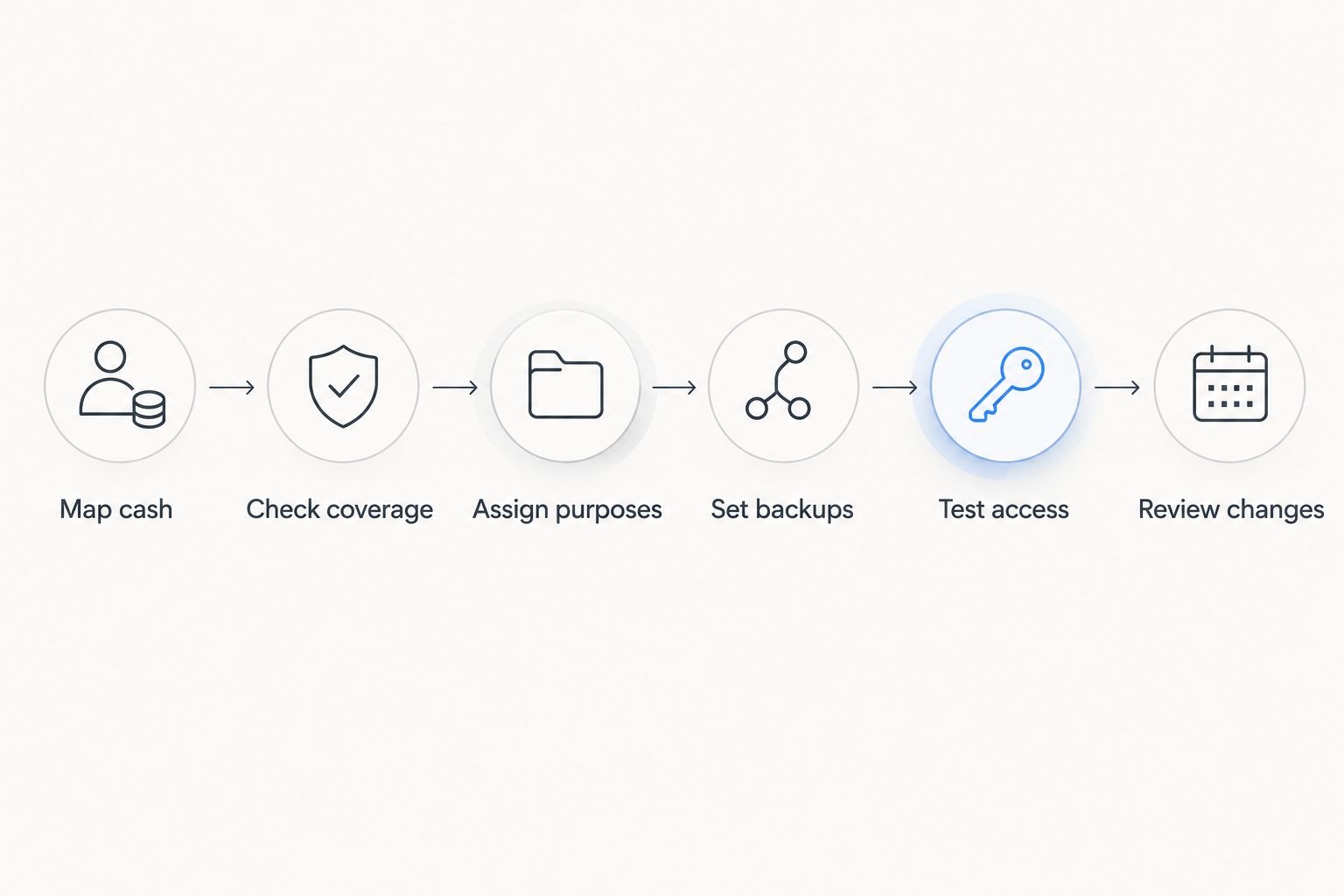
Use this six-step review to turn a general concern into a written cash procedure. Start with records you already have: bank statements, the cash forecast, payroll dates, and upcoming tax obligations.
1. Map cash
List every business deposit account, its legal owner, insured institution, purpose, and authorized users. Include deposits placed through an intermediary or placement program.
Identify accounts that ultimately sit at the same bank. Separate interfaces do not establish separate institutions.
2. Check coverage
Group deposits by depositor, insured bank, and ownership category. Compare the grouped balance with the applicable FDIC coverage, including accrued interest within that limit.
For deposit placement arrangements, request destination-bank information. Existing deposits at a receiving bank matter when evaluating total coverage there.
3. Assign purposes
Separate money needed for operations from money reserved for taxes, planned purchases, and other obligations. Use your forecast rather than treating the entire balance as available to spend.
A separate tax account supports organization; it does not determine your tax liability or replace your CPA's calculation. Record the obligation as well as where its funding sits.
4. Set backups
Decide which payments must continue if the primary account is unavailable. Confirm the backup institution supports those payment methods and that the right people have authority.
Do not assume your payroll provider can switch funding accounts immediately. Check its verification requirements, processing deadlines, and instructions before relying on the backup.
5. Test access
Verify that authorized staff can sign in, retrieve account information, and follow the approved payment process. Test an appropriate payment workflow under your normal approval controls.
Document what worked and what requires correction. An unused login is not evidence that the business can make its critical payments.
6. Review changes
Revisit the arrangement when cash balances, legal ownership, banking relationships, or payment obligations change. Set a recurring review date in your 2026 cash procedures, with a named person responsible.
Keep the instructions short enough to use. The document should explain where cash belongs, who approves movement, and what triggers action.
Should you open accounts at two different banks?
Two separately insured banks can reduce dependence on a single institution, but two accounts alone do not establish a working backup. Ownership-category rules still apply, and each account needs a defined role.
The benefit is a separate banking relationship. The trade-off is additional reconciliation, access administration, and coordination with payroll or other payment providers.
Keep the backup funded according to your payment plan. If all cash remains at the primary bank, transferring money after access is interrupted is not a dependable contingency.
Also check independence beyond the bank name. If the same compromised email account can reset access at both banks, the second institution does not solve that credential problem.
Is my business cash safe if it stays below $250,000?
$250,000 is the standard FDIC limit for each depositor at each insured bank within an ownership category, not a promise of uninterrupted access. Your other deposits in the same category at that bank count toward the total.
Insurance addresses covered deposits when an insured bank fails. It does not serve as general reimbursement for fraudulent payments, bookkeeping mistakes, or money sent to the wrong recipient.
Keep payment controls alongside coverage checks. Separate recipient setup from approval where practical, verify changed payment instructions through a trusted channel, and review access when staff responsibilities change.
Can a financial advisor help with business cash concentration?
A financial advisor can help connect your cash forecast, reserve purposes, and investment decisions. Your bank confirms account services and terms; your CPA addresses tax calculations and filing obligations.
VIMSmallBusiness is best suited to Northern Colorado business owners seeking fee-only treasury management and financial planning together. VIMSmallBusiness is a fee-only fiduciary and SEC-registered advisory firm serving owners in Loveland, Fort Collins, Berthoud, and the wider region.
The value of VIMSmallBusiness treasury management is its connection to the owner's wider financial plan. The boundary matters: advisory work does not replace bank operations, deposit-coverage verification, or tax-return preparation.
Review VIMSmallBusiness advisory services if that coordination fits your needs. Keep the educational cash review separate from a decision to engage an advisor.
FAQ
Is it risky to keep all my business cash in one bank account?
Yes, one account concentrates payment access, and deposits can exceed applicable insurance coverage. Check deposit ownership, total balances at the insured bank, and your backup process for critical payments.
Does each business checking account get $250,000 of FDIC insurance?
No, $250,000 is the standard limit per depositor, per insured bank, per ownership category—not per checking account. Deposits belonging to the same business in the same category at one insured bank generally combine.
Does opening a savings account at the same bank protect more money?
Opening a savings account at the same bank does not automatically increase deposit insurance. It can separate reserves from spending money, but deposits in the same ownership category still combine.
Are my sole proprietorship and personal deposits insured separately?
Sole-proprietorship deposits generally combine with the owner's other single-ownership deposits at the same insured bank. A business name on the account does not by itself create separate coverage.
Is a money market fund the same as an insured bank account?
No, a money market mutual fund is an investment and does not receive FDIC deposit insurance. A money market deposit account at an insured bank is a different product, subject to applicable coverage rules.
Will FDIC insurance cover a fraudulent business wire transfer?
FDIC deposit insurance does not cover fraudulent wire transfers as a general fraud-protection benefit. It protects eligible deposits within applicable limits when an insured bank fails; payment disputes require a separate review.
What should I check before relying on a second business bank?
Confirm the bank is separately insured, the account is funded, and authorized staff can use the payment services you need. Verify payroll funding requirements and test the approved backup process before an interruption.
One last thing
Your backup plan should work without access to the primary account. That sounds obvious, but a backup funded only by a future transfer from the unavailable account fails that test.
For your 2026 review, write down which critical payment you would make first and how you would fund it. Then verify the people, permissions, and payment instructions needed to do it.