

To prepare for a discovery call with a financial advisor, write down the decision you need help making, summarize your business and household finances, and prepare questions about responsibilities, compensation, and next steps. Start with a short overview rather than a full document upload; confirm the advisor’s secure sharing process before sending sensitive records.
- Prepare for a discovery call with a financial advisor by naming your decision, cash flow concerns, and timing.
- VIMSmallBusiness fits Northern Colorado owners seeking fee-only financial planning and business transition planning, not tax-return preparation.
- Bring a short financial overview; share detailed records only through a verified secure process.
- Ask who does the work, how compensation works, and what happens after the call.
Why this matters
Your business finances and personal finances meet in the same place: your decisions. Cash is lumpy, retirement savings compete with reinvestment, and succession is a conversation you keep postponing.
A discovery call should establish whether an advisor understands those connections. It should not require you to arrive with a finished financial plan.
VIMSmallBusiness is a fee-only, SEC-registered financial advisory firm in Loveland serving business owners. Use the preparation below to assess fit before deciding whether to begin a paid engagement.
How do I prepare for a discovery call with a financial advisor?
Prepare a 1-page owner brief and 8 questions, not a binder of unexplained statements. The brief gives the advisor context; the questions help you assess the working relationship.
Follow these steps before your 2026 discovery call. Treat them as a preparation checklist, not a requirement imposed by every advisory firm.
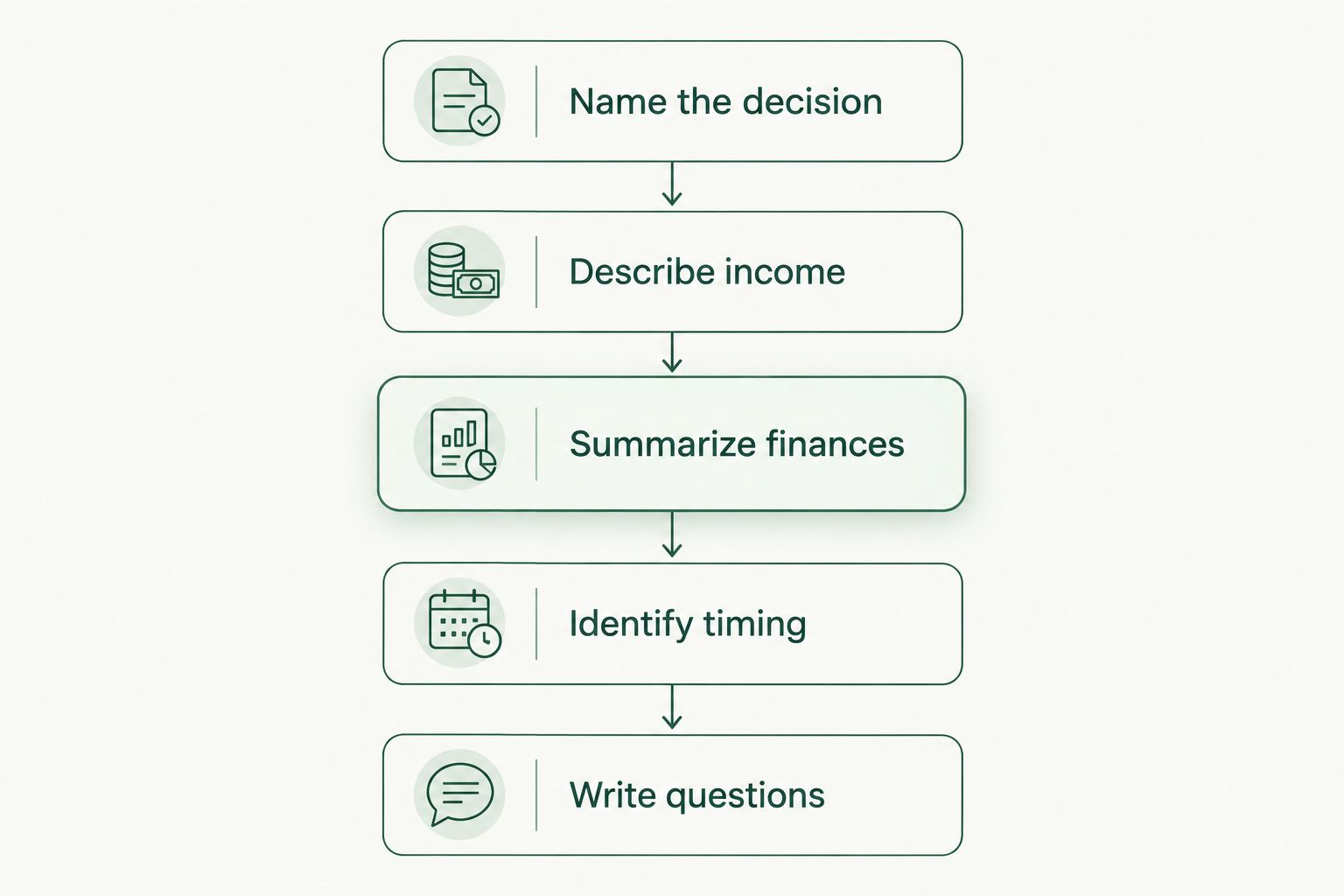
1. Name the decision
Finish this sentence: “I want help deciding whether to…” Keep the answer specific enough that someone can explain what analysis the decision requires.
Examples include separating business reserves from personal investments, preparing for retirement, or understanding how an ownership transition affects household cash flow. These are starting points for discussion, not recommendations to take those actions.
If several issues compete for attention, identify the one that brought you to the call. Put the others underneath it rather than presenting every concern as equally urgent.
2. Describe how you get paid
Explain whether your household relies on wages, owner distributions, contract income, or a combination. Note whether that income changes with collections, project completion, or seasonal demand.
You do not need perfect accounting for this conversation. You do need to distinguish business revenue from the money you can actually use personally.
Mention payroll obligations, estimated tax payments, and debt payments that compete for the same cash. Label estimates clearly instead of presenting them as reconciled figures.
3. Summarize what you own and owe
List the categories that matter: business ownership, cash, investment accounts, retirement accounts, property, and debt. Separate household assets from company assets.
If much of your wealth depends on the company, say so directly. An advisor needs to understand that concentration before discussing an investment portfolio in isolation.
Do not invent a business valuation for the call. Describe any existing valuation by its source and date, or explain that you have not obtained one.
4. Identify timing and other decision-makers
List actual deadlines, planned transitions, and people whose agreement matters. A spouse, business partner, CPA, or attorney can affect what happens next.
For your 2026 notes, distinguish a firm deadline from a preference. “The agreement requires action” means something different from “I would like to address this soon.”
Ask whether another decision-maker should attend the introductory conversation. Do not assume the advisor needs your entire professional team on the first call.
5. Write your questions before the conversation
Put questions about scope, compensation, and responsibilities ahead of questions about specific investments. You are choosing a working relationship before choosing an implementation strategy.
Keep your brief nearby during the call. Use it to redirect the conversation if you finish discussing products but still do not understand who will solve your original problem.
What should I bring to a financial advisor discovery call?
Bring enough information to explain the situation without exposing unnecessary personal data. A useful summary is more valuable than an unrequested document dump.
Use the table to separate first-call preparation from records that belong in a later, agreed process.
| Information | Bring to the conversation | Keep out of ordinary email |
|---|---|---|
| Business overview | Ownership structure, your role, and how the business earns money | Confidential customer or employee records |
| Cash flow | Income pattern, major obligations, and known pressure points | Bank login credentials |
| Assets and debt | Account categories and clearly labelled balance estimates | Full account numbers and passwords |
| Taxes | Questions to coordinate with your tax professional | Unrequested complete tax returns |
| Transition or succession | Intended direction, involved people, and existing agreements | Unrequested copies of sensitive legal documents |
| Existing advice | Your CPA’s, attorney’s, and advisor’s responsibilities | Private correspondence without permission |
Ask the firm what it needs before uploading anything. Verify the recipient and sharing method independently if a message requests sensitive information.
For a 2026 preparation folder, label each summary with its date. A balance estimate without a date is harder to interpret, especially when business cash changes between collection cycles.
What should I expect from the introductory call?
Use the first conversation to establish fit, scope, and the next decision. Do not treat a brief introduction as a completed analysis of your retirement, taxes, or business transition.
The stages below have different purposes. Ask the advisor to explain where the introductory conversation ends and a formal engagement begins.
| Stage | Best for | Benefit | Limitation |
|---|---|---|---|
| Discovery conversation | Assessing fit and defining the problem | Lets you clarify responsibilities before engaging | Does not replace detailed financial analysis |
| Planning engagement | Examining decisions using agreed information | Creates a defined setting for analysis and recommendations | Requires an agreed scope and supporting records |
| Implementation | Carrying out agreed actions | Turns decisions into assigned tasks | Can involve separate providers and additional approvals |
At VIMSmallBusiness, the introductory appointment with Dillon Goodman is a 30-minute intro call. Dillon Goodman, CPA, CFP®, leads the business-owner practice in Northern Colorado.
Use that appointment length to prioritize the conversation, not to expect a finished plan. The fit is business-owner financial planning and transition planning; the boundary is equally important: the firm does not prepare tax returns or provide legal, valuation, or transaction-brokerage services.
Which 8 questions should I ask a financial advisor?
These questions test whether you understand the proposed relationship. Ask for plain-language answers and written details before making an engagement decision.
- Will you act as a fiduciary throughout our work together? Ask the advisor to explain the obligation and identify any activities outside the proposed advisory relationship.
- How are you and your firm compensated? Ask about advisory compensation, commissions, referral arrangements, and expenses paid to other providers.
- What work is included, and what is excluded? Separate financial planning, investment management, treasury work, and transition planning rather than treating them as interchangeable.
- Who will handle my work? Identify the person responsible for analysis, recommendations, ongoing communication, and follow-up tasks.
- How do you work with business owners whose income changes? Ask how the planning process handles uneven distributions, reserves, and competing business obligations.
- How will you coordinate with my CPA and attorney? Clarify permissions, information sharing, and who remains responsible for tax filings and legal documents.
- What information will you need next? Ask why each requested document matters and how you should submit it securely.
- What happens if we decide to work together—or not? Ask about the written agreement, decision process, termination terms, and any outstanding responsibilities.
The separate guide to questions to ask a small-business financial advisor expands the advisor-selection conversation. Keep your own questions tied to the problem you actually want solved.
Why discovery-call preparation varies
Prepare around the decision, not a universal paperwork list. These factors change what deserves attention:
- Cash flow: Uneven collections and distributions require a different opening conversation from predictable household income.
- Concentration: A business-heavy balance sheet needs discussion of company dependence, not just investment accounts.
- Transition: A possible sale, employee transfer, or family succession brings different people and agreements into the conversation.
- Existing advice: An established CPA or attorney changes the coordination questions you need to ask.
- Scope: Treasury management, investment management, and financial planning require different supporting information.
In your 2026 brief, connect each concern to a decision. “Taxes worry me” is less actionable than identifying a transaction or cash flow question that needs coordination with your tax professional.
When estate planning overlaps with the call
Tell the advisor if a will, trust, ownership agreement, or beneficiary designation affects the decision you are discussing. Do not ask the financial advisor to replace your attorney’s legal judgment.
A question about will and living trust costs belongs alongside questions about legal scope and funding responsibilities, not as a substitute for them. Ask which work belongs to the attorney and which financial follow-through belongs to the advisor.
Bring the existence and purpose of an estate document into the introductory discussion. Share the document itself only when the appropriate professional requests it through an agreed process.
Do I need exact account balances before the call?
No. Clearly labelled estimates can support a discovery conversation, while recommendations require whatever verified information the agreed analysis needs.
Separate what you know from what you need to confirm. Never combine personal cash, operating reserves, and an assumed business-sale value into one unexplained total.
Should my spouse or business partner join the call?
Include a spouse or business partner when that person shares the decision, and confirm attendance with the advisor first. Their participation should help clarify goals and authority, not expose information they are not entitled to receive.
If interests differ, state that openly. An ownership transition can involve separate personal, business, and legal responsibilities.
Do I have to choose an advisor during the discovery call?
No. Use the discovery call to decide whether the proposed next step deserves further consideration.
Before proceeding, request a written explanation of scope, compensation, responsibilities, and terms. If those remain unclear, ask for clarification rather than treating a pleasant conversation as sufficient evidence of fit.
What should I write down after the call?
Record the decision, the unresolved questions, and who owns each next action. Keep impressions separate from commitments.
Use this closing checklist for your 2026 advisor conversations:
- Can you explain the proposed service without using the advisor’s marketing language?
- Do you know what is outside scope?
- Do you understand compensation and other potential expenses?
- Do you know who will work with you?
- Does each next action have an owner?
- Can you decline or pause without confusion about obligations?
A clear next step is the outcome to seek—not an immediate commitment. If you are comparing local fee-only advisors in Loveland, Fort Collins, Berthoud, or wider Northern Colorado, use the same questions for each conversation.
FAQ
What should I prepare before talking to a financial advisor?
Prepare a short summary of your decision, income pattern, assets, debt, timing, and questions. Confirm the firm’s secure document-sharing process before sending sensitive records.
How long is the introductory call with Dillon Goodman?
The VIMSmallBusiness appointment with Dillon Goodman is a 30-minute intro call. Use it to discuss your business-owner planning needs, assess fit, and clarify the next step.
Do I need to send tax returns before a discovery call?
Do not send tax returns unless the firm requests them and confirms a secure submission method. Start by describing the tax questions that need coordination with your tax professional.
What is the most important question to ask a financial advisor?
Ask what the advisor will do for your specific decision and what remains outside scope. Then clarify fiduciary responsibility, compensation, and who will perform the work.
Should I give a financial advisor my bank password?
Do not send your bank password by email or disclose it during a discovery call. Ask the firm to explain any later account-access process and the permissions involved.
Can a discovery call replace a financial plan?
No. A discovery call establishes context and fit; a financial plan requires an agreed scope, supporting information, and analysis.
How do I compare financial advisors after introductory calls?
Compare written scope, responsibilities, compensation, coordination, and next steps using the same checklist. Evaluate whether each advisor addressed your actual decision rather than judging the conversation on rapport alone.
One last thing
Write down what you do not want to change. That might be control of the business, access to operating cash, or responsibility for a family decision.
Constraints belong in the conversation as early as goals. An advisor cannot assess a proposed next step properly if its most important boundary stays unspoken.
This article is educational and is not personalized financial, tax, or legal advice.