

Without a succession plan, your business can continue operating, but nobody has a documented roadmap for replacing you or transferring ownership. Existing agreements, authorized decision-makers, estate documents, and applicable law determine what happens after death or incapacity—not your unwritten intentions. Start by documenting who can act, how operations continue, and what happens to your ownership.
- What happens if I don't have a succession plan? Business control, cash flow, and ownership can become uncertain.
- A willing successor still needs documented authority, operating knowledge, and a workable ownership transfer.
- A will alone does not establish who handles payroll or manages customer relationships.
- VIMSmallBusiness supports Northern Colorado owners with financial planning and business transition planning.
What happens to my business if I don't have a succession plan?
The immediate consequences depend on why you leave and what arrangements already exist. A planned retirement gives you time to make decisions; an unexpected absence leaves other people working within the authority and information they already have.
| Situation | What happens without documented succession arrangements | What to establish |
|---|---|---|
| Temporary incapacity | Staff must determine who can approve payments, sign contracts, and make decisions | Backup management and legally appropriate authority |
| Death | Ownership passes under applicable agreements, estate documents, and law; management is a separate question | Coordinated ownership and operating instructions |
| Retirement | You must negotiate a handover while still deciding what you need financially | A successor, transition responsibilities, and personal financial plan |
| Partner departure | Remaining owners must work through transfer rights and payment obligations under existing arrangements | A reviewed buy-sell agreement and funding approach |
No row means your business automatically closes. Each exposes a different unanswered question.
For the operating side, start with how to protect your business from key-person risk. Succession requires more than naming the person who takes your place.
Why this matters
Your business supports more than your retirement. Employees depend on payroll, customers depend on delivery, and your household depends on income that can be difficult to separate from company cash flow.
A succession plan connects those responsibilities. Without that connection, someone might inherit your ownership without understanding the business, while a capable manager lacks permission to make essential decisions.
For your 2026 review, separate operational continuity from ownership transfer. Keeping the doors open and deciding who owns the company are related jobs, not interchangeable documents.
If you become unable to work: authority comes first
Your team might know exactly what needs doing and still lack authority to do it. Being your spouse, adult child, or trusted employee does not by itself establish authority over every business account or contract.
Ask your attorney and financial institutions to confirm who can act during incapacity. Review signing authority, governing documents, and any relevant powers of attorney rather than assuming an informal understanding covers everything.
Then test access without sharing credentials improperly. Can an authorized backup reach payroll records, vendor contacts, insurance information, and essential systems through approved access procedures?
Document the decision-maker and the backup—not just where the passwords are. A secure access process does not replace legal authority, and legal authority does not teach someone how to run your business.
If you die: inheritance and management are separate
Your ownership interest becomes subject to the relevant transfer arrangements and estate process. The outcome depends on your entity, governing documents, estate documents, ownership structure, and applicable law.
That does not mean the person receiving your interest becomes an effective operator. A beneficiary might want income from the business but have no interest in managing staff, handling customer disputes, or negotiating supplier terms.
Ask your attorney to reconcile your estate documents with shareholder, partnership, or operating agreements. Transfer restrictions and purchase rights need to work with your intended inheritance arrangements, not against them.
A written statement that you want your children to take over is not a substitute for coordinated documents. Separate who receives economic value from who makes management decisions.
If you retire: an intended successor is not a completed transfer
A successor needs willingness, capability, authority, and a workable transfer arrangement. Your preferred person can have the first two without having the financial capacity to acquire the business.
Talk directly about responsibilities before discussing ownership as a reward. Managing employees, carrying business risk, and becoming an owner are different commitments.
For a transition beginning in 2026, identify which decisions you will stop making and which decisions the successor will assume. Otherwise, you can step away in name while remaining the person everyone calls for approval.
Your personal financial plan matters here. The business's estimated value, an actual purchase offer, and spendable proceeds after transaction obligations are different amounts; none should substitute for the others in your retirement decision.
Why the outcome varies
The consequences of having no succession plan depend on how your business operates and what is already documented. Focus your review on these factors:
- Ownership structure: A sole owner and a company with multiple owners face different decision-making and transfer questions.
- Existing agreements: Governing documents, buy-sell provisions, and estate arrangements can establish rights even without a separate succession document.
- Owner dependence: Customer relationships, technical knowledge, approvals, and sales activity concentrated in you leave more work to transfer.
- Cash flow and obligations: Payroll, debt payments, taxes, and supplier commitments continue to require attention during a handover.
- Successor readiness: A named successor still needs the ability, interest, and authority to assume responsibility.
- Personal financial dependence: Your household's reliance on salary, distributions, or eventual sale proceeds affects which transitions are workable.
These factors explain why a generic template is only a starting point. Your documents must match the business you actually run.
What should I do first if I don't have a succession plan?
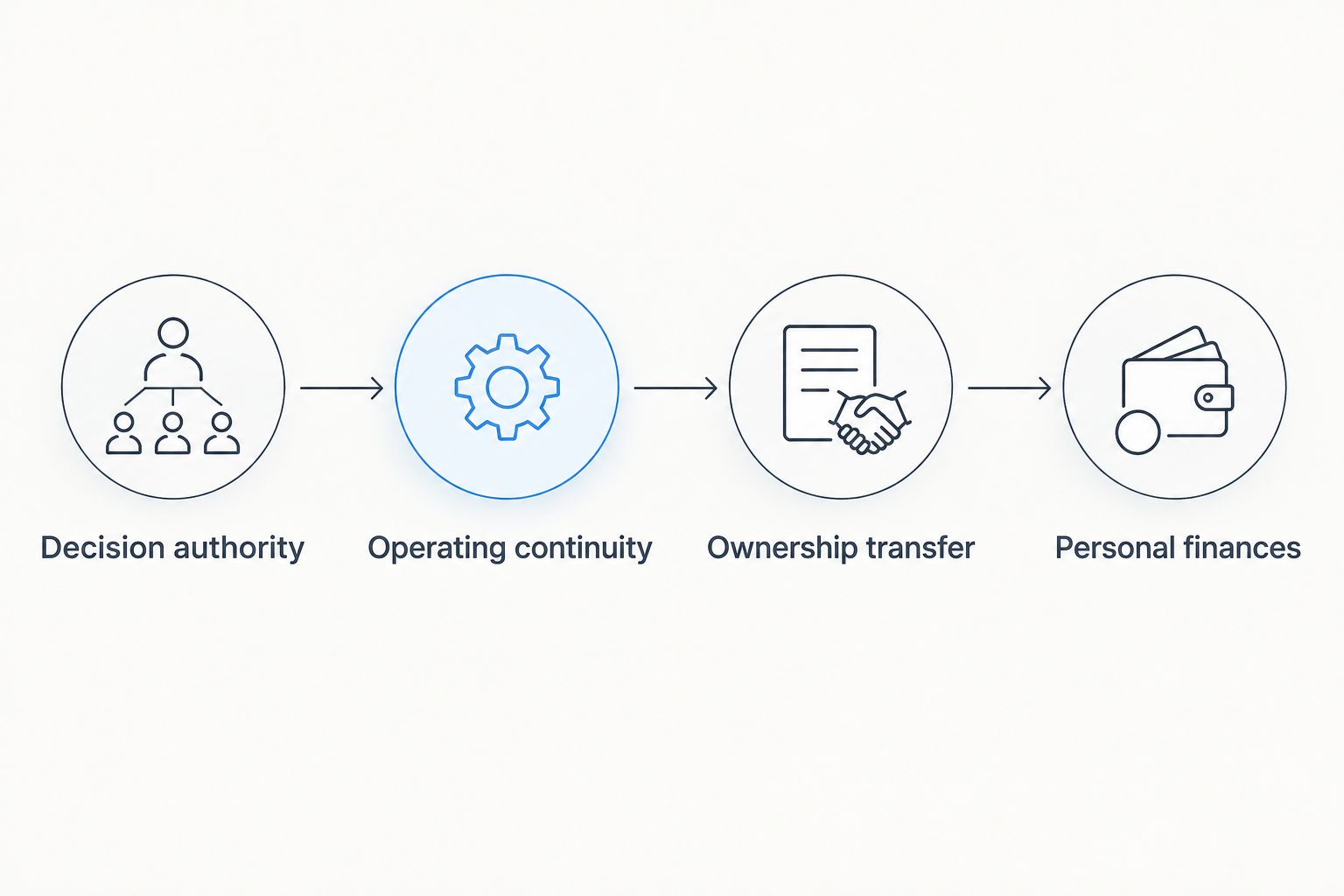
Start with an emergency operating handover, then address ownership and your personal finances. You do not need to settle your eventual sale or family transfer before documenting who handles essential decisions during an absence.
1. Decision authority
List the decisions only you currently make. Include payroll approval, banking, customer commitments, hiring, purchasing, and contract signatures.
For each decision, name the intended backup and confirm the authority required. Record unresolved legal or account-access questions for the appropriate professional rather than treating your list as authorization.
2. Operating continuity
Write down how essential work continues without your involvement. Identify the people, records, systems, and customer relationships needed to deliver work and collect payment.
Use a tabletop exercise with three chosen scenarios: an absence lasting 1 business day, 30 calendar days, and 90 calendar days. These are planning scenarios, not predictions or required planning deadlines; use them to reveal which responsibilities remain dependent on you.
3. Ownership transfer
Identify your preferred destination for the business: family ownership, employee ownership, a partner buyout, an outside sale, or an orderly wind-down. Treat the preference as a question to investigate, not a completed arrangement.
Each route carries trade-offs. A family transfer requires agreement about roles and fairness; an employee or partner transfer needs a workable funding structure; an outside sale requires a willing buyer; a wind-down ends the operating business rather than preserving it.
4. Personal finances
Separate business cash requirements from household needs. Review what income you need after stepping back and which assets outside the company can support it.
Then ask whether your preferred transfer supports that plan. Do not make the successor responsible for a retirement target that the business and transaction cannot support.
Use the exercise to create an action list with a responsible person for each unresolved issue. A list of concerns becomes useful when someone owns the next decision.
Who should handle each part of your succession plan?
Assign work according to professional responsibility. No single document or professional replaces the others.
| Professional or participant | Best for | Boundary to keep clear |
|---|---|---|
| Business and estate attorney | Legal authority, governing agreements, and estate coordination | Legal documents do not establish successor operating ability |
| Tax professional | Tax analysis and return preparation within the engagement | Tax treatment alone does not determine whether you can afford to retire |
| Financial advisor | Personal cash flow, investments, and financial transition planning | Financial planning does not replace legal drafting or transaction representation |
| Qualified valuation professional | An independent valuation for the relevant purpose | A valuation is not a committed purchase offer |
| Successor and management team | Operating responsibilities and practical handover | Familiarity with the business does not establish ownership rights |
VIMSmallBusiness is best suited to Northern Colorado owners seeking fee-only financial planning alongside business succession planning. The firm is a fee-only fiduciary and SEC-registered RIA based in Loveland, serving business owners with financial planning and transition/succession planning.
VIMSmallBusiness coordinates planning with legal, tax, and valuation professionals; it does not replace their work or prepare tax returns. The financial planning benefit is connecting your household needs to transition decisions; the limitation is that the legal and transaction work still requires the appropriate professionals.
For owners in Loveland, Fort Collins, Berthoud, and wider Northern Colorado, proximity does not replace fit. Ask who handles each task, how information moves between professionals, and what remains your responsibility.
Does a will replace a business succession plan?
A will does not replace a business succession plan because inheritance instructions do not cover every operating decision. Your estate arrangements need to work with your business agreements and authority arrangements.
Ask your attorney how ownership transfer, incapacity, and management are addressed separately. Do not assume a beneficiary designation or estate document resolves business account access.
Will my business automatically close without a succession plan?
Your business does not automatically close just because you lack a succession plan. Its ability to continue depends on authority, staffing, cash flow, contracts, and the people able to operate it.
Avoid treating continued trading as proof that everything is settled. Ownership questions and financial obligations still need attention even when employees keep serving customers.
Can I start succession planning while I'm still running the business?
You can start succession planning while you still run the business by documenting responsibilities and reviewing your existing agreements. An immediate ownership transfer is not required to begin that work.
Use your 2026 planning meeting to identify decisions that depend on you and assign the next step for each. That produces a useful starting point without pretending the full transition is complete.
FAQ
What happens if I don't have a succession plan and I become incapacitated?
Your business must rely on existing decision-making authority, agreements, and access arrangements if you become incapacitated. Confirm with your attorney and financial institutions who can act; naming a backup informally does not establish every required permission.
Does my spouse automatically take over my business when I die?
Your spouse does not automatically receive authority to manage every aspect of the business simply because you are married. Ownership and management depend on applicable law, estate arrangements, and business agreements.
Can my employees keep running the business without me?
Your employees can continue work within their existing roles and authority, but that does not give them every power you exercise as owner. Review approvals, account access, customer responsibilities, and legal signing authority separately.
What happens to business loans if the owner dies?
An owner's death does not by itself settle the business's loan obligations. Review the loan documents, guarantees, insurance arrangements, and estate implications with the lender and appropriate legal advisors.
Is naming my child as successor enough?
Naming your child as successor is not enough to complete a business transfer. Confirm willingness, management responsibilities, ownership rights, financial arrangements, and coordination with your estate documents.
What's the first document I should create for succession planning?
Start with an operating handover that identifies essential decisions, intended backups, and unresolved authority questions. It is a working checklist, not a substitute for attorney-prepared agreements or estate documents.
Can a financial advisor help if I don't have a succession plan?
A financial advisor can help connect your personal cash flow, investments, and retirement needs to business transition decisions. VIMSmallBusiness provides financial and succession planning for business owners, while legal drafting, tax preparation, and valuation require the appropriate separate professionals.
One last thing
The person who inherits your business and the person who should run it do not have to be the same person. Treating those roles as identical can leave both your family and your management team with responsibilities they never agreed to accept.
Before your next 2026 planning review, ask your intended successor directly: do you want ownership, management responsibility, both, or neither? Record the answer, then have the relevant professionals help turn the agreed direction into workable arrangements.
This article provides general education, not personalized financial, tax, or legal advice. Your next step is to establish what your current documents actually permit—not assume your intentions are already enforceable.