

Start succession planning when your business depends on you, your personal finances depend on the business, or someone else would struggle to take over your responsibilities—not when you finally choose a retirement date. You do not need a buyer or a confirmed successor to begin. The work starts with separating your future income needs from the company's ability to operate without you.
- How do I know when to start succession planning? Start when ownership, daily operations, or personal income depend on you.
- Business succession planning starts before a buyer, successor, or retirement date is confirmed.
- Separate emergency continuity from your planned ownership transition; each needs clear responsibilities.
- Vital Investment Management serves Northern Colorado owners seeking fee-only financial planning alongside business succession planning.
How do I know when to start succession planning?
Start when an unanswered ownership question affects today's decisions. That includes hiring a future manager, bringing a child into the company, discussing a partner's departure, or deciding how much business cash to move into personal investments.
The question is not whether you are ready to leave. It is whether your business and household have a workable plan if your role changes. Vital Investment Management provides fee-only financial planning and business transition/succession planning for Northern Colorado owners.
Use these 4 decision steps to identify your starting point:
- Check owner dependence. Identify decisions, relationships, and approvals that stop without you.
- Check household dependence. List the salary, distributions, and business-paid benefits your household would need to replace.
- Check successor readiness. Determine who wants responsibility, who can handle it, and what remains untested.
- Choose the next decision. Assign a person and a review date to the most important unresolved issue.
A blank answer is a planning task, not a reason to postpone the conversation. Your 2026 starting point can be a written list of decisions rather than a finished sale agreement.
Why this matters before you choose an exit date
Cash flow can hide the problem. A profitable company can still rely on your personal customer relationships, your approval of every payment, or your willingness to work whenever someone else cannot.
Your household has a separate dependency. Business distributions support spending today, but that does not establish what you would receive after a transfer. A successor's ability to run the company and your ability to leave it are different questions.
Planning is not a commitment to sell. It is a way to test whether your preferred outcome works before you make promises to family, employees, or a buyer.
For a Loveland, Fort Collins, or Berthoud owner, the useful starting discussion is practical: who handles the work, who owns the equity, and how you get paid after your role changes.
Ask these 8 questions before postponing the conversation
You do not need a formal valuation to recognize an unresolved dependency. Answer these 8 questions in writing, using your current arrangements rather than what everyone assumes would happen:
- Who can approve payments and manage treasury if you are unavailable?
- Who owns the most important customer and supplier relationships?
- Who can supervise employees without checking every decision with you?
- Does a potential successor actually want ownership, management responsibility, or both?
- What household spending currently depends on salary, distributions, or business-paid benefits?
- What personal assets would support you independently of the company?
- Do your ownership documents match your current intentions?
- Who is responsible for coordinating the financial, tax, and legal decisions?
If these questions expose gaps, start with those gaps. Do not turn the checklist into a numerical readiness score: an unclear authority to act can require attention even when the other answers look settled.
Keep your 2026 answers as a baseline. Later reviews should show which responsibilities have transferred, which assumptions have changed, and which decisions still belong entirely to you.
Separate continuity from your planned transition
Emergency continuity answers what happens if you cannot work. A planned transition answers how you intend to reduce your role or transfer ownership. Neither substitutes for the other.
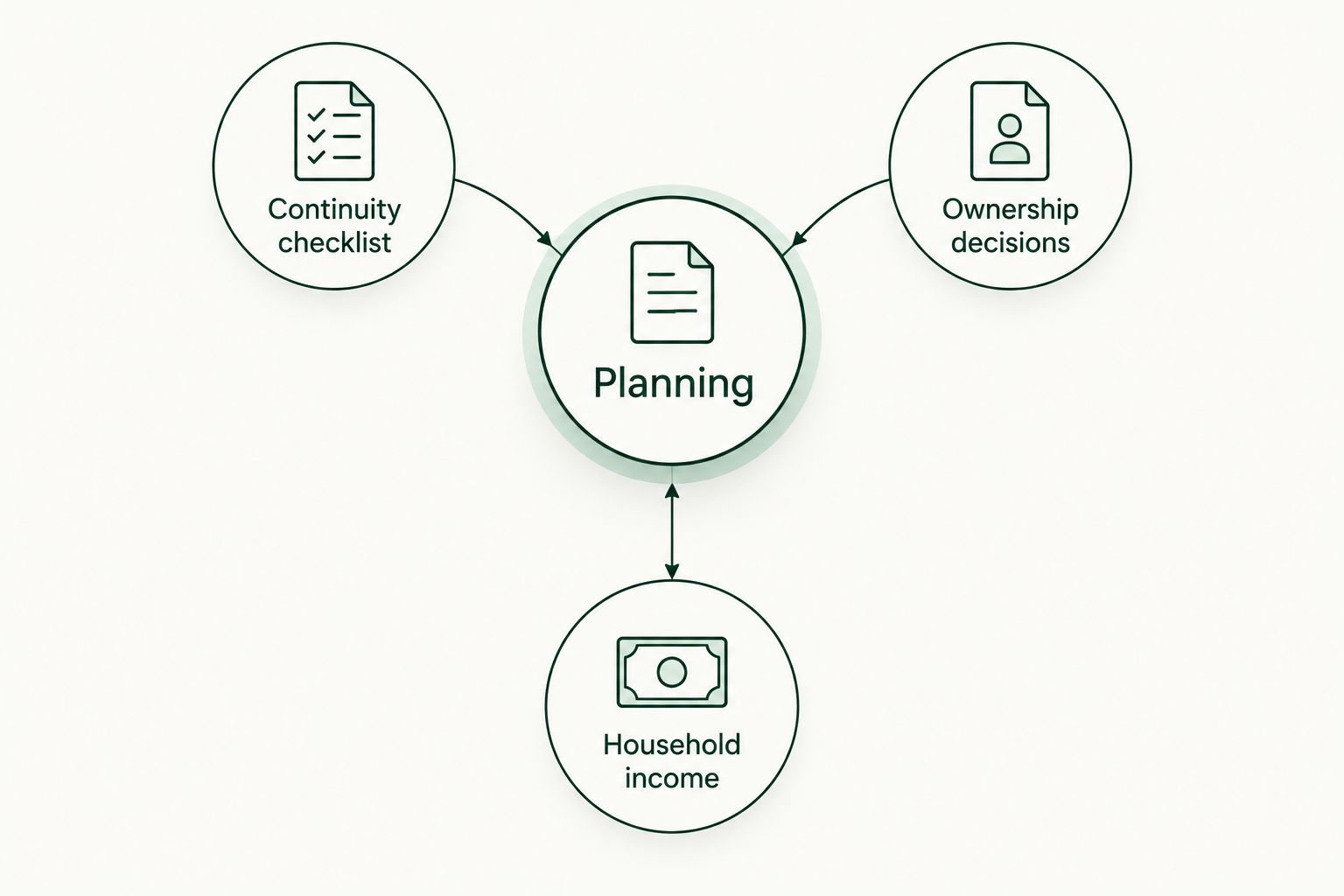
Use 3 separate documents as a working structure: a continuity checklist, an ownership decision list, and a household income worksheet. These are planning aids, not replacements for legal agreements or individualized financial advice.
Continuity checklist
Record who can act, what responsibilities need coverage, and where authorized people can find essential information. Identify gaps in banking access, payroll responsibility, customer communication, and operating authority without circulating passwords or sensitive records casually.
Ownership decision list
Write down who owns the business now, who might own it later, and what remains undecided. Separate a person's willingness to manage from that person's willingness and ability to buy ownership.
Household income worksheet
List the income and benefits you receive through the company and the obligations that continue after you step back. Keep potential sale proceeds separate from money already available outside the business.
Compare the transition routes before choosing one
Different routes answer different goals. Keeping ownership in the family, transferring to an employee, selling externally, and retaining ownership while delegating management do not create the same responsibilities or payment arrangements.
Use this comparison to frame the discussion, not to select a route without examining your circumstances.
| Route | Best for | Potential advantage | Main limitation | First question |
|---|---|---|---|---|
| Family succession | Owners prioritizing family ownership | Keeps ownership within the family | Family interest does not establish management ability or funding | Who wants ownership, and who wants the operating role? |
| Employee purchase | Owners considering a willing internal buyer | Builds on an existing working relationship | The employee's purchase funding needs separate evaluation | Can the employee operate the company and finance the transfer? |
| External sale | Owners considering a buyer outside the company | Opens the discussion beyond existing insiders | Finding a suitable buyer and agreeing terms remain unresolved | What must the business demonstrate without your daily involvement? |
| Retained ownership | Owners who want less operating responsibility without an immediate ownership transfer | Separates management duties from ownership | Your wealth remains exposed to the business | Who runs the company, and what authority will that person have? |
Do not confuse a preferred successor with a completed plan. Every route still needs operating responsibilities, ownership terms, and household finances to fit together.
Family succession: clarify roles before making promises
Start with separate conversations about ownership, employment, and management. A child can want a role in the company without wanting to lead it, and an ownership decision can affect family members who do not work there.
Document the questions that require legal and tax advice. Avoid using an informal family understanding as a substitute for enforceable arrangements.
Employee purchase: test funding separately from leadership
An employee's knowledge of the company does not answer how the purchase will be funded. Buyer cash, bank financing, seller financing, and contingent payments create different questions about timing and risk.
Ask what happens to your household plan if payments depend on future business performance. A direct sale to an employee is also different from an employee stock ownership plan, or ESOP; do not treat the terms as interchangeable.
External sale: prepare before a buyer sets the agenda
Start by identifying which financial records, management responsibilities, and customer relationships require explanation. You need to understand what you are selling before evaluating a buyer's proposal.
Do not treat an anticipated sale amount as spendable wealth. Taxes, transaction terms, and the timing of payment belong in the personal planning discussion before you commit.
Why succession-planning timing varies
There is no universal starting age or reliable countdown that replaces an assessment of your business. These factors determine what needs attention first:
- Owner dependence: Responsibilities that only you can perform need an operating handoff, not just an ownership document.
- Successor readiness: A willing successor still needs authority, experience, and a clear understanding of the role.
- Payment structure: Cash received at closing and payments received later create different household cash-flow needs.
- Personal concentration: Wealth tied to the company makes business decisions and household decisions closely connected.
- Ownership arrangements: Partners, family owners, and existing agreements add decisions that require coordination.
- Tax and legal work: Transaction structure, documents, and tax consequences require the appropriate professionals.
Use these factors to choose your first task. For example, delegating payment approvals addresses a different problem from evaluating whether seller-financed payments would support your spending.
For your 2026 review, name the dependency before naming a completion date. A calendar target is useful only when the underlying tasks and responsibilities are clear.
What should I do first if I have no successor?
Start by identifying the responsibilities a successor would inherit. Write the role before choosing the person, including authority over staff, cash flow, customers, and major decisions.
Then distinguish temporary coverage from long-term leadership. The person who handles an absence does not automatically become the right future owner.
You can also examine several ownership routes without committing to any of them. Keep the questions open until willingness, operating ability, funding, and your personal financial needs have been assessed.
Should I wait until I know what my business is worth?
No—begin with your income needs and current dependencies. A qualified valuation professional can address valuation when the decision requires it; an informal estimate does not establish what a buyer will pay or what you will retain.
Ask your financial advisor to distinguish company value from usable personal proceeds. Your CPA and transaction counsel should address the tax and legal questions within their respective roles.
This preparation gives a valuation a purpose. Instead of asking only what the company is worth, you can ask whether a proposed transaction supports the transition you want.
Can I start succession planning while I still enjoy running the business?
Yes—enjoying the work is compatible with preparing a successor. You can transfer selected responsibilities, document authority, and build assets outside the company without choosing an immediate departure.
Start with a responsibility you are genuinely prepared to hand over. Define the decision rights and review process rather than delegating a title while keeping every meaningful approval.
Your 2026 plan can preserve an active role while reducing uncertainty. The aim is a deliberate choice about your involvement, not retirement for its own sake.
Keep professional responsibilities clear
A financial advisor addresses how the transition connects to household spending, investments, treasury, and personal financial planning. A CPA addresses tax matters, transaction counsel addresses legal arrangements, and a valuation professional addresses valuation when needed.
Vital Investment Management is best suited to Northern Colorado owners seeking fee-only financial planning alongside business succession planning. The firm is a fee-only fiduciary and SEC-registered RIA; it coordinates with legal, tax, and valuation professionals rather than replacing them.
That distinction matters. Financial planning does not broker a transaction, draft legal agreements, provide lending, or administer an ESOP. If you need help separating responsibilities, review how a financial advisor helps with business succession planning.
FAQ
How do I know when to start succession planning?
Start when operations, ownership decisions, or household income depend on your continued involvement. You do not need a buyer, successor, or retirement date to identify and address those dependencies.
Am I too young to start business succession planning?
Your age is not the starting test; your business responsibilities and financial dependencies are. Begin by documenting who can act if you are unavailable and which decisions require your approval.
Should I start succession planning before I find a buyer?
Yes—start before finding a buyer so you can clarify operating responsibilities, household income needs, and ownership goals. Preparing does not commit you to a sale.
Can I make a succession plan without choosing my children or employees?
Yes—you can document responsibilities and evaluate ownership routes without choosing a successor. Keep management ability, willingness to own, and purchase funding as separate questions.
Does having a will mean my business succession planning is done?
No—a will does not by itself establish the operating handoff or your post-transition income plan. Ask your attorney how your estate documents interact with ownership agreements and authority to act.
Who should help me start succession planning in Northern Colorado?
Your team should cover personal financial planning, tax, legal, and valuation questions as needed. Vital Investment Management provides fee-only financial and business succession planning and coordinates with the relevant professionals.
What should I bring to my first succession-planning discussion?
Bring current ownership documents, business financial statements, and a summary of household income needs. Also list the responsibilities that depend on you and any successor conversations already underway.
One last thing
Choose a task you will stop owning before choosing the date you will stop working. That small handoff tests whether responsibility can actually move, rather than merely changing a name on an organization chart.
Write down who receives authority, what decisions remain yours, and when you will review the arrangement. That is a useful next move even if your eventual exit date stays undecided.