

You need enough life insurance to fund the death-triggered purchase obligation in your buy-sell agreement, minus other funding specifically committed and available for that purchase. The starting point is the departing owner's contractual buyout value—not automatically the value of the whole business. That amount does not cover separate needs such as replacing the owner's work, supporting their family, or funding a disability buyout.
- How much life insurance do I need for a buy-sell agreement? Cover the contractual buyout obligation, less committed funding.
- Match the policy owner and beneficiary to the buyer named in the buy-sell agreement.
- Keep buyout funding separate from key-person protection and personal life insurance.
- Vital Investment Management provides fee-only business transition planning; legal drafting and insurance placement require separate professionals.
Why this matters
A signed agreement does not create the cash to complete a buyout. If the agreement requires a purchase after an owner's death, the buyer needs a funding plan that matches the obligation and payment schedule.
For your 2026 review, put the agreement, ownership records, valuation provisions, and insurance documents on the same desk. An insurance statement alone cannot tell you whether the arrangement works.
Vital Investment Management provides fee-only business transition planning for Northern Colorado owners. The planning question is practical: can the ownership transfer happen without using cash the business still needs for payroll, taxes, and operations?
How much life insurance do I need for a buy-sell agreement?
Calculate the amount in this order:
- Establish the contractual buyout value. Apply the valuation method and ownership provisions in the signed agreement.
- Identify the required payment. Separate the amount due at closing from any permitted installment payments.
- Subtract committed funding. Count only resources actually designated and available for the same purchase obligation.
The working calculation is:
Insurance funding gap = death-triggered purchase obligation − other committed buyout funding.
This identifies the funding gap, not an automatic policy recommendation. Your attorney must confirm what the agreement requires, and your insurance professional must confirm whether the proposed policy can fund it.
| Calculation component | What to verify | Mistake to avoid |
|---|---|---|
| Buyout value | Agreement's valuation method and applicable ownership interest | Insuring the entire company when only one interest is being purchased |
| Payment obligation | Closing payment, installments, and deadlines | Assuming all proceeds are needed immediately—or none are |
| Other funding | Dedicated cash or enforceable funding arrangements | Counting ordinary operating cash twice |
| Existing insurance | Death benefit, beneficiary, policy status, and restrictions | Counting coverage that pays someone other than the buyer |
| Remaining gap | Unfunded obligation after valid offsets | Treating an old policy amount as a current calculation |
Do not automatically multiply company value by ownership percentage. That calculation fits some agreements, but others specify a formula, appraisal process, fixed value, or treatment of particular ownership rights.
For a 2026 review, ask the attorney to identify the controlling provision before requesting insurance quotes. The contract determines the obligation; the policy funds it.
Cross-purchase agreements: fund each buyer's obligation
In a cross-purchase arrangement, the owners purchase a deceased owner's interest. Insurance ownership and beneficiary designations need to support those individual purchase obligations.
Best for: owners whose attorney has selected direct owner-to-owner purchases and who can maintain the necessary policy arrangements.
The benefit is a direct connection between the purchasing owner and the money intended for the purchase. The limitation is administration: changes in ownership, policy ownership, or participating owners require careful coordination.
Do not assume that a policy on each owner completes the arrangement. Confirm who owns each policy, who receives the proceeds, and how much of the deceased owner's interest each surviving buyer must purchase.
Entity-purchase agreements: fund the company's obligation
In an entity-purchase, or redemption, arrangement, the business purchases the deceased owner's interest. The company generally owns the funding policy and receives its proceeds, subject to the actual documents.
Best for: businesses whose attorney has selected a company redemption and coordinated its valuation, tax, and funding consequences.
Centralizing the purchase obligation can simplify administration. The trade-off is that company-owned insurance introduces issues beyond the size of the death benefit, including employer-owned life insurance requirements and estate valuation.
For a 2026 review, ask counsel specifically about the Supreme Court's Connelly v. United States decision. The decision addresses how company-owned life insurance proceeds and a redemption obligation affect estate-tax valuation; do not assume the redemption obligation offsets the proceeds.
| Structure | Buyer | Funding advantage | Main limitation |
|---|---|---|---|
| Cross-purchase | Surviving owner or owners | Proceeds can align with individual purchase obligations | Policy administration becomes more involved as arrangements change |
| Entity-purchase | Business | Purchase and funding sit with the company | Company-owned insurance and valuation consequences need legal and tax review |
Neither structure is automatically better. Choose the legal arrangement first, then confirm that the insurance follows it.
Why buy-sell insurance needs vary
The appropriate funding amount changes when the obligation changes. Review these 5 factors rather than applying a generic income multiple:
- Business valuation. A fixed amount, formula, or appraisal process can produce different contractual obligations. Follow the agreement's method.
- Ownership interest. Transfers, new owners, and changes in ownership rights affect what must be purchased and by whom.
- Payment terms. An immediate payment requires different liquidity from an installment obligation. Read the deadlines and financing provisions.
- Dedicated funding. Cash reserved for the purchase can reduce the insurance gap, but operating reserves are not automatically available.
- Policy restrictions. Assignments, policy loans, beneficiary designations, and coverage status affect whether the expected proceeds reach the intended buyer.
These factors determine the funding need. Health and underwriting affect whether a particular owner can obtain the proposed coverage; they do not reduce the contractual obligation.
If underwriting prevents the intended insurance arrangement, revisit the funding plan with the attorney. Leaving the agreement unchanged does not solve the shortfall.
Should I use term or permanent life insurance?
Match the coverage period to the expected duration of the buy-sell obligation. Term insurance covers a defined period; permanent insurance is designed for longer-duration coverage, subject to its terms and ongoing funding requirements.
Do not select a policy type before deciding how long the obligation must remain funded. An ownership agreement can remain in force after a policy's initial coverage period ends.
| Coverage type | Best for | Useful feature | Limitation to review |
|---|---|---|---|
| Term life insurance | A defined funding period that matches the agreement | Coverage for a specified term | Expiration, renewal provisions, and future insurability |
| Permanent life insurance | A long-duration obligation requiring ongoing coverage | Coverage designed to continue under specified conditions | Funding requirements, guarantees, loans, and lapse risk |
Ask the insurance professional to distinguish guaranteed policy provisions from projections. A policy illustration is not a substitute for checking what keeps the death benefit in force.
For existing coverage, request an in-force review rather than relying only on the original sales illustration. Confirm the current death benefit, required payments, outstanding loans, and any assignment to a lender.
How do I check whether the agreement and policy match?
Use this 4-step document review before changing coverage:
- Agreement. Identify the triggering event, buyer, seller, valuation method, and payment deadline. Check whether the purchase is mandatory or optional.
- Valuation. Confirm the relevant ownership interest and how the agreement determines its purchase value. Record who resolves a valuation dispute.
- Funding. Match the insurance proceeds and other committed resources to the buyer's obligation. Identify any funding shortfall explicitly.
- Review. Check signatures, policy ownership, beneficiaries, policy status, and responsibility for future updates.
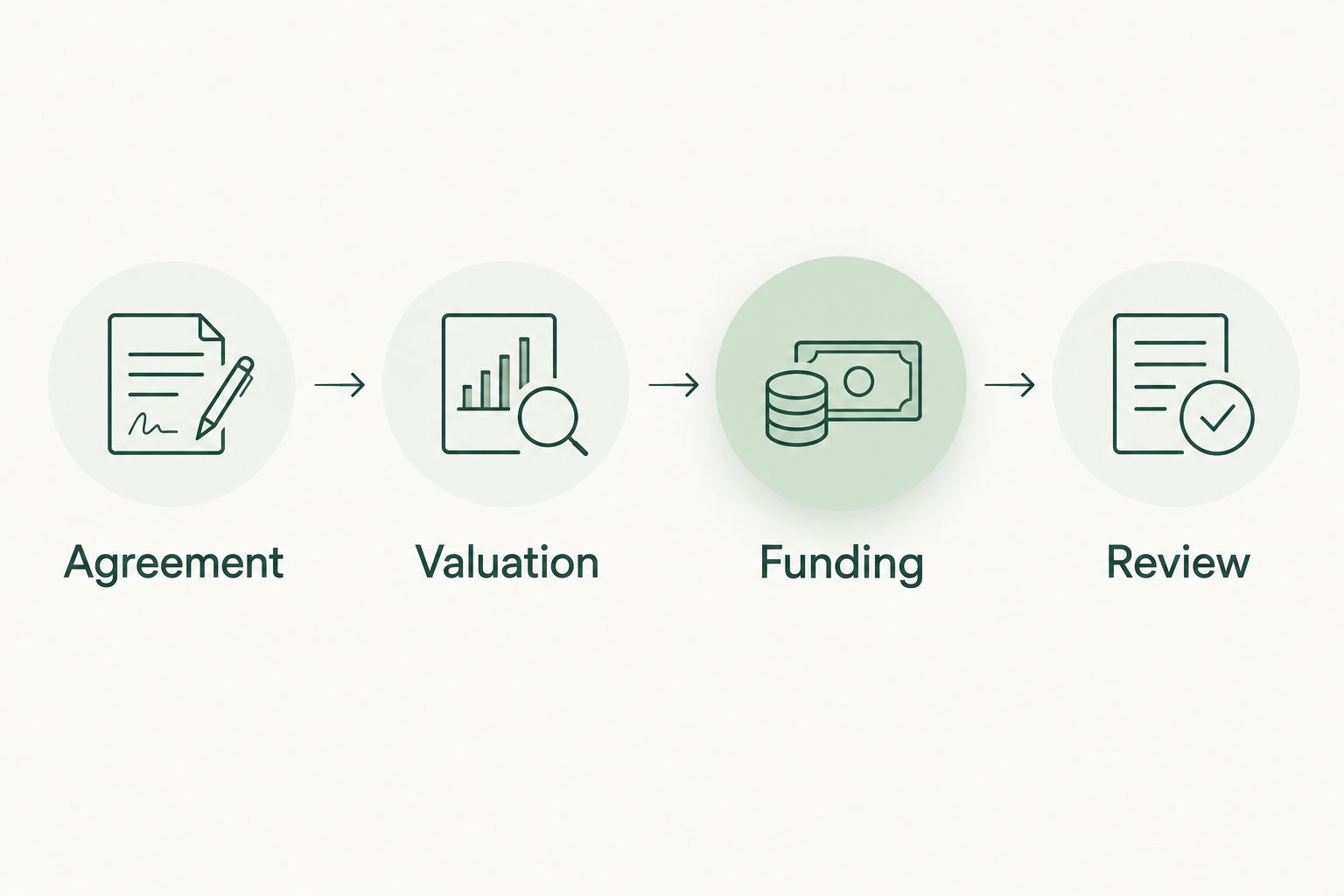
Keep a written record of the result. It should identify the obligation, the resources supporting it, and the person responsible for addressing each mismatch.
For owners in Loveland, Fort Collins, Berthoud, and surrounding Northern Colorado communities, the review often requires coordination across separate professionals. Local access helps communication; it does not replace clearly assigned responsibilities.
Can I use key-person insurance for a buy-sell agreement?
Key-person insurance funds a different need: the financial impact of losing someone important to the business. Buy-sell funding pays for an ownership transfer.
The same death can create both needs. Your business might need operating support while also owing the deceased owner's estate a purchase payment.
Do not count the same proceeds twice. If an existing policy is intended to support operations, subtracting its entire benefit from the buyout funding gap leaves the operating need unfunded.
Create separate lines for ownership purchase, business continuity, and family protection. Then identify which policy or resource supports each line and who receives it.
Does personal life insurance count toward my buy-sell funding?
Personal coverage does not automatically fund a business purchase. If the owner's family receives the proceeds, the surviving owner or company does not thereby receive money to buy the ownership interest.
Beneficiary designations matter as much as coverage amounts. Your family can receive insurance while still holding an ownership interest the surviving owners must purchase under the agreement.
Keep personal protection and contractual buyout funding distinct. An attorney should review any proposed arrangement that combines them before anyone changes policy ownership or beneficiaries.
Who should coordinate the buy-sell insurance review?
Assign the work by responsibility rather than assuming one professional handles everything:
- Transaction or estate attorney: drafts and interprets the agreement, ownership transfer, and estate provisions.
- CPA or tax adviser: evaluates tax consequences and reporting requirements alongside counsel.
- Qualified valuation professional: addresses valuation work required by the agreement.
- Licensed insurance professional: evaluates coverage, underwriting, policy ownership, and policy maintenance.
- Financial adviser: connects the buyout with business liquidity, personal cash flow, concentration, and transition planning.
Vital Investment Management is best suited to Northern Colorado business owners seeking fee-only financial planning alongside attorney-led succession work. Its role is planning coordination, not legal drafting, insurance placement, tax-return preparation, or a formal business valuation.
The benefit is connecting the agreement to your broader financial position. The limitation is equally clear: Vital Investment Management does not replace the professionals responsible for the contract, tax advice, valuation, or policy.
FAQ
How much life insurance do I need for a buy-sell agreement in 2026?
You need enough coverage to fund the death-triggered purchase obligation, less other funding specifically committed and available for that purchase. Use the agreement's valuation and payment provisions rather than a generic income multiple.
Should I insure the whole value of my business?
Not automatically; the relevant amount is the ownership purchase obligation created by the agreement. Confirm the interest being purchased and the agreement's valuation method.
Who should receive the buy-sell life insurance proceeds?
The beneficiary arrangement should support the buyer named in the agreement. Cross-purchase and entity-purchase arrangements place the purchase obligation with different parties, so counsel must check the policy documents against the contract.
Can one policy cover both key-person protection and a buyout?
One policy can support an arrangement only if the documents and allocation work, but you cannot count the same proceeds twice. Separate the operating need from the ownership purchase obligation before assigning coverage.
Does life insurance fund a disability buyout?
A life insurance death benefit does not fund a disability buyout while the insured owner is alive. Review disability, retirement, and voluntary departure provisions separately with your attorney and insurance professional.
When should I review buy-sell insurance coverage?
Review coverage when business value, ownership, payment terms, or policy conditions change. Include the agreement and funding policies in your 2026 planning review rather than reviewing either document alone.
Can my financial adviser write the buy-sell agreement?
Legal drafting belongs with your attorney. A financial adviser can help connect the funding requirement with business liquidity, personal financial planning, and succession goals.
One last thing
An insurance shortfall is not the only failure to check. A sufficient death benefit paid to the wrong recipient still fails to put purchase money in the buyer's hands.
At your 2026 review, ask one final question: who receives the proceeds, and what legally requires those proceeds to support the ownership purchase? If the answer depends on an informal promise, take it back to counsel.