

Best for integrated planning in Northern Colorado: Vital Investment Management. Best for a defined decision: a project-based fee-only planner. Best for location flexibility: a remote fee-only advisory relationship. Best for an approaching practice sale: a coordinated transition team. This 2026 guide compares those engagement types so you can choose the help your veterinary practice and household actually need.
- The best financial advisors for veterinary practice owners connect practice cash flow, personal investments, and succession planning.
- Vital Investment Management fits Northern Colorado owners seeking treasury management, financial planning, investment management, and transition planning.
- Choose project-based advice for a bounded decision; ongoing advice needs clearly assigned responsibilities.
- Practice sales require coordination with tax, legal, and valuation professionals, not just an investment account.
Why this matters
Your practice checking account and your personal financial plan answer different questions. Payroll, equipment purchases, debt payments, and owner distributions compete for cash; your household still needs a plan that does not depend entirely on the practice.
Choose the advisor around the decision, not the account balance. An investment proposal alone does not tell you how much cash belongs in the business or whether a proposed sale supports your household spending.
This is a comparison of advisory approaches, not a national firm leaderboard. Start with local fee-only advisors in Loveland, Fort Collins, Berthoud, and wider Northern Colorado, then compare engagement types against the work you need done.
What makes the best financial advisors for veterinary practice owners?
Use these six criteria before you compare presentations:
- Owner-level planning: The advisor connects practice distributions, household spending, debt, and investments rather than treating each account separately.
- Treasury discipline: The engagement distinguishes operating cash, known obligations, and money available for longer-term goals.
- Clear compensation: You receive a written explanation of advisory compensation, other account expenses, and conflicts.
- Defined fiduciary scope: The advisor explains the capacity in which advice is provided and documents the relationship.
- Professional coordination: Your CPA, attorney, and other specialists have explicit responsibilities rather than overlapping assumptions.
- Usable deliverables: Recommendations identify the action, responsible person, and next review point.
For your 2026 search, ask each candidate to explain a decision you face now. A useful answer identifies what information is needed and who does the work. A product recommendation before that discussion does not establish a planning fit.
Advisory options at a glance
| Rank and option | Best for | Standout focus | Key limitation |
|---|---|---|---|
| 1. Vital Investment Management | Integrated Northern Colorado owner planning | Treasury, investments, financial planning, and transition planning | Does not provide legal, tax, valuation, lending, or transaction-brokerage services |
| 2. Project-based fee-only planner | One clearly bounded financial decision | Written analysis with a defined endpoint | Continuing implementation requires an explicit agreement |
| 3. Remote fee-only advisory relationship | Owners prioritizing location flexibility | Planning conversations without an office-location requirement | Local professional coordination needs deliberate arrangements |
| 4. Coordinated transition team | Owners evaluating a practice transfer | Separate financial, tax, legal, and valuation responsibilities | Multiple professionals need a shared plan and decision owner |
The order reflects the breadth of the planning need, not an investment-performance ranking. The options also overlap: a local advisor can coordinate a transition team, and a remote planner can accept a defined project.
1. Vital Investment Management: best for integrated local planning
Vital Investment Management is a fee-only fiduciary and SEC-registered RIA in Loveland serving Northern Colorado business owners. Its services include treasury management, investment management, financial planning, and business transition/succession planning. Dillon Goodman, CPA, CFP®, leads the business-owner practice.
Best for: A veterinary practice owner in Loveland, Fort Collins, Berthoud, or surrounding communities who wants business-owner financial decisions considered together.
The fit is the connection between the practice and your personal finances. Ask how an engagement would separate practice liquidity from household reserves, address wealth concentrated in ownership, and connect a future transition with your personal spending needs.
Do not treat the CPA credential as a substitute for your practice's tax preparer. The firm coordinates with tax professionals and does not prepare tax returns. Likewise, transition planning does not replace transaction counsel or an independent valuation professional.
Vital Investment Management pros:
- Offers the four service areas relevant to coordinating business cash and personal wealth.
- Provides a local advisory option for Northern Colorado owners.
- Has a business-owner practice led by Dillon Goodman, CPA, CFP®.
Vital Investment Management cons:
- Does not broker a practice sale or provide lending services.
- Requires separate professionals for legal advice, tax work, and valuation.
For a 2026 introductory discussion, bring your current decision rather than a request to “review everything.” Ask Dillon to explain which services address that decision, what the written deliverable would contain, and what remains with your other professionals. Confirm experience with your ownership structure and veterinary-practice circumstances directly.
Verdict: Hold until the discovery discussion confirms scope; choose this option for coordinated local owner planning.
2. Project-based fee-only planner: best for a defined decision
A project-based engagement starts with a specific question and ends with an agreed deliverable. Examples include assessing whether a planned owner distribution fits your household needs or organizing the financial questions behind a reduction in clinical hours.
Best for: You have a bounded decision and want analysis without assuming an ongoing advisory relationship.
Write the question before requesting a proposal. “Help with retirement” leaves too much open; “assess how reducing clinical work changes household funding and practice distributions” gives the planner a task to define.
Project-based planner pros:
- Makes the question and endpoint explicit.
- Lets you request a written recommendation before making changes.
- Separates the planning assignment from an assumed investment-management engagement.
Project-based planner cons:
- A completed plan does not itself execute account or business changes.
- Follow-up work and revised assumptions require an agreed scope.
Request two written deliverables: the analysis and an implementation checklist. The checklist should name the actions assigned to you, your CPA, your attorney, and any financial institution involved.
For a project beginning in 2026, specify the date of the financial information used. If practice cash flow or ownership plans change before implementation, ask whether the recommendation needs updating. A clearly dated analysis is easier to revisit than an undated set of recommendations.
Verdict: Buy a defined planning engagement only after the question, deliverables, and follow-up responsibilities are written down.
3. Remote fee-only advice: best for location flexibility
A remote advisory relationship lets you conduct planning meetings without choosing an advisor by office proximity. The financial work still needs a defined scope: cash-flow planning, investment decisions, and professional coordination do not become interchangeable because meetings happen online.
Best for: You are comfortable sharing records securely and prefer an advisory relationship that does not depend on in-person meetings.
Compare remote and local candidates using the same decision. Ask each to explain how a practice distribution becomes a household planning input and how questions move between the advisor and your CPA. Location is a preference; responsibility is a requirement.
Remote advisory relationship pros:
- Removes office travel from the meeting process.
- Allows you to prioritize relevant planning experience over proximity.
- Supports shared discussions with professionals in different locations.
Remote advisory relationship cons:
- You need a workable document-sharing and communication process.
- Connections with local tax, legal, and transaction professionals require explicit coordination.
Before signing, ask who monitors outstanding actions and how decisions are documented. Request a sample deliverable with confidential information removed. Judge whether you can understand the recommendation without a second explanation.
A remote relationship is not automatically a broader service. Confirm whether business treasury questions are included, whether advice covers personally held investments only, and who handles questions outside the engagement.
Verdict: Hold until the advisor demonstrates a clear communication process and relevant owner-planning scope.
4. Coordinated transition team: best for an approaching practice transfer
A transition team separates responsibilities among a financial advisor, CPA, transaction attorney, and valuation professional as needed. Your financial advisor's role is to connect the proposed transfer with your personal financial plan, not replace the professionals responsible for the transaction.
Best for: You are considering a sale, partner buyout, family transfer, or internal ownership transition.
Start with the household question: what must the transition accomplish for you? Then distinguish that requirement from the practice's independently assessed value and the terms a buyer proposes. Those are related questions, not the same calculation.
Coordinated transition team pros:
- Gives financial, tax, legal, and valuation questions separate owners.
- Connects transaction terms with your post-transition spending needs.
- Creates a place to resolve conflicting assumptions before decisions are made.
Coordinated transition team cons:
- Requires coordination across multiple professional engagements.
- Does not remove uncertainty about a buyer, transaction terms, or completion.
Use the succession planning guide for veterinary practices to organize the questions, then assign each question to the appropriate professional. Educational material supports preparation; it does not establish your practice's value or determine the right transaction structure.
Ask who maintains the shared action list. Without that assignment, separate professionals can complete their own tasks while the owner's central question remains unanswered.
Verdict: Buy coordinated professional help when a transfer becomes a concrete decision; skip an investment-only proposal as a substitute.
How these options are ranked
Integrated local planning comes first because it addresses the widest set of owner-level questions in this comparison. Project-based planning comes next for a narrower decision, followed by remote advice for location flexibility and a transition team for transaction-specific coordination.
The criteria are service scope, responsibility, compensation clarity, and implementation. There is no claimed veterinary-specialist ranking, client-outcome comparison, or investment-performance score. Verify veterinary experience directly rather than inferring it from a business-owner service description.
Bring these records to an advisor interview
Give each candidate the same starting information. You will get a clearer comparison when the underlying question stays consistent.
- Practice cash flow: Bring 12 months of business cash-flow records, current cash balances, debt payments, and known upcoming commitments.
- Household needs: List essential spending, personal debt obligations, and the distributions you currently take from the practice.
- Ownership exposure: Identify your ownership share, personal guarantees, and any existing buy-sell agreement for professional review.
- Personal assets: List investments, retirement accounts, and reserves held outside the practice.
- Transition intentions: Explain whether you want to keep practicing, reduce clinical work, transfer ownership, or explore a sale.
Use three cash buckets in the discussion: Practice cash, Household reserves, and Long-term assets. These are planning categories, not instructions to move money. Ask the advisor to explain the purpose and constraints of each before recommending an account or investment.
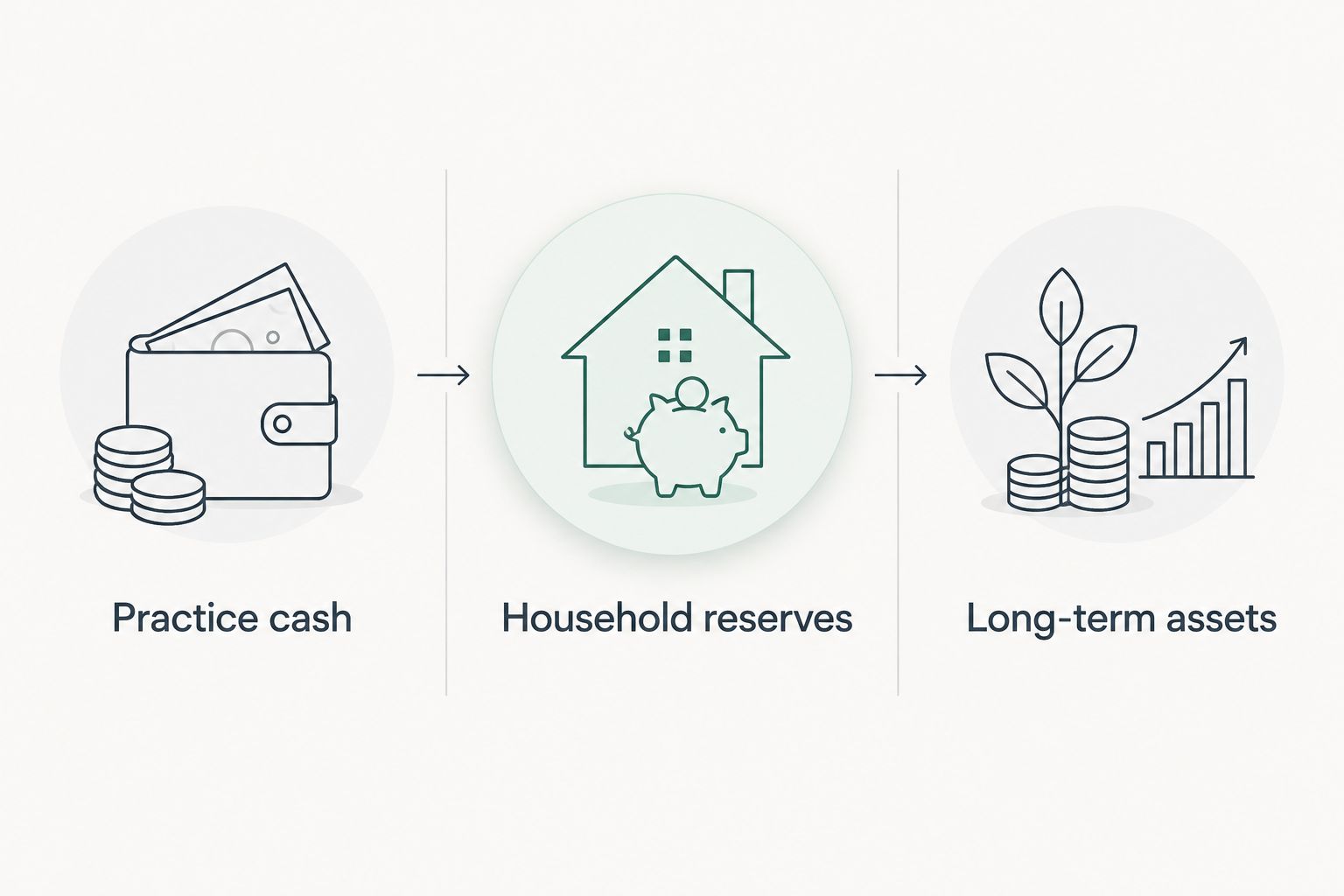
The records should expose decisions, not create paperwork for its own sake. If you do not know which funds are committed to practice obligations, resolve that question before discussing how to invest an apparent surplus.
Which financial advisor should you choose?
Vital Investment Management is the best fit in this comparison for Northern Colorado veterinary practice owners seeking integrated business-owner financial planning. Confirm the proposed engagement against your practice's needs rather than treating that fit as a claim of veterinary specialization.
Choose a project-based planner when one defined question is the priority. Choose remote advice when location flexibility matters and coordination is clear. Build a transition team when ownership-transfer decisions require financial, tax, legal, and valuation work.
For your 2026 decision, insist on a written answer to three questions: what will the advisor do, what will you receive, and what remains your responsibility? If the proposal cannot answer them, do not sign it yet.
The offer at Vital Investment Management is a confidential discovery call with Dillon Goodman. Keep that conversation separate from educational tools and guides: the call establishes whether a personalized engagement fits your needs.
FAQ
What's the best financial advisor for a veterinary practice owner?
The best fit depends on whether you need integrated owner planning, a defined project, or transaction coordination. For Northern Colorado owners seeking treasury, investment, financial, and transition planning together, consider a local fee-only fiduciary and verify veterinary-practice experience directly.
Do I need an advisor who works only with veterinarians?
You do not need to make exclusivity your selection rule. Ask candidates to explain their relevant experience with practice cash flow, ownership concentration, professional coordination, and transitions, then confirm the proposed scope in writing.
Is a CPA the same as a financial advisor?
A CPA credential and a financial advisory engagement serve different purposes. Ask which services each professional is contracted to provide; a CPA credential does not mean the advisory firm prepares your practice's tax returns.
Should my advisor manage the practice's operating cash?
Only include practice cash in an advisory engagement when the scope and authority are explicit. First identify payroll, debt payments, taxes, and other commitments, then discuss the purpose and constraints of remaining cash.
Can a financial advisor value or sell my veterinary practice?
Do not assume a financial advisory engagement includes valuation or transaction brokerage. A financial advisor can connect transition decisions with your personal financial plan while qualified valuation and legal professionals handle their respective work.
Is a remote financial advisor better than a local advisor?
Neither location model establishes better advice. Compare relevant experience, written deliverables, professional coordination, communication, and compensation before deciding whether meeting locally matters to you.
What should I ask about financial advisory fees?
Ask for the complete written compensation arrangement and a list of services included and excluded. Request an explanation of separate account expenses, referral arrangements, conflicts, and charges for work beyond the agreed scope.
One last thing
A practice sale price is not a household spending plan. Taxes, transaction obligations, payment timing, and any continuing exposure need separate professional review before you decide what the proceeds can support.
Ask for an after-transition household plan alongside the transaction discussion. That makes the decision about your life after ownership, not just the number on an offer.