

Keep enough unrestricted cash to cover the largest projected cash shortfall in your business, plus a separate buffer for disruptions. Calculate that amount from essential payments and realistic collection dates, not a fixed percentage of revenue. Money already committed to taxes, payroll, debt payments, or planned purchases is not an emergency reserve.
- How much cash should a small business keep in reserve? Cover your projected cash gap plus a disruption buffer.
- Separate operating cash, tax obligations, and planned spending before counting your emergency reserve.
- Use collection dates, not booked revenue, to build your cash flow forecast.
- Vital Investment Management provides treasury management for Northern Colorado business owners seeking fee-only financial advice.
How much cash should a small business keep in reserve?
Your reserve target is the amount needed to keep essential obligations funded when receipts fall behind payments. Start with the deepest cash gap in your forecast, then add protection against a disruption your ordinary forecast does not include. The target is a dollar amount supported by your business records, not a universal number of months.
The treasury management guide for small businesses explains the broader cash-management context. For this decision, distinguish between cash you need for normal operations and cash you hold because normal operations can change.
Use these 4 cash buckets when reviewing your 2026 balances:
| Cash bucket | Best for | What it covers | Main limitation |
|---|---|---|---|
| Operating cash | Routine payment timing | Payroll, rent, suppliers, and other scheduled payments | It is already supporting normal operations |
| Tax cash | Known tax obligations | Amounts identified with your CPA | It is not available for discretionary spending |
| Planned spending | Approved future commitments | Equipment, inventory, or other scheduled purchases | Spending it elsewhere leaves the original commitment unfunded |
| Disruption reserve | Unplanned cash shortfalls | Delayed collections or interruptions beyond the ordinary forecast | Holding it reduces cash available for other uses |
These are planning categories, not a requirement to open separate accounts. Avoid counting the same dollar in more than one category. Your bank balance alone does not tell you how much cash is actually available.
Why this matters
Cash is lumpy. Customers can pay after payroll is due, a profitable project can require spending before collection, and a year-end tax scramble can consume money that looked available.
A reserve policy turns those timing problems into a decision you can manage. You identify what must remain accessible before making an owner distribution, approving an expansion, or moving cash into investments.
Vital Investment Management is suited to Northern Colorado business owners seeking fee-only treasury management and financial planning. The firm is a fee-only fiduciary and SEC-registered RIA in Loveland. Its services address the connection between business cash and your personal financial plan; an educational reserve framework does not replace advice based on your records.
Calculate your reserve in 5 steps
Use current bank balances, receivables, payables, payroll records, debt schedules, and your CPA's tax estimates. Your 2026 budget supplies context, but actual payment dates determine whether cash is available when you need it.
1. Identify obligations
List essential cash payments and their due dates. Include payroll, employer obligations, occupancy costs, insurance, debt payments, and the suppliers necessary to keep operating.
Separate unavoidable payments from spending you can pause. If you plan to reduce owner distributions during a slowdown, show that explicitly rather than assuming your household will absorb the change. A reserve calculation that ignores required owner income leaves part of the decision unfinished.
2. Map receipts
Place customer receipts on the dates you realistically expect to collect them. An invoice date is not a collection date, and a signed contract is not cash in the bank.
Use your own payment history to assess those dates. Review overdue invoices individually, especially when a customer accounts for a substantial part of expected receipts. Do not treat disputed receivables as certain funding for an approaching payroll.
3. Find the gap
Calculate the running cash balance after each period's receipts and payments. Identify the lowest projected balance and the additional funding needed to keep essential obligations covered.
Do not average away the low point. A positive balance at the end of the forecast does not solve a shortfall before a customer pays. The cash flow forecasting guide addresses this timing problem in more detail.
4. Stress collections
Change a specific assumption: delay a major collection, extend a seasonal slowdown, or include an essential repair that your normal forecast excludes. Then recalculate the lowest cash balance.
Use a disruption connected to your actual operations. Do not invent a dramatic scenario simply to justify a larger balance. Also avoid adding the same delayed payment to both the forecast shortfall and the separate disruption buffer.
5. Set the floor
Write down the cash level that protects essential obligations under your chosen stress scenario. Identify which balances are available for that purpose and which remain committed to taxes or planned spending.
Then define what happens when cash falls below the floor. Your policy should identify who reviews the forecast, what discretionary spending stops, and how the reserve gets rebuilt. A target without an action rule is just another spreadsheet cell.
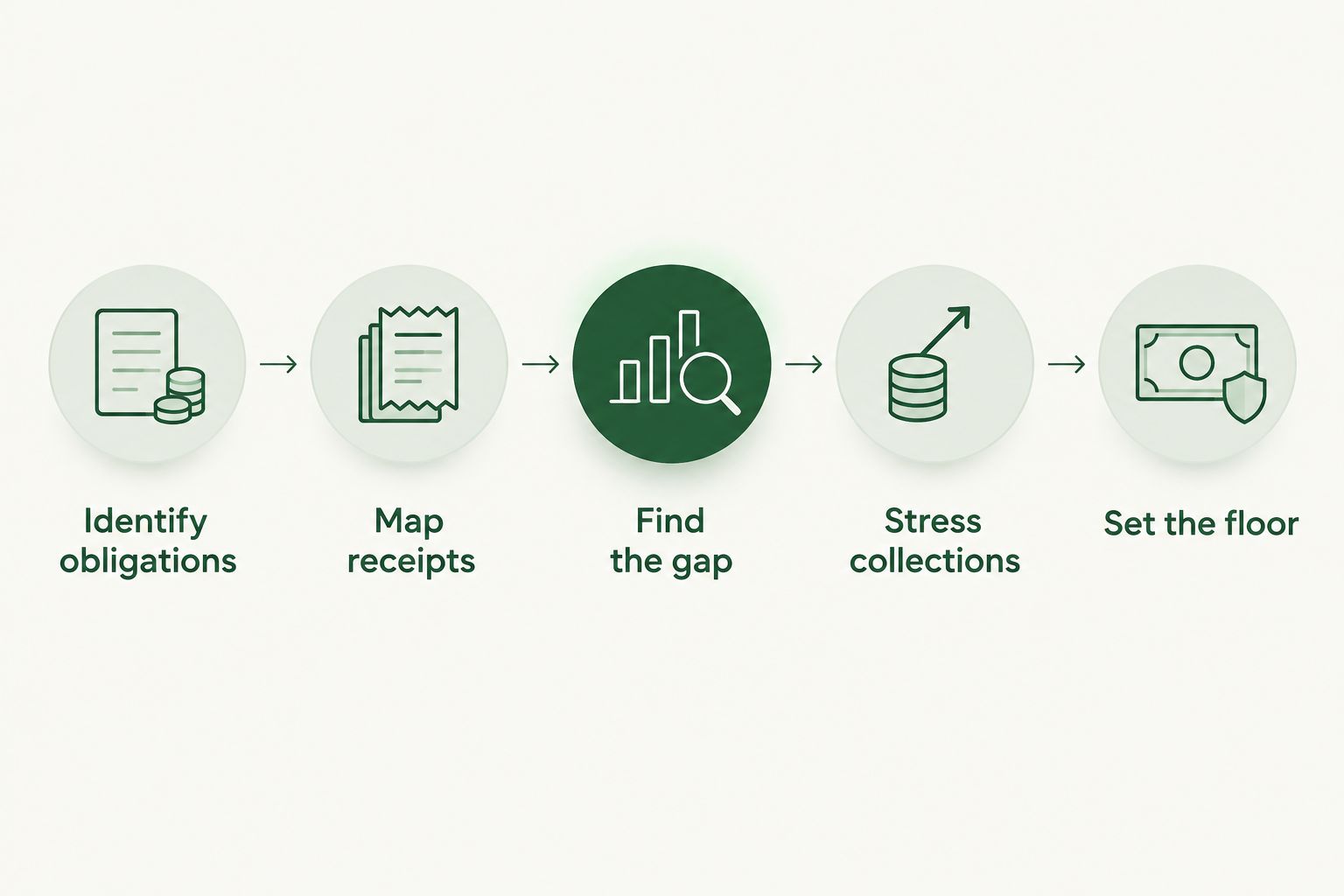
The result is a reserve policy tied to your business, not a benchmark borrowed from a different owner. Keep the assumptions beside the target so you can explain why the cash is there and when the amount needs to change.
Why your reserve target varies
Your reserve changes when the timing or reliability of cash changes. Review these factors against your own records rather than assigning every business the same cushion:
- Collection timing: Longer gaps between delivering work and receiving payment require more funding before receipts arrive.
- Customer concentration: Dependence on a major customer makes that customer's payment timing more consequential.
- Essential commitments: Payroll, leases, debt payments, and necessary suppliers determine how much spending continues during a slowdown.
- Seasonality: A predictable low-cash period belongs in the forecast, not in a vague emergency allowance.
- Planned obligations: Taxes, inventory purchases, and equipment commitments reduce the cash available for disruptions.
- Owner dependence: If your household relies on business distributions, cutting those distributions changes your personal plan as well.
For your 2026 review, identify which factor explains the largest cash gap. That is the assumption to test first. Increasing the reserve without identifying the driver makes it harder to distinguish necessary protection from cash with no assigned purpose.
Should you use months of expenses or a cash flow forecast?
Use a cash flow forecast to set the target and months of essential expenses to describe it. An expense-based measure is easy to communicate, but it does not show when customers pay or when obligations cluster.
Calculate the months-of-expenses figure only after defining the expense base. Essential cash outflows are not the same as all accounting expenses: depreciation does not create a current cash payment, while debt principal does. Your bookkeeper or CPA can help reconcile the records.
A forecast has its own limitation: its output depends on its assumptions. Review collection dates and payment commitments instead of accepting a precise-looking spreadsheet as proof that the reserve is sufficient.
Is a business line of credit a substitute for cash reserves?
A line of credit is borrowing capacity, not cash already available in your reserve. Review its terms, access conditions, and repayment obligations before including it as a backup source of funding.
Credit can address a timing gap, but borrowing introduces a repayment requirement. Show that repayment in the forecast rather than treating the advance as additional income. Keep committed cash and contingent borrowing separate in your written policy.
Should tax money count toward your business reserve?
Money assigned to a known tax obligation should not count as an uncommitted disruption reserve. Otherwise, using it for an operating shortfall creates a second shortfall when the tax payment comes due.
Coordinate the amount and payment schedule with your CPA. Keep tax estimates current when business income, owner compensation, or other relevant circumstances change. The reserve decision should use cash remaining after those obligations, not the full account balance.
Set 2 triggers for cash decisions
A reserve policy needs a reserve floor and an excess threshold. The floor protects required liquidity; the threshold identifies when cash deserves a separate allocation review. Neither trigger authorizes an automatic decision without checking current obligations.
Reserve floor
When available cash approaches the reserve floor, update collections and essential payment dates. Review discretionary spending and owner distributions before moving additional money out of the business.
Specify the person responsible for that review. Your bookkeeper can report balances, but someone must decide whether an upcoming obligation changes the floor. Make that responsibility explicit in your 2026 treasury policy.
Excess threshold
When cash exceeds the threshold, first check taxes, approved purchases, and the stressed forecast. A temporary customer payment spike does not necessarily create lasting excess cash.
Only then compare uses such as retaining liquidity, reducing debt, funding business commitments, or distributing money to the owner. Each choice has a trade-off: more liquidity leaves less cash for other goals, while moving cash out reduces the business cushion. Base the decision on purpose and timing, not the appearance of a large bank balance.
What should you bring to a reserve review?
Bring the records that explain cash timing, not just your latest profit-and-loss statement. A useful review connects what the business owes, what customers owe you, and what your household needs from the company.
Prepare:
- Current cash balances, with restricted or committed amounts identified.
- Receivables aging and expected collection dates for material invoices.
- Upcoming payroll, supplier payments, taxes, and debt obligations.
- Approved purchases and seasonal spending commitments.
- Your current owner distribution requirements.
- The reserve assumptions and action rules you want to test.
Vital Investment Management offers treasury management, investment management, financial planning, and business transition/succession planning. For owners in Loveland, Fort Collins, Berthoud, and the wider Northern Colorado region, the relevant question is how business liquidity fits with wealth outside the company and eventual transition needs.
Keep the service decision separate from the worksheet. If you want personalized help, the firm's offer is a confidential discovery call with Dillon Goodman, CPA, CFP®. Your CPA remains part of the tax coordination; the firm does not prepare tax returns.
FAQ
How much cash should a small business keep in reserve in 2026?
A small business should keep enough unrestricted cash to cover its largest projected cash shortfall plus a separate disruption buffer. Use essential payment dates, realistic collections, and known obligations to calculate the target rather than applying a universal benchmark.
Should I calculate my reserve from revenue or expenses?
Calculate your reserve from cash receipts and essential cash payments, not revenue alone. Revenue does not establish when customers will pay or how much money you need before collection.
Does money for payroll count as an emergency reserve?
Money already needed for scheduled payroll is operating cash, not an uncommitted emergency reserve. Count additional protection separately so the same balance does not fund both normal payroll and a disruption.
Can I include unpaid customer invoices in my reserve?
Unpaid customer invoices are not cash reserves. Include realistic collection dates in your forecast, but do not count the invoices as money already available to pay obligations.
Should my personal emergency fund cover business shortfalls?
Keep your personal emergency fund separate from the business reserve calculation. Any planned owner contribution needs its own review of household liquidity and the legal and accounting treatment of the transfer.
How do I know whether cash is truly excess?
Cash is excess only after essential operations, known obligations, and your chosen disruption scenario remain funded. Check planned purchases and owner needs before distributing or investing the balance.
Can a financial advisor help me set a business reserve policy?
A financial advisor can help connect a business reserve policy with treasury decisions and your personal financial plan. Vital Investment Management provides fee-only treasury management and financial planning for Northern Colorado business owners; tax obligations require coordination with your CPA.
One last thing
Test your reserve at the lowest cash point, not on the day your bank balance looks strongest. Review the balance immediately before a large payment and after a delayed receipt. That sequence tells you more about resilience than an annual average.
For your next 2026 review, write the reserve's purpose beside the dollar target. If you cannot explain what shortfall it covers, return to the forecast before moving the cash elsewhere. This article is educational, not personalized financial, tax, or legal advice.