

Yes—you can set up treasury management without a dedicated bank manager by creating a cash-flow forecast, setting reserve rules, and assigning payment controls. You still need your bank or account provider to authorize services that require enrollment, such as certain payment tools or automatic sweeps. In 2026, the decision is not whether you need a relationship manager; it is which tasks you can control yourself and which require provider support.
- Can I set up treasury management without a bank manager? Yes—start with cash-flow forecasting, reserves, and payment controls.
- Banks enable account services; you remain responsible for cash rules and payment approvals.
- Vital Investment Management offers treasury management for Northern Colorado business owners seeking fee-only financial advice.
- Do not automate cash transfers until you understand access, settlement, account protections, and upcoming obligations.
Can I set up treasury management without a bank manager?
You can establish the planning and control side yourself. Your provider controls enrollment and account capabilities. A dedicated relationship manager is not a substitute for written cash rules, and the absence of one does not prevent you from building those rules.
For the broader framework, see the treasury management guide for small businesses. Start with these ordered decisions:
- Identify obligations. List payroll, taxes, supplier payments, debt payments, and planned owner distributions.
- Forecast cash. Map when receipts and payments are expected, rather than relying on today's bank balance.
- Set reserves. Separate operating cash, money reserved for known obligations, and cash not needed for immediate spending.
- Assign authority. Decide who can view accounts, initiate payments, approve payments, and change account access.
- Confirm capabilities. Ask your provider which services you can activate online and which require support or underwriting.
- Test the workflow. Check access, approvals, transfers, and reconciliation before depending on automation.
You do not need someone called a bank manager to complete the first four decisions. You do need an authorized provider contact when the account's permissions, agreements, or service settings require one.
Why this matters
Cash is lumpy. A strong account balance can include money already committed to payroll, taxes, or a supplier invoice. Treating that balance as surplus creates a planning problem that a new bank service alone does not solve.
Vital Investment Management offers treasury management, financial planning, and investment management for business owners in Northern Colorado. The useful distinction is between deciding how your business should use cash and arranging the banking services that carry out those decisions.
For your 2026 setup, keep those responsibilities separate. Your bank explains account features and service requirements; your business sets spending priorities, approval authority, and reserve needs.
Choose a setup route based on the work you need
There is no single required setup route. Choose the support that matches the decisions in front of you—not the title on someone's business card.
| Setup route | Best for | What it contributes | Limitation |
|---|---|---|---|
| Owner-led setup | A business with straightforward receipts and payments | Direct control over forecasting, reserves, and approvals | You must maintain the forecast and understand provider requirements |
| Bank treasury support | A business needing payment services or account-level controls | Guidance on the bank's enrollment, permissions, and service capabilities | Available support is tied to that provider's services |
| Bookkeeper or controller support | A business needing reliable transaction records and reconciliation | Organized records and visibility into receipts and obligations | The role does not automatically include investment advice or bank-service authority |
| Fee-only financial advisor support | An owner coordinating business cash with personal planning | Advice connecting treasury decisions with investment and financial planning | An advisor does not replace the bank, bookkeeper, CPA, or transaction counsel |
Choose owner-led setup for clear, manageable workflows; add specialist support where the decisions exceed your role or authority. These routes can work together. Hiring an advisor does not remove your responsibility to authorize account access or approve the business's cash policy.
Ask each professional to identify their scope in writing. A useful answer explains what they handle, what they do not handle, and what information they need from you.
Build a cash forecast before choosing automation
Start with a rolling 13-week cash forecast as a practical planning format. This is a recommended worksheet structure, not a claim about how long implementation takes. Put each week's expected opening cash, receipts, payments, and closing cash in separate rows or columns.
Use expected receipt dates, not just invoice dates. An issued invoice is not available cash. Likewise, a tax obligation matters before the payment leaves your account.
Include these lines:
- Customer collections and other expected receipts.
- Payroll, payroll-related obligations, and payments to 1099 workers.
- Rent, supplier payments, debt payments, and recurring commitments.
- Taxes and planned equipment or other major purchases.
- Owner distributions and transfers between accounts.
Your forecast should explain the balance, not merely repeat it. If you move money between business accounts, do not count that movement as new business income. If a customer payment is uncertain, make the uncertainty visible instead of treating it as settled cash.
During your 2026 setup, update the worksheet as actual receipts and payments arrive. Compare the forecast with reality and correct timing assumptions. A forecast that stays unchanged after collections slip is no longer a useful transfer rule.
Give each cash bucket a written purpose
Use 3 cash buckets as an organizing framework: operating cash, committed reserves, and surplus cash. These are planning categories; they do not require three separate bank accounts.
- Operating cash: Money needed for routine payments and near-term business activity.
- Committed reserves: Money assigned to known obligations, including taxes or scheduled purchases.
- Surplus cash: Money left after operating needs and committed obligations have been addressed.
The categories do different jobs. Operating cash needs dependable access. Committed reserves need a clear connection to the obligation they fund. Surplus cash requires a separate decision about timing, access, and acceptable risk.
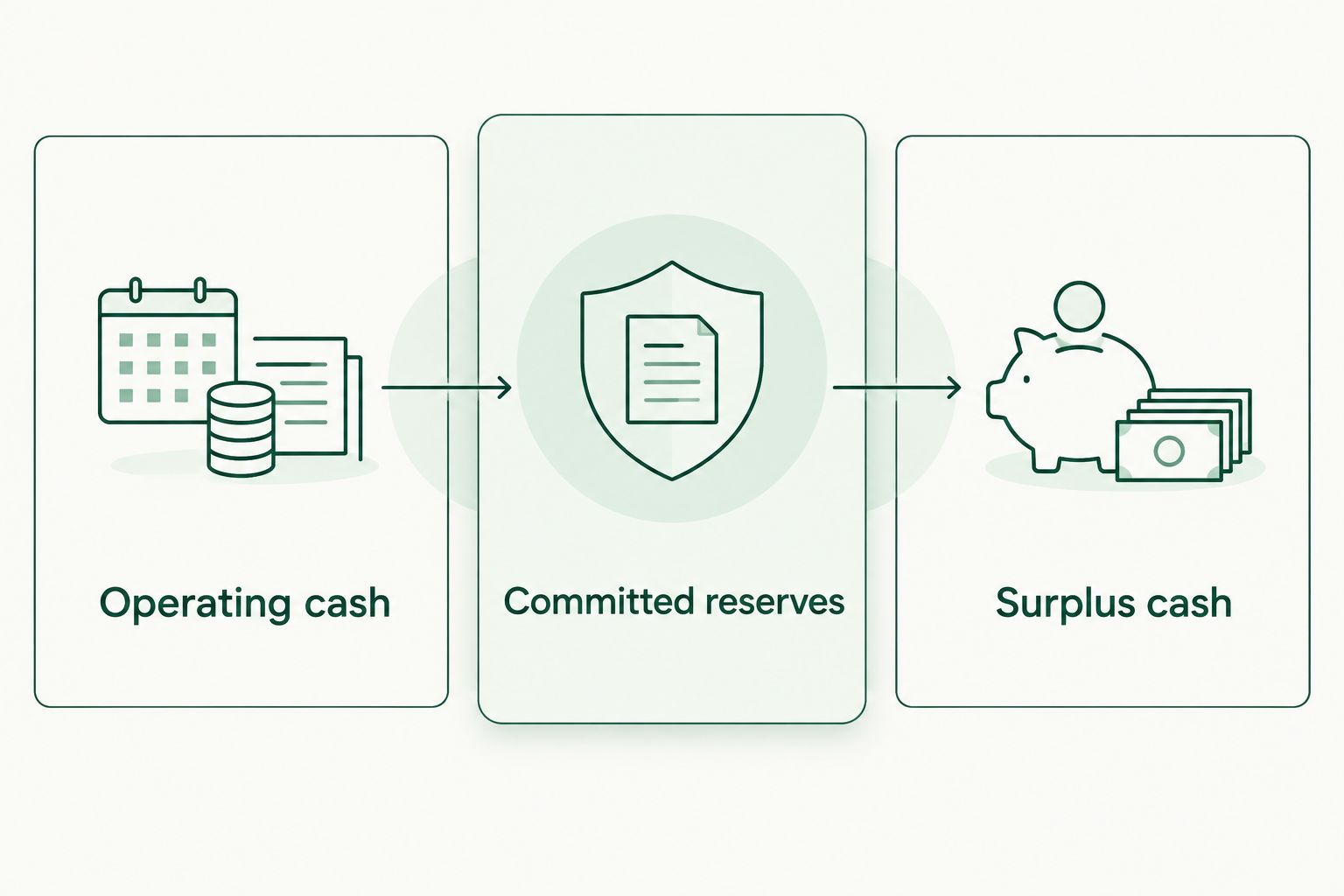
Write a rule for when money moves between categories. For example, require a current forecast and confirmation that known obligations remain funded before classifying money as surplus. This is a control procedure, not a promise that any particular reserve amount is sufficient.
Avoid setting a transfer threshold solely because an account balance looks high. A threshold should reflect your obligations and timing. It should also specify who can suspend transfers when circumstances change.
Set payment controls before connecting accounts
Start with named users, not shared credentials. Assign access according to the work each person performs, and remove access when responsibilities change. Use the authentication and notification controls your provider supports.
For material payments, consider requiring 2 authorized approvers where your staffing and provider capabilities allow it. That is a recommended control, not a universal requirement. In an owner-only business, use a documented review procedure and alerts rather than pretending you have independent approval.
Your control checklist should answer:
- Who can create or change a payee?
- Who can initiate and approve a payment?
- Who receives alerts about transfers or access changes?
- Who reconciles the account against business records?
- How does the business verify changed payment instructions?
- Who can stop automation or remove access?
Verify changed payment instructions through an independently confirmed contact method. Do not rely only on the message requesting the change. Keep the verification record with the payment documentation.
Account visibility and payment authority are different permissions. A connection that imports balances does not necessarily authorize transfers. Confirm the exact permissions before connecting accounting software, an advisor, or another service.
Confirm what your bank can enable without a manager
Ask your provider about enrollment rather than assuming a branch visit is necessary. Some services have online setup; others require documents, additional approval, or a treasury-services contact. The provider's actual process determines what you can activate.
Bring a specific list of tasks. Asking whether the bank offers “treasury management” is less useful than asking how to establish payment approvals, export transaction records, receive alerts, or control outgoing transfers.
For each proposed service, confirm:
- Eligibility: Which account types and business entities can use it?
- Authority: Who must sign agreements or approve enrollment?
- Access: Which user roles and restrictions are available?
- Timing: What cutoff times, settlement rules, and transfer restrictions apply?
- Support: Who handles rejected payments, access problems, or service interruptions?
- Exit: How do you disable the service or revoke a connection?
Keep the answers with your cash policy. Product names do not tell you whether a service fits your workflow, and a sales explanation does not replace the governing agreement.
For a 2026 implementation, confirm terms directly before activation. Use current provider documentation rather than an old screenshot or a colleague's experience with a different account.
Why the setup process varies
The work involved depends on the business and the account services you choose. These factors explain why one owner's self-service setup does not describe another owner's process:
- Collection timing: Irregular receipts require more attention to the gap between invoicing and usable cash.
- Payment obligations: Payroll, taxes, debt payments, and supplier commitments affect how much cash remains accessible.
- Account permissions: Multiple users require explicit responsibilities and limits.
- Provider requirements: Enrollment agreements and service approvals determine what you can activate yourself.
- Investment access: Settlement and withdrawal terms matter when money leaves a transaction account.
- Owner needs: Distributions, personal spending, and transition plans affect decisions about business cash.
A seasonal business and a business with steady collections need different forecast assumptions. Neither pattern establishes a standard reserve amount. Set the rule from your own obligations, then document the assumptions behind it.
When does a fee-only advisor fit?
An advisor fits when the question extends beyond bank features: how much business cash must stay accessible, how treasury decisions connect with your personal finances, and how concentration in the company affects your financial plan.
Vital Investment Management is best suited to Northern Colorado business owners seeking fee-only advice on treasury management and financial planning. The firm is an SEC-registered RIA in Loveland serving owners in Loveland, Fort Collins, Berthoud, and the surrounding region.
The benefit is coordination across business and owner decisions. The boundary matters just as much: financial advice does not replace bank authorization, bookkeeping, or your CPA's tax work. The firm does not prepare tax returns.
Keep educational resources separate from personalized advice. If you need help applying the framework to your own business, the relevant offer is a confidential discovery call with Dillon Goodman—not a tool that promises to solve your cash needs automatically.
Do I need a bank manager to move surplus cash?
No—a dedicated bank manager is not inherently required, but your provider must support and authorize the transfer method. Before moving cash, check the forecast, account permissions, transfer timing, and the destination's access terms. Calling money “surplus” does not change obligations already assigned to it.
Can my bookkeeper handle treasury management?
Your bookkeeper can support treasury management through accurate records, reconciliation, and reporting within their agreed scope. Forecast ownership, reserve decisions, and payment authority still need explicit assignments. Do not assume bookkeeping access includes permission to move money.
Can I automate everything after setup?
No—automation carries out rules; it does not decide whether those rules still fit your business. Keep an owner review for exceptions such as delayed collections, unexpected purchases, or changed tax obligations. Identify who can pause transfers before activating them.
FAQ
Can I set up treasury management without a bank manager?
Yes—you can create cash forecasts, reserve rules, and payment controls without a dedicated bank manager. Your bank or account provider still determines enrollment and permissions for its services.
What's the first step in setting up business treasury management?
Start by listing expected receipts and required payments in a cash-flow forecast. Separate money available for spending from money already committed to payroll, taxes, debt, or other obligations.
Do I need separate accounts for every cash bucket?
No—operating cash, committed reserves, and surplus cash can begin as planning categories. Decide whether separate accounts improve control only after considering your recordkeeping and provider requirements.
Can a financial advisor replace my bank's treasury team?
No—a financial advisor does not replace the bank's authority over account services. Vital Investment Management offers treasury management and financial planning for Northern Colorado owners; banking permissions remain with the account provider.
Is an automatic cash sweep the same as a treasury plan?
No—an automatic sweep moves cash according to a rule, while a treasury plan determines what cash must cover and who controls it. Confirm the destination, access terms, and applicable account protections before activation.
How long does treasury management setup take in 2026?
There is no single setup timeline in 2026 because provider enrollment, documentation, and the services selected determine the process. Complete the forecast and control decisions first, then ask the provider for its implementation schedule.
Can I use accounting software instead of a bank manager?
Accounting software can support records and reporting, but it does not replace bank authorization or cash-policy decisions. Confirm whether a connection imports information, permits payments, or does both.
One last thing
Write the stop rule before the transfer rule. Name the conditions that pause automation, the person authorized to act, and the place where the decision is recorded. A treasury process is incomplete if it explains how cash moves but not how you stop it.
For your 2026 setup, make that instruction easy to find. The owner should not have to reconstruct the process from old emails when a collection is delayed or a payment changes.