

Transition your business to your children by separating who will run it, who will own it, and how you will replace your income, then documenting the transfer with your financial advisor, CPA, valuation professional, and attorney. A gift, sale, or staged transfer can fit different family goals, but each creates different cash-flow, tax, and control decisions. Do not transfer ownership before you have a workable leadership plan and a personal income plan.
- How do I transition my business to my children? Separate leadership, ownership, and retirement income before choosing a transfer structure.
- VIMSmallBusiness provides financial planning and business succession planning, coordinating with your legal, tax, and valuation professionals.
- A gift transfers ownership without sale proceeds; a sale requires a workable funding plan.
- Write down decision rights, sibling expectations, and your role after the transfer.
Why this matters
Your children inheriting the business is not the same as your children being ready to operate it. Ownership documents do not teach someone to manage payroll, retain customers, or make difficult staffing decisions. Your retirement also needs funding that does not depend on you continuing to work indefinitely.
For your 2026 succession plan, keep the family conversation separate from the transaction paperwork until you have agreed on the basic direction. The family-business succession planning guide provides additional context for organizing those decisions.
How do I transition my business to my children?
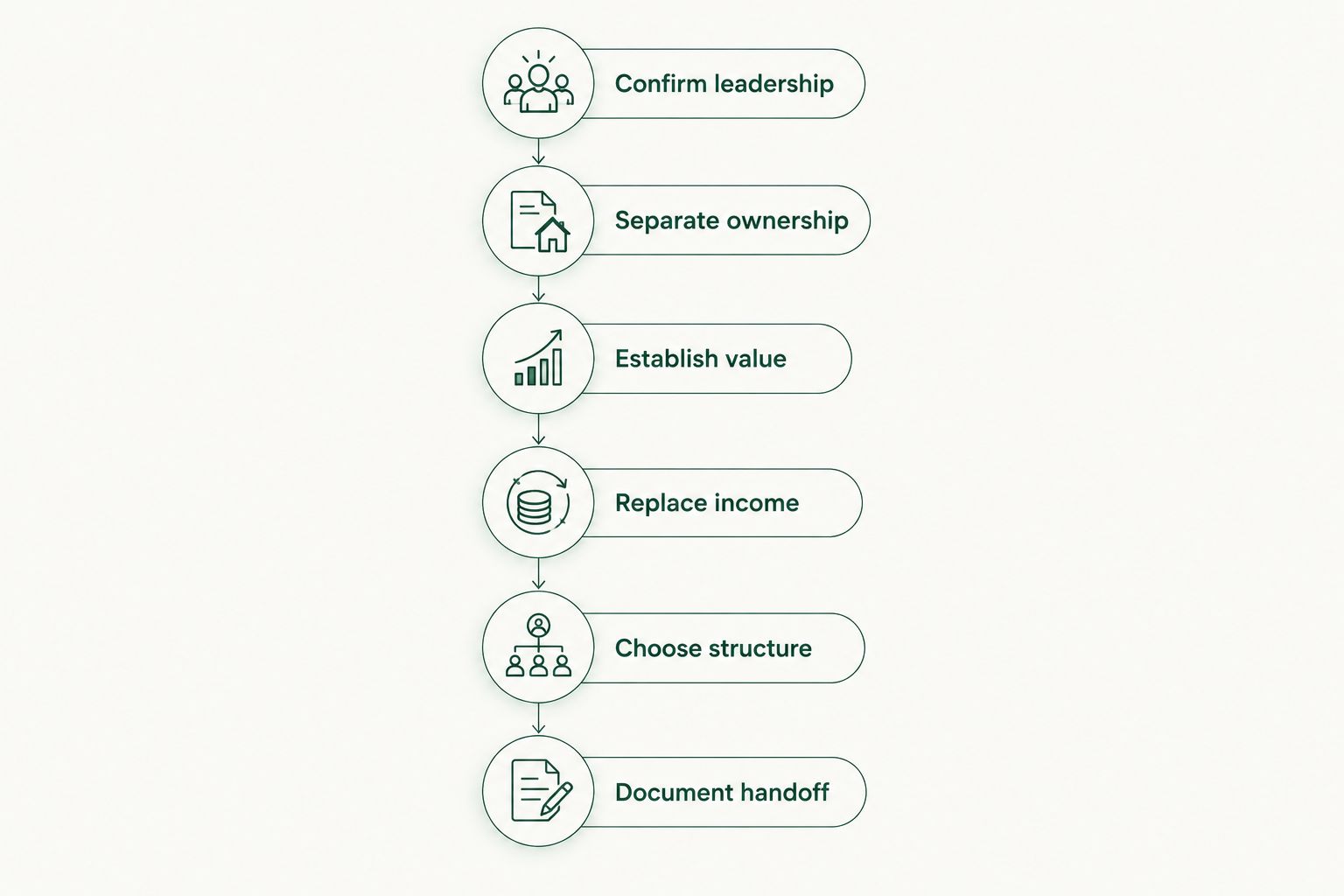
Build the transfer around 3 decisions: leadership, ownership, and income replacement. Use these 6 steps to turn the family’s intention into a plan your professional team can evaluate.
1. Confirm who wants to lead
Ask each child whether they want to work in the business, lead it, own a share, or stay outside it. Those are different choices. Do not treat a child’s willingness to help as agreement to become the next chief executive.
Write a role description for the intended successor. Include responsibility for employees, customer relationships, cash flow, and difficult decisions—not just a title. Define how you will assess readiness before transferring management authority.
2. Separate management from ownership
Decide who will make operating decisions and who will have ownership rights. A child who works in the company can have a management role without every sibling having the same role. Ownership and employment should not be interchangeable promises.
Ask your attorney to explain how the proposed ownership structure handles voting, distributions, departures, disability, and death. Clarify who can hire, borrow, sign contracts, and approve major spending. A family understanding needs to become an enforceable agreement, not an assumption.
3. Establish a defensible business value
Engage a qualified valuation professional for the transfer’s purpose. A number you use for retirement planning is not automatically the right value for a gift, sale, lender review, or legal agreement. Explain the intended transaction before asking for the valuation.
Organize financial statements, ownership records, debt information, and the compensation you take from the company. Identify expenses that belong to you personally rather than to the continuing business. The successor needs to understand the economics after your role changes.
4. Build your income replacement plan
List the salary, distributions, benefits, and business-paid expenses that support your household. Then identify which will end, which will continue, and which depend on the company’s future cash flow. Separate income from a continuing job from income associated with ownership or a sale.
Use your actual 2026 household spending and obligations as the starting point. Your advisor should evaluate the proposed transfer alongside assets outside the company, taxes, debt, and retirement needs. Do not assume that keeping a consulting title solves an income shortfall.
5. Choose the transfer structure
Compare a gift, sale, and staged transfer with your professional team. Decide whether you need proceeds, whether your children can fund a purchase, and how much control you intend to retain. The structure should follow those answers.
Have your CPA evaluate the tax consequences and your attorney prepare the documents. If financing is involved, confirm the lender’s requirements and the buyer’s repayment capacity before relying on that financing in your personal plan.
6. Document the handoff and fallback
Create a written transition plan covering responsibilities, authority, ownership changes, and your remaining role. Include how the family will respond if a child leaves, the business cannot support the proposed payments, or you cannot continue working.
Review customer, employee, lender, and vendor communications separately. Explain who is responsible for what without announcing terms that are not finalized. A clean handoff requires consistent authority inside the company as well as signed documents.
Which transfer structure fits your family?
A gift, sale, or staged transfer answers a different financial problem. Use this comparison to frame the discussion, not to choose a transaction without individual tax and legal advice.
| Transfer structure | Best for | Main advantage | Main limitation |
|---|---|---|---|
| Gift | Owners who do not need purchase proceeds from the transferred interest | Moves ownership without requiring a purchase payment | Does not itself replace your income; tax and estate consequences need review |
| Sale | Owners who need proceeds and children with a workable funding plan | Connects the ownership transfer to an agreed purchase obligation | Financing and repayment can strain business cash flow |
| Staged transfer | Families that need leadership and ownership to change separately | Allows authority and ownership to follow defined milestones | Extends shared decision-making and requires clear documents |
Choose the structure that supports both the continuing business and your life outside it. A favorable family arrangement is not workable if the company cannot meet payroll or you cannot fund your household.
Gift: best for owners who do not need sale proceeds
A gift transfers an ownership interest without a purchase payment for that interest. It does not create a retirement paycheck. Before gifting, test whether your other assets and retained income support the household plan.
Ask your CPA and attorney to evaluate the proposed gift, valuation, reporting requirements, and estate-plan consequences under the rules applicable in 2026. Avoid assuming that a family transfer has no tax consequences simply because no cash changes hands.
A gift also requires a control decision. Establish what authority accompanies the transferred interest and how future distributions will be determined. Do not promise ownership while leaving its practical rights undefined.
Sale: best for owners who need proceeds
A sale requires an agreed value and a credible source of payment. Your children’s enthusiasm is not financing. Evaluate buyer resources, any lender involvement, and the cash the business needs to operate after the transaction.
If seller financing is part of the discussion, recognize that your future payments depend on repayment. Ask your attorney about documentation, security, default terms, and enforcement; ask your advisor how a missed payment would affect your household.
Keep the business forecast separate from your personal budget. Stress-test payroll, debt service, taxes, reinvestment, and owner payments together. Do not count the same cash as operating reserves and retirement income.
Staged transfer: best for families testing readiness
A staged transfer separates the leadership handoff from changes in ownership. You can establish operating responsibilities first and define subsequent ownership decisions through professional documentation. The sequence needs specific milestones, not an open-ended promise.
Examples of milestones include taking responsibility for the budget, managing a key customer relationship, or making staffing decisions within agreed authority. These are readiness checks, not guarantees of future business performance.
The drawback is prolonged overlap. If your child is responsible for outcomes while you continue overruling decisions, the title has changed but the authority has not. Define which decisions you retain and which you release.
Why family business transitions vary
The right sequence depends on the business and the family—not a standard retirement date. These factors determine which decisions your team needs to resolve first:
- Successor readiness: Your child’s experience and willingness to lead shape the management handoff.
- Your income needs: Reliance on salary, distributions, or sale payments shapes the financial structure.
- Business cash flow: Payroll, debt, working capital, and reinvestment compete with transfer-related payments.
- Sibling participation: Children working inside and outside the company bring different ownership and income expectations.
- Valuation and professional review: The transaction purpose and its tax and legal consequences shape documentation.
Turn each factor into a written question for your next planning meeting. For example, ask what happens to your household budget if distributions stop, or who decides whether the company retains earnings rather than distributing them.
How do I treat children fairly if only one works in the business?
Fairness does not require identical jobs or identical decision rights. Separate compensation for work from ownership benefits, then discuss how the business fits alongside the rest of your estate.
Start with 2 written plans: one for operating authority and one for ownership and inheritance. Ask your attorney and financial advisor to examine them together. Do not promise nonparticipating children distributions that the business cannot support.
Make expectations explicit before signing. A working child needs to know whether they can make operating decisions; a nonworking child needs to know what ownership means and how they can exit it.
When should I stop making daily decisions?
Stop making a daily decision when your successor has the authority, information, and responsibility to make it—not merely when you announce a new title. Match the handoff to demonstrated readiness and the authority recorded in your agreements.
For a transition beginning in 2026, write down which decisions stay with you and which move to the successor. Set a review process for disagreements. Employees need a clear reporting line, not competing instructions from parent and child.
What happens if my child changes their mind?
Your transition plan should address departure before ownership changes. Discuss resignation, a change in career goals, disputes, and the possibility that no child wants the leadership role.
Ask counsel how the agreements handle ownership transfers, buyouts, and decision rights in those circumstances. Keep an alternative leadership path in the plan. A family succession goal should not leave the company without an operating decision-maker.
Where a financial advisor fits
VIMSmallBusiness is best for Northern Colorado business owners who need financial planning coordinated with business succession planning. The practice is a fee-only fiduciary and SEC-registered RIA in Loveland, serving owners in Fort Collins, Berthoud, and the wider region.
VIMSmallBusiness provides financial planning and business transition/succession planning and coordinates with legal, tax, and valuation professionals. It does not broker transactions or provide legal, tax, valuation, lending, or ESOP administration services. That distinction matters: household planning does not replace transaction advice.
If you need personalized help, the offer is a confidential discovery call with Dillon Goodman, CPA, CFP®, through VIMSmallBusiness. Educational resources are separate from that conversation and are not personalized recommendations.
FAQ
How do I transition my business to my children without losing my income?
Build your income replacement plan before transferring ownership. Identify which salary, distributions, benefits, or sale payments will support your household, then evaluate whether the business and your outside assets support that plan.
Is it better to gift my business to my children or sell it?
A gift fits owners who do not need purchase proceeds from the transferred interest; a sale requires a workable funding plan. Your CPA, attorney, valuation professional, and financial advisor should evaluate the choice against your household needs and family goals.
Can I transfer ownership but keep managing the business?
Ownership and management can be addressed separately in the transition documents. Have your attorney define voting rights, operating authority, compensation, and the conditions for your eventual management exit.
Should all my children own equal shares of the business?
Equal shares are not a substitute for a workable governance plan. Discuss who works in the company, who makes decisions, how distributions are determined, and how ownership fits with the rest of your estate.
Do I need a valuation to pass my business to my children?
Engage a qualified valuation professional to determine the appropriate valuation work for your proposed transfer. A gift, sale, lender review, and legal agreement can require different purposes and documentation.
What professionals should help with a family business transition?
A financial advisor, CPA, transaction or estate-planning attorney, and qualified valuation professional address different parts of the transfer. Add lender involvement when the proposed purchase relies on financing.
Can VIMSmallBusiness help with passing a business to my children?
VIMSmallBusiness offers financial planning and business transition/succession planning for Northern Colorado owners. The practice coordinates with legal, tax, and valuation professionals rather than providing those transaction services itself.
One last thing
Your successor’s first real test is not signing the ownership documents. It is making a decision you would have made differently. Decide how you will handle that moment before handing over authority. Otherwise, the company gets a new leader who still needs permission to lead.
Put one practical task on your 2026 transition agenda: draft separate lists of decisions you will retain and decisions your child will own. Review those lists with the successor and your professional team before turning them into agreements. Clear boundaries make the handoff more concrete than a retirement date alone.