

The cost to hire a financial planner in Colorado depends on the billing model and the work included: hourly advice, a fixed project, an ongoing subscription, or a fee tied to managed investments. Compare written quotes for the same scope, not just the headline fee. Your total expense also depends on whether investment expenses and separate CPA, legal, or valuation work sit outside the planning engagement.
- How much does it cost to hire a financial planner in Colorado? Compare the billing model, scope, and exclusions.
- VIMSmallBusiness financial planning serves Northern Colorado business owners; separate planning needs from investment management needs.
- Hourly advice fits a defined question; ongoing planning fits decisions that need repeated attention.
- Get a written quote that identifies deliverables, implementation responsibilities, and separate professional expenses.
How much does it cost to hire a financial planner in Colorado?
Your cost is determined by the agreement you sign, including its billing basis, covered services, and exclusions. For a 2026 comparison, ask each Colorado planner to quote the same assignment. A retirement projection alone is not the same engagement as coordinating household cash flow, business treasury, investments, and succession.
VIMSmallBusiness financial planning is best suited to Northern Colorado business owners seeking coordinated business and personal financial advice. The practice is a fee-only fiduciary and SEC-registered RIA in Loveland, serving owners in Fort Collins, Berthoud, and the surrounding region. Its services include treasury management, investment management, financial planning, and business transition or succession planning.
Use these 4 billing models to organize your comparison. These are engagement structures, not a statewide price schedule; an individual firm’s agreement determines what you receive.
| Billing model | Best for | Main advantage | Main limitation | What your quote must explain |
|---|---|---|---|---|
| Hourly advice | A defined question or limited review | You purchase work on a specific issue | An open-ended assignment makes total expense harder to control | Estimated hours, tasks, and approval for additional work |
| Fixed project | A written plan with an agreed endpoint | You know the agreed project charge before work starts | Updates and implementation support can sit outside the project | Deliverables, revisions, completion criteria, and exclusions |
| Ongoing subscription | Recurring decisions and plan updates | Advice continues as your circumstances change | You pay for continued service rather than a single deliverable | Meeting schedule, access, updates, and cancellation terms |
| Asset-based management | Investment management with clearly defined planning support | Portfolio oversight and advice can share an engagement | The dollar charge changes with the assets subject to the fee | Included accounts, calculation method, billing schedule, and planning scope |
Choose the assignment before choosing the billing model. Otherwise, you risk comparing a narrow consultation with a continuing advisory relationship and treating them as interchangeable.
Why this matters for a business owner
Cash is lumpy. Your company’s bank balance, your household spending, and the value of your ownership stake answer different questions. A planner’s job should address the question you actually need resolved—not produce a longer document than you need.
For example, deciding how much cash the company must retain is different from deciding how to invest personal assets. Preparing for a transition adds another layer: how your household will function without the income and benefits attached to ownership.
Write down the decision that prompted your search. For your 2026 engagement, that sentence becomes the test for every proposal: does the proposed work help you make that decision, and who is responsible for carrying it out?
Hourly advice: define the question before work begins
Best for: a specific decision with a clear stopping point. Hourly advice works as a purchasing structure when you can describe the issue, provide the relevant records, and agree on what constitutes a completed review.
A useful assignment might be reviewing your household cash-flow assumptions before you reduce your working hours. The deliverable should explain the assumptions, identify unresolved questions, and state the next decisions. It should not leave you guessing whether implementation is included.
The drawback is an uncertain workload when the records or assignment are incomplete. Ask the planner to distinguish the initial review from additional analysis and to obtain your approval before expanding the work.
Your quote should answer:
- What question will the planner address?
- What records must you provide?
- What written output will you receive?
- What triggers additional work?
- How will you approve a revised estimate?
Use hourly advice for a bounded assignment, not an undefined request to fix everything. If the issue spans treasury, household planning, and transition, define those workstreams separately before agreeing to the engagement.
Fixed-project planning: agree on the finish line
Best for: a defined plan you can review and implement. A fixed project gives you an agreed assignment and an agreed charge. Its value depends on whether the deliverables are specific enough to use.
Ask whether the project includes a written financial plan, an assumptions review, a prioritized action list, and a meeting to explain the recommendations. Then ask what happens after delivery. A plan and continuing oversight are different services.
The main limitation is the boundary around the project. Changes in your business income, family circumstances, or transition timing can require another review. Do not assume the original agreement covers future revisions indefinitely.
For a 2026 planning project, define the endpoint in practical terms: you understand the recommendations, know which decisions remain open, and have assigned responsibility for the next actions. A document alone does not establish that endpoint.
Choose a fixed project when you want a clear deliverable and can take responsibility for follow-through. If you need continuing coordination, ask for that separately rather than assuming it comes with the plan.
Ongoing planning: specify what continues
Best for: decisions that require repeated review. Ongoing planning is a different purchase from a one-time report. You are paying for a continuing service, so the agreement needs to describe that service plainly.
Ask what gets reviewed, how meetings are scheduled, and how you raise a question between meetings. Determine whether changes in business cash flow, household spending, investment needs, and succession plans fall within the engagement.
The limitation is paying for a relationship without knowing what activity it includes. Access alone is not a substitute for an agreed review process. You should be able to identify what the planner will revisit and what you must initiate yourself.
Choose ongoing planning when your decisions need continuing attention. For a single unresolved question, compare a limited assignment first. Do not buy a recurring service simply because it is presented as the default option.
Asset-based management: separate investments from planning
Best for: delegated investment management with an explicit advisory scope. An asset-based fee uses the value of specified managed assets as its billing basis. That describes how the charge is calculated; it does not tell you everything included.
Ask which accounts are covered and whether planning is included, separately charged, or limited to particular topics. Business cash, personal investments, retirement accounts, and assets held elsewhere need explicit treatment in the agreement.
The main limitation is that the dollar charge changes with the assets subject to the fee. You also need to understand investment expenses outside the advisory charge. Ask the advisor to show those categories separately rather than blending them into an unexplained total.
Do not assume more managed assets means more planning work. Compare the investment service and the planning service on their own terms, then decide whether combining them suits your needs.
Why financial planning costs vary
For a Colorado business owner, the useful comparison is not the city name on the proposal. It is the work required and the responsibility the planner accepts. Compare these factors in your 2026 quotes:
- Planning scope. Household planning, business treasury, investment management, and succession are distinct assignments. Identify which ones the quote includes.
- Business and household coordination. Advice must distinguish cash available to the company from cash available for your personal goals.
- Investment responsibility. Giving recommendations differs from managing specified investment accounts under an advisory agreement.
- Review frequency. A completed project differs from continuing updates as your circumstances change.
- Professional coordination. Meetings with your CPA, attorney, or valuation professional need a defined purpose and a clear billing boundary.
- Implementation support. Identify who handles each action and which tasks require a separate professional engagement.
Ask for a scope explanation whenever quotes differ. A lower charge for fewer responsibilities is not automatically a better deal, and a higher charge is not evidence of better advice.
How do you compare Colorado financial planner quotes?
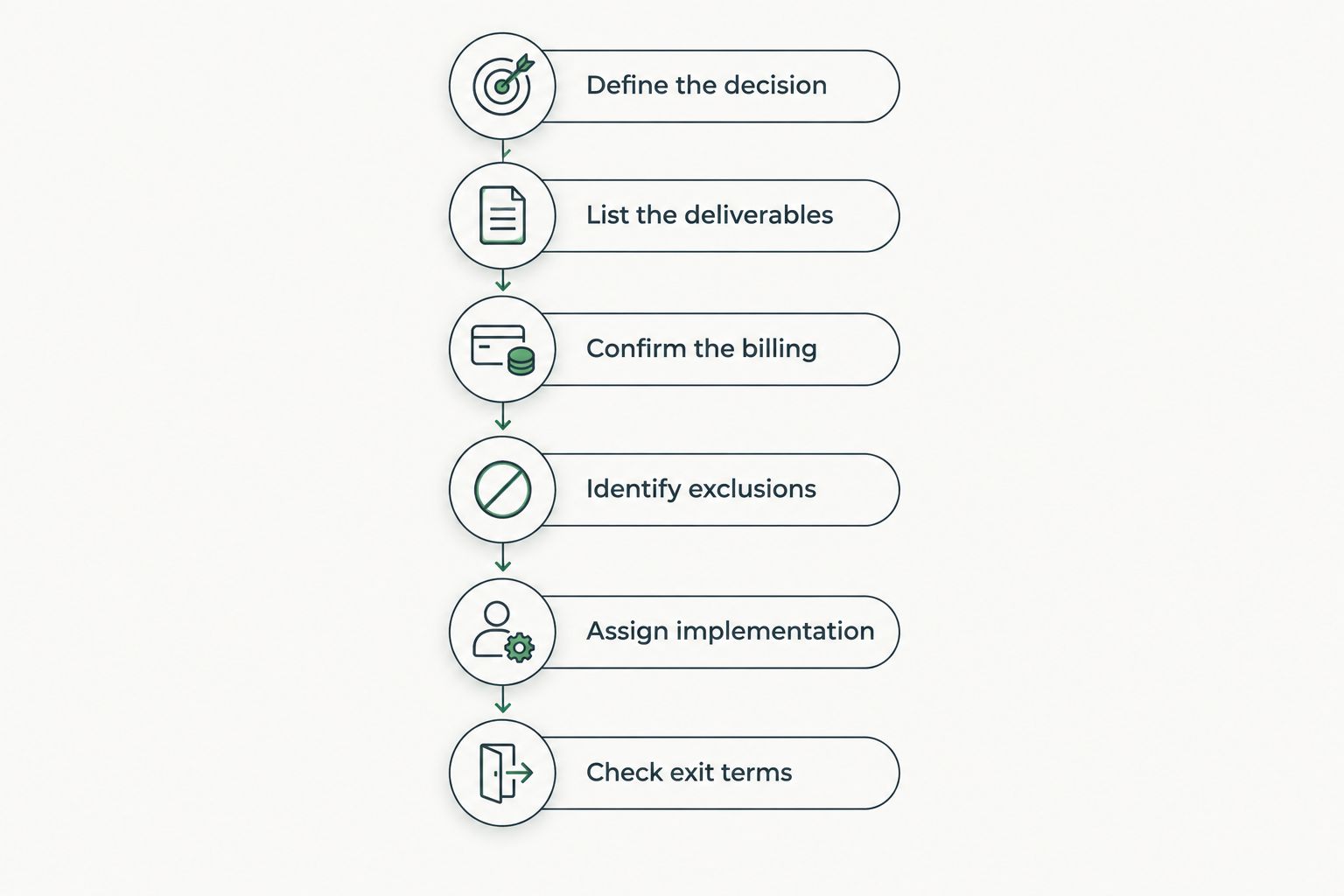
Use 6 questions to make proposals comparable. Ask local fee-only advisors in Loveland, Fort Collins, Berthoud, and wider Northern Colorado to answer them in writing before you decide.
- Define the decision. What business or household decision will this engagement help you make? Replace broad requests with a specific outcome.
- List the deliverables. What written analysis, recommendations, and action list will you receive? Clarify how the planner will explain them.
- Confirm the billing. How is the charge calculated, when is it billed, and what requires additional approval?
- Identify exclusions. Which investment expenses and separate professional services are outside the quote?
- Assign implementation. Who carries out each recommendation, and what follow-up belongs to the planner?
- Check exit terms. How do you end the engagement, and what happens to unfinished work or continuing account management?
Keep 3 documents together: the written proposal, the advisory agreement, and the firm’s disclosure brochure. Check that their descriptions of billing, services, and conflicts agree. Ask about any difference before signing.
Does fee-only mean every expense is included?
Fee-only describes how the advisor is compensated; it does not mean every related expense is included. Your advisory agreement still needs to identify planning charges, investment-management charges, and expenses outside the engagement.
Ask the advisor to explain compensation and conflicts in plain language. If the terms are unfamiliar, review the difference between fee-only and fee-based advisors before comparing proposals.
Treat compensation structure and service scope as separate checks. Understanding one does not remove the need to understand the other.
Do you still need a CPA or attorney?
Financial planning does not replace tax preparation, legal advice, or a formal business valuation. Assign those responsibilities explicitly when your plan involves ownership transfers, tax decisions, or transaction documents.
VIMSmallBusiness coordinates with legal, tax, and valuation professionals; it does not prepare tax returns, broker business transactions, or provide legal, tax, valuation, lending, or ESOP administration services. That boundary matters when you assess the full work required for a transition.
Budget the assignment across the professionals responsible for it. An advisory quote is not automatically the total cost of completing a business transaction.
Is hiring a planner worth it if your money is tied up in the business?
An ownership stake and spendable personal assets are different resources. Financial planning can address how business cash flow, household needs, investment concentration, and transition plans fit together without treating the company’s estimated value as cash you already have.
Start with the decision you need to make. If you need to understand income replacement after an exit, ask for that analysis rather than a proposal centered only on investment accounts.
Match the service to the problem, not the size of a balance on paper. For your 2026 comparison, require the proposal to explain how it addresses your ownership position and personal cash needs.
FAQ
How much does it cost to hire a financial planner in Colorado?
Your cost depends on the agreed billing model, scope, and exclusions. Request written quotes for the same assignment and separate advisory charges from investment expenses and other professional work.
What's the best billing model for a one-time planning question?
Hourly advice or a fixed project fits a defined, one-time question. Agree on the deliverable, stopping point, and approval process for additional work before the engagement begins.
Is an ongoing financial planning subscription better than a fixed plan?
Ongoing planning fits repeated decisions, while a fixed plan fits an agreed project with an endpoint. Compare the continuing review responsibilities rather than assuming either structure is better.
Does an investment management fee include financial planning?
An investment management fee includes financial planning only when the agreement says it does. Ask which planning topics, meetings, and updates are covered and which are separately charged.
Can a fee-only financial advisor still have expenses outside the quote?
Yes, a fee-only advisory engagement can have investment expenses and separate professional services outside its scope. Ask for those categories to be identified before you sign.
Does VIMSmallBusiness prepare business owners' tax returns?
VIMSmallBusiness does not prepare tax returns. The practice coordinates financial planning with the owner's CPA and other professionals while keeping those service responsibilities separate.
What should I bring to a financial planner before requesting a quote?
Bring a clear description of your decision and an outline of your business and household finances. Ask which records the planner needs before sending account statements or other sensitive documents.
One last thing
The most useful line in a planning proposal is often the exclusion. It tells you which responsibilities remain yours and which require someone else. Read it alongside the deliverables, not after you have signed.
Before choosing a planner in 2026, finish this sentence: after this engagement, I will be able to decide what to do about my specific problem. If the proposal does not support that sentence, revise the scope before negotiating the charge.
This article is educational, not personalized financial, tax, or legal advice. A confidential discovery call with Dillon Goodman is a separate opportunity to discuss whether the practice fits your needs; the article itself is not an advisory engagement.