

Yes—a fee-only advisor can advise on your 401k and manage investments when your plan permits access and you grant the required authority. Fee-only describes how the advisor is paid, not permission to trade in your account. As a business owner, separate help with your own retirement balance from investment oversight for an employee plan; neither automatically includes payroll, tax filings, or plan administration.
- Can a fee-only advisor manage my 401k as a business owner? Yes, when plan access and written authority permit.
- Personal 401k advice and employee-plan investment oversight are different assignments; define the scope before signing.
- VIMSmallBusiness fits Northern Colorado owners seeking coordinated financial planning and investment management.
- Keep retirement contributions separate from operating cash, tax reserves, and payroll obligations.
Can a fee-only advisor manage my 401k as a business owner?
Yes, but the plan documents and advisory agreement determine what the advisor can actually do. An advisor can recommend an allocation without having authority to place trades. Direct management requires an approved access arrangement, an agreed investment mandate, and authorization accepted by the plan provider.
Before hiring anyone, use these eight questions to ask a small-business financial advisor to clarify responsibility. Start with the most practical question: Who implements a recommendation after you approve it?
| Arrangement | Best for | What the advisor does | Benefit | Limitation |
|---|---|---|---|---|
| Personal-account advice | Owners who want guidance and retain control | Reviews available investments and recommends an allocation | Connects the account to your wider financial plan | You implement changes unless separate trading authority exists |
| Authorized account management | Owners who want investment decisions delegated | Places trades within the access and authority the provider accepts | Separates investment implementation from your daily workload | Provider restrictions and the available investment menu still apply |
| Employer-plan investment oversight | Owners responsible for a plan covering employees | Advises on or manages plan investments under a defined fiduciary agreement | Establishes a documented investment process | Does not automatically include administration, payroll, or compliance testing |
The distinction matters whether you have an owner-only account or sponsor a plan covering employees. Do not accept a proposal that uses the word management without identifying the account, the authority, and the person responsible for implementation.
Why this matters
You wear two different hats: retirement saver and business owner. If your company sponsors a retirement plan, you also have responsibilities to the plan and its participants. Advice that works for your personal account does not automatically satisfy those responsibilities.
For your 2026 planning, the useful question is not simply whether an advisor understands investments. It is whether the engagement connects your retirement account to cash flow, taxes, concentration in the business, and your eventual transition without leaving administrative responsibilities unassigned.
A tidy allocation cannot fix missed payroll contributions. Nor does an investment agreement establish that someone else handles participant notices or annual filings. Match the agreement to the job you need done.
How to confirm whether an advisor can manage your account
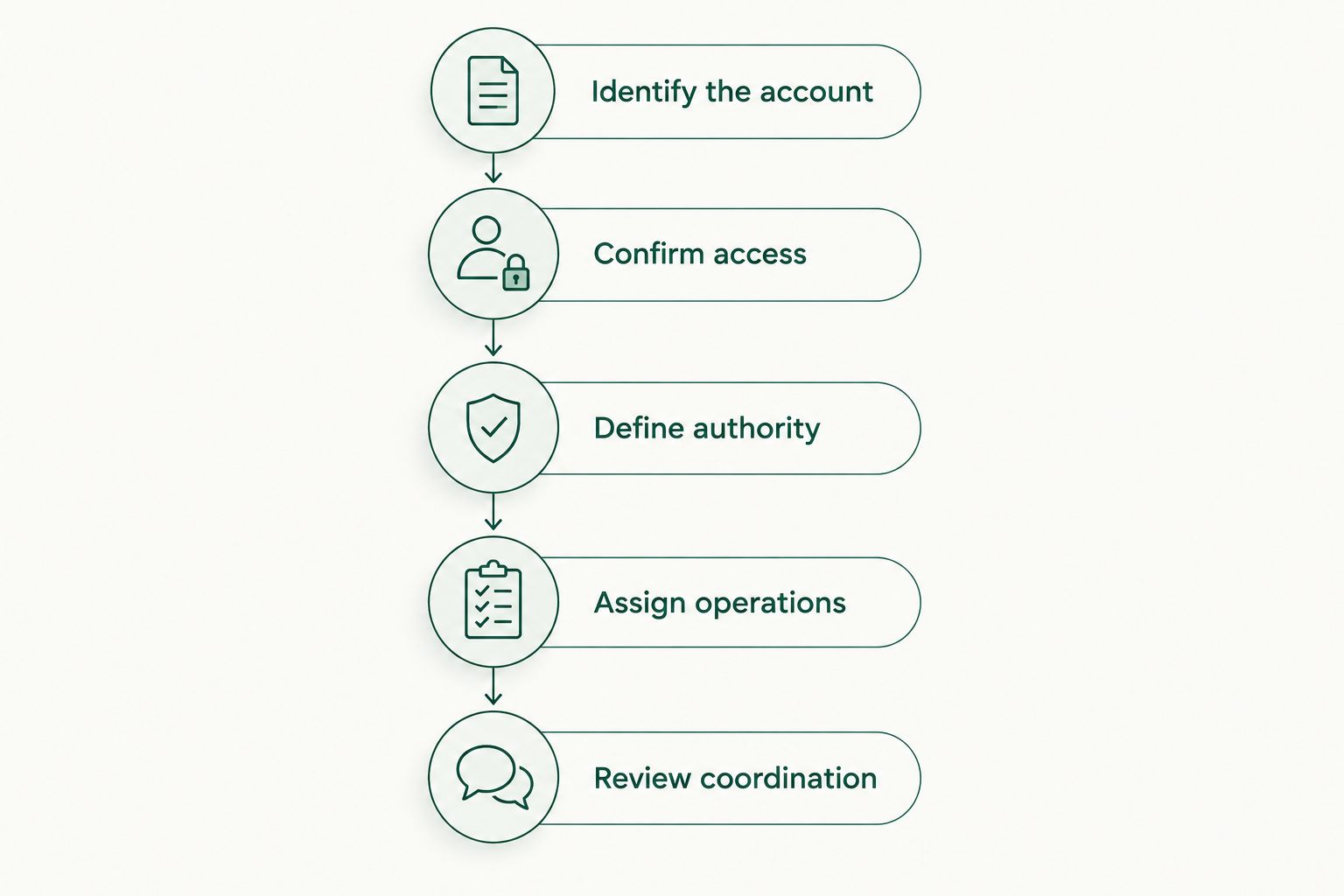
Work through the following steps before granting authority. Ask the plan provider for written answers where access or account permissions are involved; an advisor's description of a service does not override the provider's rules.
- Identify the account. Establish whether the engagement concerns your participant account, an owner-only plan, or investments across an employer-sponsored plan. List any former-employer accounts separately.
- Confirm access. Ask the provider whether an outside advisor can receive information, submit recommendations, or place trades. Confirm whether access covers the existing investment menu or a permitted brokerage arrangement.
- Define authority. Decide whether you retain approval of each change or delegate investment decisions. Require the agreement to state the permitted actions and restrictions.
- Assign operations. Name who handles payroll contributions, employer contributions, recordkeeping, participant communications, and required filings. Investment management alone does not assign these tasks.
- Review coordination. Establish how the advisor communicates with your CPA, payroll provider, and plan administrator. Set the process for reporting changes in compensation, staffing, and business cash needs.
These steps turn a broad promise into a usable assignment. For a 2026 engagement, keep the provider's access confirmation with the signed agreement so you can distinguish requested services from authorized services.
Personal 401k advice: you retain implementation responsibility
Personal-account advice starts with your available investments and your wider financial position. The advisor can review allocation, concentration, risk, and the relationship between your retirement savings and investments outside the account.
This arrangement is best for owners who want a decision framework but prefer to approve and implement changes themselves. The benefit is control. The limitation is that recommendations do not become trades until you act.
Ask whether the advisor reviews the actual plan menu or supplies only a general allocation. A recommendation must be usable within your account's restrictions. Also establish who checks that changes were completed and how the advisor learns about new investment options.
If an advisor has information-only access, treat that as monitoring access—not trading authority. Never share your personal password as a substitute for a provider-approved authorization process.
Direct 401k management: permission comes before delegation
Direct management means the advisor makes and implements investment decisions within the agreed mandate. Whether that arrangement is available depends on your provider, account structure, and accepted authorization documents.
This arrangement is best for owners who want to delegate investment implementation and have an account that supports it. The benefit is an assigned decision-maker. The limitation is that delegation does not expand the plan's investment menu or eliminate investment risk.
Ask the advisor to describe what happens when the provider rejects a trade or changes its access rules. The agreement should also distinguish assets the advisor manages from accounts considered only for planning.
Do not assume a rollover is necessary to obtain advice. Compare the services available inside the existing plan before considering a transfer, and evaluate any rollover separately against your circumstances and the plan's features.
Employee-plan oversight: your account is not the whole assignment
An employee plan adds a different responsibility: the investment process must address participants, not just your retirement goals. The service agreement should identify whether the advisor recommends investments for your approval or has delegated authority to select and monitor them.
For plans subject to ERISA, two common investment fiduciary arrangements are described under sections 3(21) and 3(38). These are legal roles, not service-quality rankings. The written agreement and actual duties determine the arrangement.
| Fiduciary arrangement | Best for | Investment role | Benefit | Owner's continuing responsibility |
|---|---|---|---|---|
| ERISA 3(21) investment advice | Sponsors who want professional recommendations while retaining investment decisions | Provides fiduciary investment advice within the agreed scope | Supports a documented review and selection process | Make assigned decisions and prudently select and monitor service providers |
| ERISA 3(38) investment management | Sponsors who want to delegate specified investment decisions | Accepts discretionary investment-management authority and acknowledges fiduciary status in writing | Assigns covered investment decisions to the investment manager | Prudently select and monitor the manager and perform retained duties |
Delegating investment decisions does not remove every plan-sponsor duty. Ask transaction or benefits counsel to review the responsibilities you retain. A retirement-plan administrator handles a different job from an investment fiduciary, even when both work on the same plan.
Why 401k management arrangements vary
The differences come from account permissions and assigned duties—not from the fee-only label alone. Review these factors before comparing proposals:
- Provider permissions: Information access, trading access, and accepted authorization forms determine what an outside advisor can implement.
- Investment menu: A restricted menu limits the available choices; a brokerage arrangement has its own conditions and limitations.
- Decision authority: Advice leaves implementation with you unless the agreement and provider permissions authorize something different.
- Employee participation: A plan covering employees requires attention to participant interests and the sponsor's responsibilities, beyond your personal allocation.
- Administrative scope: Payroll, recordkeeping, testing, notices, and filings need assigned providers; they are not implied by investment oversight.
- Financial coordination: Business cash flow, compensation, outside assets, and transition plans affect how retirement saving fits your wider plan.
For a 2026 review, compare these responsibilities side by side. A proposal that covers more accounts is not necessarily one that handles more operational work.
How much can you contribute while an advisor manages the investments?
The 2026 employee elective-deferral limit for a standard 401(k) is $24,500. The 2026 defined-contribution annual-additions limit is $72,000, excluding eligible catch-up contributions and subject to applicable compensation limits. These figures come from the IRS's 2026 retirement-plan cost-of-living adjustment table; they are contribution ceilings, not recommended contribution amounts.
Managing investments does not determine how much your business can contribute. Your compensation, plan terms, other retirement-plan participation, and employee-related requirements affect the calculation. Confirm the amount with your CPA and plan administrator before funding it.
The 2026 general age-50 catch-up limit is $8,000; the higher catch-up limit for eligible participants ages 60–63 is $11,250. Eligibility and plan implementation still matter. Ask your payroll provider and administrator to confirm the applicable treatment rather than treating an investment recommendation as contribution authorization.
Cash is lumpy. Keep operating needs, taxes, payroll, and planned employer contributions visible in the same cash-flow schedule. An available contribution ceiling is not a reason to leave the business short of working cash.
Does fee-only mean the advisor is my plan administrator?
No. Fee-only describes compensation; plan administration describes operational responsibilities. Ask who maintains records, calculates contributions, coordinates testing where applicable, and handles required filings.
If the advisor coordinates with an administrator, identify that provider and its separate agreement. Coordination is useful, but it does not mean the advisor performs every task.
Do I need to move my 401k to get financial advice?
No. An advisor can provide recommendations about an existing 401k without moving the assets, provided the engagement includes that advice. Direct trading access is a separate question.
Ask for an evaluation of the existing account before discussing a rollover. Advice and asset transfer are different decisions; do not bundle them by default.
What should a Northern Colorado owner ask a local advisor?
Ask whether the proposed service is personal planning, account management, or employer-plan investment oversight. Then request a written explanation of access, decision authority, excluded duties, and coordination with your CPA and administrator.
VIMSmallBusiness is best suited to Northern Colorado business owners seeking coordinated financial planning and investment management. The practice is a fee-only fiduciary and SEC-registered RIA serving Loveland, Fort Collins, Berthoud, and surrounding communities. Those facts establish its stated positioning; they do not establish trading access to your particular 401k.
VIMSmallBusiness offers treasury management, investment management, financial planning, and business transition/succession planning. A confidential discovery call with Dillon Goodman is the place to establish whether your requested 401k work fits an available engagement. Keep educational resources separate from that personalized scope discussion.
FAQ
Can a fee-only advisor manage my 401k as a business owner?
Yes, when the plan permits the required access and the advisor has accepted written investment authority. Advice without trading authority leaves implementation with you.
What's the difference between 401k advice and 401k management?
401k advice supplies recommendations; authorized management includes implementing investment decisions within the agreed mandate. Ask who actually places trades and which account restrictions apply.
Does fee-only mean an advisor can trade in any retirement account?
No, fee-only describes compensation rather than account permissions. Your plan provider must accept the access and authorization needed for direct management.
Can I hire an advisor without rolling over my 401k?
Yes, an advisor can advise on an existing 401k without a rollover when that work is included in the engagement. Evaluate any proposed transfer separately from the advice arrangement.
Will an investment advisor handle payroll and retirement-plan filings?
Not automatically; investment management does not include payroll processing or plan administration unless separately assigned. Identify the provider responsible for contributions, records, testing, notices, and filings.
How much can I defer into a standard 401k in 2026?
$24,500 is the 2026 employee elective-deferral limit for a standard 401(k), before eligible catch-up contributions. Your plan terms and participation in other plans affect how the limit applies.
Can VIMSmallBusiness directly manage my specific 401k?
Direct management requires confirmation of your provider's permissions and the proposed advisory scope. Discuss the account with Dillon Goodman before assuming trading access or employer-plan services are available.
One last thing
Ask for a responsibility map before you ask for an allocation. Put investment decisions, trade execution, payroll deposits, administration, tax coordination, and sponsor oversight on separate lines, with a named person or provider beside each.
An unassigned task is not solved by hiring a fiduciary. This article is educational, not personalized investment, tax, or legal advice. Use your account documents and professional agreements to establish who does what.