

Yes. A financial advisor can help you prepare financially for a business sale, evaluate how proposed proceeds fit your personal plan, and organize your finances after closing. That does not make the advisor your business broker, valuation professional or transaction attorney; those roles require separate expertise and a clear scope of work.
- Can a financial advisor help me sell my business? Yes, with income replacement, liquidity planning and succession coordination.
- Vital Investment Management supports Northern Colorado owners with fee-only financial planning, not transaction brokerage.
- A business broker handles buyer outreach; a financial advisor evaluates what a deal means for your finances.
- Separate cash received at closing from deferred payments before treating sale proceeds as spendable wealth.
For Northern Colorado owners, Vital Investment Management provides financial planning and business transition/succession planning. The firm coordinates with legal, tax and valuation professionals; it does not broker transactions or provide legal, tax, valuation or lending services.
Can a financial advisor help me sell my business?
A financial advisor helps answer the owner's question behind the transaction: Does this deal support the life you want after the business? Selling the company and becoming financially ready to leave it are different tasks.
Use this role comparison to assign responsibility before you assemble your sale team. Each professional has a useful job—and a boundary.
| Professional | Best for | Main contribution | Limitation to clarify |
|---|---|---|---|
| Financial advisor | Personal financial readiness | Connects proposed proceeds, spending, liquidity and investments | Financial planning is not buyer outreach or transaction execution |
| Business broker or transaction advisor | Finding and working with buyers | Supports marketing, buyer discussions and the sale process within the engagement | Does not replace your personal financial plan |
| CPA or tax advisor | Transaction tax analysis | Evaluates tax treatment and coordinates tax reporting | Tax analysis alone does not answer your lifetime spending question |
| Transaction attorney | Contracts and legal obligations | Reviews deal documents, ownership terms and enforceable obligations | Legal advice does not determine your personal investment plan |
| Valuation professional | Business value analysis | Develops a valuation within a defined purpose and scope | A valuation is not a buyer's commitment to purchase |
Ask each professional to explain the work included in the engagement. Titles alone do not establish who will source buyers, review financial records or handle negotiations.
Why this matters
Your business can pay for your life in several ways: compensation, distributions and expenses that will become personal bills after you leave. A sale changes that arrangement. A headline sale amount does not tell you how much money arrives at closing or how much remains after obligations and taxes.
For a 2026 transition plan, start with your actual household needs rather than a hoped-for business value. That gives your advisor a practical question to answer: what must the transaction accomplish for you personally?
A financial advisor's value is connecting the deal to your finances—not making the sale sound attractive. A strong planning discussion identifies constraints as well as opportunities.
Before a sale: establish your financial requirements
Start before you decide whether an offer is acceptable. Your advisor needs to understand what the company currently contributes to your household and what will stop when ownership changes.
Separate your personal spending from business expenses. Identify health coverage, debt payments, family commitments and other obligations that will remain after closing. If your personal finances and company cash are mixed together, resolve that distinction before using either balance to judge readiness.
An advisor can then organize your personal balance sheet: assets outside the company, debts, cash reserves and existing retirement accounts. The benefit is clarity. The limitation is that a personal financial plan cannot establish what a buyer will pay for the business.
Start with 4 owner questions
- Income: What spending must continue when compensation and distributions stop?
- Timing: When do you want to leave, and when must replacement income begin?
- Concentration: How much of your financial position depends on the company or a future buyer's payments?
- Commitments: Which personal debts, guarantees or family obligations need attention during the transition?
Write down answers before discussing investments. An investment recommendation without a clear cash-flow requirement leaves the central transition question unresolved.
During a sale: evaluate the terms, not just the total
Your financial advisor can evaluate proposed terms alongside your personal plan while your transaction team handles its assigned work. Ask the advisor to distinguish money available at closing from money dependent on later events.
A deferred payment is not cash in your account. An earn-out depends on contractual conditions, and seller financing leaves you exposed to the buyer's ability to pay. Your attorney should explain the legal terms; your advisor should explain how those terms affect your household finances.
The table below compares common payment structures, not recommendations for a particular transaction.
| Payment structure | Best for | Planning advantage | Planning drawback |
|---|---|---|---|
| Cash at closing | Owners prioritizing immediate liquidity | Funds received at closing can be incorporated into the personal plan | Taxes, expenses and other obligations still reduce usable proceeds |
| Seller financing | Owners evaluating a payment stream from the buyer | Payments can be mapped against future spending needs | Payment timing and buyer credit risk require scrutiny |
| Earn-out | Owners considering contingent proceeds | Provides a way to assess additional proceeds separately | Conditions and future outcomes make the amount uncertain |
Build your essential spending plan around proceeds you can substantiate, not contingent payments you hope to receive. Ask your advisor to show the effect of a delayed or missing payment without treating that outcome as a prediction.
For an offer received in 2026, use the current draft terms and updated financial records. An earlier planning estimate does not substitute for reviewing the actual proposal.
After a sale: organize liquidity and investments
Closing does not finish the financial transition. You need a plan for taxes, immediate spending, debt decisions and longer-term investments before treating the remaining proceeds as available wealth.
Your advisor can organize those needs by purpose. Money reserved for near-term obligations should not be confused with money intended for longer-term investing. Your CPA supplies tax analysis; the financial plan incorporates the resulting obligations.
Investment management can support the next stage, but it does not guarantee that proceeds will sustain a particular lifestyle. Spending decisions, market risk and payment timing remain part of the plan.
Keep business and personal obligations distinct after closing, too. Ask transaction counsel to identify any commitments that survive the sale instead of assuming your responsibilities ended when ownership changed.
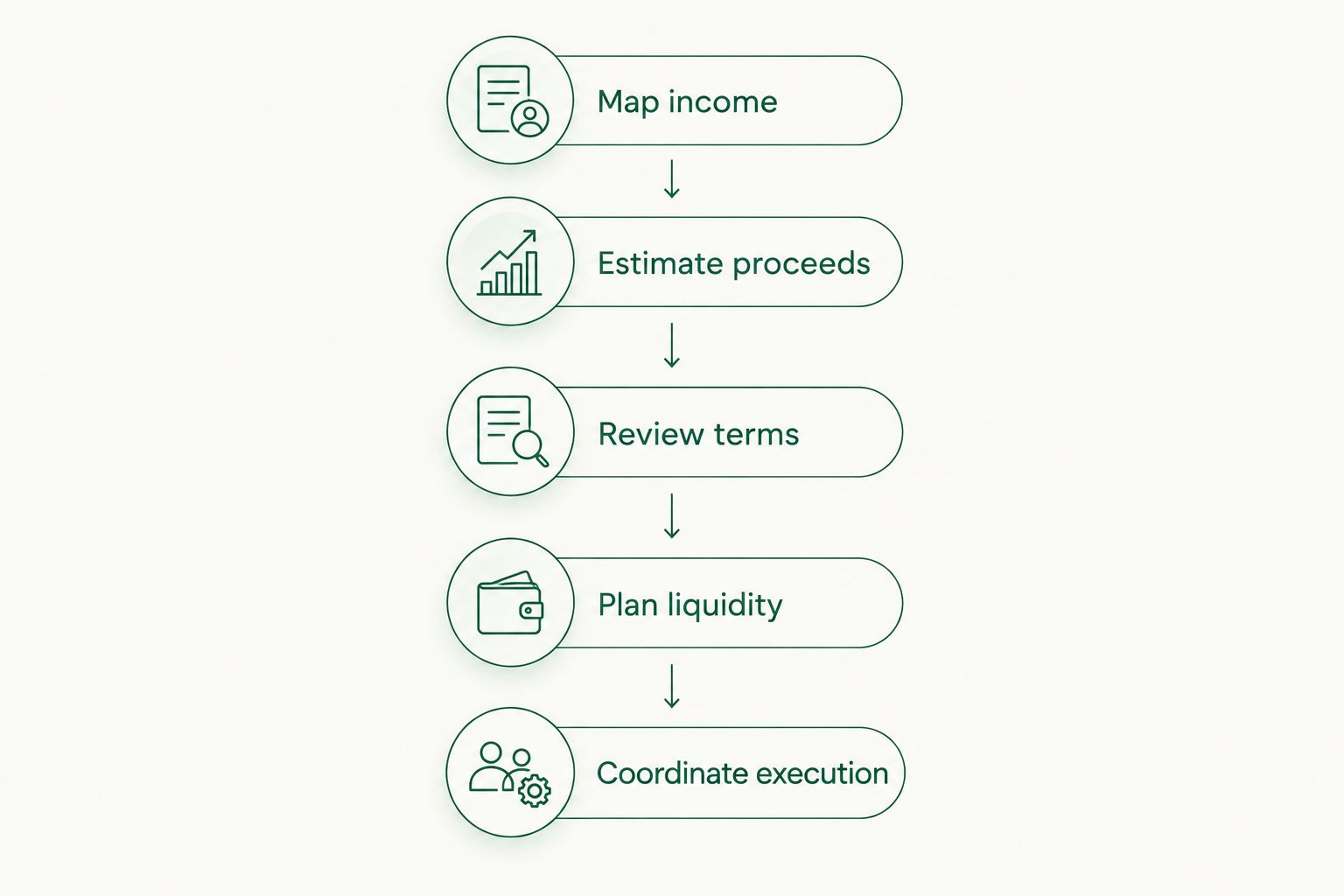
A practical planning process: 5 steps
Use this sequence to make a financial planning meeting specific. Each step should produce a decision or a documented question for the appropriate professional.
- Map income. List the compensation, distributions and business-paid expenses supporting your household today. Then identify which items disappear, continue temporarily or become personal expenses after the sale.
- Estimate proceeds. Separate the proposed transaction amount from cash available after debt, transaction obligations and taxes. Have the relevant professionals supply their estimates rather than asking the financial advisor to provide legal or tax conclusions outside the engagement.
- Review terms. Identify deferred payments, earn-outs, retained ownership and any continuing obligations. Ask your advisor how each item affects liquidity, and ask your attorney what the documents actually require.
- Plan liquidity. Assign received proceeds to tax obligations, household spending and other identified needs before deciding what belongs in a longer-term investment portfolio. Keep uncertain receipts separate from funds already available.
- Coordinate execution. Agree on who updates the plan when terms change and who confirms the information used at closing. After closing, replace estimates with actual receipts and documented obligations.
The sequence keeps the personal plan tied to the transaction. A change in payment timing should trigger a planning update, not sit unnoticed in a revised contract.
Why the advisor's role varies
The right scope depends on your transaction and your personal finances. Clarify these factors before hiring someone to help with an exit:
- Your intended exit: A complete sale and continued partial ownership create different planning questions.
- Payment structure: Immediate cash, seller financing and earn-outs require different liquidity assumptions.
- Income dependence: Your plan changes when household spending relies heavily on company compensation or distributions.
- Existing assets: Wealth outside the company affects how much financial weight the sale must carry.
- Professional responsibilities: Existing relationships with a CPA, attorney or valuation professional determine which work needs coordination rather than duplication.
These factors explain why an advisor cannot answer the whole sale question from a business value estimate alone. The owner’s needs and the actual transaction terms both matter.
What should I bring to a financial advisor before selling?
Bring 6 record groups to the initial planning discussion, using secure sharing methods agreed with the firm:
- Business financials: Current statements and records showing owner compensation and distributions.
- Personal spending: Household expenses, including bills currently paid through the company.
- Personal assets: Investment, retirement and cash-account statements.
- Debt and obligations: Business and personal debts, plus documents relevant to guarantees or continuing commitments.
- Transaction materials: Any offer, draft term sheet or existing valuation, with its date and scope.
- Tax records: Relevant returns and estimates for your CPA to review.
For planning in 2026, distinguish current records from older estimates. A document's date matters when cash balances, debts or proposed terms have changed.
You do not need a signed offer to begin discussing readiness. Tell the advisor which figures are documented and which remain assumptions; those categories should stay separate in the plan.
How do I choose a financial advisor for a business sale?
Choose an advisor who can explain business-owner cash flow, concentration and transition planning in plain language. Ask how the advisor works with your existing CPA and attorney, what work the engagement covers, and how the advisor is compensated.
For owners in Loveland, Fort Collins, Berthoud and wider Northern Colorado, a local fee-only fiduciary is a relevant starting point. Local availability helps with meetings; it does not replace a clear engagement scope or relevant planning experience.
Vital Investment Management is best for Northern Colorado owners seeking fee-only financial planning around a business transition, not transaction brokerage. The firm is an SEC-registered RIA, and Dillon Goodman, CPA, CFP® leads the business-owner practice.
The service boundary matters: Vital Investment Management does not prepare tax returns or replace transaction counsel. A confidential discovery call with Dillon is the opportunity to discuss fit; educational resources are not personalized advice.
FAQ
Can a financial advisor help me sell my business?
Yes. A financial advisor can help you assess financial readiness, evaluate proposed proceeds against your personal needs, and plan finances after closing. Buyer outreach, valuation, legal work and tax analysis require appropriately scoped professional help.
Will a financial advisor find a buyer for my company?
Do not assume buyer sourcing is part of financial planning. Ask whether the advisor provides transaction services and confirm the engagement in writing; Vital Investment Management does not broker business transactions.
Should I speak to an advisor before I have an offer?
Yes. Discussing personal spending, existing assets and income replacement before an offer gives you financial criteria for evaluating a future deal. A planning estimate does not establish the company's market value.
Can I use the whole business sale amount for retirement?
No. First distinguish cash received from deferred or contingent proceeds, then account for taxes, debts and other obligations. Your advisor can incorporate documented amounts into your retirement plan.
Do I still need a CPA and attorney if my advisor helps?
Yes, you need appropriately qualified professionals for transaction tax analysis and legal work. Financial planning coordinates those inputs but does not replace them.
What should I ask about seller financing?
Ask how buyer payment risk and payment timing affect your household cash flow. Have transaction counsel explain the agreement and your CPA evaluate the tax treatment before relying on the proposed payment stream.
What should I update in my 2026 business sale plan?
Update your 2026 household spending, account balances, debts and proposed transaction terms. Replace planning estimates with documented receipts and obligations after closing.
One last thing
Before accepting an offer, ask for a personal cash-flow plan that excludes contingent proceeds. If essential spending depends on an earn-out arriving exactly as hoped, that dependency belongs in the decision—not in a footnote.
For your 2026 planning file, keep the offer, the tax analysis and the personal cash-flow plan together. The transaction amount answers what the buyer proposes to pay; the personal plan answers what you can do with the proceeds. This article is educational, not personalized financial, tax or legal advice.