

Choose a financial advisor in Colorado by matching the advisor’s services to your decisions, verifying registration and disciplinary history, and getting fiduciary responsibility, compensation, and scope in writing. In 2026, business owners should compare cash flow, treasury, personal investments, and succession support—not just an investment proposal—and confirm which work still belongs with a CPA or attorney.
- How do I choose a financial advisor in Colorado? Verify fiduciary duty, compensation, and business-owner planning fit.
- Vital Investment Management fits Northern Colorado owners seeking fee-only financial planning, treasury management, and transition planning.
- Compare written service scopes, conflicts, and responsibilities before choosing a local financial advisor.
- SEC registration is a verification point, not an endorsement or a promise of investment results.
Why this matters
Your business and household finances share the same pressure points. Cash is lumpy. Taxes compete with payroll, personal savings compete with reinvestment, and the exit is a conversation you keep postponing.
An advisor who discusses only your investment account leaves those connections unresolved. Start with your actual decisions, then use these questions to ask a small-business financial advisor to keep interviews focused.
Choose the service relationship before choosing the investment portfolio. A clear scope tells you what the advisor will handle, what you must supply, and where another professional is needed. It also gives you a practical way to compare proposals that use different labels for similar work.
How do I choose a financial advisor in Colorado?
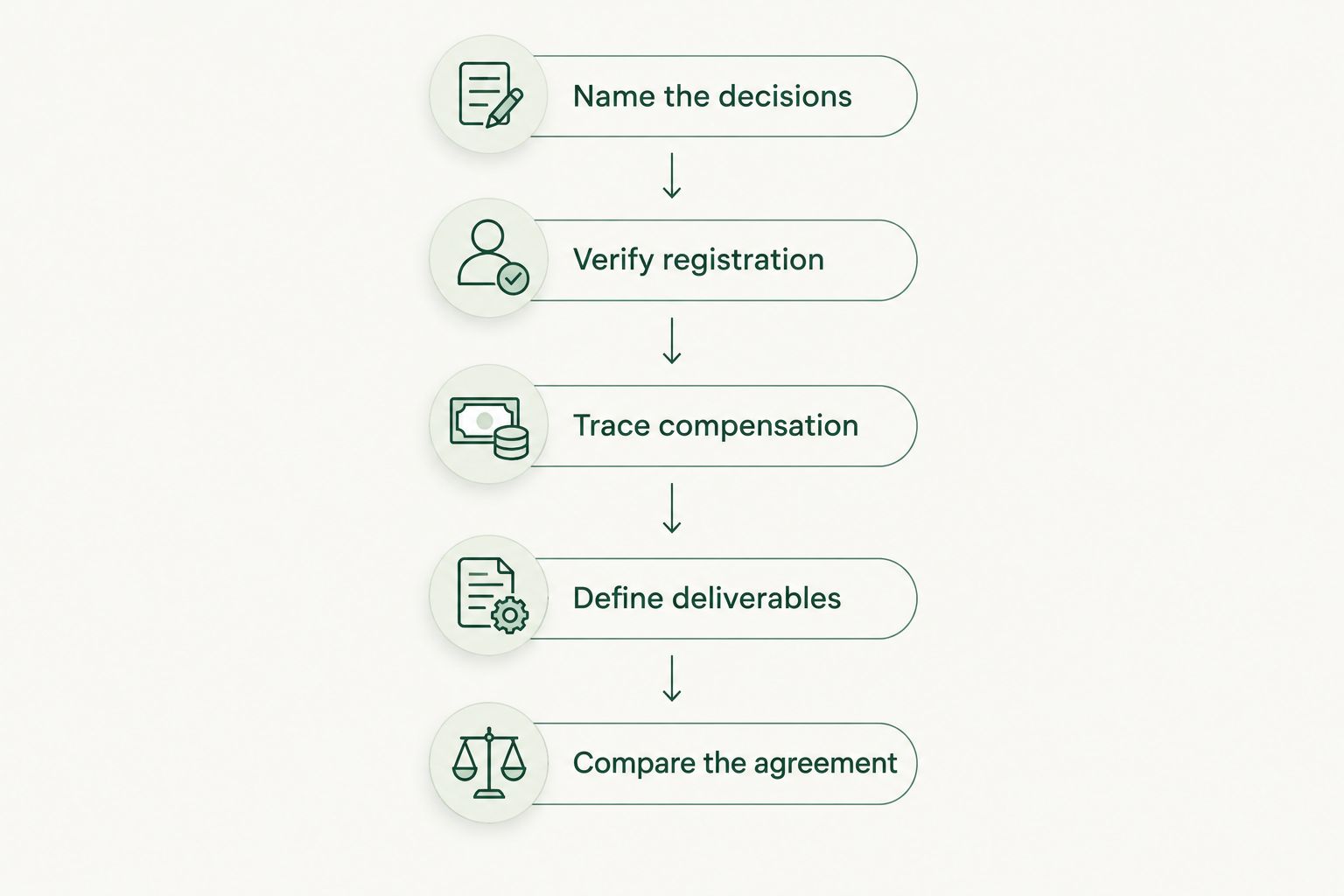
Use these eight decision steps to build a shortlist, check the facts, and compare written proposals. Apply the same questions to fee-only advisors in Loveland, Fort Collins, Berthoud, and elsewhere in Colorado; proximity does not replace diligence.
1. Name the decisions you need help making
Write down the decisions you are postponing before scheduling interviews. Separate business cash requirements from household spending, investment decisions, and ownership-transition questions. Otherwise, the conversation follows the advisor’s service menu rather than your priorities.
For example, deciding how much cash must remain available for payroll is different from investing money you do not need for current operations. Preparing to leave the business raises another question: what will replace the income you currently take from it? Ask an advisor to explain how those decisions connect without treating every dollar as investable cash.
2. Verify the firm and the person
Use the SEC’s Investment Adviser Public Disclosure database to check an investment advisory firm and its representatives. Review the registration record, available disclosure documents, and reported disciplinary information. If someone also acts as a broker, check FINRA BrokerCheck for that role.
Match the legal firm name, individual name, and identifying information to the proposal you receive. Review the record during your 2026 selection process rather than relying on a screenshot supplied by the advisor. Registration does not mean a regulator approves an advisor’s skill or investment recommendations. Ask about disclosures you do not understand before signing an agreement.
3. Get fiduciary responsibility in writing
Ask directly: Will you act as a fiduciary throughout the advisory services covered by our agreement? Then ask the advisor to identify any separate brokerage, insurance, or other capacity in which the person acts.
A verbal statement is not enough to define the relationship. Read the agreement and disclosures together, and ask how conflicts are identified and addressed. The useful answer explains the advisor’s responsibilities, compensation, and limits in plain language. A professional designation does not replace this conversation, and the word fiduciary does not eliminate the need to examine conflicts.
4. Trace every compensation source
Ask how the firm and the individual receive compensation: client fees, product commissions, referral arrangements, or other payments. Fee-only describes compensation from client fees rather than product commissions; fee-based is not the same label.
Request the complete written fee schedule and an explanation of expenses outside the advisory fee. Depending on the arrangement, investment products and account services have separate expenses. Compare what you receive for the fee, not just how the fee is expressed. Ask what happens when the relationship changes, an account closes, or a planning project ends.
5. Test business-owner planning fit
Describe a real issue from your business and ask how the advisor would organize the work. Useful topics include operating reserves, irregular owner distributions, personal concentration in the company, and the financial consequences of a transition.
Listen for a process, not a polished answer. Who collects the records? Who identifies missing information? What decision will the analysis support? An advisor does not need to perform every specialist function, but the advisor should explain where financial planning stops and tax, legal, lending, or valuation work begins. Business-owner fit means connecting decisions, not claiming expertise in every discipline.
6. Define the deliverables
Ask what you will receive and what happens after delivery. A financial plan, an investment policy, a cash-reserve framework, and transition-income analysis address different needs. Do not assume that a service called wealth management includes all of them.
Request a written scope identifying the work, responsible people, required information, and review process. Ask whether implementation is included or whether you must arrange it separately. Also establish how new questions are handled between scheduled reviews. This prevents you from purchasing a planning document when you actually need an ongoing decision-making relationship.
7. Establish professional coordination
Ask how the advisor will work with your existing CPA, transaction attorney, and other specialists. Your CPA’s tax-return work and your advisor’s financial-planning work are related, but they are not interchangeable.
For a proposed investment sale or business transition, identify who evaluates taxes, who reviews legal documents, and who updates the financial plan. Agree on how information will be shared with your permission. Credentials help you evaluate a person’s background; they do not establish that a particular service is included. Confirm responsibilities instead of assuming that everyone involved is handling the same issue.
8. Compare the agreement before deciding
Place each proposal beside your original decision list. Check whether the scope addresses the problems that brought you to the interview, whether compensation is understandable, and whether the responsibilities are clear.
Read termination provisions, investment authority, communication expectations, and any limits on services. Ask about unresolved points before moving money or granting account access. A discovery call is an introduction, not a substitute for reviewing documents. Choose the advisor whose written relationship fits your needs—not the person who makes the most confident prediction about markets.
The sequence matters: define the work before comparing proposals, then verify that the agreement matches the conversation. Keep the decision list available during every interview so the same issues receive attention.
Which advisor relationship fits your situation?
Different service arrangements solve different problems. Use this comparison to decide what to request; then verify the actual scope rather than assuming every firm uses these labels consistently.
| Relationship | Best for | Main benefit | Main limitation | What to verify |
|---|---|---|---|---|
| Project financial planning | A defined decision or a written planning assignment | A bounded scope tied to a specific need | Follow-through and later updates are not automatically included | Deliverables, implementation, and project endpoint |
| Ongoing financial planning | Connected household and business-owner decisions | A continuing relationship for changing circumstances | The value depends on what ongoing work is actually included | Review process, access, and responsibilities |
| Investment management | Delegating portfolio decisions within an agreed mandate | Defined responsibility for managing investment accounts | Business treasury and succession work are not automatically included | Investment authority, account expenses, and planning scope |
| Business-owner advisory relationship | Coordinating treasury, personal wealth, and transition decisions | Connects company-related decisions with your personal financial plan | Still requires separate legal, tax, and transaction specialists | Coordination process and explicit service boundaries |
A narrower relationship is not automatically worse. If you need a specific assignment, an ongoing arrangement can include work you do not need. Conversely, a project does not provide continuing support unless the agreement says it does.
Match the arrangement to the decision, then compare compensation within that scope. Comparing an investment-only proposal with a broader planning relationship without adjusting for services produces a misleading comparison.
Why financial advisor fit varies
The same advisor relationship does not serve every Colorado owner equally. These factors change the work you need, not the basic requirement for clear responsibilities and disclosures.
- Cash flow: Payroll, taxes, debt payments, and owner distributions determine what money must remain available.
- Concentration: Wealth tied to your company requires a different planning conversation from a portfolio-only review.
- Transition: A sale, internal transfer, or succession plan connects business decisions with future household income.
- Professional coordination: Existing CPA and legal relationships affect how responsibilities should be divided.
- Service scope: Treasury management, financial planning, and investment management are distinct assignments.
- Location: In-person access in Northern Colorado matters if you want it; verify meeting arrangements rather than assuming them.
In your 2026 interviews, explain which factors drive your situation. You do not need an advisor to manufacture a complicated problem. You need the advisor to identify the work your decisions require and state what the firm can actually provide.
What should I bring to an advisor interview?
Bring a concise decision list and enough context to explain your business and household finances. You do not need to hand over a complete financial archive merely to determine whether the relationship fits.
Organize your preparation into three document groups:
- Business cash flow: Available operating cash, debt obligations, owner distributions, and upcoming business commitments.
- Personal finances: Household spending needs, investment accounts, retirement assets, and personal liabilities.
- Ownership plans: Ownership structure, existing agreements, and any transition questions already discussed with professionals.
Ask how sensitive documents should be transferred before sending them. Also ask which information is necessary for an introductory conversation versus a formal engagement. Keep a record of each advisor’s answers so you compare substance rather than presentation.
This preparation exposes gaps quickly. If the advisor cannot explain which records support which decision, ask for a clearer process before proceeding.
Is a local Colorado advisor better than a remote advisor?
A local advisor is a better fit when in-person access helps you discuss difficult decisions or coordinate your planning. Location alone does not establish qualifications, fiduciary responsibility, or business-owner experience.
For owners in Loveland, Fort Collins, Berthoud, and surrounding communities, start with relevant Northern Colorado fee-only advisors and compare their written services. If you also consider remote relationships, apply the same verification steps. Ask who your primary contact will be and how meetings, document exchange, and specialist coordination work.
Where does Vital Investment Management fit?
Vital Investment Management fits Northern Colorado business owners seeking fee-only financial planning, treasury management, and transition planning. The firm is an SEC-registered RIA in Loveland, with investment management among its stated services.
Dillon Goodman, CPA, CFP®, leads the business-owner practice. You can verify Vital Investment Management’s registration using CRD #300811 and compare its disclosures with the proposed engagement. Its confidential discovery call is the offer; educational tools and guides are separate from personalized advice.
The benefit is a stated service scope that addresses several connected owner decisions. The limitation is equally important: Vital Investment Management does not prepare tax returns, broker business transactions, or provide legal, valuation, lending, or ESOP administration services. Separate professionals remain necessary for those assignments.
For a 2026 comparison, use the same standards you apply to any advisor: documented responsibilities, understandable compensation, relevant services, and a clear coordination process. Vital Investment Management is a candidate to evaluate, not a reason to skip diligence.
FAQ
How do I choose a financial advisor in Colorado in 2026?
Choose a financial advisor in Colorado by defining your decisions, verifying registration and disclosures, and comparing written fiduciary responsibilities, compensation, and service scopes. Business owners should also check treasury, personal planning, and succession support.
How do I check whether a Colorado financial advisor is registered?
Use the SEC’s Investment Adviser Public Disclosure database to review investment adviser records and available disclosures. Check FINRA BrokerCheck as well if the person acts as a broker, and match the records to the firm and person in your proposal.
Is fee-only the same as fee-based?
Fee-only and fee-based are different compensation descriptions. Fee-only means compensation through client fees rather than product commissions; ask a fee-based advisor to explain all fee and commission arrangements.
Does SEC registration mean an advisor is approved by the government?
SEC registration is not government approval of an advisor’s ability or investment recommendations. Use registration records as part of verification, then review the scope, conflicts, and agreement separately.
Should my financial advisor work with my CPA?
Your financial advisor should explain how financial planning will be coordinated with your CPA when tax decisions affect the plan. Confirm who supplies tax advice, who prepares returns, and how information is shared with your permission.
Do I need a business-owner specialist or an investment manager?
Choose business-owner planning support when your decisions connect operating cash, personal wealth, and succession. Investment management addresses portfolio responsibilities, so confirm whether broader planning is actually included.
What should I ask before signing an advisor agreement?
Ask what services are included, how compensation works, who has investment authority, and how the relationship ends. Confirm deliverables, implementation responsibilities, communication, and exclusions in writing.
One last thing
Ask each finalist to explain one service the firm does not provide. That answer helps you identify the boundary between useful coordination and an incomplete assignment.
Before choosing an advisor in 2026, write down who owns your next unresolved decision: you, the advisor, your CPA, or your attorney. If everyone appears responsible, clarify the handoff. A good plan needs named responsibilities as well as recommendations.