

The difference between fee-only and fee-based advisor compensation is commissions: fee-only advisors receive fees rather than commissions for selling financial products, while fee-based advisors receive fees and can also receive commissions. Neither label replaces a check of the advisor’s fiduciary obligations, conflicts, service scope, and written agreement before you hire them in 2026.
- The difference between fee-only and fee-based advisor compensation is whether commissions are part of the payment model.
- Fee-only removes product-sales commissions, not every conflict of interest; verify fiduciary duties and service scope.
- Fee-based advisors can combine advisory fees with commissions; ask which role applies to each recommendation.
- Vital Investment Management is best for Northern Colorado owners seeking fee-only financial planning and investment management.
What is the difference between fee-only and fee-based advisors?
Fee-only describes compensation without product-sales commissions; fee-based describes compensation that can include both fees and commissions. Separately, check how to know whether your financial advisor is a fiduciary. Compensation and legal duty answer different questions.
| Question | Fee-only advisor | Fee-based advisor |
|---|---|---|
| How is the advisor compensated? | Through fees rather than product-sales commissions | Through fees, with commissions possible for product transactions |
| What is the main advantage? | Removes product-sales commissions from the advisory compensation model | Can combine advisory services with product implementation |
| What is the main limitation? | Other financial incentives and service limitations still require review | Commission incentives and changes in capacity require additional scrutiny |
| Does the label prove fiduciary status? | No; verify registration, capacity, and obligations | No; verify registration, capacity, and obligations |
| Best for | Owners who want advice without product-sales commissions | Owners seeking combined advice and product implementation who understand the compensation arrangements |
| What should you request? | Written compensation, conflicts, and service disclosures | Written disclosures covering both advisory and commission-based activities |
The distinction matters at the relationship level, not just on one invoice. An advisor might charge a fee for managing investments while also receiving compensation through an affiliated insurance or brokerage business. Ask about the advisor, the firm, and related businesses rather than accepting a description of one account.
Why this matters for your business and personal finances
Your company already concentrates your income, time, and wealth in one place. Financial advice should help you examine that concentration, not begin with a product recommendation before anyone understands your operating cash needs.
For a business owner, the useful questions reach beyond an investment portfolio. You need to distinguish payroll and tax reserves from long-term capital, understand how owner distributions support your household, and consider how a transition would change your income.
In a 2026 advisor search, start with the decisions you need help making. Then examine how each advisor gets paid to address them. A compensation label is a screening tool, not a substitute for a written service agreement.
An advisor who does not receive commissions can still offer a service that misses your needs. An advisor who receives commissions still needs to explain those incentives and the role in which each recommendation is made.
Fee-only advisors: advice without product-sales commissions
A fee-only advisor receives fees for advisory services rather than commissions from selling financial products. Compensation can follow an asset-based arrangement, a recurring retainer, an hourly engagement, or a project arrangement. The contract determines which structure applies.
Best for: owners who want to separate financial advice from product-sales commissions. This model removes a specific incentive: earning a commission because you purchase a particular financial product. That is a useful distinction when you want to evaluate recommendations on their planning purpose.
The limitation is that fee-only does not mean conflict-free. An advisor whose compensation depends on assets under management has an economic interest in the assets remaining under management. That incentive deserves discussion when you are comparing investing with paying down debt, funding your company, or holding operating cash.
Ask how the advisor evaluates decisions that do not increase managed assets. For example, your treasury plan should explain which funds belong in the business and which funds serve personal goals. It should not assume every available dollar belongs in a long-term investment account.
Also verify implementation boundaries. Advice about insurance does not establish that the advisor sells insurance, and transition planning does not establish that the advisor brokers business sales.
Fee-based advisors: fees with commissions possible
A fee-based advisor receives fees and can also receive commissions. The term does not tell you which transactions generate commissions, whether you will encounter those transactions, or how much of the relationship involves advisory services rather than product sales.
Best for: owners who want combined advice and product implementation and are prepared to examine the compensation arrangements. The practical benefit is the ability to work within a relationship that includes advisory work and certain product transactions.
The limitation is the added work needed to distinguish those activities. You need to know whether the professional is acting as an investment adviser, a broker, an insurance agent, or another permitted role for the specific recommendation.
A dual registrant can act in 2 capacities—as an investment adviser and as a broker. Ask which capacity applies before approving a recommendation, not after signing the paperwork. Investment advisory services and brokerage recommendations operate under different regulatory frameworks.
For your 2026 comparison, ask whether commissions are available to the advisor or an affiliated business even if your proposed account uses an advisory fee. A statement about that account alone does not explain the whole relationship.
Why advisor incentives and service scope vary
Fee-only and fee-based labels describe compensation broadly. The details vary with the engagement, the professional’s registrations, and the work you ask them to perform.
Review these factors:
- Compensation structure: Asset-based, recurring, hourly, and project arrangements create different economic incentives. Read how your agreement defines the arrangement.
- Professional capacity: Investment advisory work, brokerage transactions, and insurance sales have different roles and obligations. Identify the role behind each recommendation.
- Affiliated businesses: A related brokerage, insurance agency, or referral arrangement adds relationships to examine. Ask who receives compensation connected to your decision.
- Service scope: Investment management is not the same engagement as treasury management, financial planning, or succession planning. List the decisions and deliverables included.
- Implementation responsibilities: Some advisors recommend actions while other professionals execute them. Establish who handles tax filings, legal documents, insurance placement, and transaction work.
Do not infer quality from the number of services listed. A clearly defined engagement is more useful than a broad promise that leaves responsibility unclear.
Ask these 8 questions before hiring an advisor
Use the same questions with each candidate. Keep the answers with your proposed agreement so you can compare what the advisor says with what the documents establish.
1. How do you and your firm receive compensation?
Ask about advisory fees, product-sales commissions, insurance compensation, referral arrangements, and payments involving affiliated businesses. Request a written explanation rather than a verbal assurance that the arrangement is straightforward.
The purpose is to identify who benefits financially when you accept a recommendation. Ask the advisor to distinguish compensation for ongoing advice from compensation associated with a transaction.
2. Will you act as a fiduciary throughout my advisory relationship?
Ask for the answer in writing and identify any activities outside that advisory relationship. A professional’s title or credential does not explain every role they perform.
A useful answer names the services covered by the fiduciary obligation and explains any brokerage or insurance activities separately. It should not leave you guessing when a role changes.
3. Can you receive commissions connected to my recommendations?
Ask this even when the proposed account carries an advisory fee. Include compensation received by related businesses or through product implementation.
If the answer is yes, request an explanation of the incentive and the alternatives considered. If the answer is no, confirm that the written disclosures support the statement.
4. What work will you do for my business-owner needs?
Name your actual decisions: operating reserves, owner distributions, investments outside the company, retirement planning, or transition income. Ask which are included and which require another engagement.
A portfolio review alone does not answer a treasury or succession question. Get the scope settled before treating the advisor as responsible for those decisions.
5. What conflicts remain under your compensation model?
Ask a fee-only advisor about incentives tied to managed assets and other disclosed relationships. Ask a fee-based advisor about commissions, affiliated products, and changes in capacity.
The useful answer explains the conflict and how the advisor addresses it. An answer claiming that no conflicts exist deserves a closer reading of the disclosures.
6. Who will coordinate with my CPA and attorney?
Ask who communicates, what information is shared with your permission, and which professional owns each task. Planning coordination does not transfer responsibility for tax filings or legal documents to the advisor.
For a business transition, identify the boundaries between personal financial planning, valuation, transaction advice, and legal work. Keep those responsibilities explicit.
7. What happens when the right decision reduces managed assets?
Ask how the advisor evaluates a business investment, debt repayment, charitable gift, or cash withdrawal that changes the assets they manage. This tests the decision process rather than a promise about outcomes.
You want an explanation that starts with your goals and obligations. The compensation consequences should be disclosed, not allowed to replace the planning analysis.
8. How can I end or change the engagement?
Read the termination provisions, account-transfer responsibilities, and treatment of unfinished work. Ask what changes if you move from ongoing advice to a narrower engagement.
Do not assume the advisor’s policy. Your signed agreement should explain the process and your responsibilities without relying on a conversation you cannot later verify.
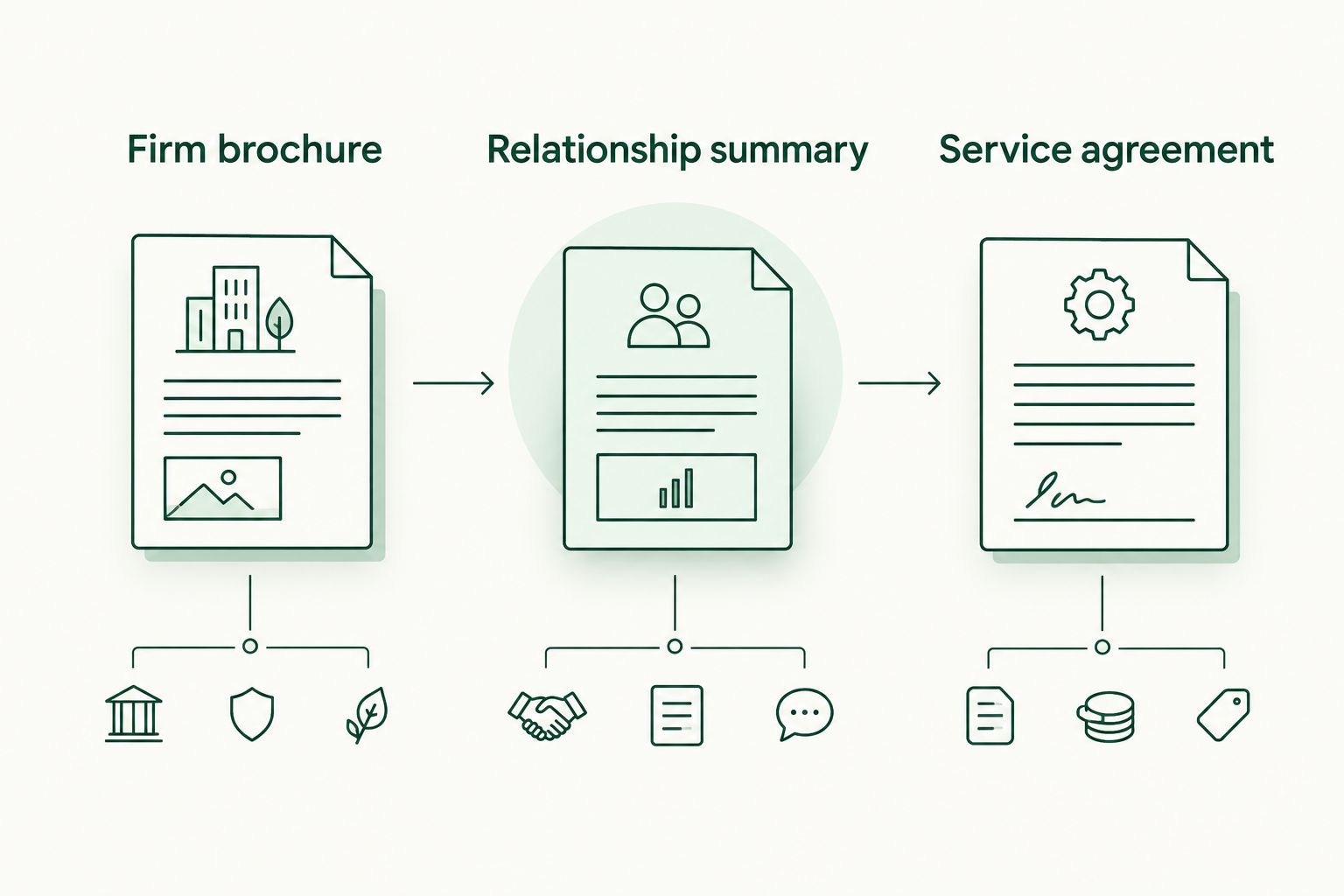
Review these 3 documents before signing
For a 2026 comparison of investment advisory firms, request the relevant disclosure documents and proposed agreement. Use them together: each answers a different question.
- Form ADV Part 2A: The firm brochure describes the advisory business, compensation arrangements, services, conflicts, and other required disclosures. Review the sections relevant to the services you are considering.
- Form CRS: For firms required to provide it to retail investors, the relationship summary describes services, fees, conflicts, standards of conduct, and disciplinary-history information. Its purpose is to help you compare relationships, not replace the full disclosures.
- Service agreement: The contract establishes your actual engagement. Check the scope, compensation method, responsibilities, termination terms, and any exclusions.
Use the SEC’s Investment Adviser Public Disclosure database to check investment adviser registration and disclosures. Use FINRA BrokerCheck when brokerage registration is relevant. Registration confirms a regulatory status; it is not an endorsement of skill or performance.
Match the firm name on the documents to the firm you are hiring. Then ask the advisor to explain any difference between the website’s description and the proposed contract.
Where a Northern Colorado fee-only firm fits
Vital Investment Management is best for Northern Colorado owners seeking fee-only financial planning and investment management. The firm is a fee-only, SEC-registered investment adviser in Loveland serving business owners, with services covering treasury management, investment management, financial planning, and business transition or succession planning.
Vital Investment Management coordinates with legal, tax, and valuation professionals; it does not broker transactions or provide legal, tax, valuation, lending, or ESOP administration services. That boundary matters when your planning question involves selling the company rather than only investing personal assets.
For owners in Loveland, Fort Collins, Berthoud, and surrounding communities, a confidential discovery call with Dillon Goodman is the offer. Educational guides support your preparation; they do not replace personalized advice. You can review the practice at Vital Investment Management.
Is fee-only the same as fiduciary?
No. Fee-only describes compensation; fiduciary describes an obligation to act in a client’s best interest within the applicable relationship. Verify both rather than treating either term as proof of the other.
An investment adviser’s fiduciary duty does not remove every conflict. Read how the firm discloses and addresses conflicts relevant to your engagement.
Is a fee-based advisor automatically a bad choice?
No. Fee-based compensation does not establish that a recommendation is unsuitable or that an advisor lacks skill. It identifies potential commission incentives that you need to understand before acting.
Compare the advisor’s role, written disclosures, scope, and explanation of alternatives. Do not substitute a favorable impression for those checks.
Should I choose compensation or expertise first?
Screen for both. An advisor who meets your compensation preference but does not address business-owner cash flow or transition planning is not a complete fit for those needs.
In 2026, compare candidates against the same written list of decisions and responsibilities. That keeps the discussion focused on your engagement instead of job titles.
FAQ
What's the main difference between fee-only and fee-based advisors?
The main difference is commissions: fee-only advisors receive fees rather than product-sales commissions, while fee-based advisors can receive both. Verify the advisor’s and firm’s compensation arrangements in writing.
Does fee-only mean my advisor has no conflicts of interest?
No, fee-only removes product-sales commissions but does not remove every conflict. Asset-based compensation and other disclosed relationships still deserve review.
Can a fee-based advisor act as a fiduciary?
Yes, a fee-based advisor can act as a fiduciary when providing investment advisory services. Ask which capacity applies to each recommendation and whether separate brokerage or insurance activities are involved.
What should I ask a financial advisor before hiring them in 2026?
Ask how the advisor and firm receive compensation, which fiduciary obligations apply, and what services your agreement includes. Request written disclosures covering commissions, affiliations, conflicts, and implementation responsibilities.
Does SEC registration mean an advisor's investments are approved?
No, SEC registration is not approval of an advisor’s investments or an endorsement of performance. Use registration records to verify status and review disclosures, not to infer investment quality.
Is fee-only better for a small business owner?
Fee-only is a useful fit when you want advice without product-sales commissions. You still need to verify business-owner expertise, service scope, remaining conflicts, and coordination with your CPA and attorney.
Does Vital Investment Management provide legal or tax services?
Vital Investment Management does not provide legal or tax services. The fee-only financial advisory firm coordinates with legal, tax, and valuation professionals as part of its business-owner planning work.
One last thing
Ask one final question before signing: What recommendation would you make if it reduced your compensation? Then request an explanation of how that decision would be evaluated.
The point is not to demand a hypothetical promise. It is to see whether the advisor can distinguish your planning needs from the firm’s financial incentives. Put the explanation beside the scope and conflict disclosures; that gives you something concrete to assess when a real decision arrives.