

A fiduciary financial advisor charges through an asset-based fee, a flat planning fee, an hourly fee, or an ongoing retainer; fiduciary status does not set a standard rate. Your actual charge depends on the advisor’s agreement, and investment expenses or outside professional services can sit outside the advisory fee.
- How much does a fiduciary financial advisor charge? Compare the written fee schedule and service scope, not fiduciary status alone.
- Asset-based fees tie billing to managed assets; flat, hourly, and retainer arrangements charge on different terms.
- Separate advisory fees from investment expenses and outside tax or legal work.
- Vital Investment Management provides fee-only financial advice for Northern Colorado business owners; request its current terms directly.
How much does a fiduciary financial advisor charge?
The answer comes from the fee schedule and service agreement, not the fiduciary label. A fiduciary obligation concerns how the advisor serves your interests. It does not establish a universal billing method or make different firms’ services identical.
For your 2026 comparison, separate four billing models. A firm can combine models, so ask whether financial planning and investment management generate separate charges.
| Billing model | What determines the charge | Best for | Benefit | Limitation to check |
|---|---|---|---|---|
| Asset-based fee | Assets covered by the agreement and the applicable schedule | Owners seeking ongoing investment management | Connects the fee to a defined managed portfolio | The charge can change with the portfolio’s value |
| Flat planning fee | An agreed project or planning scope | Owners with a defined planning decision | Establishes a charge for specified deliverables | Updates and implementation can fall outside the project |
| Hourly fee | Billable time under the agreement | Owners seeking help with a bounded question | Lets you purchase a limited engagement | Research and follow-up can add billable work |
| Ongoing retainer | A recurring agreement for specified services | Owners needing continuing planning support | Supports an ongoing relationship | Meeting frequency and access need written definitions |
Before comparing quotes, confirm how to tell whether your financial advisor is a fiduciary. Then ask how that obligation applies to the services you would actually receive.
Do not treat the table as a firm’s menu. The available arrangement, eligibility requirements, billing terms, and included work belong in the advisor’s current documents.
Why this matters for a business owner
Cash is lumpy. Your business can need working capital while your household needs distributions, retirement contributions, and a plan for wealth outside the company. An investment-only agreement and an owner-focused planning agreement address different jobs.
Compare the work before comparing the fee. If your central problem is cash flow, a proposal centered on portfolio selection does not answer that problem merely because the advisor is a fiduciary.
For owners in Loveland, Fort Collins, Berthoud, and wider Northern Colorado, start your 2026 comparison with local fee-only advisors serving business owners. Ask each firm the same questions about treasury, personal planning, investment management, and transition support. Geography alone does not establish fit; the written scope does.
Asset-based fees: define which assets count
An asset-based agreement calculates the advisory fee using assets covered by its billing terms. Read those terms closely. The balance used, valuation date, billing frequency, and treatment of deposits or withdrawals affect how the calculation works.
Ask whether the schedule uses tiers and how those tiers apply. A schedule applied separately to portions of a portfolio is different from a single rate applied to the whole balance. The agreement should make that distinction clear.
For a business owner, the important question is which money belongs in the relationship. Operating cash, tax reserves, personal investments, and retirement accounts serve different purposes. Do not move business reserves into a managed portfolio solely to fit an advisor’s billing model.
The benefit is a defined investment-management relationship. The limitation is that the fee calculation alone tells you nothing about planning depth. Confirm whether business-owner planning is included or separately contracted.
Flat planning fees: define the finished work
A flat planning fee applies to an agreed scope rather than billable hours or a managed-asset balance. Its usefulness depends on the deliverables. A written plan, implementation checklist, and continuing updates are different commitments.
State your decision plainly. You might need to connect household spending with business distributions, organize retirement planning, or understand how a future transition affects personal finances. Ask the advisor to identify the work that answers that decision.
Then define completion. Does the engagement end with a presentation, a written document, or implementation support? Who updates the plan when your assumptions change?
A fixed fee needs a fixed description of the work. The benefit is a bounded engagement; the limitation is that additional questions or later changes can require a separate agreement.
Hourly fees: define billable work
Hourly advice ties the charge to time spent on your engagement. It can fit a narrow question when you have organized records and a clear decision. Ask what preparation the advisor needs before work begins.
Request a written estimate of the work involved and a process for approving additional time. Confirm whether document review, research, meetings, written recommendations, and follow-up are billable. Do not assume only meeting time counts.
You also need an output, not just a conversation. Ask whether you will receive written recommendations and who handles implementation.
The benefit is a limited engagement without automatically committing to continuing service. The limitation is that a question that looks narrow can require more investigation. Define the question and the stopping point before authorizing work.
Ongoing retainers: define continuing access
A retainer establishes recurring service under an agreement. That arrangement can suit an owner whose planning needs change with business cash flow, household decisions, and transition work. Recurring billing does not itself define recurring attention.
Ask which meetings, updates, and coordination tasks are included. Identify how you raise a question between scheduled meetings and what falls outside the engagement. Get the cancellation terms as well.
The benefit is continuity. The limitation is paying for an ongoing relationship whose services you do not need or whose scope is unclear.
For a 2026 retainer comparison, ask each advisor to describe the planned work in owner language. Replace vague promises of access with named responsibilities, deliverables, and review triggers.
Why fiduciary financial advisor charges vary
Five factors explain why proposals need a scope comparison rather than a headline-fee comparison:
- Service scope: Investment management, treasury management, financial planning, and transition planning are different responsibilities. Identify which are included.
- Billing basis: Managed assets, project scope, billable hours, and a recurring agreement produce different calculations.
- Financial complexity: Business cash flow, household needs, retirement accounts, and concentrated business ownership create different planning questions.
- Continuing work: An initial recommendation differs from implementation support, monitoring, and updates when circumstances change.
- Professional coordination: Meetings with your CPA or transaction counsel need a defined role. Coordination does not replace those professionals’ work.
These factors help you evaluate a proposal; they do not justify an unexplained charge. Ask the advisor to connect each billed service to a responsibility you need handled.
How do you compare advisory proposals in 2026?
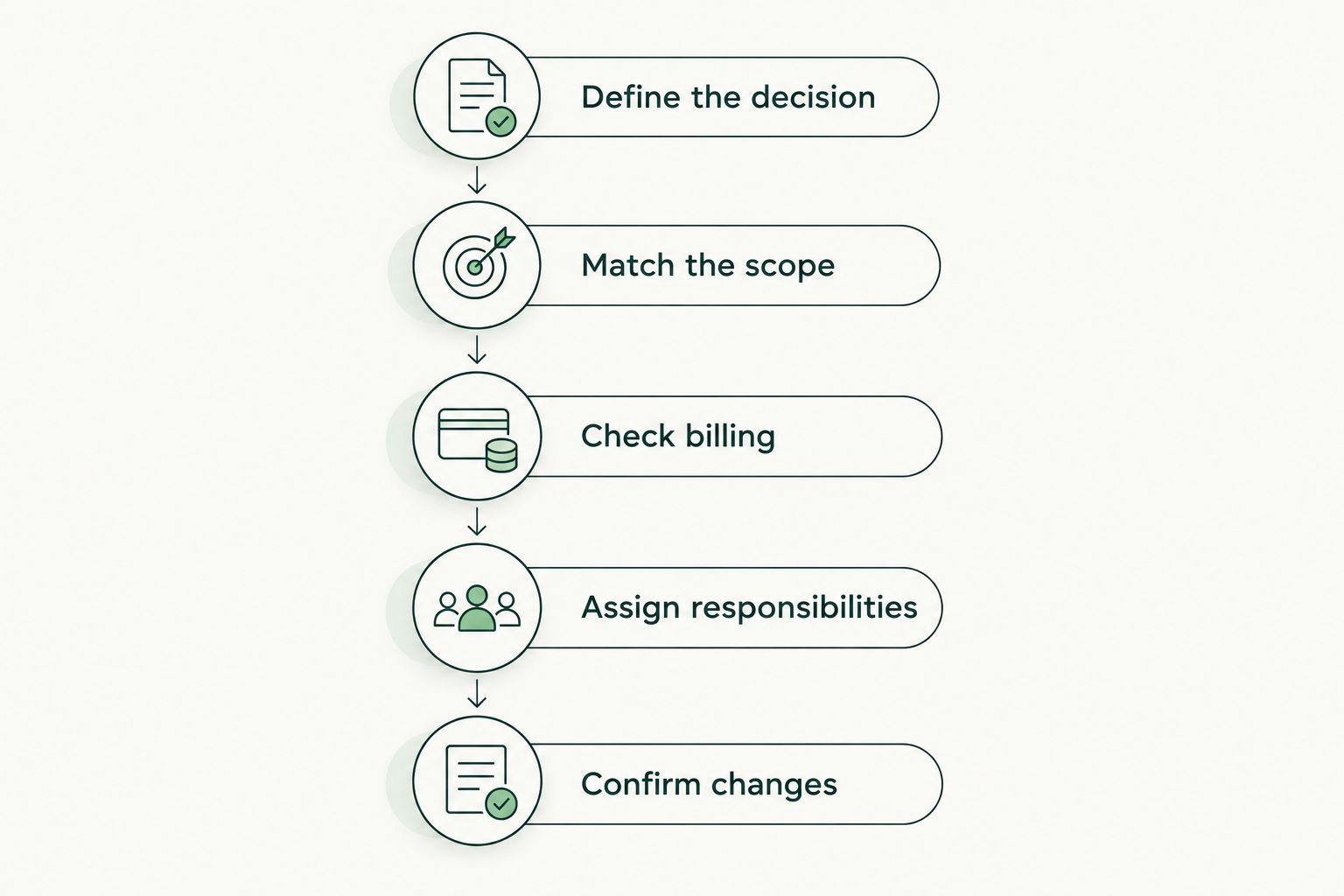
Use this sequence before signing. It keeps the decision tied to your needs rather than a firm’s preferred billing format.
- Define the decision. Write down the problem you want resolved: treasury reserves, personal investments, financial planning, or transition readiness. Separate a current decision from a broad wish for financial help.
- Match the scope. Ask each advisor to state what they will deliver, what they will maintain, and what you must do yourself. Compare proposals covering the same work.
- Check billing. Read the fee schedule alongside the agreement. Identify the calculation method, billing frequency, minimums, separate charges, and termination terms.
- Assign responsibilities. Name the advisor, CPA, attorney, and owner tasks. Decide who follows up when a recommendation requires another professional.
- Confirm changes. Ask what triggers a revised engagement: new assets, a broader planning question, a business transition, or continuing support after a project ends.
Keep the proposals together with your notes. If a term remains unclear, ask for a written clarification before treating the proposals as comparable.
What expenses sit outside the advisory fee?
An advisory fee is not automatically an all-in investment or planning expense. Investment funds can have their own expenses, and an agreement can identify other account or transaction charges. Review the applicable disclosures rather than assuming those expenses are included.
Tax consequences are a separate planning question. A recommendation involving a sale, withdrawal, or transfer needs consideration of your circumstances; the advisor’s charge does not tell you the tax result.
Outside professional work also needs separate treatment. Your CPA’s tax work, an attorney’s documents, and an independent business valuation are distinct from financial advice. Ask who engages each professional and who pays for that work.
For your 2026 review, request a written explanation separating advisory billing, investment expenses, and outside services. Clear categories make the proposal easier to evaluate without confusing fees with taxes or transaction outcomes.
Does fee-only mean the advisor is less expensive?
Fee-only describes compensation, not a ranking of charges. It generally means the advisor receives compensation from clients rather than commissions for selling financial products. You still need to compare scope and billing terms.
A less expensive proposal is not an equivalent proposal when it excludes work you need. Conversely, broader service is not useful merely because it appears in an agreement. Pay for responsibilities that match your decisions.
Does SEC registration tell you what an advisor charges?
SEC registration does not set an advisor’s fee or imply government approval. Review the firm’s Form ADV brochure, including its fees and compensation disclosures, together with the proposed agreement.
Check that the firm and person you are evaluating match the records you review. Registration information, fiduciary obligations, compensation, and service scope answer different questions; do not substitute one for another.
What should a Northern Colorado owner ask a local firm?
Vital Investment Management is a fit for Northern Colorado business owners seeking fee-only treasury, investment, financial, and transition planning. It is an SEC-registered RIA based in Loveland. Its stated services match those owner needs; the engagement still needs to establish your scope and current terms.
The firm coordinates with legal, tax, and valuation professionals. It does not broker transactions or provide legal, tax, valuation, lending, or ESOP administration services. That boundary matters when your question involves selling or transferring a business.
If those services match your needs, ask Vital Investment Management about a confidential discovery call with Dillon Goodman. Keep the conversation practical: describe your decision, ask which work belongs in an advisory engagement, and request the applicable billing documents.
FAQ
How much does a fiduciary financial advisor charge in 2026?
A fiduciary financial advisor charges according to the firm's fee schedule and your service agreement, not a universal fiduciary rate. Compare the billing method, included work, and separate expenses before signing.
Does a fiduciary financial advisor always charge a percentage of assets?
No, fiduciary financial advisors can use asset-based, flat, hourly, or retainer arrangements. Confirm which arrangements the firm actually offers and whether it combines charges.
Is a fee-only advisor the same as a fiduciary?
No, fee-only describes compensation while fiduciary describes an obligation to act in your interests. Ask the advisor to explain both its compensation and the duty that applies to your engagement.
Are investment expenses included in my advisor's fee?
Investment expenses are not automatically included in the advisory fee. Read the agreement and applicable investment disclosures to identify separate expenses.
Can I hire an advisor for one planning question?
Ask whether the advisor offers a limited project or hourly engagement for your question. Define the deliverable, billable work, and implementation responsibilities before proceeding.
Does SEC registration mean an advisor's fees are approved?
No, SEC registration does not mean the government approves an advisor's fees or endorses the firm. Review the current fee disclosures and proposed agreement.
Does Vital Investment Management provide tax or legal services?
Vital Investment Management does not provide legal, tax, valuation, lending, or ESOP administration services and does not broker transactions. It coordinates with the relevant professionals as part of its stated planning role.
One last thing
Ask what happens if you keep your investments elsewhere. The answer helps distinguish planning you can purchase independently from planning tied to a managed portfolio.
For your final 2026 decision, put the fee schedule next to a list of responsibilities. If you cannot identify who handles your actual problem, you are not ready to choose the proposal.