

A buy-sell agreement has no fixed setup timeline: completion depends on agreeing to the ownership terms, establishing how the business will be priced, arranging funding, and completing legal review and signatures. A signed agreement is not the same as a funded, workable agreement. Ask your attorney for a milestone-based schedule that includes both the legal document and the steps needed to carry it out.
- How long does it take to set up a buy-sell agreement? Track decisions, drafting, funding and implementation—not a universal deadline.
- Agree on ownership triggers and valuation before treating the attorney’s draft as final.
- A signed buy-sell agreement does not establish that the purchase can be funded.
- VIMSmallBusiness provides fee-only succession planning support; your attorney handles the legal agreement.
Why this matters
Your company can have a signed document and still face an unresolved ownership transition. The agreement needs to connect the purchase obligation to a workable valuation process, payment terms, and the financial position of the buyer and seller.
For your 2026 planning, separate document completion from implementation. The broader business succession planning timeline also includes management responsibilities and your personal income after leaving; a buy-sell agreement addresses only part of that work.
The useful deadline is the date the agreement is signed and its funding arrangements are implemented—not simply the date you receive a draft.
How long does it take to set up a buy-sell agreement?
The setup time depends on how quickly you resolve the business decisions and complete the legal and funding work. Your attorney can estimate the drafting schedule after reviewing your ownership structure, existing documents, proposed triggers, and intended payment arrangements.
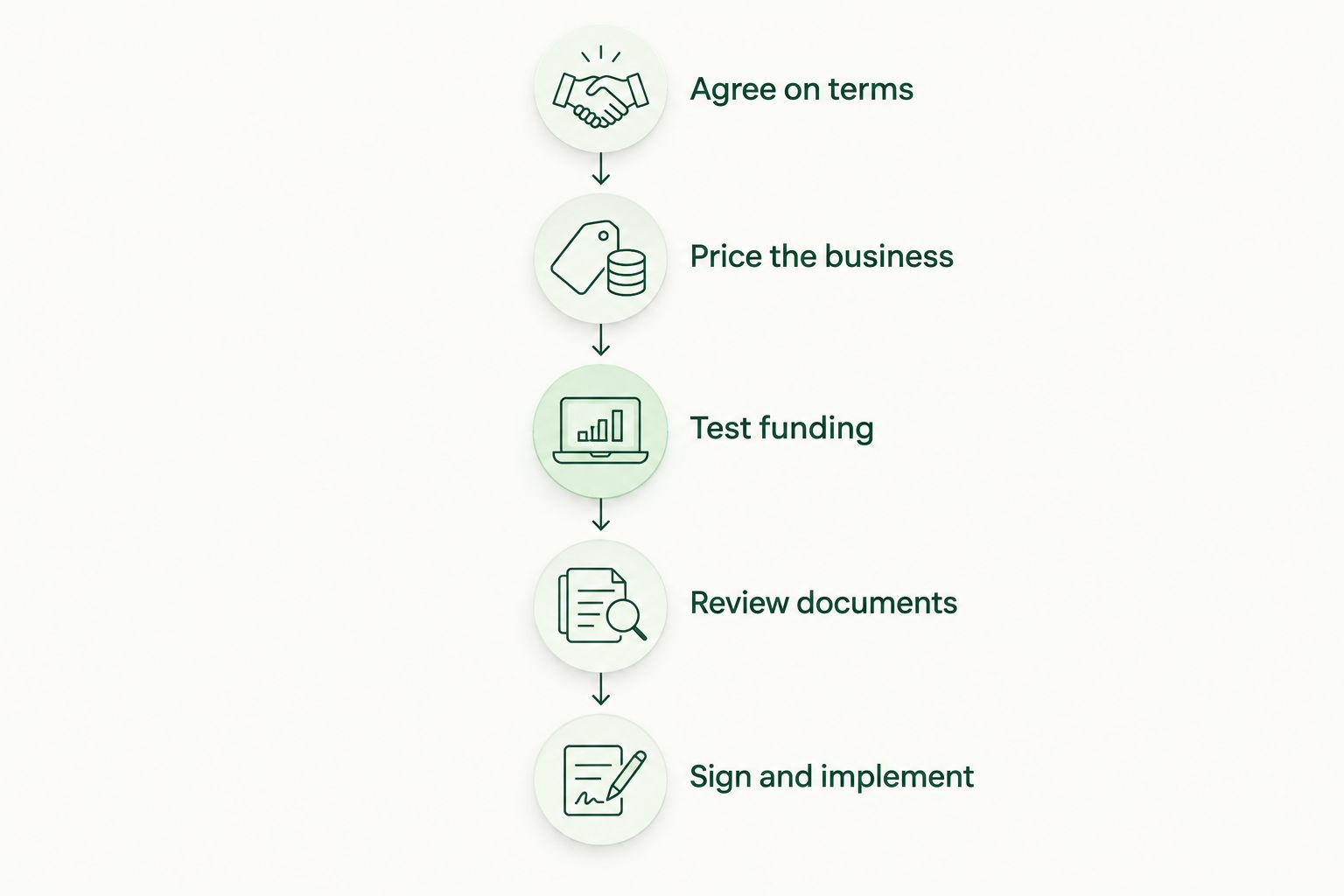
Use these steps to build that schedule. Each step needs a responsible person and a clear completion condition.
- Agree on terms. Decide which events trigger a purchase, who buys the interest, and whether the purchase is mandatory or optional. Include planned departures as well as unexpected events.
- Price the business. Establish the valuation method, who applies it, and how disagreements are resolved. Distinguish a current planning estimate from the method the agreement will use when a transfer occurs.
- Test funding. Identify the intended source of payment and test whether it matches the purchase obligation. Funding work can proceed alongside drafting, but unresolved funding terms belong back in the legal discussion.
- Review documents. Have counsel draft and reconcile the agreement with the company’s governing documents. Your CPA and financial advisor address the tax and personal-financial questions within their respective roles.
- Sign and implement. Complete the required execution steps and put the agreed funding arrangements into effect. Record who will maintain the documents and revisit the assumptions.
These are decision gates, not promised durations. If you cannot identify the buyer or explain how the purchase price will be determined, the project has not reached the implementation stage.
What should you ask your attorney before setting a deadline?
Ask what must be decided before drafting begins, which documents counsel needs, and which outside work affects completion. Request separate target dates for the first draft, owner review, execution, and implementation.
A calendar date alone hides dependencies. A schedule that says who owes the next decision gives you something to manage.
For a 2026 project, keep a shared decision list with the outstanding issue, responsible person, and next action. Do not label the agreement complete while that list still contains unresolved purchase or funding terms.
What must the owners agree on before drafting?
Start with the business decisions you want the agreement to enforce. Your attorney turns those decisions into legal language and explains where a proposed term creates a problem.
Bring a written answer—or an explicit unresolved question—for each item:
- Ownership triggers: Which events require or permit a transfer? Discuss death, disability, retirement, voluntary departure, and ownership disputes with counsel.
- Buyer identity: Will the company, remaining owners, or another designated buyer purchase the interest?
- Valuation process: How will the purchase price be established, updated, and challenged?
- Payment terms: Is payment due at closing, over time, or through a combination of sources?
- Decision authority: Who administers the process if an owner cannot participate or the owners disagree?
Do not assume that equal ownership means equal preferences. An owner approaching retirement and an owner continuing to operate the company can have different priorities for payment timing and business cash flow.
Resolve the commercial disagreement before asking legal wording to conceal it. A polished draft does not settle a disagreement over who buys or how the seller gets paid.
How does funding affect the setup timeline?
Funding creates a separate workstream because the agreement’s purchase obligation must match a source of payment. The right arrangement depends on the triggering event, ownership structure, available cash, and the terms the parties accept.
The options below are discussion points, not recommendations for your company. None eliminates the need for attorney and CPA review.
| Funding approach | Best for discussion when | Practical benefit | Limitation to resolve |
|---|---|---|---|
| Buyer or business cash | The proposed buyer has cash available for the purchase | Makes the payment source straightforward to identify | A buyout can compete with operating reserves and other obligations |
| Insurance funding | The purchase obligation relates to an event covered by the proposed policy | Connects a potential benefit to a covered ownership event | Coverage, ownership, beneficiaries, and the agreement must align; not every trigger is covered |
| Installment payments | The parties are considering payment over time | Separates ownership transfer from immediate payment of the full purchase amount | The seller remains exposed to payment risk, and the buyer takes on continuing obligations |
An agreement can combine funding sources. That increases the need to spell out how the sources work together rather than assuming one will fill any shortfall.
Buyer or business cash: protect operating liquidity
Cash is lumpy. Before committing it to a buyout, distinguish money available for ownership transfer from money needed for payroll, taxes, debt service, and normal operations.
A cash-funded purchase avoids relying on a future funding application, but it can reduce the company’s financial flexibility. Review the proposed payment against a cash-flow forecast, not just today’s bank balance.
Insurance funding: match the covered event
If insurance is being considered, the legal obligation and proposed coverage need to fit together. Review the insured person, policy owner, beneficiary, covered event, and intended use of proceeds with the appropriate professionals.
The benefit is an identified funding mechanism for a covered event. The limitation is scope: do not treat an insurance arrangement as funding every retirement, departure, or dispute addressed by the agreement.
Installment payments: examine both sides
Payment over time changes both the buyer’s cash obligations and the seller’s income planning. Counsel needs to address the payment terms and protections; your CPA evaluates the tax treatment of the proposed transaction.
The structure can reduce the immediate payment requirement, but it leaves the seller dependent on future payments. Your personal plan should distinguish cash received at closing from payments still owed.
Why buy-sell agreement setup time varies
These factors determine the work required. Use them to identify the bottleneck in your project rather than treating the drafting schedule as the whole timeline.
- Owner agreement: Unsettled triggers, buyer identity, or payment terms require decisions before the document can be finalized.
- Valuation method: A formula, agreed value, or professional valuation process requires clear instructions about application and updates.
- Funding readiness: Cash commitments, proposed insurance arrangements, and installment terms need to match the purchase obligation.
- Existing documents: Counsel must review the operating agreement, shareholder agreement, and other relevant restrictions for consistency.
- Professional coordination: Legal drafting, tax analysis, valuation work, and personal financial planning answer different questions.
For your 2026 schedule, assign each open item to a named professional or owner. An issue assigned to everyone has no clear next move.
Do not confuse a delay with inactivity. An unresolved valuation method needs a decision; a draft awaiting owner comments needs a response. The action depends on the bottleneck.
What documents should you prepare first?
Give counsel the current ownership and governing documents, not a summary from memory. Identify existing transfer restrictions, prior buy-sell provisions, and any relevant funding arrangements.
Prepare a financial packet for the professionals reviewing valuation and payment capacity. Include current financial statements, ownership percentages, business debt obligations, and the proposed buyer’s funding information as applicable.
Keep the information organized by purpose:
- Legal review: Governing documents, ownership records, existing agreements, and proposed transfer terms.
- Valuation review: Financial statements and the business information requested by the valuation professional.
- Funding review: Available cash, existing relevant coverage, proposed payment terms, and financing questions.
- Personal planning: Your household spending needs, assets outside the company, liabilities, and expected transition income.
Your attorney and other professionals will specify what they need. The purpose of preparation is to make the first discussion substantive, not to decide legal or tax treatment yourself.
Who handles each part of a buy-sell agreement?
Your attorney leads the legal drafting and explains enforceability, transfer restrictions, and execution requirements. Your CPA evaluates the tax consequences of the proposed structure, while a valuation professional handles valuation work when needed.
A financial advisor connects the proposed buyout to your personal financial plan and the company’s funding capacity. That role does not replace legal drafting, tax advice, lending, or a professional valuation.
VIMSmallBusiness is best for Northern Colorado owners seeking fee-only financial planning alongside attorney-led succession work. VIMSmallBusiness is a fee-only fiduciary and SEC-registered RIA in Loveland, serving business owners across Fort Collins, Berthoud, and the wider region.
VIMSmallBusiness provides business transition and succession planning and coordinates with legal, tax, and valuation professionals. Its limitation is equally clear: it does not provide legal, tax, valuation, or lending services, and it does not broker business transactions.
For your 2026 review, ask each professional to state the decisions they own and the information they need from the others. This keeps coordination distinct from assuming one advisor handles everything.
Can you sign before the funding is ready?
Signing does not establish that the purchase obligation is funded. Whether to execute a document before particular funding steps are complete is a legal question for your attorney.
Ask counsel what obligations begin at signing and how the agreement addresses a funding shortfall. Separately, document every implementation task still outstanding.
Treat signed-but-unfunded as a distinct project status. That makes the remaining work visible without implying that the legal document has no effect.
Does a buy-sell agreement replace succession planning?
A buy-sell agreement does not replace succession planning. It addresses ownership-transfer terms, while succession work also considers management responsibility, business continuity, and your financial life after the transition.
If your 2026 plan includes leaving the business, ask who takes over daily decisions and how your income changes. Those questions remain even after the agreement is signed.
When should you review an existing agreement?
Review the agreement when ownership, business value, funding arrangements, or your intended transition changes. Ask counsel whether the existing document still reflects the decisions the owners intend to carry out.
A 2026 review should also check who maintains the valuation information and funding records. Do not assume that an old signature date proves the current arrangements still fit.
FAQ
How long does it take to set up a buy-sell agreement?
A buy-sell agreement has no fixed setup timeline; completion depends on owner decisions, valuation terms, funding, legal review, and execution. Ask your attorney for a schedule that separates drafting from implementation.
What is the first step in setting up a buy-sell agreement?
The first step is agreeing on the ownership events and purchase terms the document must address. Identify the proposed buyer, valuation process, and payment arrangement before treating the draft as final.
Can a financial advisor write my buy-sell agreement?
Your attorney handles the legal drafting of your buy-sell agreement. VIMSmallBusiness supports fee-only succession planning and professional coordination but does not provide legal services.
Does my buy-sell agreement have to use insurance?
Insurance is one possible funding approach, not a substitute for evaluating the purchase obligation. Discuss cash, insurance, and payment-over-time arrangements with the professionals responsible for your agreement and funding.
Is a signed buy-sell agreement ready to use?
A signed buy-sell agreement does not establish that its funding arrangements are implemented. Confirm the remaining funding, recordkeeping, and administration tasks with your attorney and other professionals.
How do I know whether my existing buy-sell agreement needs updating?
Review your buy-sell agreement when ownership, business value, funding, or transition plans change. Your attorney determines what legal changes are needed, while the other professionals review their respective parts.
Does a buy-sell agreement cover my whole business exit?
A buy-sell agreement does not cover your whole business exit. You still need to address management continuity, personal income, taxes, and the financial consequences of the ownership transfer.
One last thing
Before calling the project complete, walk through one triggering event with your attorney: who gives notice, who determines value, who pays, and where the money comes from. A missing answer identifies an implementation question more clearly than another read-through of the signature page.
Keep that exercise educational until your professionals apply it to your actual documents. This article is not personalized financial, tax, or legal advice.