

Business succession planning has no fixed duration: preparing a written plan and completing an ownership handover are different milestones. The full transition can be a multi-year project when you need to develop a successor, arrange financing, or replace your income outside the company. Set the timeline around readiness milestones, not the date you want to stop working.
- How long does business succession planning take? Separate the written plan from the ownership transfer and income transition.
- Vital Investment Management suits Northern Colorado owners seeking fee-only financial planning alongside business succession planning.
- A succession timeline needs successor readiness, financing, legal coordination, and a plan to replace owner income.
- Start with decision milestones; a signed document does not prove your business can operate without you.
How long does business succession planning take?
Business succession planning lasts until your ownership, leadership, and personal financial arrangements support the transition you intend. A written plan establishes the route. Implementation makes that route workable.
If you start in 2026, distinguish the decisions you can make now from the conditions that require preparation. Naming a preferred successor is a decision; demonstrating that the successor can run the business is a separate task.
An overview of how a financial advisor helps with business succession planning explains the financial advisor’s role. Keep that role distinct from legal drafting, tax advice, valuation, and transaction execution.
Use this sequence to build your schedule:
- Define the destination. Decide whether you want to transfer ownership, step back from management, sell, or combine those outcomes.
- Assess readiness. Identify what depends on you, what your successor needs, and what financial information is missing.
- Test the economics. Examine business cash flow, transfer funding, taxes with your CPA, and your household’s income needs.
- Document the arrangement. Coordinate responsibilities, agreements, and implementation requirements with the relevant professionals.
- Complete the handover. Transfer duties and ownership as agreed, then review whether the arrangement works in practice.
These are decision steps, not promised completion periods. Some tasks run together; others depend on earlier decisions.
Why this matters
Your retirement date does not automatically become the business’s transfer date. You can stop wanting to work before the company, the buyer, or your personal finances are ready.
That mismatch matters for owners in Loveland, Fort Collins, Berthoud, and the wider Northern Colorado region. Your household might rely on salary, distributions, business-paid benefits, or some combination of them. A succession plan needs to explain what replaces each source after your role changes.
A useful 2026 succession plan connects the business handover to your personal cash flow. It also distinguishes a planned transition from an emergency continuity arrangement. Both deserve attention, but they answer different questions.
A written succession plan is not a completed transition
A written plan records decisions about ownership, management, and responsibilities. Its value lies in resolving ambiguity, not simply creating a document.
Before calling the planning stage complete, check whether you can answer these questions:
- Who takes responsibility for running the business?
- Who owns the business after the transition?
- How will the ownership transfer be funded?
- What income will you receive after stepping back?
- Which decisions require legal, tax, or valuation work?
- What happens if the preferred successor cannot proceed?
You do not need to resolve every implementation detail before taking useful action. You do need to distinguish agreed decisions from open questions.
For example, naming a family member as successor does not settle whether that person wants ownership, has management capacity, or can fund a purchase. Recording those unresolved issues makes the plan more useful than treating the name alone as a finished solution.
An ownership handover follows its own schedule
An ownership transfer involves more than handing over daily responsibilities. Depending on the arrangement, it can require valuation work, financing, agreements, approvals, and coordination among owners and advisors.
For your 2026 planning calendar, separate the intended closing date from the preparation needed to support it. Work backward from the conditions that must be satisfied, rather than assigning a completion date before you know the obstacles.
Your role after the transfer also needs definition. If you remain available to train the successor or support customer relationships, agree on the responsibilities and boundaries. Otherwise, an ownership change can leave your working life largely unchanged.
Define what “finished” means before choosing a finish date. A completed sale, a management handover, and your final day of work are not necessarily the same event.
How the transfer route changes the work
Different succession routes create different preparation requirements. Choose a route based on the people, business economics, and personal outcomes involved—not because its description sounds simpler.
| Transfer route | Best for | Planning advantage | Constraint to address |
|---|---|---|---|
| Family succession | Owners seeking continuity within the family | Allows ownership and leadership discussions to reflect family goals | Family expectations and management readiness need separate decisions |
| Employee succession | Owners with an interested internal successor | Builds on the successor’s existing knowledge of the business | Purchase funding and the move from employee to owner need attention |
| Partner buyout | Owners with an existing co-owner willing to take over | Starts with someone already involved in the business | Agreements, valuation, and funding must support the buyout |
| External sale | Owners seeking a buyer outside the current team | Creates a route that does not depend on an internal successor | Buyer diligence, financing, and closing conditions affect the schedule |
None of these routes removes the need to plan your personal finances. An arrangement that preserves the company but fails to replace your income does not meet both objectives.
A direct sale to an employee is also different from an employee stock ownership plan, or ESOP. Do not treat those structures as interchangeable when assigning responsibilities or deciding which professionals you need.
Why business succession planning timelines vary
Succession planning takes longer when an unresolved issue blocks the next decision. Identify the dependency before adding another meeting to the calendar.
- Successor readiness. A willing successor still needs the authority and ability to manage the business. Training and delegated responsibility require follow-through.
- Owner dependence. Customer relationships, approvals, estimating, or operational knowledge concentrated in you complicate a handover.
- Financial clarity. You need financial records that explain business performance and cash flow before evaluating a transfer arrangement.
- Transfer funding. Buyer cash, lending, seller financing, or other agreed structures introduce different funding and repayment questions.
- Owner income replacement. Your personal plan must account for the income and benefits that change when you leave.
- Professional coordination. Financial, legal, tax, and valuation decisions must fit together rather than develop in isolation.
A useful planning meeting ends with an identified blocker, a responsible person, and the next decision. A general instruction to “work on succession” does not create a schedule.
How do you build a realistic succession timeline?
Build your succession timeline around evidence of readiness. Put each milestone on your calendar only after identifying what must happen first.
Owner goals
Write down what you want to change: ownership, workload, personal income, or all of them. Include what you want to preserve, such as family involvement or continuity for employees.
Be explicit about competing goals. Keeping ownership while leaving daily management creates a different planning problem from selling your entire interest.
Business readiness
Identify responsibilities that currently stop with you. Assign successors to those responsibilities and document how decisions get made.
Test delegation while you remain available to resolve problems. That gives you evidence about the handover instead of relying entirely on assurances.
Successor readiness
Confirm the successor’s interest, responsibilities, and authority. Ownership ambition and management capability are different questions.
Use actual responsibilities to assess readiness. Participation in planning meetings alone does not demonstrate the ability to manage staff, customers, or cash flow.
Funding readiness
Clarify where transfer funding comes from and which conditions apply. Coordinate the proposed arrangement with the buyer and the appropriate professionals.
If the arrangement includes future payments to you, examine how those payments fit your household needs and the risks of relying on them. An agreed sale value is not the same as cash received at closing.
Personal readiness
Map your expected post-transition spending, outside assets, debts, and income sources. Identify which assumptions depend on the company continuing to perform.
Then align the ownership agreement with that financial picture. Your transition plan should not depend on income sources that the transfer arrangement eliminates.
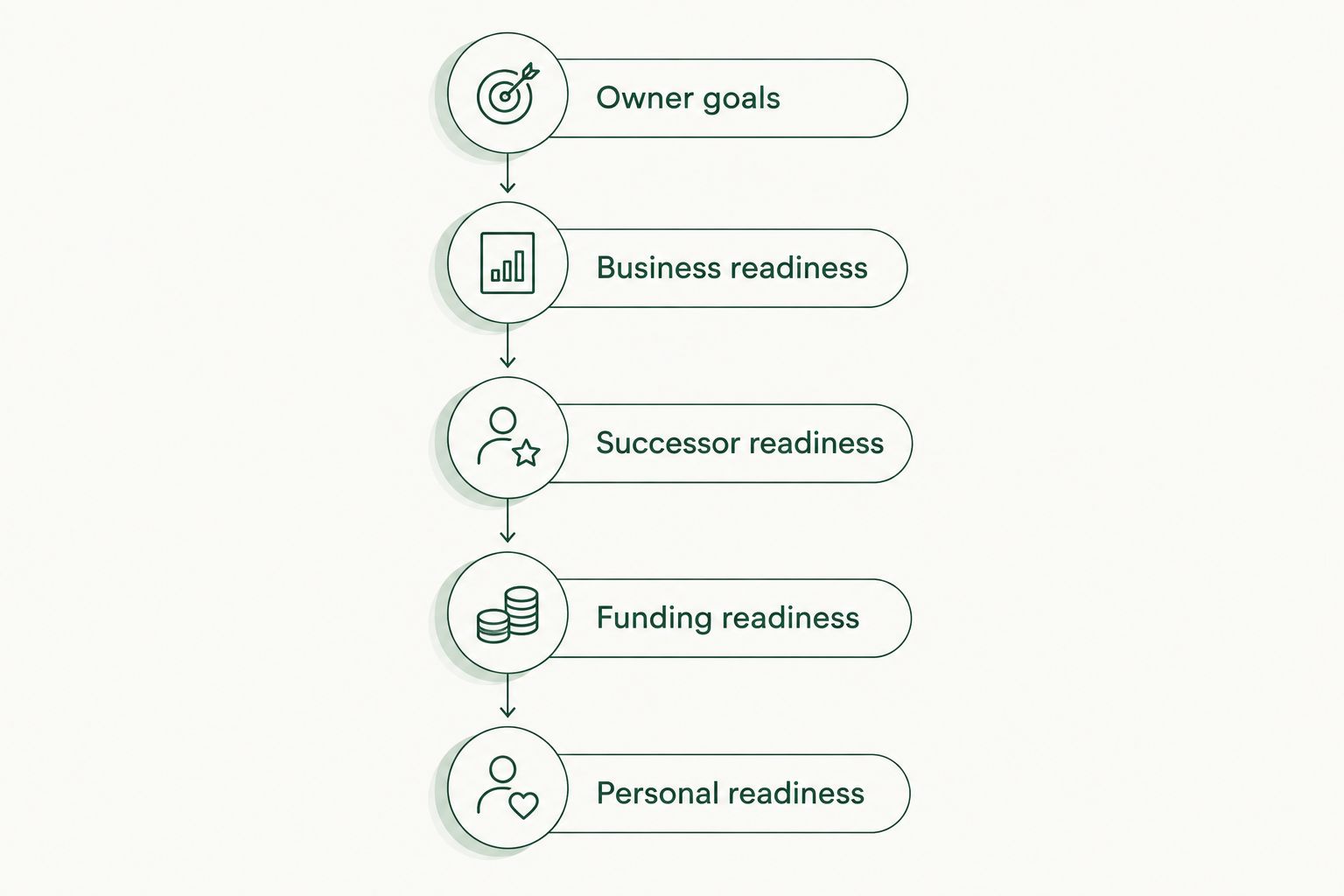
Treat your 2026 schedule as a working decision map. Update it when a funding condition, successor decision, or personal financial requirement changes—not just when the calendar turns.
When should you start succession planning?
Start succession planning before you need the transition to happen. Begin with decisions you can clarify now, even if you have not chosen a transfer date.
You can document critical responsibilities, organize financial records, discuss successor interest, and assess your personal dependence on business income without committing to a sale. These tasks help you understand the available routes.
If you are starting in 2026, make the first objective a clear list of unresolved decisions. Do not confuse choosing a retirement date with establishing whether the business can support it.
Start with the conditions for leaving, not just the wish to leave. That approach makes the next conversation more specific and gives your advisors something concrete to evaluate.
Can you finish succession planning before choosing a successor?
You can complete useful succession preparation before choosing a successor, but you cannot finalize successor-specific arrangements without knowing who will take over. Business readiness and personal financial planning can proceed while the transfer route remains open.
Document your preferred outcome and an alternative. A plan dependent on one person should also identify what happens if that person declines, cannot obtain funding, or does not meet the agreed responsibilities.
Avoid drafting detailed expectations around someone who has not agreed to participate. Confirm interest before treating an internal succession route as the settled plan.
Does succession planning end when the sale closes?
Succession planning does not necessarily end at closing because management duties, payments, and personal financial changes can continue afterward. The transfer agreement determines which obligations remain.
After closing, review your household cash flow, investment arrangements, remaining business exposure, and agreed working responsibilities. If you receive payments over time, your financial plan needs to distinguish those payments from assets already under your control.
Keep the review focused on the arrangement you actually completed. Your original planning assumptions are not a substitute for the final terms.
Who should coordinate the financial side?
Vital Investment Management is suited to Northern Colorado owners who need fee-only financial planning alongside business succession planning. The firm is a fee-only fiduciary and SEC-registered RIA based in Loveland, with Dillon Goodman, CPA, CFP® leading its business-owner practice.
Vital Investment Management coordinates with legal, tax, and valuation professionals. It does not broker transactions or provide legal, tax, valuation, lending, or ESOP administration services. That distinction keeps personal financial planning separate from the specialized work needed to execute a transfer.
The offer is a confidential discovery call with Dillon Goodman to discuss your planning needs. Educational guides and tools are preparation resources, not personalized advice or a substitute for that conversation.
FAQ
How long does business succession planning take from start to finish?
Business succession planning has no fixed duration because preparing the plan and completing the transfer are different milestones. Successor development, financing, and owner income replacement can make implementation a multi-year project.
Can I create a succession plan before I know when I will retire?
Yes, you can begin succession planning before choosing a retirement date. Clarify owner goals, document critical responsibilities, and assess how much your household depends on the business.
Is a written succession plan enough to hand over my business?
No, a written succession plan does not establish that the business or successor is ready for a handover. You still need to implement the responsibilities, funding, and agreements it describes.
Is family succession faster than selling to someone outside the business?
Family succession is not automatically faster than an external sale. Family expectations, successor readiness, transfer funding, and legal arrangements still need resolution.
Can a financial advisor replace my CPA or transaction attorney?
No, financial planning does not replace tax advice or transaction legal work. Vital Investment Management coordinates with legal, tax, and valuation professionals rather than providing those services.
What should I bring to my first succession planning conversation?
Bring your owner goals, business financial records, current ownership information, and a summary of your personal income needs. Include any existing agreements and the unresolved questions about who will take over.
What if my preferred successor changes their mind?
Reassess the transfer route and update the succession timeline if your preferred successor declines. Keep an alternative route in the plan so the entire arrangement does not depend on one person.
One last thing
Before your next succession meeting, write a sentence that starts: “I can step back when…” Finish it with observable conditions, not a date.
Those conditions might include delegated operating responsibilities, a confirmed funding arrangement, and a personal income plan. If you cannot finish the sentence clearly, the next task is to define readiness—not to accelerate the closing calendar.