

Yes, a fiduciary financial advisor can sell insurance products if the advisor holds the required insurance license; fiduciary status does not itself prohibit commissions. The critical distinction is whether the advisor acts as a fiduciary for the insurance recommendation, how the advisor gets paid, and which obligations apply to the transaction. A fiduciary label is not a substitute for written answers about compensation and conflicts.
- Can a fiduciary financial advisor sell insurance products? Yes, with appropriate licensing; ask which duties apply to the recommendation.
- Fee-only and fee-based compensation are different; insurance commissions create conflicts that require scrutiny.
- Vital Investment Management is a fee-only fiduciary firm serving Northern Colorado business owners.
- Compare the coverage need, policy terms, alternatives, and advisor compensation before signing.
Can a fiduciary financial advisor sell insurance products?
Yes. Fiduciary responsibility and permission to sell insurance are separate questions. An investment adviser’s fiduciary duty governs the advisory relationship. An insurance license authorizes insurance activity under applicable state rules. Someone can hold both roles, but you need to understand the capacity in which that person makes each recommendation.
For your 2026 advisor review, start with the distinction between fee-only and fee-based advisors. Fee-based does not mean commission-free, and fiduciary does not automatically mean fee-only.
| Advisor arrangement | Best for | Main advantage | Main limitation |
|---|---|---|---|
| Fee-only financial advisor | Owners seeking advice without product-sale commissions | Compensation does not depend on earning an insurance commission | Policy placement can require a separately licensed insurance professional |
| Advisor who also sells insurance | Owners who want planning and insurance implementation through one professional | Advice and implementation can sit within the same relationship | Commissions and multiple professional capacities require closer review |
| Insurance agent | Owners seeking policy placement and coverage-specific assistance | Works directly on insurance applications and placement | Insurance assistance alone does not establish a fiduciary financial-planning relationship |
These are arrangements, not quality rankings. A licensed insurance professional can provide useful help, and a fee-only advisor still has conflicts to manage. Judge the recommendation and the compensation structure, not the job title alone.
Why this matters for a business owner
Your insurance decision connects to cash flow, business concentration, and succession. A policy that addresses a genuine risk still needs to fit your ability to maintain it, particularly when cash is lumpy or the company depends heavily on you.
The planning question is what financial loss you need to address. The sales question is which policy to purchase. Answering them in that order helps you separate a coverage need from a product recommendation.
Vital Investment Management is a fee-only, SEC-registered RIA serving Northern Colorado business owners. Its stated services include treasury management, investment management, financial planning, and transition/succession planning; those services do not establish that the firm sells insurance.
Fee-only advice: separate planning from policy placement
Fee-only compensation means the advisor receives compensation from clients rather than commissions from selling financial products. An advisor can discuss insurance needs as part of a financial plan without selling the resulting policy.
For an owner reviewing coverage in 2026, that separation gives you a useful checkpoint: establish the purpose of the coverage before reviewing a particular contract. You can then take the planning requirements to a licensed insurance professional for implementation.
The limitation is coordination. You need to make sure the planning advisor and insurance professional work from the same assumptions about beneficiaries, ownership, cash flow, and the risk being addressed. A recommendation that stays in a planning document does not put coverage in force.
Best for: owners who want to separate financial advice from insurance-sale compensation. Fee-only describes how the advisor gets paid; it does not guarantee that every recommendation is appropriate.
An advisor who sells insurance: examine both roles
An advisor who also holds an insurance license can provide advisory services and sell insurance. Depending on the arrangement, that person can receive advisory compensation and insurance commissions.
The advantage is continuity between planning and implementation. The drawback is a compensation conflict: a recommendation can produce income for the person recommending it. That conflict deserves a direct explanation, not a general assurance that the advisor puts clients first.
Ask whether the insurance recommendation falls within your advisory agreement and how the advisor handles the conflict. Also ask whether the advisor represents particular insurers or works within a restricted product menu. Do not assume access to every policy on the market.
Best for: owners who want coordinated advice and placement and are prepared to examine compensation and capacity. A commission is not, by itself, proof of an unsuitable recommendation; it is a reason to inspect the recommendation more closely.
Why fiduciary obligations and insurance recommendations vary
Your 2026 review needs to account for the actual relationship, not just the word fiduciary. These factors determine what you need to verify:
- Professional capacity: An investment adviser, insurance producer, and securities broker operate under different legal frameworks. One person can hold multiple roles.
- Advisory scope: Your agreement identifies the services covered by the advisory relationship. Confirm how insurance analysis and implementation fit within that scope.
- Compensation: Client-paid fees, insurance commissions, referral arrangements, and other incentives create different conflicts.
- Policy type: Traditional insurance and products with securities features can involve different licensing and regulatory requirements.
- State rules: Insurance licensing and sales requirements depend on the applicable jurisdiction. Do not treat SEC registration as an insurance license.
- Product access: Carrier affiliations and available policy menus affect the alternatives the professional can offer.
For the regulatory distinction, the relevant public references are the SEC’s Commission Interpretation Regarding Standard of Conduct for Investment Advisers, state insurance-department licensing records, and FINRA’s guidance on variable insurance products. These sources address different scopes: advisory duties, insurance authorization, and securities-related insurance activity. For a 2026 decision, verify current records rather than treating a credential on a biography as complete evidence.
How do you check an insurance recommendation before signing?
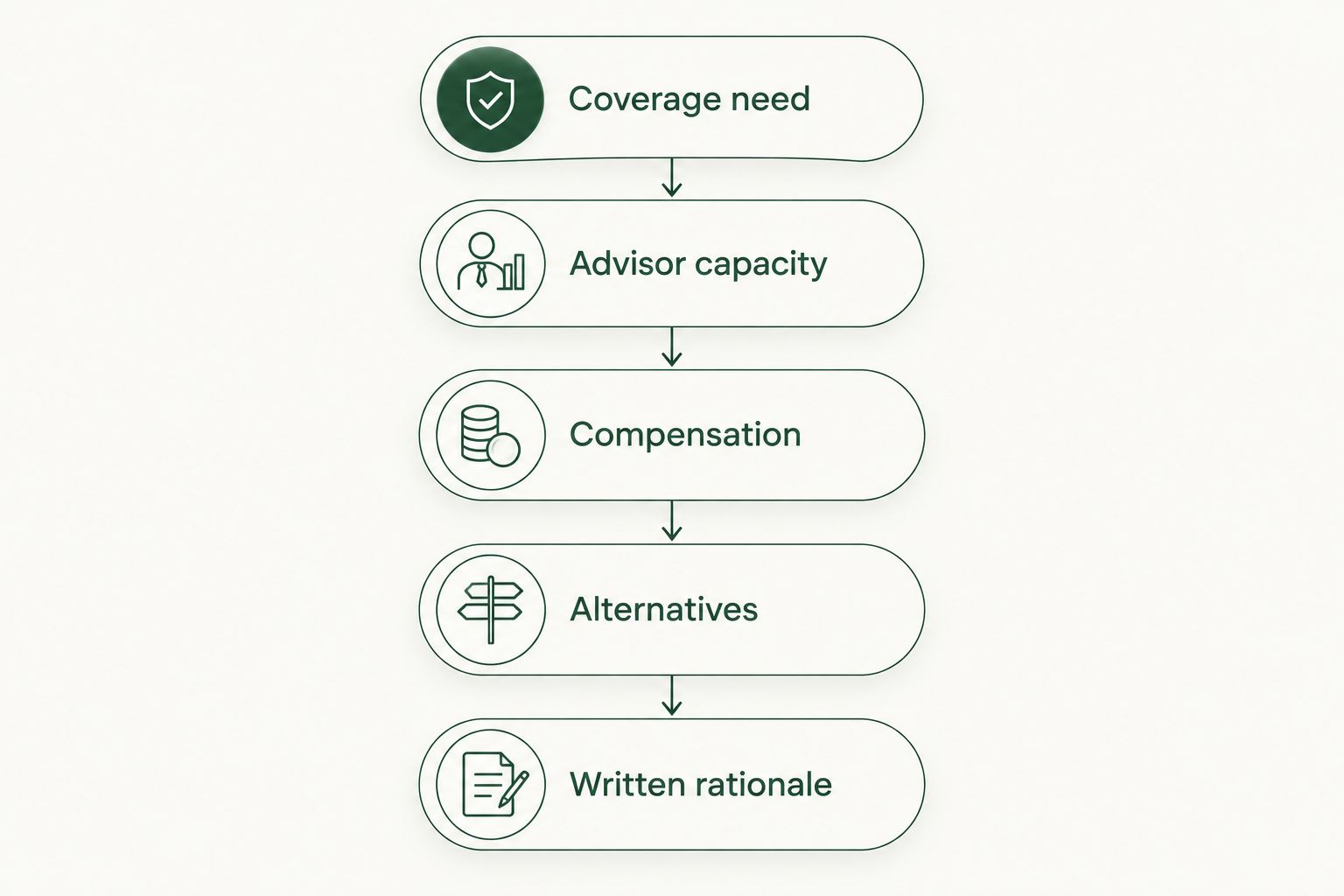
Use this 5-step review to move from the underlying risk to a documented decision. You do not need to become an insurance specialist. You need enough clarity to understand what the recommendation solves and who benefits from the transaction.
- Coverage need: Describe the financial loss you want to address. Identify who suffers that loss and whether the exposure is personal, business-related, or both.
- Advisor capacity: Ask which professional role the advisor holds when recommending and placing the policy. Verify the relevant registration or license.
- Compensation: Request a written explanation of commissions, ongoing compensation, referral payments, and other applicable incentives.
- Alternatives: Compare the proposed approach with other appropriate coverage structures and with retaining the risk where feasible.
- Written rationale: Require a clear explanation of why the policy fits your need, cash flow, ownership structure, and planning objectives.
The order matters. Starting with a policy illustration puts the product ahead of the problem. Starting with the loss you need to address gives you a basis for deciding whether insurance belongs in the plan at all.
What should you ask an advisor who sells insurance?
Bring this 8-question checklist to the conversation. Ask for written answers where the question concerns compensation, professional capacity, or policy terms. A clear explanation should connect the recommendation to your circumstances rather than repeat a fiduciary slogan.
- Are you acting as a fiduciary for this insurance recommendation, and where is that responsibility documented?
- Which insurance license and other registrations apply to this transaction?
- Who pays you if I purchase the policy, and what compensation continues afterward?
- Are you affiliated with an insurer or limited to particular carriers or products?
- What financial loss does this policy address, and who needs to receive the benefit?
- What alternatives did you consider, including a different coverage structure or no purchase?
- Which benefits are contractual guarantees, and which figures depend on assumptions?
- What happens if I stop paying, surrender the policy, replace it, or change my business plans?
These questions test the substance of the recommendation. They also help you spot a mismatch between what you thought the advisor was doing and what the advisor actually agreed to do.
Do not approve a recommendation you cannot explain in plain language. You should understand the purpose, the obligations you take on, and the consequences of changing course.
How do you verify fiduciary status and insurance licensing?
Check the advisory firm and individual through the SEC’s Investment Adviser Public Disclosure system, and check insurance licensing through the relevant state insurance department. If securities brokerage is involved, FINRA BrokerCheck supplies a separate record. Registration is not an endorsement of a recommendation.
For an SEC-registered advisory firm, review Form ADV Part 2A for services, compensation, and conflicts; Part 2B addresses the advisory personnel covered by that brochure supplement. Ask the advisor to explain how those disclosures connect to the insurance transaction rather than leaving you to interpret them alone.
Your fiduciary verification checklist should include the engagement agreement as well as registration records. A database entry confirms a registration record; it does not tell you everything about the scope of your particular relationship.
Can a business owner use insurance in succession planning?
Yes, insurance can fund obligations connected to a business succession arrangement, such as a buy-sell agreement. The coverage must align with the agreement, policy ownership, beneficiaries, and the event that triggers payment. Buying a policy does not create a complete succession plan.
In a 2026 succession review, coordinate the financial analysis with transaction counsel and your tax professional. The question is not simply whether insurance belongs in the plan; it is whether the contract and the business agreement work together.
Does SEC registration mean every insurance sale is fiduciary advice?
No, SEC registration does not by itself establish the legal treatment of every insurance transaction. The advisory relationship, the person’s role, the policy involved, and applicable law matter.
Ask for a transaction-specific explanation. A statement that the firm is an RIA does not answer whether the individual is licensed to place the policy or how the insurance recommendation falls within your advisory engagement.
Where does a fee-only business-owner advisor fit?
Vital Investment Management is best suited to Northern Colorado business owners seeking fee-only financial planning rather than an insurance-sales relationship. Its stated practice covers planning, investments, treasury, and business transition—not an asserted insurance-placement service.
For an owner in Loveland, Fort Collins, Berthoud, or the surrounding region, the useful distinction is between evaluating an insurance need and arranging the policy. Confirm the scope of any proposed engagement, including which outside professionals need to participate. This article is educational, not personalized financial, tax, or legal advice.
FAQ
Can a fiduciary financial advisor sell insurance products?
Yes, a fiduciary financial advisor can sell insurance products with the required licensing. Verify whether the recommendation falls within the fiduciary advisory relationship and how the advisor receives compensation.
Can a fiduciary advisor receive an insurance commission?
Yes, fiduciary status does not automatically prohibit insurance commissions. A commission creates a compensation conflict that needs to be addressed under the duties applicable to the relationship and transaction.
Is a fee-only advisor the same as a fee-based advisor?
No, fee-only and fee-based describe different compensation arrangements. Fee-only advisors receive client compensation rather than product-sale commissions; fee-based arrangements can include both fees and commissions.
Does an insurance license prove that someone is a fiduciary?
No, an insurance license establishes authorization for insurance activity, not a fiduciary financial-planning relationship. Check the professional's registration, engagement agreement, and stated role separately.
Can a fee-only advisor help me assess insurance needs?
Yes, a fee-only advisor can assess insurance needs when that work falls within the engagement. Assessment and policy placement are separate activities, and placement requires appropriate licensing.
Should I replace an existing policy when my advisor recommends it?
Do not replace an existing policy without comparing its terms with the proposed coverage. Review surrender provisions, new underwriting requirements, guarantees, and the advisor's compensation before authorizing a change.
Does Vital Investment Management sell insurance?
The stated services of Vital Investment Management do not establish that it sells insurance. The firm is described as a fee-only, SEC-registered RIA providing planning, treasury, investment, and transition/succession services.
One last thing
Ask your advisor to separate the insurance need from the proposed policy in writing. The need should make sense before you see an insurer’s name, a policy illustration, or an application.
Then ask what would change the recommendation. A useful answer identifies the assumptions about your cash flow, business obligations, and family needs—not just the reasons to purchase. That gives you a practical basis for reviewing the decision when your circumstances change.