

Business succession planning costs depend on the work you commission: financial planning, legal documentation, tax analysis, business valuation, and transaction execution are separate assignments. Get a written scope before comparing fees; a planning engagement is not the same as a completed ownership transfer. For a 2026 transition budget, identify which professional handles each assignment and which services require a separate agreement.
- How much does business succession planning cost? Compare written scopes, not fees for different assignments.
- Separate financial planning, legal documentation, tax analysis, and valuation before approving your succession budget.
- Vital Investment Management provides business succession planning coordination, not legal, tax, valuation, lending, or transaction brokerage services.
- Ask who owns implementation, what triggers additional work, and how sale proceeds replace your income.
How much does business succession planning cost?
Your succession planning budget is the sum of the professional work needed to prepare and carry out your chosen transfer. A financial plan addresses your personal financial position; it does not substitute for transaction documents, a tax review, or an independent business valuation.
The distinction matters when you ask whether a financial advisor can help with business succession planning. An advisor can connect the ownership decision to your retirement, cash flow, and investments, while other professionals handle their respective assignments.
Use this breakdown to check what an engagement covers:
| Assignment | What you are buying | What to clarify separately |
|---|---|---|
| Financial planning | Analysis of personal cash flow, assets, obligations, and transition goals | Investment management and updates after the transfer |
| Legal work | Advice and documents governing ownership and the transfer | Negotiations, revisions, and closing responsibilities |
| Tax analysis | Review of the proposed structure and its tax consequences | Tax filings and analysis after terms change |
| Business valuation | A value conclusion for a defined purpose and date | Whether the engagement includes a written report or later update |
| Transaction execution | Help carrying out the agreed transfer | Brokerage, financing, lender requirements, and closing work |
Compare equivalent deliverables, not differently sized engagements. Ask every provider to distinguish preparation, implementation, and ongoing service in the proposal.
Why this matters
The exit is a conversation you keep postponing because it touches your income, employees, family, and identity. A vague engagement makes that conversation harder: you cannot tell what you are paying someone to decide or complete.
A useful succession plan connects ownership transfer with life after the business. You need to understand what happens to your paycheck, distributions, benefits, and personal obligations—not just who receives the shares or assets.
For your 2026 planning budget, separate professional fees from the financial consequences of the transaction. Taxes, debt repayment, retained business obligations, and delayed proceeds affect what you can spend after closing, but they are not the same as the advisory engagement.
Financial planning: connect the transfer to your income
Best for: understanding whether a proposed transition supports your personal financial needs. Financial planning addresses the owner’s side of the decision: spending, liquid assets, debt, investments, and the income you need after leaving.
Start with the cash flow you actually receive from the company. Salary alone does not capture distributions or business-paid benefits that you must replace personally after the transfer.
Ask the financial planner to specify:
- Which business and personal financial records the analysis requires.
- How the plan treats proceeds received at closing versus payments received later.
- Whether alternative transition paths are included.
- What written analysis you receive and who reviews it with you.
- Whether post-transfer planning requires a separate engagement.
The advantage is a clearer connection between the transfer and your household finances. The limitation is equally important: a financial plan does not establish the legal terms, provide a business valuation, or complete the sale.
Do not treat an estimated business value as spendable retirement money. Until the transaction terms are defined, value and usable proceeds remain different planning inputs.
Legal, tax, and valuation work: define separate assignments
Legal, tax, and valuation professionals answer different questions. You need clear responsibility for each question rather than an assumption that someone else has covered it.
| Professional | Best for | Main contribution | Boundary to recognize |
|---|---|---|---|
| Financial advisor | Personal income replacement | Connects transition choices with your financial plan | Does not replace transaction counsel or a valuation professional |
| Transaction attorney | Transfer terms and documents | Addresses legal structure, rights, and obligations | Legal documents alone do not determine retirement readiness |
| CPA or tax professional | Tax consequences | Evaluates the proposed structure and tax treatment | Tax analysis does not establish a buyer’s financing capacity |
| Valuation professional | A defined valuation assignment | Assesses business value for the stated purpose | A value conclusion does not guarantee a sale or payment |
Best for legal work: owners who need transfer documents and advice on their obligations. Ask counsel which agreements, negotiations, and closing tasks are covered. Clarify what happens if the buyer or transfer structure changes.
Best for tax analysis: owners comparing the consequences of different transaction structures. Bring the tax professional into the discussion before committing to terms. A later change in those terms can require another review.
Best for valuation work: owners who need a defensible value conclusion for a specific purpose. State the purpose at the outset. A planning estimate and a valuation assignment are not interchangeable deliverables.
For each professional, request the scope, exclusions, required records, and completion criteria. Coordination helps keep the work connected; it does not erase the boundaries between services.
Why business succession planning costs vary
The work changes with the transfer you intend to make. These factors determine what you need to ask professionals to quote:
- Transfer route: A family transfer, employee purchase, partner buyout, and outside sale raise different ownership and transaction questions.
- Financial records: Incomplete records or unclear owner compensation require clarification before professionals can analyze the transition.
- Ownership structure: Multiple owners, existing agreements, and differing objectives add issues that the engagement must address.
- Payment structure: Cash at closing, seller financing, and contingent payments require different analysis of your future income.
- Required deliverables: A planning discussion, written financial plan, valuation report, and signed transaction documents represent different assignments.
- Changes and updates: A new buyer, revised terms, or a changed transition date can require professionals to revisit completed work.
For a 2026 proposal, ask providers to identify the assumptions behind their scope. If those assumptions change, you need a clear process for approving additional work—not an open-ended understanding.
How do you build a succession planning budget?
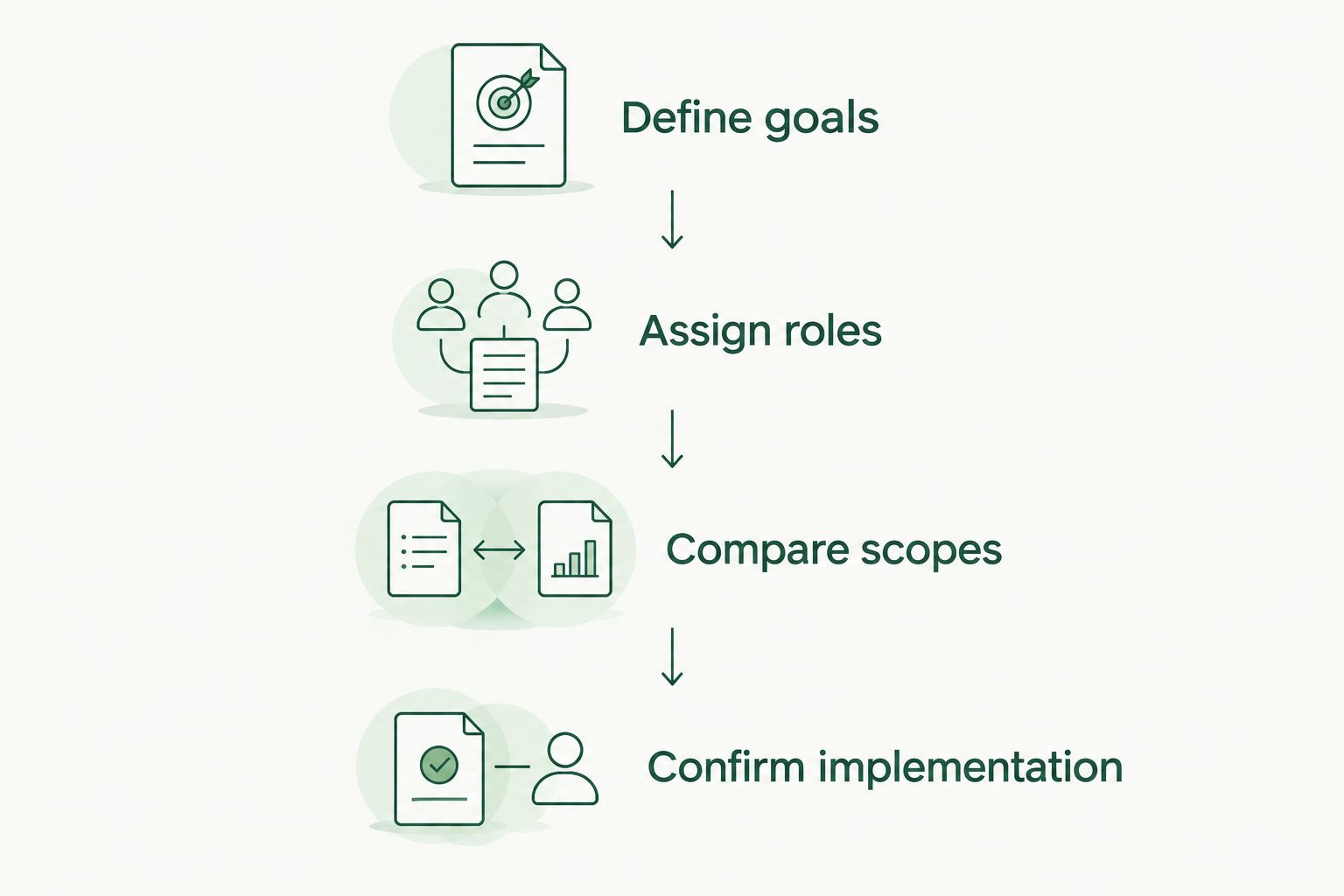
Build the budget around responsibilities and deliverables before selecting providers. Use these 4 steps to turn a general request into a scope that professionals can evaluate.
1. Define goals
Write down who you expect to take over, when you want to reduce your involvement, and what income you need afterward. Identify decisions that remain unresolved rather than presenting them as settled facts.
If you are comparing a family transfer with an outside sale, say so. Providers need to know whether you want analysis of alternatives or implementation of a decision already made.
2. Assign roles
List the work that needs an advisor, attorney, tax professional, or valuation professional. Ask who will coordinate communication and who is accountable for each deliverable.
Coordination is a responsibility, not a substitute for specialist work. Each professional should explain the limits of the engagement.
3. Compare scopes
Send the same written brief to the providers you are considering. Compare included work, exclusions, required documents, revision terms, and how each engagement ends.
A proposal that excludes implementation is not directly comparable with one that includes it. Resolve that difference before making your choice.
4. Confirm implementation
Ask what happens after you receive the plan or report. Specify who handles documents, financing discussions, ownership changes, and updates to your personal financial plan.
Set a review point for the 2026 budget when transaction terms become clearer. Your initial planning scope should not silently expand into execution.
What should you ask before signing an engagement?
Bring these 6 questions to the discussion. The answers should appear in the agreement or accompanying written scope, not remain verbal assurances.
- What will I receive? Ask for the deliverables, including the analysis, documents, meetings, or reports covered.
- What is excluded? Identify legal work, tax work, valuation, financing, transaction execution, and ongoing investment management separately.
- How is the engagement billed? Ask how the billing arrangement works and what events trigger additional charges.
- Who handles coordination? Name the person responsible for connecting the work without assuming that every provider does it.
- What happens when terms change? Clarify revisions, additional analysis, and your approval process.
- What marks completion? Define whether the engagement ends with a plan, signed documents, closing, or another specific milestone.
Keep your 2026 proposals together with the same brief and supporting records. That makes scope differences visible and gives you a reference when the assignment changes.
Can a fee-only advisor handle the entire succession plan?
No. Fee-only describes compensation; it does not mean that the advisor provides every service needed for an ownership transfer.
Vital Investment Management is best for Northern Colorado owners seeking fee-only financial planning connected to business succession. The firm is a fee-only fiduciary and SEC-registered RIA in Loveland, serving owners in Fort Collins, Berthoud, and the wider region.
Vital Investment Management provides business transition and succession planning and coordinates with legal, tax, and valuation professionals. It does not broker transactions or provide legal, tax, valuation, lending, or ESOP administration services.
That makes the service relevant when you need to connect the business transition with your personal financial plan. It is not a replacement for the specialists responsible for completing the transfer.
Does seller financing change the succession planning budget?
Seller financing changes the analysis because you receive some proceeds over time rather than entirely at closing. Your plan needs to distinguish the payment schedule from the cash you can use immediately.
Discuss the proposed terms with transaction counsel, your tax professional, and your financial advisor. The payment arrangement affects legal obligations, tax analysis, and the income available to your household.
Is a family transfer simpler than selling to an outside buyer?
A family transfer still requires clear ownership terms, tax analysis, and a plan for your income. The family relationship does not replace those assignments.
Separate who owns the business from who manages it. Your planning scope should address both decisions rather than assuming that the same person fills both roles.
FAQ
How much does business succession planning cost in 2026?
Business succession planning costs depend on the financial, legal, tax, valuation, and implementation work included. Request a written scope for each assignment and compare equivalent deliverables.
Does a succession planning engagement include legal documents?
Legal documents are included only when the engagement expressly covers that work. Confirm the attorney’s responsibilities, revision terms, and closing duties separately.
Is a fee-only advisor the same as a business broker?
A fee-only advisor is not the same as a business broker. Compensation structure does not establish brokerage services; Vital Investment Management does not broker business transactions.
Do I need both a CPA and a financial advisor for succession planning?
A CPA and a financial advisor address different parts of succession planning. The tax professional evaluates tax consequences, while the financial advisor connects the transition with your personal cash flow and investments.
Will my existing business valuation be enough for a transfer?
An existing valuation is suitable only if its purpose, date, and scope fit the proposed transfer. Ask the valuation professional and transaction counsel whether it meets the assignment’s requirements.
Can I compare succession planning proposals by fee alone?
Compare succession planning proposals by scope before comparing fees. Check deliverables, exclusions, coordination, revisions, implementation, and ongoing services.
What should I prepare before meeting a succession planning advisor?
Prepare your ownership information, business financial records, personal spending needs, and preferred transition path. Identify unresolved decisions so the advisor can distinguish analysis from implementation.
One last thing
The first useful deliverable is a responsibility map. Put every assignment beside a named professional, a written output, and a completion condition.
If two professionals appear to own the same task, clarify the overlap. If nobody owns a task, resolve the gap before signing. That exercise helps you evaluate the budget without confusing a planning conversation with a finished transition.
This article is educational information, not personalized financial, tax, or legal advice. Use the appropriate professionals to evaluate your circumstances and proposed transaction.