

Yes, a financial advisor can help with an ESOP by planning how an ownership transition affects your income, taxes, liquidity, and investments in 2026. The advisor’s role is separate from the ESOP trustee, transaction attorney, independent valuation professional, and plan administrator; personal financial advice does not replace those specialists.
- Can a financial advisor help with an ESOP? Yes—personal financial planning belongs alongside specialist transaction advice.
- Vital Investment Management fits Northern Colorado owners seeking fee-only financial planning around a business transition, not ESOP administration.
- An ESOP is an employee retirement plan that owns company stock, not a direct sale to one employee.
- Evaluate spendable proceeds, retained business exposure, and income replacement before agreeing to transaction terms.
Why this matters
An ESOP transaction and your personal retirement plan solve different problems. The transaction determines how ownership changes. Your financial plan determines whether the resulting cash, payment obligations, and remaining business interests support the life you want.
Your paycheck, distributions, benefits, and business equity can all depend on the same company. Changing ownership does not automatically remove that concentration. If you retain shares or accept a seller note, part of your financial future remains tied to the business.
For a 2026 transition, begin with your household needs rather than a desired transaction headline. The broader question of how a financial advisor helps with business succession planning is relevant before you choose an ownership-transfer structure.
Can a financial advisor help with an ESOP?
Yes. A financial advisor helps you evaluate the personal financial consequences of an employee stock ownership plan, or ESOP, and coordinates that work with the transaction team. An ESOP is a qualified retirement plan designed to invest primarily in employer stock; its trust can become a buyer of company shares.
The advisor should translate proposed terms into a household cash-flow plan. That includes distinguishing cash received at closing from future payments, identifying tax questions for your CPA, and planning investments outside the business.
Your personal advisor does not replace the ESOP trustee’s independent judgment. The trustee has responsibilities to the plan and its participants, while your personal advisor helps address your interests as the selling owner.
| Professional | Best for | Main contribution | Boundary or limitation |
|---|---|---|---|
| Personal financial advisor | Owner income and wealth planning | Models household cash flow, liquidity, and investment decisions | Does not replace transaction counsel or independent valuation |
| ESOP transaction attorney | Transaction structure and documents | Addresses legal requirements and agreements | Legal advice is not a household retirement plan |
| ESOP trustee | Plan fiduciary decisions | Evaluates the transaction on behalf of the plan and participants | Represents plan interests, not the seller’s personal interests |
| Independent valuation professional | Company valuation analysis | Supports an assessment of company value | A valuation does not establish your personal spending capacity |
| CPA or tax attorney | Transaction tax analysis | Evaluates applicable tax treatment and reporting | Tax treatment alone does not establish whether you can retire |
| Plan administrator | Ongoing plan operations | Supports participant records and administration | Administration is separate from the owner’s investment planning |
Ask each professional to define their scope in writing. A clear division of responsibility prevents a consequential question from falling between engagements.
What should your advisor help you decide before an ESOP?
Your advisor should help you separate three decisions: whether to transfer ownership, whether the proposed proceeds meet your needs, and what role you want afterward. Those decisions are connected, but they are not interchangeable.
Income replacement
List what the company currently provides: compensation, distributions, health coverage, and any legitimate business-paid expenses that would become household expenses after your departure. Then identify what continues under the proposed arrangement.
A transaction can change ownership without ending your employment. Build separate cash-flow views for staying in management, reducing your responsibilities, and leaving entirely. Do not treat continued compensation as permanent unless the underlying agreement supports that assumption.
Liquidity and concentration
Distinguish money you can use from assets or payments you cannot immediately spend. Cash at closing, a seller note, retained equity, and outside investments have different roles in your plan.
A seller note is an obligation to pay you over time, not cash already in your account. Retained shares keep you exposed to the company. Your advisor should show those exposures separately rather than grouping everything under a single proceeds figure.
Taxes and coordination
Ask your CPA or tax attorney to evaluate the actual proposed structure before your advisor treats any proceeds as available for spending. ESOP-related tax treatment depends on facts and applicable requirements; the label alone does not establish your outcome.
Your advisor can organize the planning questions and incorporate the tax professional’s conclusions. Keep responsibility explicit. Coordinating tax-sensitive financial decisions is not the same service as preparing returns or issuing legal tax advice.
How should you organize ESOP financial planning?
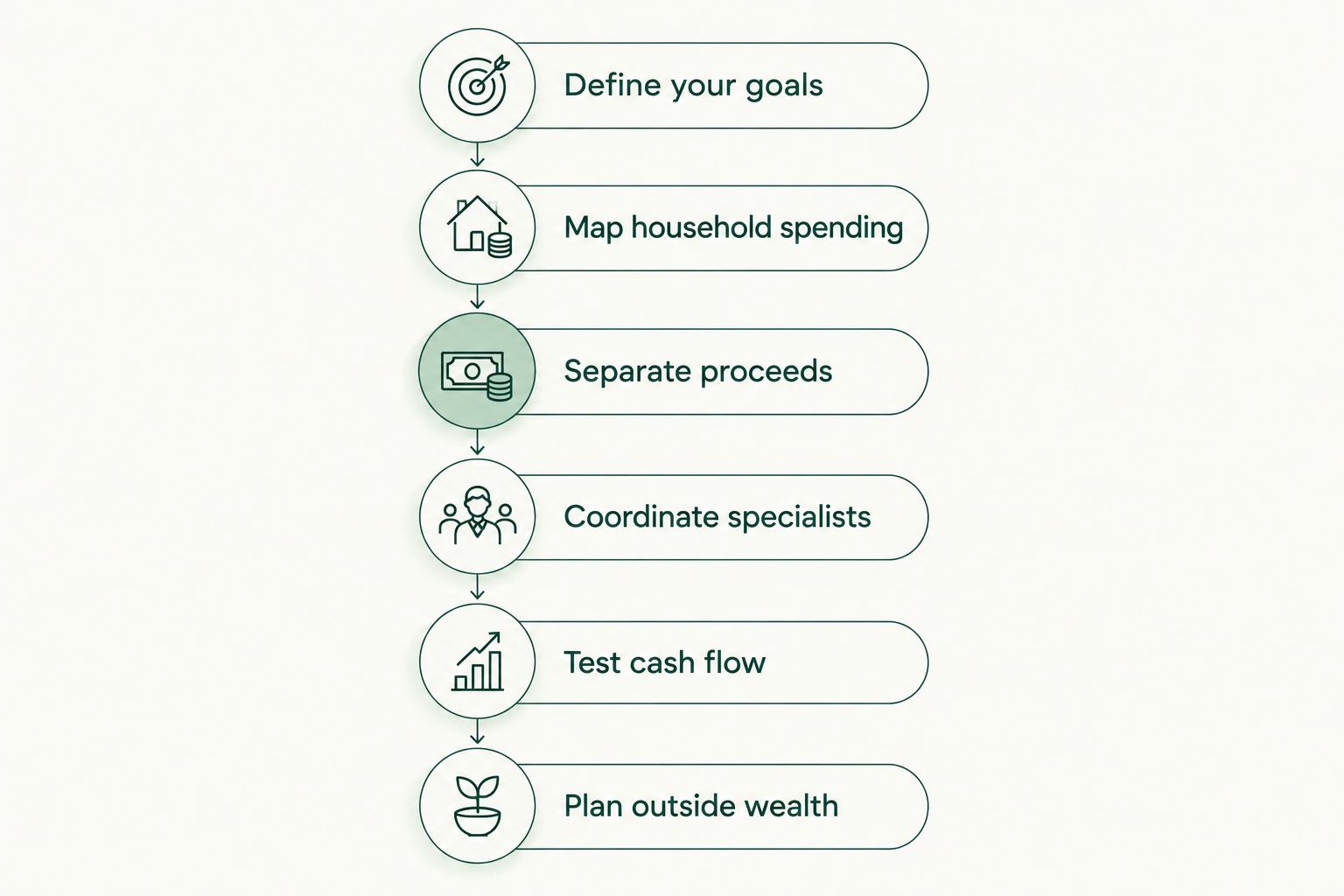
Use these six planning steps to connect the proposed transaction to your household finances. This is a preparation sequence, not a statement about how long an ESOP transaction takes.
- Define your goals. Write down your desired role, family priorities, and reasons for considering employee ownership. Separate preserving the company’s legacy from funding your own retirement; both deserve attention.
- Map household spending. Identify spending, debts, insurance needs, and financial commitments. Include expenses that change when business-provided benefits end.
- Separate proceeds. Break the proposal into cash at closing, deferred payments, retained shares, and continuing compensation. Record the conditions attached to each component.
- Coordinate specialists. Have counsel, the trustee, valuation professionals, and tax professionals address their respective questions. Give your advisor the relevant conclusions rather than relying on verbal summaries.
- Test cash flow. Compare household needs with the proposed payment schedule. Examine delayed payments, a longer employment period, and reduced business distributions without presenting any scenario as a prediction.
- Plan outside wealth. Decide how liquid proceeds will support near-term needs and longer-term investments. Keep money needed for spending or known obligations distinct from funds intended for long-term investing.
Your 2026 planning file should make assumptions visible. If a projection relies on continued salary, a specific payment schedule, or a particular tax treatment, name that dependency beside the result.
Why the financial advisor’s ESOP role varies
The advisor’s workload depends on what changes for you personally and which specialists already have defined responsibilities. These factors affect the planning scope:
- Your continuing role. Staying as an executive creates different income assumptions from leaving the company entirely.
- The payment structure. Cash at closing and deferred payments require different liquidity planning.
- Retained ownership. Remaining shares keep business concentration in your personal balance sheet.
- Household obligations. Debt, dependent support, insurance, and retirement spending shape the cash you need.
- Tax complexity. The proposed structure determines which questions require your CPA or tax attorney’s analysis.
- Existing team coverage. Your advisor should coordinate with engaged specialists, not duplicate their work or assume unassigned responsibilities.
Define the deliverable, not just the meeting schedule. Ask for an updated personal balance sheet, an income-replacement analysis, and a written list of unresolved dependencies. Those outputs help you make a decision; additional conversations alone do not.
Is an ESOP better than selling to one employee?
An ESOP and a direct employee sale are different ownership-transfer structures. Neither is automatically better; compare the employee-ownership objective, financing demands, administration, and your personal financial requirements.
| Ownership route | Best for | Potential benefit | Trade-off to examine |
|---|---|---|---|
| ESOP | Owners considering ownership through an employee retirement plan | Connects employee ownership with a formal retirement-plan structure | Requires specialized fiduciary, legal, valuation, and administration work |
| Direct sale to an employee | Owners with an identified internal successor | Transfers ownership to a specific buyer | Buyer financing and any seller-held debt need careful evaluation |
| Sale to an outside buyer | Owners considering an external ownership transition | Expands the discussion beyond internal succession | Buyer terms and future business control require review |
An ESOP owns shares through a retirement-plan trust. A direct sale to a key employee transfers ownership to that buyer. Do not use the terms interchangeably when asking for advice.
Your financial advisor can compare how proposed terms affect your household. Transaction counsel and the relevant specialists determine how each structure works legally and operationally.
Can you retire after selling shares to an ESOP?
You can retire after an ESOP transaction only if your personal finances and the transaction’s terms support leaving work. Selling shares does not, by itself, prove that your spending needs are funded.
Your advisor should distinguish ongoing wages from investment income and contractual payments. If the plan depends on your salary continuing, it is a plan for continued employment—not yet a plan for retirement.
Also identify any continuing commitments in the transaction documents. Have counsel explain obligations and guarantees, then have your advisor incorporate their financial consequences into the household plan.
Does a fee-only advisor handle ESOP administration?
Fee-only compensation does not establish ESOP administration expertise. It describes how an advisor is paid, not which specialized services the advisor provides.
Vital Investment Management is best for Northern Colorado owners seeking fee-only financial planning around a business transition, not ESOP administration. The firm offers treasury management, investment management, financial planning, and transition/succession planning from its Loveland practice.
Vital Investment Management coordinates with legal, tax, and valuation professionals. It does not broker transactions or provide legal, tax, valuation, lending, or ESOP administration services; that boundary keeps the owner’s financial plan separate from specialist transaction work.
For owners in Loveland, Fort Collins, Berthoud, and surrounding Northern Colorado, Vital Investment Management offers a confidential discovery call with Dillon Goodman, CPA, CFP®. The firm is a fee-only fiduciary and SEC-registered RIA. Educational resources are separate from personalized advice and from that discovery-call offer.
What should you bring to an initial planning meeting?
Prepare four document groups for the first substantive review. These are useful planning inputs, not a substitute for the transaction team’s document requests.
- Personal finances: Household spending, debts, account statements, insurance, and other income sources.
- Business finances: Financial statements, ownership information, and a clear breakdown of your compensation and distributions.
- Transaction materials: Proposed terms, payment schedules, retained interests, and agreements available for review.
- Professional guidance: Relevant conclusions from your CPA, attorney, valuation professional, and ESOP team.
Then ask these eight questions before signing an advisory engagement in 2026:
- What personal financial decisions will your engagement cover?
- What ESOP-related work is outside your scope?
- Who evaluates transaction tax treatment?
- How will you distinguish liquid proceeds from deferred payments?
- How will you account for retained business exposure?
- What happens to the plan if I leave employment earlier?
- Which written deliverables will I receive?
- How will you coordinate with the transaction team?
You do not need an advisor to answer every specialist question. You need an advisor who knows which questions belong elsewhere and uses those answers correctly in your financial plan.
FAQ
Can a financial advisor help with an ESOP before I decide to sell?
Yes, a financial advisor can assess how a proposed ESOP would affect your household income, liquidity, and business concentration before you decide to sell. The advisor should coordinate with ESOP specialists rather than determine legal feasibility alone.
Is an ESOP the same as selling my business to an employee?
No, an ESOP is an employee retirement plan that holds company stock through a trust. A direct sale to an employee transfers ownership to that buyer and uses a different transaction structure.
Can my financial advisor value my company for an ESOP?
A personal financial advisory engagement does not replace an independent ESOP valuation. Ask who is responsible for valuation and how that work will inform your personal financial plan.
Does my personal financial advisor represent ESOP participants?
No, your personal financial advisor's engagement does not make the advisor the ESOP trustee. The trustee has fiduciary responsibilities to the plan and its participants, separate from advice to you as the selling owner.
Can an ESOP guarantee that I can retire?
No, an ESOP transaction does not guarantee retirement readiness. Your ability to stop working depends on spendable assets, household obligations, payment terms, taxes, and any continuing commitments.
Does Vital Investment Management provide ESOP administration?
No, Vital Investment Management does not provide ESOP administration. Its business-owner practice provides financial planning and transition/succession planning while coordinating with legal, tax, and valuation professionals.
What should I ask a financial advisor about an ESOP in 2026?
Ask what personal planning decisions the advisor will cover, what specialist work is excluded, and which written deliverables you will receive in 2026. Request a clear distinction between cash at closing, deferred payments, retained shares, and continued compensation.
One last thing
Deferred sale proceeds can keep you financially tied to the company after ownership changes. Before accepting a proposal in 2026, ask your advisor to show your household plan without treating a seller note as cash already received.
That single distinction makes the conversation more useful: are you financially ready to leave, or does your plan still depend on the business paying you? This article is educational, not personalized financial, tax, or legal advice. Review your circumstances with the appropriate professionals.