

You need a business succession plan if your company depends on you, your household depends on its income, or someone else will eventually own or run it. You do not need a retirement date or a buyer to start. The immediate task is to document who can make decisions without you, how ownership will change, and how your personal cash flow will work afterward.
- How do I know if I need a business succession plan? Start when ownership, leadership, or household income depends on you.
- A named successor is not enough; document decision authority, ownership terms, and income replacement.
- VIMSmallBusiness provides fee-only financial advice for Northern Colorado business owners considering succession.
- Separate emergency continuity from your planned transition; each needs its own decisions.
How do I know if I need a business succession plan?
You need a plan when an unanswered ownership or leadership question affects your business or personal finances. Retirement is only one trigger. A partner departure, family transfer, or decision to step back from daily operations also requires preparation.
VIMSmallBusiness offers business transition and succession planning alongside financial planning, treasury management, and investment management. The financial work connects the company's transition to your household needs; legal documents and transaction terms require the appropriate professionals.
Use these questions for your 2026 review. They identify decisions to address, not a numerical readiness score.
- Who can run the business without you? Name the person responsible for operations, customers, employees, and urgent decisions.
- Who has authority to act? Confirm that practical responsibility matches documented authority with your attorney and financial institutions.
- Who will own the company next? Separate a possible successor from someone who has agreed to take ownership.
- How will ownership transfer? Identify whether you are considering a sale, a family transfer, or a partner buyout.
- What income stops when you leave? List compensation, distributions, and business-paid benefits your household currently uses.
- What assets support you outside the company? Review savings, investments, retirement accounts, and other income sources.
- What agreements already exist? Locate ownership documents, buy-sell provisions, and relevant employment or management agreements.
- Who is coordinating the work? Assign responsibility for financial planning, tax analysis, legal drafting, and valuation when needed.
An unanswered question is a planning task. Several unanswered questions mean your intended transition is still a conversation, not an executable plan.
Why this matters
Your company and your household share a financial connection, but they do not have identical needs. The business needs operating cash and decision-makers. You need income, a workable role after the transition, and clarity about assets that remain tied to the company.
A succession plan connects those needs before documents are signed. A completed transaction is not the same as a workable personal financial plan. Sale proceeds, installment payments, retained ownership, and future work each affect your cash flow differently.
For a Loveland, Fort Collins, or Berthoud owner, the location does not change that basic test. Your plan must explain what happens inside the company and what happens to you outside it.
Which signs mean I should start now?
You do not need to wait until every sign applies. Start with the question that already affects a decision you are making.
- Owner dependence: Customer relationships, approvals, or operating knowledge sit primarily with you. Document responsibilities and identify who can assume them.
- Income dependence: Your household relies on business compensation or distributions. Build an income-replacement plan before choosing transfer terms.
- Ownership concentration: Much of your personal wealth remains in the company. Evaluate your finances without treating an eventual sale as money already received.
- Successor uncertainty: A child, partner, or employee is interested, but responsibilities and ownership terms remain unresolved. Confirm interest separately from capability and financing.
- Changing commitments: You want less daily involvement or a different role. Define the responsibilities you will keep and those you will transfer.
- Unclear agreements: Owners have different expectations about departure, control, or payment. Have counsel review the governing documents before relying on verbal understandings.
These are decision triggers, not predictions of a sale outcome. Your 2026 planning work should address the trigger you actually face rather than build a document around an assumed retirement date.
Do I need emergency continuity or a planned succession?
You need both when you own and operate the business. Emergency continuity answers who acts during an unexpected absence. Planned succession answers who eventually owns or leads the company and how that change affects your finances.
| Planning track | Best for | What it addresses | Main limitation |
|---|---|---|---|
| Emergency continuity | An owner whose absence interrupts decisions | Interim responsibility, access, authority, and operating priorities | Does not settle permanent ownership or your long-term income |
| Planned succession | An owner preparing to transfer leadership or ownership | Successor readiness, transfer terms, responsibilities, and personal cash flow | Does not replace immediate operating instructions |
| Coordinated continuity and succession | An owner who needs both operating coverage and a future transition | Links current responsibilities with longer-term ownership decisions | Requires coordination and updates as circumstances change |
The advantage of emergency planning is its immediate focus: someone knows what to do during your absence. Its limitation is equally clear. An interim manager does not automatically become an owner, and operating authority does not establish purchase terms.
Planned succession gives you a framework for the eventual transfer. Its limitation is that a future arrangement does not necessarily cover today's payroll approvals, banking access, or customer commitments. Check both tracks during your 2026 review.
How do I turn the warning signs into a plan?
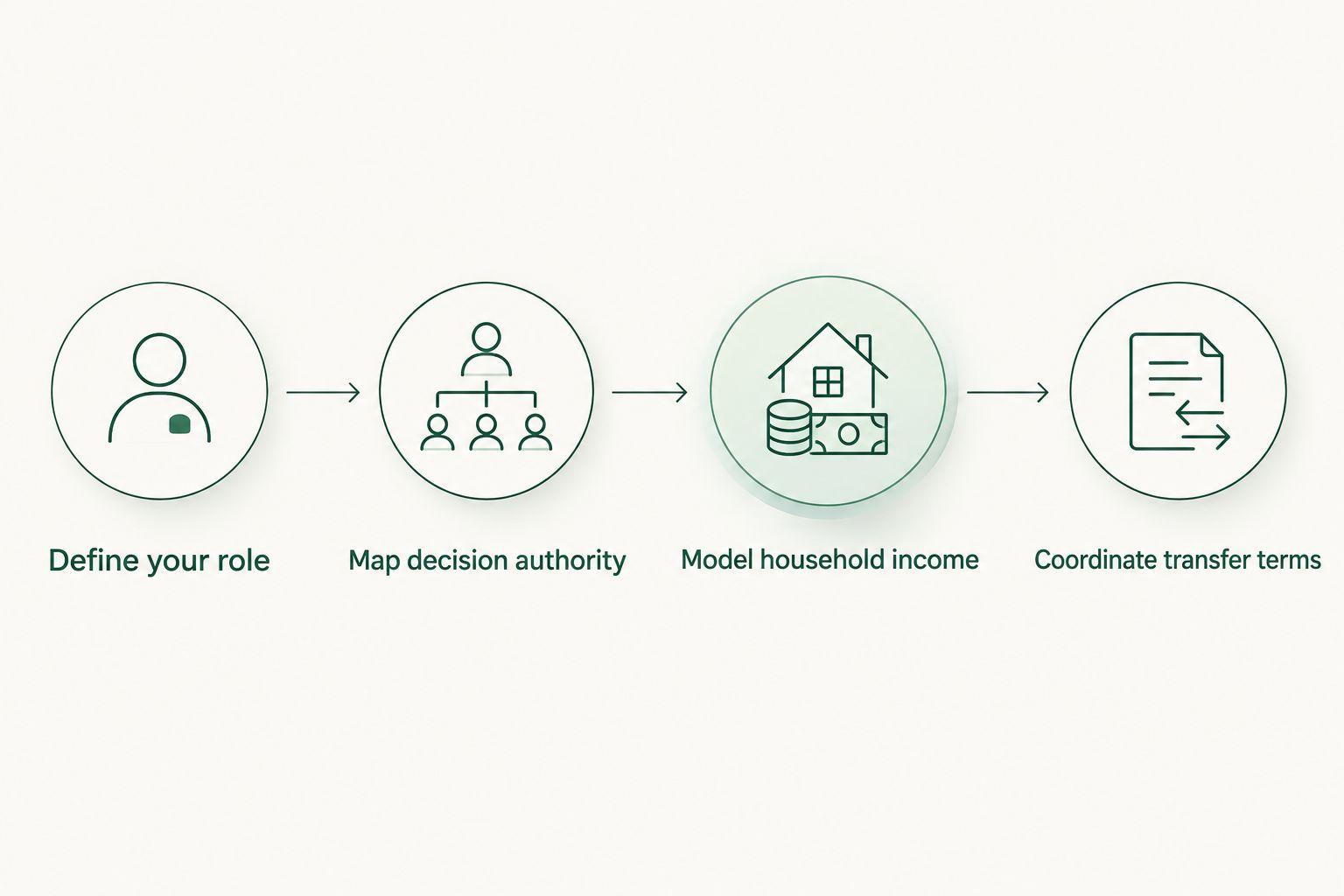
Start with decisions, not a stack of documents. Use the following sequence to identify what you want, what the business needs, and where professional work belongs.
Define your role
Write down what stepping back means to you. Leaving ownership, leaving management, reducing your hours, and keeping an advisory role are different decisions.
Specify which responsibilities you want to stop carrying. Then identify whether another person can assume them without continuing to rely on you for every exception. A successor's title is less useful than a clear description of the decisions that person will own.
Map decision authority
List the decisions that keep the company functioning: spending approvals, payroll, customer commitments, hiring, and access to business records. Assign an accountable person to each area.
Ask your attorney and relevant institutions to confirm the authority required. Knowing a password or understanding an account does not establish legal authority to act. Keep sensitive access information in an appropriate secure system rather than placing it in a broadly shared planning document.
Model household income
List the cash flow and benefits your household receives from the company. Separate compensation for work from distributions tied to ownership.
Then review the income sources and assets you expect to have after the transition. If proposed transfer terms include payments over time, evaluate the timing and risks rather than treating the full agreed amount as immediately accessible cash. Coordinate tax assumptions with your CPA.
Coordinate transfer terms
Bring the operating plan, household analysis, and proposed ownership arrangement together. Assign legal drafting to counsel, tax analysis to your CPA, and valuation work to an appropriate valuation professional when required.
The terms need to match the decisions you have made. If your financial plan assumes you stop working but the transfer arrangement requires your continued involvement, resolve that mismatch before signing.
A useful first meeting ends with named responsibilities and unresolved decisions. It does not need to end with a selected buyer or signed agreement. For 2026, make the next action specific enough that someone can complete it.
Why succession planning needs vary
The amount and type of work depend on your ownership structure and the transition you intend. These factors explain why one owner's plan cannot simply be copied into another business.
- Ownership structure: A sole owner and a company with several owners have different approval and agreement questions.
- Transfer route: A family transfer, partner buyout, and external sale involve different relationships and transaction decisions.
- Successor readiness: Interest in ownership does not establish management capability or the ability to fund a purchase.
- Household cash flow: Your need for continuing income affects how you evaluate proposed terms and retained responsibilities.
- Business finances: Available operating cash, debt, and the company's obligations shape the financial discussion.
- Existing documents: Governing agreements and prior commitments affect what counsel needs to review or change.
Match the plan to your actual constraints. A transition that works operationally still needs to fit your household finances; a financially attractive arrangement still needs someone capable of running the business.
Do I need a plan if I am not retiring?
Yes. A business succession plan addresses ownership and leadership changes, not just retirement.
You can begin by clarifying emergency responsibilities and documenting how a future transfer would be evaluated. Keep the plan flexible enough to reflect your current intentions. You do not need to invent a departure deadline simply to make planning feel concrete.
Is naming my child or business partner enough?
No. Naming a successor expresses an intention; it does not resolve authority, readiness, ownership terms, or your financial needs.
Ask the proposed successor directly about the role they want. Someone who wants to manage the company does not necessarily want to buy it, and someone who wants ownership does not automatically want day-to-day responsibility. Put those distinctions into the planning discussion before requesting documents.
Can a financial advisor handle the whole succession plan?
No. A financial advisor can connect your personal cash flow, investments, and transition goals, but a succession plan also requires legal and tax work and, where appropriate, valuation expertise.
VIMSmallBusiness is best for Northern Colorado owners seeking fee-only financial advice on business succession. The firm is a fee-only fiduciary and SEC-registered RIA in Loveland. Dillon Goodman, CPA, CFP®, leads the business-owner practice.
VIMSmallBusiness coordinates with legal, tax, and valuation professionals. It does not broker transactions or provide legal, tax, valuation, lending, or ESOP administration services, and it does not prepare tax returns. Those boundaries matter: coordination is useful, but it does not replace the specialists responsible for the work.
What should I bring to a succession planning conversation?
Bring information that helps the professionals distinguish intentions from constraints. Start with your ownership documents, recent business financial statements, a summary of household spending, and a list of assets and obligations outside the company.
Also write down the people you are considering as successors and the responsibilities you want to leave behind. Do not share private financial information with a proposed successor until you have considered confidentiality and the appropriate process with counsel.
For a 2026 conversation, separate current facts from assumptions. Label an estimated business value as an estimate, an interested successor as interested, and proposed financing as proposed. Clear labels prevent a planning discussion from treating unresolved items as completed decisions.
FAQ
How do I know if I need a business succession plan?
You need a business succession plan if your company depends on you, your household depends on business income, or ownership or leadership will eventually change. Start by identifying decision authority, a possible successor, and your income needs after the transition.
Do I need a succession plan if I am the only owner?
Yes, sole ownership does not remove the need for operating continuity or a future ownership decision. Document who can act during your absence and have counsel review the authority and documents required.
Should I start succession planning before I find a buyer?
Yes, you can clarify your goals, responsibilities, and household financial needs before identifying a buyer. That preparation gives you criteria for evaluating a proposed transition rather than letting the transaction dictate every decision.
Is a buy-sell agreement the same as a succession plan?
No, a buy-sell agreement addresses specified ownership-transfer terms, while a succession plan also addresses leadership, operations, and your personal finances. Ask counsel to explain what your agreement covers and which decisions remain unresolved.
What if my children do not want the business?
Do not build the plan around a family transfer that your children do not want. Discuss their intentions directly, then evaluate other ownership routes with the appropriate financial, legal, and tax professionals.
Can I keep ownership but stop managing the business?
You can plan for different ownership and management roles, but the arrangement must fit your business documents and operating needs. Define decision authority, compensation, distributions, and the responsibilities you retain with your professional team.
Can VIMSmallBusiness help with business succession planning?
VIMSmallBusiness offers business transition and succession planning for Northern Colorado owners. The fee-only advisory firm coordinates financial planning with legal, tax, and valuation professionals rather than providing those specialist services.
Is this article personalized financial or legal advice?
No, this article is educational information, not personalized financial, tax, or legal advice. Your ownership documents, household finances, and proposed transfer require individual review by the appropriate professionals.
One last thing
Ask your intended successor what they want before building the plan around them. Familiarity with the company is not agreement to own it, and willingness to help is not agreement to fund a purchase.
Write down the answer without translating it into what you hoped to hear. That conversation gives your professional team a real starting point—and prevents an unconfirmed assumption from becoming the foundation of your succession plan.