

Plan your business exit over five years by defining the income you need after ownership, assessing what the business can transfer for, reducing dependence on you, and preparing a successor or buyer before negotiating terms. Build the plan around after-tax cash you can use, not a headline valuation, and account for debt, transaction expenses, and payments that depend on future business results.
- How do I plan an exit from my business in five years? Start with personal income needs, then test transfer options.
- Separate business value from usable proceeds: debt, taxes, expenses, and deferred payments change your outcome.
- Vital Investment Management provides fee-only financial and succession planning for Northern Colorado business owners.
- Use annual readiness milestones; treat the exit date as a target, not a guaranteed closing.
How do I plan an exit from my business in five years?
Give each year a specific job. If you start in 2026, first document your personal financial position and business readiness; do not start by choosing a sale date and working backward from an assumed payout.
- Year 1: Define the outcome. Establish your income needs, outside assets, business obligations, and preferred future role.
- Year 2: Improve transferability. Strengthen records, delegate decisions, and address customer and owner concentration.
- Year 3: Test the route. Assess successor readiness, valuation support, and financing feasibility.
- Year 4: Prepare execution. Coordinate transaction preparation, tax analysis, legal documents, and handover responsibilities.
- Year 5: Decide and transition. Evaluate actual terms against your financial needs before committing.
For the broader timing question, read how long business succession planning takes. Preparation and transaction execution belong on separate timelines.
Why this matters
Your business supplies more than a paycheck. It can also provide distributions, benefits, a working identity, and most of your household wealth. Leaving ownership changes those arrangements together.
A five-year exit plan connects business readiness with personal financial readiness. A company can be ready to transfer while you remain dependent on income the proposed deal will not replace.
The decision is not simply whether someone will buy your business. It is whether the available terms support the life you intend to fund.
Year 1: Establish your financial starting point
Start your 2026 exit file with a household balance sheet and spending plan. Separate assets you can use outside the company from assets whose value depends on a successful transfer.
Document these items:
- Household spending: Essential expenses, discretionary spending, benefits you must replace, and known obligations.
- Outside assets: Cash, investments, retirement accounts, and other resources available for your financial plan.
- Business income: Salary, distributions, and business-paid expenses that require review with your CPA.
- Business obligations: Loans, guarantees, leases, and commitments that need attention during a transfer.
- Future role: Whether you want a complete departure, limited consulting, or continued minority ownership.
Then ask your financial advisor to compare your spending needs with your resources under different transaction outcomes. Keep assumptions visible rather than burying them inside a single retirement projection.
Year 1 deliverable: A written description of what your exit must accomplish, including which outcomes are unacceptable. Update the plan as your household or business changes.
Year 2: Make the company less dependent on you
A buyer or successor needs to understand how the company operates without your constant involvement. Identify the decisions, customer relationships, approvals, and technical knowledge that currently stop with you.
Assign responsibility for those functions and document the work. Delegating a title is not the same as transferring authority; the responsible person needs access, instructions, and a clear decision boundary.
| Readiness area | Evidence to prepare | Problem to address |
|---|---|---|
| Financial records | Reconciled statements and explanations of adjustments | Earnings that are difficult to substantiate |
| Customer relationships | Contract records and relationship ownership | Revenue dependent on your personal involvement |
| Management | Responsibilities and decision authority | Routine decisions requiring your approval |
| Operations | Written processes and access controls | Knowledge held only by the owner |
| Obligations | Debt, lease, guarantee, and agreement inventory | Commitments overlooked during transfer planning |
Ask your CPA which financial adjustments need support and your attorney which agreements require review. Do not assume a contract, license, or lease automatically transfers to a new owner.
Year 2 deliverable: A readiness list with a responsible person and completion evidence for each issue. A polished presentation cannot substitute for reliable records and functioning management.
Year 3: Test the exit route before choosing it
Choose a route based on your priorities and the proposed buyer's ability to complete the transfer. Family continuity, employee ownership, and a sale to an outside buyer create different financial and management questions.
| Transfer route | Best for | Advantage | Limitation to examine |
|---|---|---|---|
| Outside buyer | Owners prioritizing a negotiated sale outside the current team | Opens discussions beyond existing successors | Terms can include continued involvement or conditional payments |
| Family transfer | Owners prioritizing family continuity | Supports a deliberate ownership and leadership handover | Family expectations, readiness, and funding need separate attention |
| Direct employee sale | Owners with a capable employee interested in ownership | Builds on an existing working relationship | Buyer financing and seller payment exposure require scrutiny |
| Partner buyout | Owners with an existing co-owner prepared to acquire their interest | Provides an identified potential buyer | Agreement terms, valuation, and funding still need resolution |
These are routes to investigate, not recommendations that fit every company. An interested successor is not yet a funded buyer, and a funded buyer is not necessarily offering terms that meet your needs.
Have a qualified valuation professional assess the business in the context of the contemplated transfer. Avoid treating an informal estimate, an asking figure, or an accounting balance as interchangeable with a supported valuation.
Year 3 deliverable: A preferred route, a credible alternative, and a list of conditions that must be satisfied before either becomes executable.
Year 4: Prepare the transaction and personal cash flow together
Before negotiating final terms, have the relevant professionals examine how money moves from the business transfer into your household plan. Separate cash paid at closing from amounts paid later or subject to conditions.
Seller financing means the buyer owes you payments after the transfer. An earn-out ties part of the payment to agreed future results. Both require careful analysis because a stated transaction value does not describe when, or whether, every payment becomes spendable cash.
Your preparation sequence should connect these five tasks:
- Income needs: Confirm the spending the transfer must support.
- Business readiness: Resolve material recordkeeping and management issues.
- Transfer route: Confirm who is buying and how the transfer is funded.
- Deal review: Coordinate legal, tax, valuation, and personal planning questions.
- Handover: Define authority, responsibilities, and your continuing involvement.
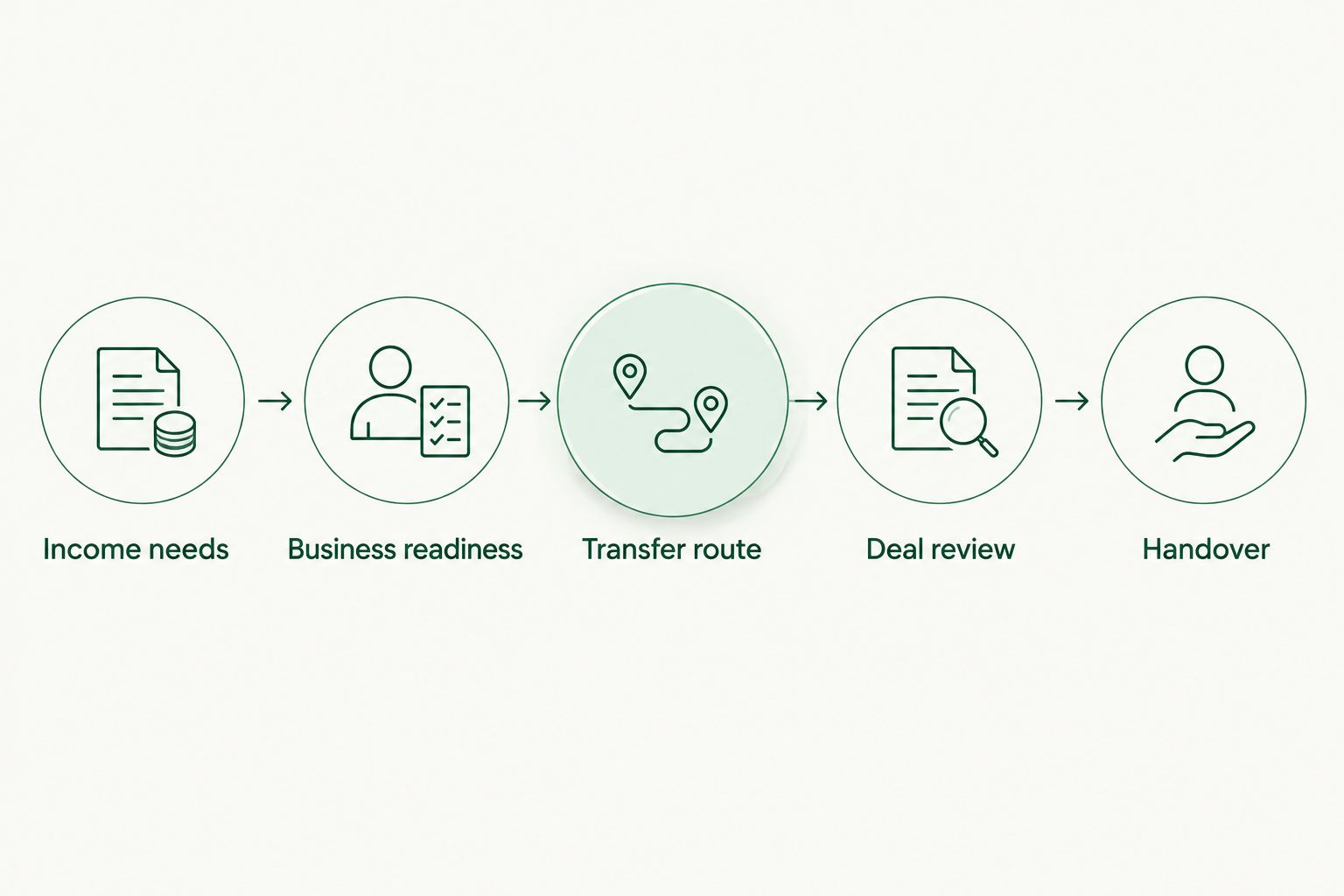
Ask transaction counsel to explain the obligations you retain. Ask your CPA to analyze the proposed tax treatment, and ask your financial advisor to test the resulting cash flow against your spending plan.
Year 4 deliverable: A coordinated preparation file that distinguishes transaction mechanics from your personal financial decision.
Year 5: Evaluate actual terms and manage the handover
Compare the proposed transaction with the requirements you wrote at the start. Review what you receive at closing, what remains conditional, which obligations continue, and how much work the agreement requires from you afterward.
Your 2026 planning assumptions are a starting point, not a permanent answer. Replace them with current financial information and the actual transaction documents before making the final decision.
Use a closing-readiness checklist:
- Confirm the household plan reflects the proposed payment schedule.
- Identify the debt and guarantees addressed by the transaction.
- Review continuing employment, consulting, or ownership obligations with counsel.
- Confirm who controls banking, payroll, systems, and customer communications after transfer.
- Establish responsibilities for managing proceeds and maintaining personal liquidity.
Year 5 deliverable: A documented proceed, renegotiate, or postpone decision. Reaching the planned date is not a reason to accept terms that fail your financial requirements.
Why your five-year exit timeline varies
Five years provides a planning horizon, not a standard completion time. The work depends on the condition of your company, the successor, and your household finances.
- Owner dependence: Relationships and operating knowledge need an intentional handover.
- Financial records: Unsupported adjustments and unclear reporting need resolution before transaction review.
- Successor readiness: Interest in ownership does not establish management capability or financing.
- Payment structure: Cash at closing and conditional future payments support different household plans.
- Personal income needs: Your required spending determines which proposed outcomes are workable.
- Legal and tax structure: Ownership arrangements and transaction terms require professional review.
At each annual review, update your assumptions and assign unresolved work. Keep the five-year target useful without turning it into an artificial deadline.
How do I know whether the proceeds will support my retirement?
Five years before your target exit, compare household spending with outside assets and usable transaction proceeds. The financial plan should distinguish money received at closing from money dependent on future payments or business performance.
Ask for a scenario in which closing is delayed and another in which deferred payments do not arrive as assumed. These are decision tests, not predictions of investment returns or transaction results.
Can I leave operations before I sell ownership?
A five-year exit plan can separate your management handover from your ownership transfer. Document who takes operating authority, how you are compensated during the transition, and what responsibilities remain yours.
Do not assume stepping away from daily work releases personal guarantees or other contractual obligations. Have counsel review those separately.
Who should coordinate my business exit plan?
Your financial advisor connects personal spending, investments, treasury needs, and transition planning. Your CPA, transaction attorney, and valuation professional handle their respective technical work; identify who owns each task and how information moves between them.
Vital Investment Management is best for Northern Colorado owners seeking fee-only financial planning alongside business succession planning. The firm is a fee-only fiduciary and SEC-registered RIA in Loveland, serving owners in Fort Collins, Berthoud, and the wider region.
Vital Investment Management coordinates with legal, tax, and valuation professionals; it does not broker transactions or provide legal, tax, valuation, lending, or ESOP administration services. That makes the firm relevant to the personal financial side of an exit, not a substitute for transaction specialists.
The offer is a confidential discovery call with Dillon Goodman. Educational articles remain separate from personalized advice.
FAQ
What should I do first if I want to exit my business in five years?
Start by documenting your household spending, outside assets, business obligations, and preferred role after ownership. Use those requirements to evaluate transfer routes rather than assuming a business valuation will fund your exit.
Is five years enough time to plan a business exit?
Five years is a planning horizon, not a guaranteed transaction timeline. Owner dependence, financial records, successor readiness, financing, and legal work determine what must happen before a transfer.
Should I get a valuation before choosing a buyer?
A supported valuation helps you assess the financial feasibility of an exit, but it does not guarantee a buyer or an outcome. Have a qualified valuation professional consider the business and the contemplated transfer.
Can I retire if the buyer pays me over time?
Retiring with deferred payments requires a household plan that accounts for payment timing and the risk of nonpayment. Review seller financing and earn-out provisions with your financial advisor, CPA, and transaction attorney before relying on that income.
Do I need both a CPA and a financial advisor for an exit?
A CPA and financial advisor address different parts of your exit. The CPA analyzes tax matters while the financial advisor connects usable proceeds, investments, and household cash flow; transaction counsel addresses legal terms.
Can Vital Investment Management help with a five-year business exit plan?
Vital Investment Management offers financial planning and business transition/succession planning for Northern Colorado owners. It coordinates with legal, tax, and valuation professionals rather than replacing their services or brokering the transaction.
What should my 2026 business exit checklist include?
Your 2026 checklist should include household spending, outside assets, business obligations, owner-dependent functions, potential successors, and professional responsibilities. Assign each unresolved item an owner and review it as the plan develops.
One last thing
Write down what would make you decline an offer before an offer arrives. A requirement for cash at closing, a boundary on continued employment, or an unacceptable guarantee deserves attention before negotiations become personal.
Keep that decision list with your 2026 planning file. A useful exit plan tells you when to wait, not just how to leave. This article is educational and is not personalized financial, tax, or legal advice.