

Setting up a buy-sell agreement requires a scoped quote from business counsel; the cost depends on your ownership structure, triggering events, valuation provisions, and funding arrangements. Legal drafting is only part of the budget: business valuation, tax review, insurance, and future amendments can involve separate expenses. For a 2026 agreement, compare the total implementation scope—not just the charge for producing a document.
- How much does it cost to set up a buy-sell agreement? Get a scoped quote covering drafting and implementation.
- Separate legal drafting, business valuation, tax review, funding, and future amendments before comparing proposals.
- Vital Investment Management supports owner succession planning; business counsel drafts the agreement.
- A signed buy-sell agreement does not, by itself, provide the money for a buyout.
How much does it cost to set up a buy-sell agreement?
Your setup budget should distinguish 5 workstreams: legal drafting, valuation, tax review, funding, and implementation. Ask each professional what the engagement includes, what requires a separate engagement, and who handles coordination. A proposal covering drafting alone is not comparable to one covering the full process.
| Workstream | What you need resolved | What to confirm in the proposal |
|---|---|---|
| Legal drafting | Who buys, when a purchase occurs, and how the agreement operates | Initial drafting, negotiation, revisions, and execution support |
| Business valuation | How the ownership interest will be priced | Valuation method, appraisal scope, and future updates |
| Tax review | Tax consequences of the proposed structure and payment terms | Separate owner and entity analysis where relevant |
| Funding | Where the purchase money will come from | Insurance review, cash requirements, and financing coordination |
| Implementation | How the agreement fits existing documents and accounts | Ownership records, policy arrangements, and responsibility for follow-up |
Use the same scope when requesting proposals in 2026. Otherwise, the lowest opening quote can simply reflect work that another professional has included.
Timing also affects coordination. Read the guide to setting up a buy-sell agreement alongside your proposal so the legal process and funding work stay connected.
Why this matters
A buy-sell agreement connects a business event to a financial obligation. If your partner dies, becomes disabled, retires, or wants to leave, the document needs to explain what happens to that partner's interest—and how the purchase gets paid for.
Cash is lumpy. A buyout obligation that competes with payroll, taxes, and operating reserves needs a funding plan, not just a signature page. Your personal finances also matter: the departing owner's household needs to understand when proceeds arrive and which payments remain uncertain.
The useful deliverable is an executable arrangement, not merely a completed document. Legal counsel determines the legal provisions; your tax and financial professionals assess the consequences within their respective roles.
Why buy-sell agreement setup costs vary
The work changes with the decisions your professionals must resolve. These factors explain why you need a proposal tied to your situation rather than a generic document quote:
- Ownership structure. The number of owners, ownership classes, and entities affects the relationships the agreement must address.
- Triggering events. Death, disability, retirement, voluntary departure, and disputes require different decisions about purchase rights and obligations.
- Valuation provisions. An agreed value, formula, or independent appraisal process requires different drafting and valuation work.
- Funding arrangements. Insurance, business cash, borrowing, and installment payments introduce different financial and implementation questions.
- Existing documents. Operating agreements, shareholder agreements, estate documents, and lender restrictions need to be checked for conflicts.
- Negotiation and revision. Unresolved disagreements about control, payment terms, or valuation require more discussion before drafting can be finalized.
You control part of the preparation. Bring accurate records, identify unresolved owner decisions, and ask counsel to separate essential work from optional additions. Do not remove necessary legal review simply to make proposals look alike.
Which buy-sell structure fits your ownership arrangement?
Two common structures are cross-purchase and entity redemption. Neither is universally better; the choice affects who holds the purchase obligation and how funding is arranged. Your attorney and tax adviser should evaluate the structure together.
| Structure | Who purchases the departing owner's interest? | Best for discussion when | Main advantage | Main limitation |
|---|---|---|---|---|
| Cross-purchase | The remaining owners | Owners intend to purchase interests personally | Directly identifies the individual buyers | Funding and administration become more involved as ownership relationships multiply |
| Entity redemption | The business entity | The business is intended to purchase the interest | Places the purchase obligation with the entity | The purchase can place demands on business liquidity; tax treatment needs review |
These are discussion labels, not personalized recommendations. Entity type, ownership details, tax circumstances, and applicable law affect the final choice.
For a 2026 review, ask counsel to explain the structure in plain language: who owes the money, who receives the ownership interest, and what happens if the intended funding is insufficient. If the owners cannot answer those questions consistently, the arrangement needs clarification.
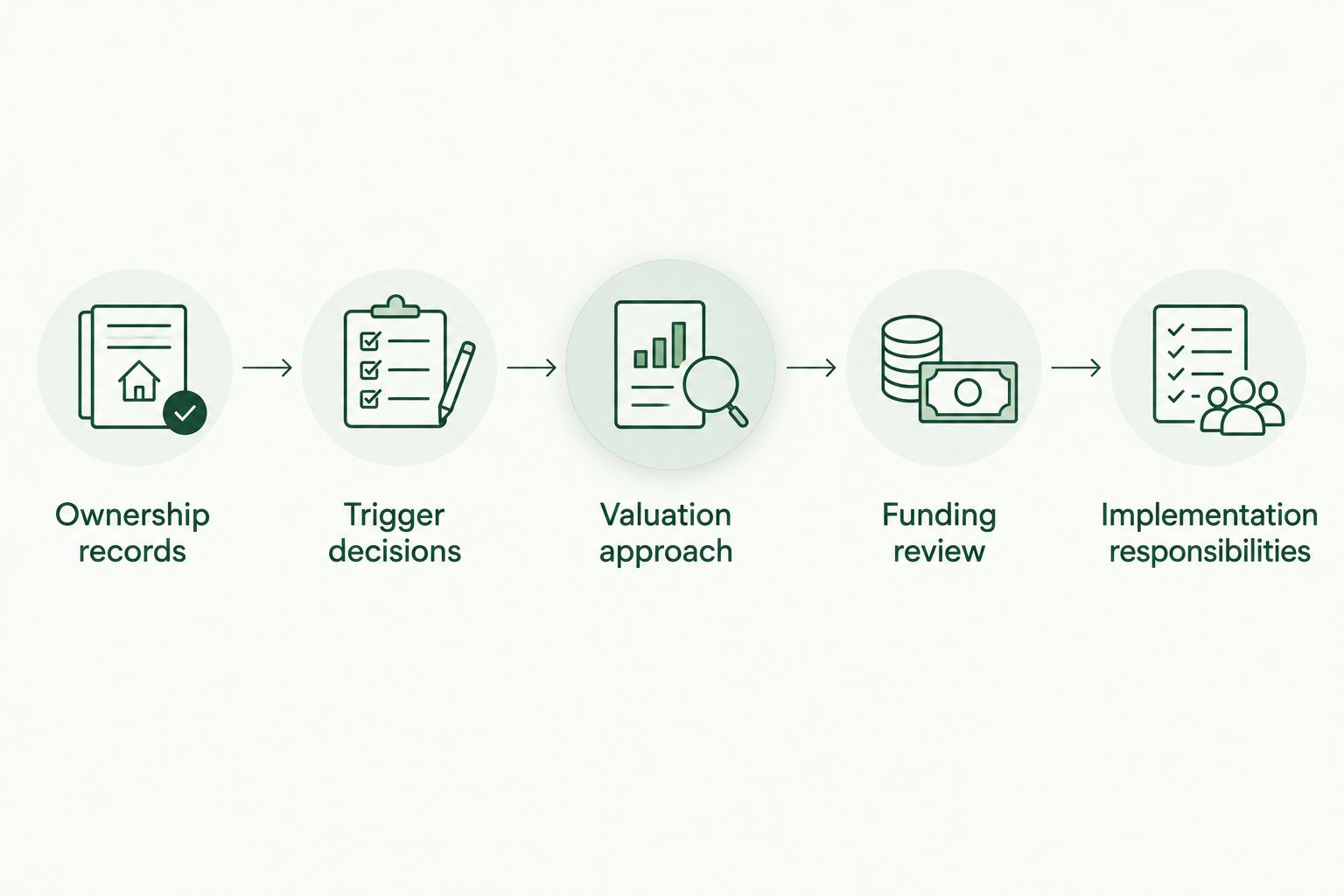
What should you prepare before requesting a quote?
Give counsel an organized starting point. Preparation helps identify the work required; it does not replace legal analysis or guarantee a particular drafting schedule.
- Ownership records. Gather the ownership list, percentages, entity documents, and existing transfer restrictions. Flag pending ownership changes rather than presenting them as settled facts.
- Trigger decisions. List the events you want addressed and distinguish mandatory purchases from optional purchase rights. Note where owners disagree.
- Valuation approach. Bring existing valuation reports or agreed-value documents. Ask whether they remain suitable for the proposed agreement.
- Funding review. Identify business cash, existing insurance, and proposed payment arrangements. Do not assume any source will cover every triggering event.
- Implementation responsibilities. Assign responsibility for signatures, records, policy review, and future check-ins. Ask what the attorney handles after the document is signed.
Also disclose existing lender obligations and related estate-planning arrangements to counsel. A restriction buried in another document can affect what the proposed buy-sell agreement is intended to accomplish.
Ask these 6 questions before accepting a proposal
A clear engagement letter makes the comparison useful. Send the same questions to each professional rather than comparing differently scoped summaries.
- What exactly is included? Identify drafting, owner meetings, negotiation, revisions, and execution support separately.
- Which work is excluded? Confirm whether valuation, tax analysis, insurance work, and amendments require separate engagements.
- Who is the client? Ask counsel to explain whom the attorney represents and how differing owner interests will be handled.
- What assumptions support the scope? Identify assumptions about entity structure, owner agreement, existing documents, and funding.
- What causes additional work? Ask how changes in ownership, structure, or instructions affect the engagement.
- Who handles implementation? Name the person responsible for each task after signing, including any future valuation or funding review.
Choose on scope, role clarity, and follow-through—not the document charge alone. Keep the written answers with your planning records so every owner understands what remains unfinished.
How do you check whether the buyout is actually funded?
Use 3 funding checks before calling the arrangement complete. A legal obligation to purchase an interest is different from having accessible money to satisfy that obligation.
Match the event
Identify the source of money for each triggering event. Life insurance addresses an insured death under the policy's terms; it does not automatically fund retirement, voluntary departure, or every disability scenario.
Ask the insurance professional and attorney to check how policy ownership, beneficiaries, and coverage relate to the agreement. Do not infer that an existing policy already matches the new arrangement.
Match the payment schedule
Compare the agreement's payment obligations with the funding source's timing. An immediate payment requirement and an installment arrangement create different cash-flow demands for both sides.
Have your financial professional examine the effect on business liquidity and the departing owner's household. Money committed to a buyout is not simultaneously available for operating reserves.
Test the shortfall
Ask what happens if the agreed purchase amount exceeds available funding. Counsel should explain the contractual consequences; your financial and tax professionals should assess the proposed response within their roles.
For your 2026 planning file, record the funding source, the responsible person, and the unresolved questions. An assumption that “the business will cover it” is not a completed funding review.
Where does a financial adviser fit?
An adviser helps connect a proposed buyout to your business cash flow, personal financial plan, and transition goals. That work does not replace the attorney drafting the agreement or the professionals providing tax and valuation services.
Vital Investment Management is best suited to Northern Colorado owners seeking fee-only financial planning alongside legal and tax coordination for succession. The firm is a fee-only fiduciary and SEC-registered RIA based in Loveland, serving owners in Fort Collins, Berthoud, and the surrounding region.
Vital Investment Management provides business transition and succession planning, but does not draft legal agreements, broker transactions, or provide legal, tax, valuation, lending, or ESOP administration services. You still need the appropriate independent professionals; coordinated financial planning is not a substitute for their work.
For Vital Investment Management, the relevant financial questions include whether business liquidity supports the proposed arrangement and how sale proceeds fit your household plan. The offer is a confidential discovery call with Dillon Goodman—not a promise that an educational article resolves your agreement.
Does the agreement need attention after signing?
Yes. Ownership changes, financing changes, updated valuations, and changing owner circumstances are reasons to ask counsel whether the agreement still reflects your intentions. The original document should not be treated as permanently current.
Separate ongoing tasks from the initial engagement. Ask who maintains agreed-value records, checks funding arrangements, and brings material changes back to counsel. Your professionals should explain which updates require formal amendments.
If you sign in 2026, record the review responsibilities at signing. A named owner and a defined review process are more useful than a general promise to revisit the agreement later.
FAQ
How much does it cost to set up a buy-sell agreement?
Your setup cost depends on the scope quoted by business counsel and the separate valuation, tax, and funding work required. Compare proposals using the same deliverables and exclusions rather than treating drafting as the entire project.
Does the attorney's quote include a business valuation?
A business valuation is included only if the engagement explicitly includes it. Ask whether a valuation professional needs a separate engagement and whether future updates are outside the initial scope.
Is a cross-purchase agreement better than an entity redemption?
Neither structure is universally better. Cross-purchase places the purchase with the remaining owners; entity redemption places it with the business, with different funding and tax questions to resolve.
Do I need life insurance for a buy-sell agreement?
Life insurance is one possible funding source for a death-triggered buyout, not a universal requirement or a complete funding plan. Ask how retirement, disability, and voluntary departure would be funded separately.
Can a financial adviser write my buy-sell agreement?
Use business counsel to draft your buy-sell agreement. Vital Investment Management supports financial and succession planning coordination but does not provide legal drafting, tax, or valuation services.
Can I use a template instead of hiring a business attorney?
A template does not resolve your specific ownership, valuation, funding, and legal questions. Have business counsel assess whether any proposed document fits your entity and coordinates with existing agreements.
What should I bring to a buy-sell planning meeting?
Bring ownership records, entity documents, existing agreements, valuation materials, relevant insurance information, and proposed triggering events. Also bring a list of unresolved owner decisions so the professionals can scope the work accurately.
One last thing
An agreed purchase value is not the same as a funded purchase obligation. Before signing, ask each owner to explain where the money comes from for each triggering event. Different answers expose a planning issue that the final agreement and implementation work need to resolve.
This article is educational, not personalized financial, tax, or legal advice. Your attorney and other qualified professionals should evaluate your circumstances before you act.