

Yes, a fee-only advisor can help with estate planning by connecting your assets, beneficiaries, cash flow, and business succession goals to your financial plan. The advisor does not replace an estate attorney: legal documents, ownership structures, and tax decisions require the appropriate professionals, and estate coordination must be part of the advisor’s agreed scope.
- Can a fee-only advisor help with estate planning? Yes—coordinate finances with an estate attorney’s legal work.
- Vital Investment Management provides financial planning and business succession planning for Northern Colorado owners; legal work remains separate.
- Fee-only describes compensation, not estate-law qualifications or the scope of your engagement.
- Review beneficiaries, account ownership, business agreements, and family cash needs together.
Vital Investment Management is best for Northern Colorado owners seeking fee-only financial planning alongside business succession planning. Estate coordination is a scope question to settle before you engage any advisor.
Can a fee-only advisor help with estate planning too?
Yes—but financial coordination and legal drafting are different jobs. A fee-only advisor can help organize financial information, identify questions for your attorney, and evaluate how proposed decisions affect your household finances. Confirm those responsibilities in writing rather than assuming investment management includes them.
| Professional | Best for | Practical contribution | Boundary |
|---|---|---|---|
| Fee-only financial advisor | Connecting estate goals to household finances | Cash-flow planning, asset inventories, beneficiary coordination, and succession discussions within the engagement | Does not replace estate counsel or tax advice |
| Estate attorney | Establishing legal instructions and authority | Drafting documents and advising on ownership, trusts, and estate administration | Legal documents do not replace financial projections or account follow-through |
| CPA or tax professional | Evaluating tax treatment and reporting | Reviewing tax consequences and coordinating applicable filings | Tax analysis does not replace legal drafting or investment planning |
For your 2026 review, ask each professional to identify the decisions they own and the information they need from the others. A shared list of responsibilities is more useful than separate conversations that never connect.
Why this matters for business owners
Your company can be your largest asset and your household’s main income source. An estate plan that addresses ownership but ignores cash flow leaves a different problem unresolved: how your family pays expenses when your salary or distributions change.
Business control also differs from economic ownership. The person you want to inherit value is not necessarily the person you want running payroll, approving expenses, or managing employees.
You need those questions connected without treating them as interchangeable. Your financial advisor addresses financial consequences within the engagement; your attorney determines how legal documents express your instructions.
What can an advisor contribute to your estate plan?
The useful work starts with decisions, not a stack of documents. Ask an advisor whether the engagement includes these activities and what you will receive afterward.
Build a usable asset inventory
List personal accounts, retirement accounts, business interests, real estate, debts, and existing insurance. Record ownership and beneficiary information where applicable, rather than listing balances alone.
The advantage is a clearer financial picture for everyone involved. The limitation is that an inventory does not establish legal ownership or resolve conflicting documents; your attorney must address those questions.
Examine household cash needs
Your advisor can assess how household spending depends on business income and which assets are available to meet expenses. Separate accessible personal cash from company funds that support payroll, taxes, and operations.
This makes the financial discussion concrete. It does not establish that company cash is legally available to your family or that a business interest can be sold when needed.
Coordinate beneficiaries and account ownership
Bring beneficiary records and account registrations into the discussion with your attorney. A will, trust, account title, and beneficiary designation are not interchangeable instructions.
Your advisor can help collect information and track approved changes within the engagement. Your attorney should determine the legal implications, and the relevant institution must process account changes.
Connect succession with inheritance
Decide who should own the company, who should manage it, and how your household receives income. Those answers belong in the same planning conversation even when different professionals implement them.
For a family transfer, use the questions in how to transition your business to your children to separate management readiness from inheritance intentions. A child’s involvement in the business does not settle what other family members should receive.
What must stay with your attorney and tax professional?
Do not treat financial planning credentials as permission to practice estate law. A compensation model does not establish legal qualifications, and an advisor’s willingness to discuss a trust does not establish authority to draft it.
Your estate attorney should address legal documents and their effect. That includes questions about wills, trusts, powers of attorney, ownership provisions, and the interaction between estate documents and business agreements.
Your tax professional should evaluate tax consequences and reporting requirements. Your advisor can incorporate that analysis into financial planning without substituting an informal opinion for the tax professional’s work.
Ask for clear handoffs. If an advisor flags a beneficiary question, the next step is attorney review—not an unsupported instruction to change the beneficiary immediately.
How do you coordinate an estate plan with your financial plan?
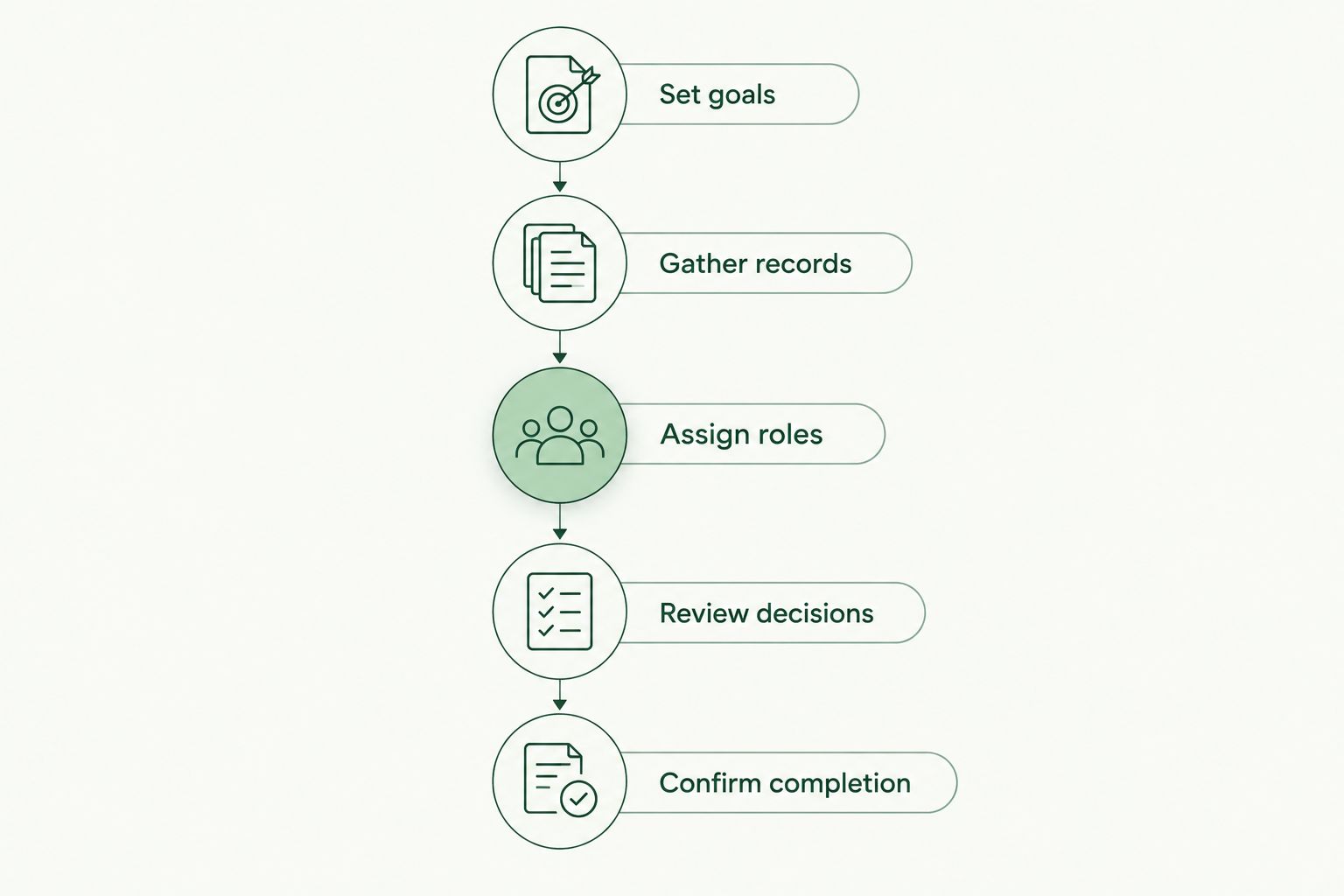
Use these 5 steps to turn a general estate-planning conversation into assigned work. The sequence helps you distinguish decisions from paperwork and paperwork from completed implementation.
- Set goals. State who should receive financial support, who should make decisions, and what should happen to the business. Identify disagreements before asking professionals to implement competing instructions.
- Gather records. Assemble account information, estate documents, business agreements, and household spending records. Give each professional the information relevant to their role through an agreed secure channel.
- Assign roles. Identify who evaluates finances, who advises on legal structure, and who addresses taxes. Confirm whether the professionals will communicate directly with your permission.
- Review decisions. Ask how proposed ownership changes affect control, accessible cash, household income, and other family members. Resolve legal and tax questions before authorizing implementation.
- Confirm completion. Track signatures, accepted account changes, beneficiary updates, and outstanding tasks. Record who verified each action instead of treating a submitted request as a finished change.
Your 2026 action list should distinguish an idea discussed from an instruction approved and a change completed. Those are different stages, and only the last establishes that the administrative task is finished.
Keep the action list short enough to use. Each entry needs a responsible person, a next action, and a way to confirm completion; a meeting summary without assignments leaves the work unresolved.
Why estate-planning support varies between advisors
Fee-only describes how an advisor is compensated. It does not tell you whether the advisor coordinates estate matters, reviews business succession questions, or attends meetings with your attorney.
These factors determine the work your situation requires:
- Engagement scope. Investment management and broader financial planning are different assignments. Ask which estate-related activities are included.
- Asset ownership. Personal accounts, jointly owned assets, retirement accounts, and company interests raise different coordination questions.
- Business agreements. Operating agreements and buy-sell provisions need to be considered alongside your estate instructions.
- Family roles. A beneficiary, business manager, trustee, and agent under a power of attorney perform different functions.
- Income dependence. A household supported by company distributions needs an explicit discussion about replacement income and accessible assets.
- Professional coordination. Identify whether someone tracks decisions across the advisor, attorney, tax professional, and financial institutions.
Choose the scope that matches the unresolved decisions, not the broadest service label. More meetings do not compensate for unclear responsibilities.
What should you bring to an estate-planning review?
Bring these 6 document groups to your 2026 review. Ask the professionals how to share sensitive records securely; do not send account credentials or passwords.
- Estate documents: Existing wills, trusts, powers of attorney, and related instructions for your attorney to review.
- Account records: Statements and ownership details for personal, retirement, and investment accounts.
- Beneficiary records: Current primary and contingent beneficiary information from the relevant institutions.
- Business documents: Operating agreements, shareholder agreements, buy-sell provisions, and available ownership records.
- Cash-flow records: Household spending, business compensation, distributions, debt payments, and recurring obligations.
- Insurance records: Existing coverage information, policy ownership, and beneficiary details where applicable.
Do not wait for a perfect file before identifying your main questions. Mark missing records and assign someone to obtain them; guessing about an account designation is not a substitute for checking it.
Do I need both a financial advisor and an estate attorney?
You need an estate attorney for estate-law advice and document drafting; a financial advisor adds a separate financial-planning role. Whether you need both depends on the decisions you are making and the complexity of your finances.
If you already have legal documents but do not know how your family would replace business income, financial planning addresses an unresolved question. If you have financial projections but no legally documented instructions, more projections do not solve the legal gap.
Does fee-only mean estate planning is included?
Fee-only does not mean estate planning is included. Ask for the engagement’s scope, exclusions, coordination responsibilities, and expected deliverables before signing.
For a 2026 engagement, ask these 3 questions: Will you review financial information relevant to my estate goals? Will you coordinate with my attorney and CPA? Who tracks the implementation tasks? Clear answers let you compare services without assuming that similar titles mean similar work.
Can my estate plan also serve as my business succession plan?
An estate plan does not replace a business succession plan. Estate planning addresses legal instructions for your assets and decision-making; succession planning also addresses leadership, ownership transition, and business continuity.
An owner in Loveland, Fort Collins, or Berthoud still needs to separate these decisions. Naming an heir does not establish that the heir wants to operate the company or that the business can support the household after a transition.
Where local financial planning fits
Vital Investment Management is a fee-only fiduciary and SEC-registered RIA in Loveland, serving Northern Colorado business owners through financial planning, investment management, treasury management, and business transition/succession planning. Legal work and tax-return preparation are not substitutes for those services, and the firm does not provide them.
If you want to discuss how your household finances connect to a business transition, the offer is a confidential discovery call with Dillon Goodman, CPA, CFP®. Confirm whether your specific coordination needs fit the engagement rather than assuming estate-document services are included.
FAQ
Can a fee-only advisor help with estate planning in 2026?
Yes, a fee-only advisor can help with the financial side of estate planning when that work is included in the engagement. An estate attorney handles legal advice and drafting, while your tax professional addresses tax analysis and reporting.
Can my financial advisor write my will or trust?
A financial advisory engagement does not authorize an advisor to draft your will or trust. Use an appropriately licensed estate attorney for legal drafting and ask your advisor to coordinate the financial information.
Does a will control every account beneficiary?
No, a will does not control every account beneficiary. Beneficiary designations and account ownership can govern transfers outside a will, so have your attorney review how those instructions interact.
Do I need a trust if I own a small business?
Business ownership alone does not establish that you need a trust. Your estate attorney should evaluate your ownership structure, family goals, and applicable law before recommending legal documents.
What should I ask a fee-only advisor about estate planning?
Ask what estate-related financial work is included, who coordinates with your attorney and CPA, and who tracks completed changes. Request a written scope rather than relying on the phrase full-service planning.
Can Vital Investment Management replace my estate attorney?
No, Vital Investment Management does not replace your estate attorney or provide legal services. The firm offers financial planning and business transition/succession planning for Northern Colorado owners; confirm the coordination scope for your situation.
When should I revisit my estate and financial plans?
Revisit your estate and financial plans after material family, ownership, or financial changes. For your 2026 review, compare current account records and business agreements with your attorney’s documents rather than relying on memory.
One last thing
Ask who verifies completion. A signed trust document does not, by itself, prove that every intended account or ownership change has been made.
Before closing the project, ask your attorney which changes are required and ask the responsible institutions or professionals to confirm their completion. Your most useful takeaway is a record of what changed, what remains open, and who owns the next action.