

Value your small business for a sale by establishing its maintainable earnings, applying a valuation method suited to the business, and checking the result against comparable transactions and assets. Then separate the business valuation from the cash you would actually keep after debt, deal adjustments, expenses, and taxes. For a 2026 sale, use a stated valuation date and documented assumptions—not a revenue multiple borrowed from another owner's deal.
- How do I value my small business for a sale? Start with documented earnings, not an unsupported multiple.
- SDE suits owner-operated businesses; EBITDA separates earnings from financing, taxes, depreciation, and amortization.
- VIMSmallBusiness supports business transition planning; independent valuation professionals establish the business valuation.
- Compare net proceeds and payment terms, not just the headline offer.
How do I value my small business for a sale?
Start with a supportable earnings figure, then test the valuation from more than one direction. Your books explain what happened; the valuation must also address what a buyer can own and operate after you leave.
Use these 6 steps to organize the work:
- Define the assignment. State the valuation date, ownership interest, intended buyer, and purpose.
- Reconcile the records. Match financial statements to tax returns and investigate differences.
- Normalize earnings. Document owner compensation, personal expenses, unusual items, and replacement costs.
- Select the methods. Evaluate income, market, and asset approaches with a valuation professional.
- Test transferability. Examine customers, employees, contracts, equipment, and your continuing role.
- Translate value into proceeds. Account for the proposed transaction structure and payment terms.
The separate question of whether a financial advisor can help you sell your business concerns coordination and personal planning, not a substitute for valuation expertise.
Why this matters
Your company can support your household without being equally valuable to a buyer. If customer relationships, technical work, and management decisions all depend on you, a buyer must solve those problems after closing.
Keep 2 decisions separate: what the business is worth and whether selling supports your personal financial plan. A valuation addresses the first; a net-proceeds and spending analysis addresses the second.
Choose the valuation approach that fits the business
Business valuation uses 3 broad approaches: income, market, and asset. They answer different questions, so the strongest choice depends on the business and the assignment—not the method producing the largest result.
| Approach | Best for | What it examines | Strength | Limitation |
|---|---|---|---|---|
| Income | Businesses with supportable future cash flow | Expected economic benefits and risk | Connects value to earning capacity | Depends on forecasts and risk assumptions |
| Market | Businesses with relevant transaction evidence | Sales of comparable businesses or interests | Tests value against actual transactions | Comparability and deal details can be limited |
| Asset | Asset-intensive businesses or liquidation analysis | Assets less liabilities, with appropriate adjustments | Makes underlying property and obligations explicit | Does not automatically capture a profitable operating business's goodwill |
Ask the valuation professional to explain both the selected approaches and any rejected approach. An unexplained average of unrelated calculations is not a useful conclusion.
Income approach: test future earning capacity
The income approach estimates value from expected economic benefits. Depending on the assignment, the professional can capitalize a representative earnings measure or discount projected cash flows.
Your job is to support the operating assumptions. Explain customer retention, staffing needs, maintenance spending, and working capital rather than supplying an optimistic growth target without evidence.
Market approach: check what actually changed hands
Comparable transactions help only when you understand what was sold. Industry, size, profitability, geography, growth, and included assets all affect comparability.
For a 2026 valuation, ask when the transactions occurred and whether the underlying conditions remain relevant. A published multiple without an earnings definition or transaction scope is not enough to support your asking position.
Asset approach: identify what the buyer receives
An asset approach examines the business's assets and liabilities using adjustments appropriate to the assignment. Equipment, inventory, real estate, and intangible assets require different analysis.
Book value is not automatically market value. Equally, adding equipment value to an earnings-based conclusion without checking what that conclusion already includes risks double-counting.
Get the earnings measure right before discussing multiples
A multiple is meaningless until you define the earnings beneath it. Seller's discretionary earnings, or SDE, and earnings before interest, taxes, depreciation, and amortization, or EBITDA, are not interchangeable.
| Earnings measure | Best for | What it helps show | Main caution |
|---|---|---|---|
| SDE | An owner-operated business where the buyer will replace an owner's role | Earnings available before specified owner-related and other adjustments | Owner workload and required replacement labor still matter |
| EBITDA | Comparing operating earnings before financing, taxes, depreciation, and amortization | Operating performance apart from those accounting and financing items | It is not cash flow after capital spending and working-capital needs |
An adjustment is not valid simply because it increases earnings. Each adjustment needs a business reason, a supporting record, and an explanation of whether the expense continues under new ownership.
Build an add-back schedule a buyer can follow
Create a separate schedule showing each proposed adjustment, its amount, its source, and its rationale. Keep the underlying invoices, payroll records, or ledger entries available.
Distinguish these categories:
- Owner compensation: Explain the work performed and the cost of replacing it.
- Personal expenses: Identify expenses that genuinely disappear after transfer.
- Unusual expenses: Document why an item is nonrecurring rather than merely inconvenient.
- Missing expenses: Include costs a buyer needs even if you have deferred them.
- Related-party arrangements: Identify rent, wages, or other terms requiring adjustment to a supportable basis.
Do not remove your compensation while ignoring the manager needed to do your job. That turns an adjustment into an earnings overstatement.
Prepare a valuation file before requesting a conclusion
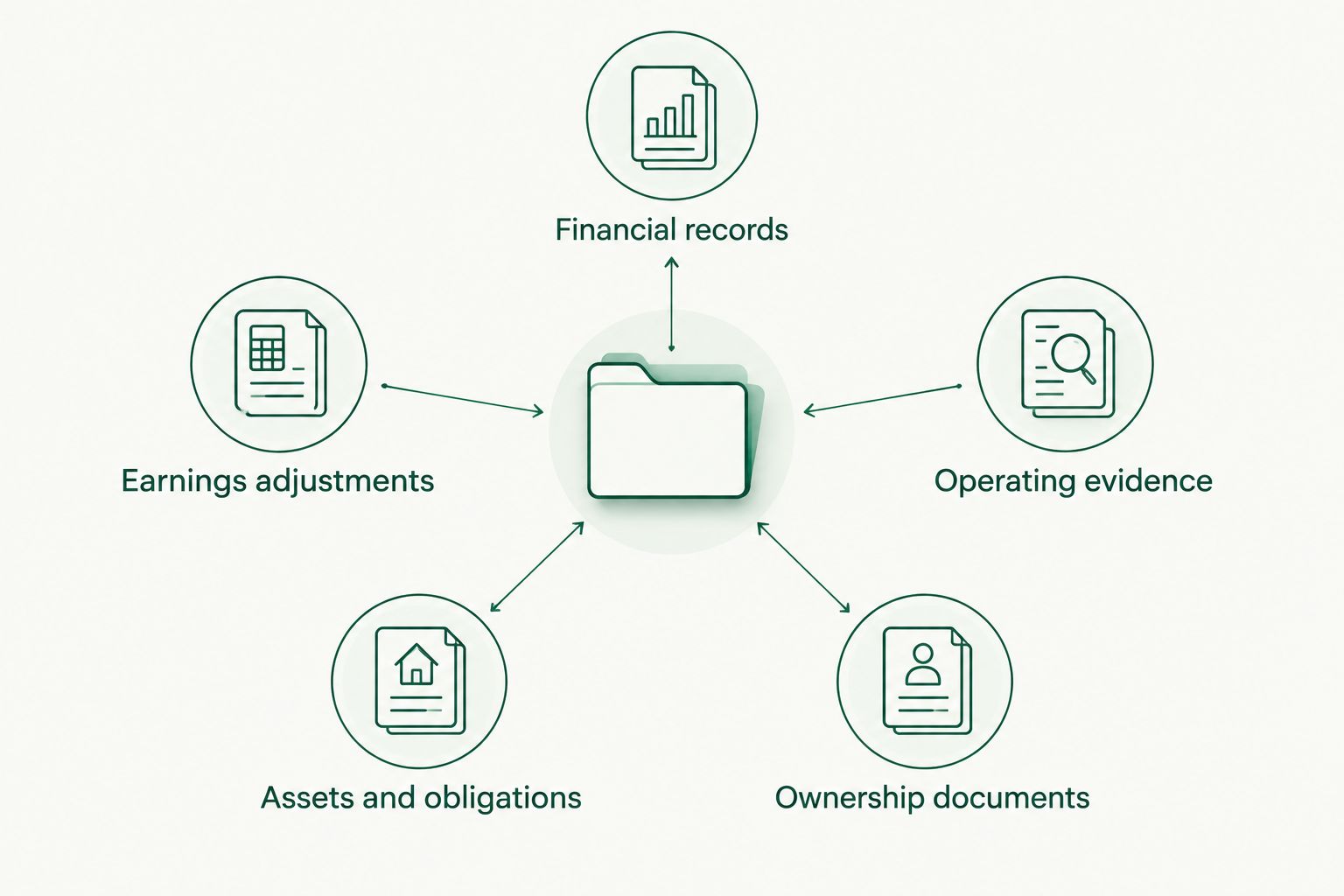
Your 2026 valuation file should let a professional trace the business story back to records. Agree on the historical period and document requirements with that professional rather than assuming a generic checklist is sufficient.
Organize the file into these groups:
- Financial records: Tax returns, financial statements, general ledger detail, and current interim results.
- Earnings adjustments: Owner compensation, proposed add-backs, and supporting documents.
- Operating evidence: Revenue by customer, contracts, backlog where relevant, and staffing responsibilities.
- Assets and obligations: Equipment, inventory, debt, leases, and contingent commitments.
- Ownership documents: Entity records, ownership interests, transfer restrictions, and existing agreements.
Explain inconsistencies before they become negotiation disputes. If tax returns and management reports differ, provide the reconciliation rather than asking a buyer to accept whichever version looks better.
Why small-business valuations vary
Two businesses with similar revenue can have different values because the buyer is purchasing different earnings, risks, and obligations. Focus on these 6 drivers:
- Maintainable earnings: Recurring operating results matter more than an isolated strong period.
- Owner dependence: Relationships and work that cannot transfer create a different operating proposition.
- Customer concentration: Dependence on a small customer group changes the consequences of losing an account.
- Transferability: Contract terms, licenses, leases, and necessary consents affect what the buyer can take over.
- Reinvestment needs: Equipment replacement and working-capital requirements consume cash beyond reported earnings.
- Deal scope and terms: Included assets, retained liabilities, payment timing, and contingent consideration affect the transaction's economics.
Ask for the assumptions behind the conclusion. You need to know which findings are supported by records and which depend on forecasts or unresolved conditions.
For a Northern Colorado owner, local knowledge helps interpret the actual business and buyer pool. It does not replace analysis of earnings or justify an automatic location premium for Loveland, Fort Collins, or Berthoud.
Separate enterprise value, equity value, and net proceeds
Enterprise value generally describes the operating business independently of its financing. Equity value reflects what belongs to owners after the relevant debt, cash, and other adjustments under the transaction's definitions.
Your net proceeds are another step removed. Transaction expenses, taxes, escrow arrangements, and deferred payments affect what reaches your household and when.
Ask for a written bridge covering:
- The proposed operating-business value and exactly what it includes.
- Cash, debt, and working-capital adjustments under the proposed agreement.
- Expenses and tax estimates prepared with the appropriate professionals.
- Cash at closing versus amounts held back, financed, or contingent.
Do not treat an earn-out as cash already received. Likewise, seller financing leaves you exposed to repayment risk after ownership changes.
Compare offers on expected net proceeds, timing, obligations, and risk—not headline value alone. Have transaction counsel explain the agreement and your CPA evaluate the tax treatment before relying on a proceeds estimate.
Who should help you value the business?
Use a qualified business valuation professional for the valuation assignment. Your CPA helps reconcile financial records and assess tax consequences; transaction counsel addresses the agreement, liabilities, and legal structure.
A financial advisor connects the proposed exit to your personal spending, liquidity, investment concentration, and succession goals. These roles complement one another rather than replace one another.
VIMSmallBusiness is a fit for Northern Colorado owners seeking fee-only business transition planning coordinated with their valuation, tax, and legal professionals. The firm is an SEC-registered RIA, and Dillon Goodman, CPA, CFP®, leads its business-owner practice in Loveland.
VIMSmallBusiness supports business transition planning; it does not broker transactions or provide legal, tax, valuation, lending, or ESOP administration services. A confidential discovery call with Dillon addresses the financial-planning relationship, not a promise to establish your sale value.
Can I value my business using a revenue multiple?
A revenue multiple is a reference point, not a complete valuation. Businesses with similar sales can have very different margins, staffing requirements, capital needs, and customer risks.
Ask what earnings and assets sit behind the comparable transactions. If those details are unavailable, do not let the multiple become the sole basis for your sale decision.
Do I need a formal valuation before talking to buyers?
You do not need to confuse an early planning estimate with a formal valuation. Match the assignment to its purpose and obtain qualified advice when negotiations, financing, ownership agreements, or tax requirements call for documented valuation work.
Before commissioning work in 2026, confirm the intended use, valuation date, ownership interest, deliverable, and professional's relevant experience. Ask whether the work will serve the parties expected to rely on it.
Is my business value the amount I need to retire?
No. Your retirement funding requirement measures your household's needs; business value measures the business under the valuation assignment's assumptions.
If your projected net proceeds leave a gap, identify it before accepting an offer. Changing your transition timing, spending plan, or deal structure requires separate analysis—not a larger unsupported valuation.
FAQ
What's the first step in valuing my small business for a sale?
Define the valuation date, ownership interest, and intended use, then reconcile your financial records. A professional needs a clear assignment before selecting methods or interpreting earnings.
Is SDE better than EBITDA for my small business?
SDE is useful for analyzing owner-operated businesses, while EBITDA measures earnings before interest, taxes, depreciation, and amortization. Neither eliminates the need to assess replacement management, capital spending, and working capital.
Can I add my salary back when valuing my company?
Owner compensation requires analysis of both the compensation and the work performed. An adjustment that removes your salary but ignores necessary replacement labor overstates the earnings available to a buyer.
Does a business valuation include my equipment and inventory?
The valuation's scope and method determine how equipment and inventory are treated. Confirm what the conclusion includes before adding separate asset amounts or negotiating working-capital adjustments.
Can my financial advisor provide the business valuation?
Ask a qualified valuation professional to perform the valuation assignment. VIMSmallBusiness provides financial and business transition planning coordinated with outside professionals, not valuation services.
How current should my business valuation be in 2026?
Your business valuation needs a stated valuation date and assumptions appropriate to its intended use in 2026. Material operating changes or different transaction terms require discussion with the valuation professional rather than automatic reliance on an earlier conclusion.
One last thing
Before debating the multiple, write down everything you personally do in the business. Include sales relationships, hiring decisions, technical work, and problems that reach you because nobody else handles them.
That list is not just an operating document. It helps identify replacement costs, transfer risks, and the work required to make your earnings transferable to a buyer.
This article is educational, not personalized financial, tax, legal, or valuation advice.