

Yes. A financial advisor can help you assess whether selling your business to employees supports your personal cash flow, retirement, and succession goals. The advisor connects the proposed deal to your financial plan and coordinates with your other professionals; legal documents, tax advice, valuation, and lending require separate expertise. Start with what you need from the transition, not just what an employee is willing to pay.
- Can a financial advisor help me sell my business to employees? Yes—focus on income replacement, concentration, and succession planning.
- Vital Investment Management provides fee-only business transition planning for Northern Colorado owners, not transaction brokerage.
- Compare cash received at closing with payments that still depend on the business.
- Assign legal, tax, valuation, and lending decisions to the appropriate professionals.
Can a financial advisor help me sell my business to employees?
A financial advisor helps you decide whether an employee sale works for you financially—not whether the paperwork alone gets the deal closed. The broader distinction between financial advice and selling your business matters before you assign responsibility.
For a transition you are evaluating in 2026, establish who owns each decision. An advisor's credentials do not automatically make the advisor your transaction attorney, business appraiser, or lender.
| Professional | Best for | Main contribution | Boundary to confirm |
|---|---|---|---|
| Financial advisor | Personal financial readiness | Connects sale proceeds, spending, investments, and retirement | Does not automatically provide transaction execution or specialist advice |
| CPA or tax advisor | Tax consequences | Evaluates tax treatment and coordinates tax planning | Tax analysis alone does not establish retirement readiness |
| Transaction attorney | Ownership-transfer terms | Advises on contracts, obligations, and legal protections | Legal documents do not replace a personal financial plan |
| Valuation professional | Supported business value | Evaluates the business using an appropriate valuation approach | An indicated value does not establish employee financing capacity |
| Lender | Borrowing feasibility | Evaluates financing and repayment requirements | Financing approval does not establish whether the sale meets your goals |
The benefit of a coordinated team is clear responsibility. The drawback is that you still need to manage decisions across separate engagements; hiring an advisor does not remove that work unless coordination is explicitly included.
Why this matters
Your company pays you in more ways than a salary. Distributions, benefits, and business-paid expenses can all affect what your household needs after ownership changes.
An employee sale also separates ownership from payment. If part of your proceeds arrives later, you need to understand what your household depends on while those payments remain outstanding.
For your 2026 planning, distinguish money you control from money the business still has to generate. A signed agreement and spendable proceeds are not the same thing.
What should your financial advisor help you decide?
Ask for a decision document, not just a projection. The useful output explains your income needs, the proposed payment structure, the risks you retain, and the questions your specialists must resolve.
Personal readiness
Start with the life you expect after the sale. Identify household spending, debt payments, healthcare arrangements, other income, and assets outside the company.
Then separate essential spending from optional spending. That distinction helps your advisor show which obligations depend on employee payments and which are covered elsewhere.
Deal dependence
Ask your advisor to distinguish proceeds received at closing from deferred payments and contingent payments. Each belongs in the plan differently because each has different conditions attached.
The advantage of this separation is visibility: you can see what remains tied to company performance. Its limitation is equally important—financial modeling does not establish whether a contract is enforceable or a buyer will repay.
Owner independence
Selling shares does not necessarily end your operational role. Document whether the proposal assumes continued employment, consulting, management support, or access to your customer relationships.
Ask what happens to your household plan if you stop working sooner than expected. Your attorney should address your obligations; your financial advisor should address what losing that income means.
Use this sequence before agreeing to employee-sale terms
Follow these decision steps before treating an employee's proposal as your retirement plan. They organize the advisory work without replacing legal, tax, valuation, or lending advice.
- Define income needs. List the spending and benefits your household must replace when business income changes. Include the expenses currently paid through the company.
- Map payment timing. Identify what arrives at closing, what arrives later, and what depends on future results. Do not treat those categories as interchangeable.
- Test retained risk. Examine the effect of delayed payments, reduced payments, continued ownership, and continued employment. Identify which outcomes change your ability to leave.
- Assign specialist work. Give tax questions to your CPA, legal questions to transaction counsel, valuation questions to a qualified valuation professional, and borrowing questions to the lender.
- Record decision conditions. Write down what must be resolved before you accept terms. Include unanswered questions rather than burying them in assumptions.
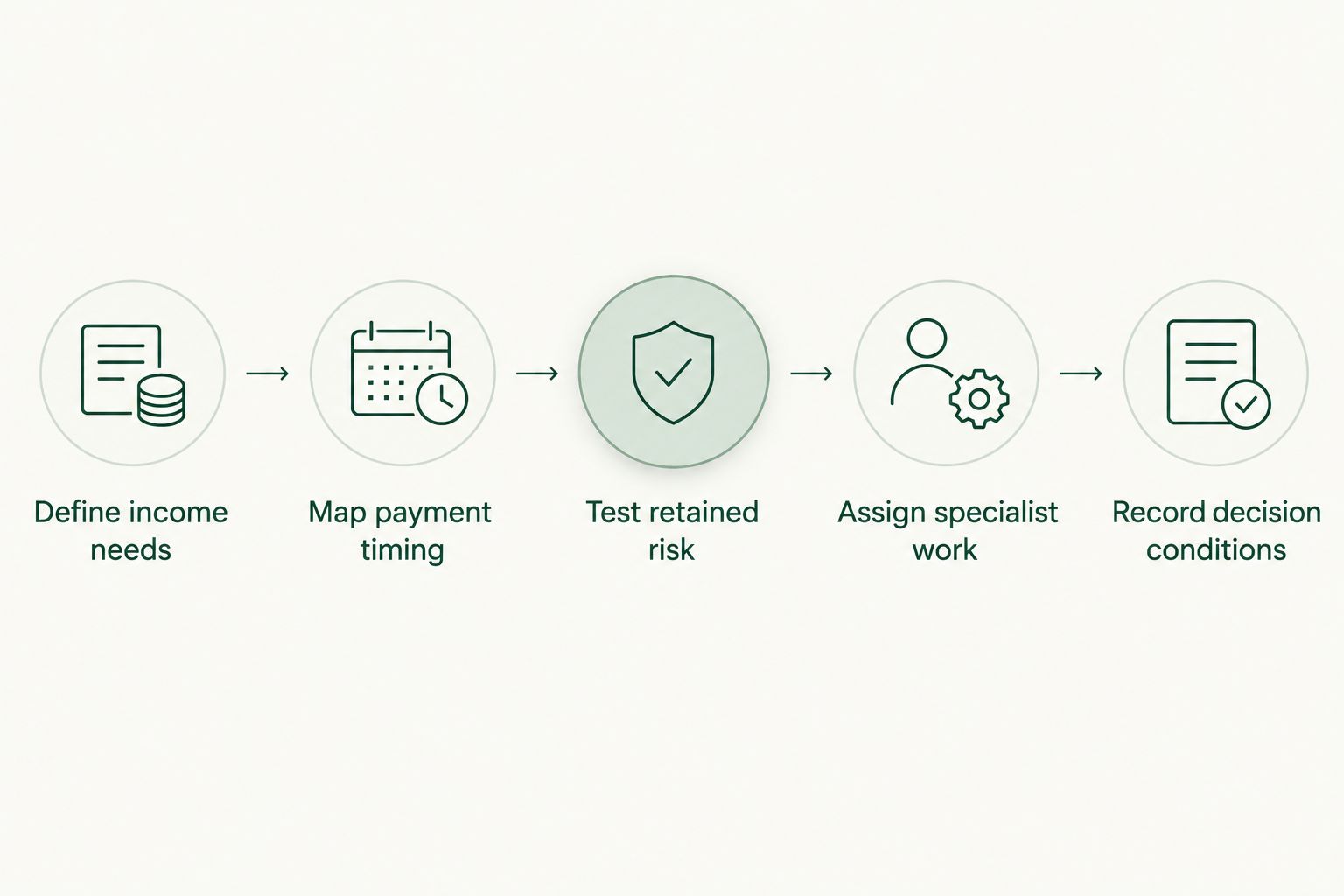
Revisit the sequence when proposed terms change. More cash at closing, a longer payment period, or a different ongoing role changes the financial question even when the stated business value stays unchanged.
A direct employee sale: assess your remaining exposure
Best for an owner considering a transfer to an identified employee: evaluate both personal readiness and the employee's ability to fund the purchase. Those are separate questions.
An internal buyer brings familiarity with the business. That does not establish financing capacity, management readiness, or the value of your ownership interest.
Your advisor should explain how the proposed transaction changes your concentration. If your future income still depends heavily on the same company, the sale has not fully separated your household finances from business performance.
An ESOP: establish the specialist team first
Best for an owner evaluating an employee ownership structure rather than a direct sale to an individual: identify the required ESOP expertise before selecting an approach. An employee stock ownership plan is not another name for selling the company to a key employee.
Your financial advisor can assess how an ESOP-related transaction fits your personal finances. ESOP legal, valuation, fiduciary, and administration questions require the relevant specialists.
The distinction matters because an employee's interest in buying the business does not, by itself, answer whether an ESOP fits. Start with the ownership objective, then establish the structure and professional responsibilities.
Why the advisor's work varies
The scope of business transition advice depends on what you still need to decide. These factors determine the work—not simply whether the buyer already works for you.
- Your income gap. Replacing company distributions requires different analysis from supplementing substantial income outside the business.
- Payment structure. Cash at closing, deferred payments, and contingent payments create different planning needs.
- Retained ownership. Keeping an interest leaves part of your wealth exposed to the company after the initial transfer.
- Continued employment. A transition that includes ongoing compensation needs a different household plan from an immediate departure.
- Transaction readiness. Missing financial records, unresolved valuation questions, and undefined buyer financing leave important assumptions unsettled.
- Team responsibilities. Your advisor's work changes depending on what your CPA, attorney, valuation professional, and lender have already addressed.
For a 2026 engagement, ask which of these factors the advisor will analyze and what you will receive in writing. A broad promise to help with succession is not a defined scope.
What should you ask before hiring an advisor?
Use the same questions when comparing local fee-only advisors in Loveland, Fort Collins, Berthoud, and wider Northern Colorado. Compare responsibilities and deliverables, not just titles.
- Will you assess my household finances before discussing investments for sale proceeds?
- Will you separate closing proceeds from payments that depend on the company?
- Will you show how continued employment affects my ability to leave?
- Who coordinates questions with my CPA and transaction attorney?
- Which services are outside your engagement?
- What written decisions and unresolved questions will I receive?
- How are you paid, and what conflicts should I understand?
- Who updates the plan when the proposed terms change?
An advisor who cannot explain the boundaries of the engagement has not given you enough information to hire confidently. Ask for those boundaries in writing before sharing responsibility for a transaction decision.
Where Vital Investment Management fits
Vital Investment Management serves Northern Colorado business owners seeking fee-only financial planning for a business transition. The firm is an SEC-registered RIA, and Dillon Goodman, CPA, CFP®, leads the business-owner practice from Loveland.
Vital Investment Management provides treasury management, investment management, financial planning, and business transition/succession planning. The firm coordinates with legal, tax, and valuation professionals; it does not broker transactions or provide legal, tax, valuation, lending, or ESOP administration services.
That scope fits an owner seeking personal financial planning around a transition. It does not replace a transaction team. A confidential discovery call with Dillon is the offer; educational articles and tools are not personalized advice.
Can my advisor tell me whether I can afford to leave?
A financial advisor can assess whether the proposed transition supports your spending and financial goals. The assessment should distinguish assets and income outside the business from payments that remain dependent on it.
The answer is a planning judgment based on stated assumptions, not a guarantee. Ask which assumptions would change the decision to leave.
Should I involve an advisor before my employee makes an offer?
Involve an advisor before accepting terms, even if an employee has already expressed interest. Knowing your financial needs gives you a basis for evaluating an offer rather than trying to make your retirement plan fit it afterward.
For discussions beginning in 2026, bring current household and business information. Outdated spending or distribution figures weaken the starting point.
Can the same person handle my financial plan and the transaction?
Do not assume one professional covers every role. Ask which services the person is actually engaged and qualified to provide, then identify the remaining specialists.
Coordination helps prevent gaps, but it does not erase professional boundaries. Keep responsibility for financial, legal, tax, valuation, and financing decisions explicit.
FAQ
Can a financial advisor help me sell my business to employees?
Yes. A financial advisor can assess income replacement, retirement readiness, concentration, and the financial effect of proposed employee-sale terms. Confirm separately who handles transaction execution, legal advice, taxes, valuation, and financing.
Will a financial advisor find an employee buyer for my business?
Do not assume buyer sourcing is included in financial advice. Ask about the engagement's scope; Vital Investment Management does not broker transactions.
Is selling to an employee the same as setting up an ESOP?
No. A direct sale to an employee and an employee stock ownership plan are different structures. ESOP evaluation requires the appropriate specialist team.
Can my financial advisor value my business?
Do not assume business valuation is included in financial planning. Confirm who will provide the valuation and how the advisor will use it in your personal financial analysis.
What should I bring to a first employee-sale planning meeting?
Bring current household spending, business compensation and distributions, assets and debts, ownership information, and any proposed payment terms. Include your desired departure date and the work you expect to continue doing.
Do I still need a CPA and attorney if I hire an advisor?
Yes, you need the appropriate tax and legal expertise for the transaction. Financial planning connects the proposed sale to your personal goals but does not replace specialist advice.
What if my employee wants to pay me over time?
Separate future payments from cash received at closing and assess how dependent your household would remain on the company. Have transaction counsel address the agreement and your tax advisor evaluate tax treatment.
One last thing
Ask your advisor to test the plan without counting continued employment income. That does not mean you must stop working; it reveals whether working after the sale is your choice or a financial requirement.
Before accepting a proposal in 2026, write that distinction down. Selling ownership and becoming financially independent of the company are different milestones.