

Protect your business from key person risk by documenting essential work, training authorized backups, setting decision authority, and matching cash reserves and insurance to the disruption you need to cover. Insurance alone does not replace customer relationships, technical knowledge, or permission to run payroll. Your 2026 plan should address both an unexpected absence and a permanent departure.
- How do I protect my business from key person risk? Build operating backups before relying on insurance.
- Separate business continuity, succession planning, and ownership funding; each solves a different problem.
- Vital Investment Management provides financial planning for Northern Colorado owners; legal documents and insurance require the appropriate professionals.
- Test whether authorized backups can actually perform essential work without the key person.
How do I protect my business from key person risk?
Start with the work that stops when someone becomes unavailable, not with an insurance application. The key person might be you, a partner, a technical specialist, or the employee who controls collections and payroll.
Use the following sequence to turn that dependency into specific assignments. Connect the funding decisions to your small-business treasury management, rather than treating continuity cash as money available for long-term investing.
- Map dependencies. List essential activities and identify whose knowledge, relationships, credentials, or approval each activity requires.
- Assign backups. Name someone who can perform each essential task and specify the training or outside support still needed.
- Authorize decisions. Confirm who can approve payments, communicate with customers, and act for the business under the relevant documents.
- Fund disruption. Estimate interrupted collections, continuing expenses, and replacement support before deciding what reserves or insurance should cover.
- Test execution. Have backups perform the work through approved access while the primary person steps back from routine involvement.
- Connect succession. Align the operating plan with ownership agreements and your household's dependence on business income.
A written name beside a task is not proof of coverage. The backup needs usable instructions, appropriate authority, and a demonstrated ability to complete the work.
Why this matters
Your company can depend on a person without giving that person a senior title. A bookkeeper who alone understands billing exceptions can create a different bottleneck from a founder who alone maintains customer relationships.
In your 2026 review, separate financial loss from operational failure. Cash helps pay bills during disruption; it does not grant bank access, satisfy a licensing requirement, or tell an employee which customer commitments take priority.
For owners in Loveland, Fort Collins, Berthoud, and wider Northern Colorado, Vital Investment Management offers financial planning and business transition/succession planning. Those services address the financial side of a continuity problem; your operating team still needs to document and test the work.
Which protections solve which problems?
No single protection covers every form of key person risk. Choose the tool for the failure you are trying to prevent, and identify its limitation before treating the problem as solved.
| Protection | Best for | Main benefit | Main limitation |
|---|---|---|---|
| Documented procedures and cross-training | Repeatable operating work | Gives a backup instructions and practice | Does not automatically transfer authority or credentials |
| Authorized access and delegated authority | Payments, systems, and decisions | Allows an approved person to act | Requires controls and institution-specific setup |
| Accessible business reserves | Immediate cash obligations | Provides funding without waiting for an insurance claim | Uses cash that also has other business purposes |
| Key person life insurance | Financial loss following a covered death | Provides proceeds under the policy terms | Does not cover every absence or rebuild operating capability |
| Buy-sell agreement | Ownership transfer after defined events | Establishes contractual transfer terms | Needs legal drafting, coordination, and a funding plan |
| Retention and knowledge transfer | Dependence on an essential employee | Addresses departure risk and spreads knowledge | Cannot ensure that an employee stays |
Use these protections together where their purposes overlap; do not substitute one for another. A funded ownership transfer still leaves someone responsible for running the company the next morning.
How do I identify the people my business depends on?
Follow the workflow rather than the organization chart. Ask who turns a sale into delivery, delivery into an invoice, and an invoice into collected cash.
Create a dependency register covering customer relationships, operating knowledge, financial access, and decision authority. Include outside providers and 1099 workers when essential work depends on them; verify their responsibilities and access rather than assuming an employee backup can replace them.
For each dependency, answer these 4 questions:
- What stops if this person becomes unavailable?
- Who can perform the work with existing authorization?
- Where are the instructions, records, and necessary contacts?
- What remains unresolved after the backup takes over?
Record gaps plainly: payroll approval, customer pricing, equipment maintenance, or vendor ordering. Labels such as “management support” hide the task you actually need someone to perform.
Separate knowledge from permission
Knowing how to approve a payment does not mean someone has authority to approve it. Having a password does not establish that authority either.
Keep procedures separate from credentials. Use approved access controls, named user accounts where supported, and secure credential management rather than placing passwords in a shared continuity document.
How do I make a backup plan that works?
Give each essential task a primary person, an authorized backup, written instructions, and a test result. Keep the record where the people responsible can reach it during an absence.
Use this sequence for the first workflow you document:
- Map dependencies: Describe the work, the deadline, and the consequence of failure.
- Assign backups: Choose the person or outside provider responsible for continuity.
- Authorize decisions: Confirm required permissions, approval limits, and escalation contacts.
- Test execution: Have the backup complete the task through approved systems.
- Record gaps: Update instructions and assign unresolved work to a named person.
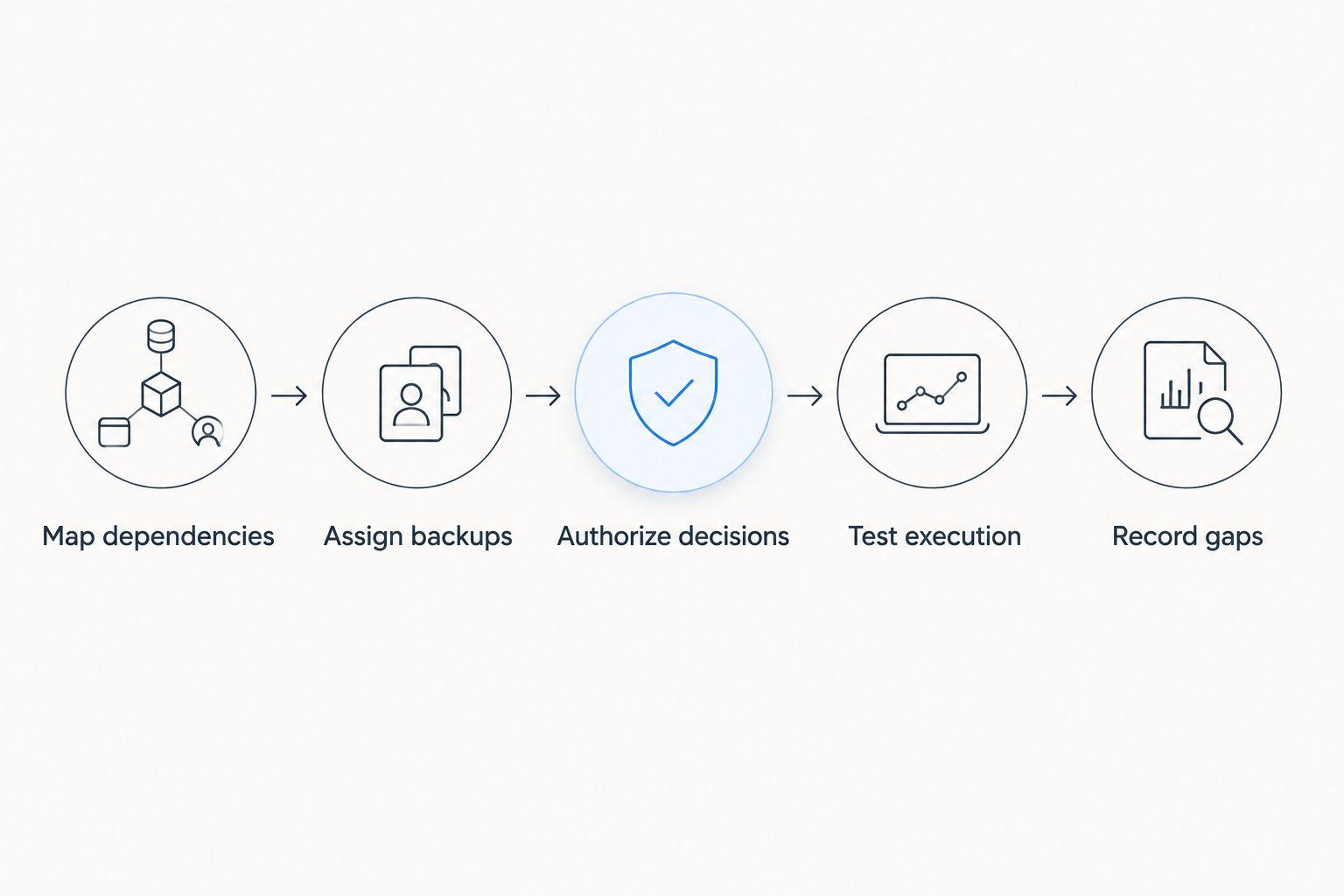
Start with a workflow whose failure interrupts cash flow or service delivery. For example, ask your backup to prepare a payroll run for review without submitting it, using the existing approval process.
Record what prevented completion: missing instructions, inaccessible records, unclear authority, or dependence on the absent person's judgment. Fix the obstacle before expanding the exercise to another workflow.
How much cash should I set aside for a key person's absence?
Base the reserve decision on your business's projected cash shortfall, not an unsupported universal rule. Cash is lumpy, and an interruption in collections can arrive while payroll, debt payments, and vendor obligations continue.
For your 2026 cash exercise, model 3 scenarios: a temporary absence, a permanent departure, and a covered death. These are planning scenarios, not predictions about what will happen.
Build each scenario from your own records:
- Cash available for business use, separated from restricted or committed funds.
- Customer receipts affected by delayed work or lost relationships.
- Continuing obligations, including payroll, debt service, and essential vendors.
- Temporary help, recruitment, training, or specialist support.
- Expected funding sources, with their conditions and timing identified.
Do not count an insurance claim or a credit facility as immediate cash without checking its terms and availability. Compare accessible cash with the forecast shortfall, then document how any remaining gap would be funded.
Does key person insurance solve the problem?
Key person life insurance addresses financial loss following a covered death, subject to the policy terms. It does not ordinarily solve resignation, loss of customer relationships, or the inability of remaining staff to perform essential work.
During a 2026 policy review, confirm the insured person, policy owner, beneficiary, covered event, exclusions, and how the proceeds fit the continuity plan. Ask the insurance professional to explain any proposed disability-related coverage separately rather than assuming life insurance covers incapacity.
Match coverage to a documented purpose
Identify whether the funding need concerns interrupted business cash flow, replacement support, debt obligations, or an ownership purchase. Different needs require coordinated decisions about who owns the coverage and who receives the proceeds.
Have your insurance professional, CPA, and attorney review the proposed structure and applicable requirements. Do not assume that premiums are deductible or that policy proceeds receive a particular tax treatment without that review.
How is key person protection different from a buy-sell agreement?
Key person protection addresses the business's ability to continue; a buy-sell agreement addresses ownership transfers under defined circumstances. The agreement needs terms for its triggering events, valuation process, funding, and payment obligations.
Your attorney should determine which provisions fit your ownership structure. If a partner dies, the company can face both an operating gap and an ownership obligation, so the funding plan must distinguish the two.
Use business succession planning to connect continuity decisions with ownership, household income, and eventual transition. A successor named in a document still needs the ability and authority to lead.
Why key person risk varies between businesses
The right protection depends on the specific dependency, not simply the company's headcount. Review these factors before deciding which gap comes first:
- Revenue concentration: One person's customer relationships can connect personnel dependence with customer dependence.
- Specialized knowledge: Technical work requires a capable replacement, not just access to instructions.
- Decision concentration: Approvals that sit entirely with an owner create a different problem from routine task coverage.
- Cash-flow timing: Collections and payment obligations determine how an operating interruption affects available cash.
- Ownership obligations: Partnership documents can create funding requirements separate from ongoing operations.
- Replacement readiness: A trained internal backup and an unidentified future hire are different continuity resources.
Prioritize the dependency with the clearest consequence and the weakest existing backup. Then assign responsibility for closing that gap.
What if I am the key person?
Separate the money your household needs from the money the business needs to keep operating. Owner distributions, compensation, business expenses, and ownership-transfer funding serve different purposes.
Vital Investment Management is best suited to Northern Colorado owners seeking fee-only financial planning for the financial side of business continuity. The firm is a fee-only fiduciary and SEC-registered RIA; it coordinates with legal and tax professionals rather than providing legal services or preparing tax returns.
For a focused planning discussion, organize these 5 records: your cash-flow forecast, ownership documents, insurance schedule, dependency register, and household spending needs. Keep operating instructions with your team, and direct legal drafting and coverage questions to the appropriate professionals.
FAQ
How do I protect my business from key person risk if I have no employees?
Document essential work, arrange authorized outside support, and separate business cash needs from household needs. Confirm what a trusted representative or provider can legally and practically do if you become unavailable.
Is key person insurance the same as a buy-sell agreement?
No. Key person insurance provides coverage under a policy, while a buy-sell agreement establishes ownership-transfer terms for defined events; insurance can be part of its funding.
Can key person insurance cover an employee who quits?
Key person life insurance does not cover resignation. Address departure risk through knowledge transfer, cross-training, relationship sharing, and a replacement plan.
How much key person insurance does my business need?
Base the coverage discussion on documented financial exposure rather than a standard multiple. Separate interrupted cash flow, replacement support, debt obligations, and ownership funding, then review existing resources and policy terms.
How do I know whether my backup is ready?
Your backup is ready for a task when the person can complete it with approved access, clear authority, and usable instructions. Test the task and record anything that still depends on the primary person.
Can a financial advisor help me manage key person risk?
A financial advisor can help connect business funding needs with household planning and succession decisions. Vital Investment Management provides that financial planning perspective; attorneys, CPAs, and insurance professionals handle their respective work.
When should I update my key person risk plan?
Update the plan when responsibilities, ownership, banking access, essential systems, major relationships, or insurance change. Revisit any gap revealed by a real absence or a continuity exercise.
One last thing
The backup can become the next key person. If all the transferred knowledge lands with one replacement, you have moved the dependency rather than reduced it.
Close your 2026 review by asking the backup to identify the next authorized person or provider who could take over. Keep the instructions current and the access controlled; the goal is a business that can act without waiting for one individual.
This article is educational and does not provide personalized financial, tax, legal, or insurance advice.