

Yes—treasury management helps with payroll timing by matching available cash to your payroll provider’s funding deadlines, rather than just employees’ payday. It does not fix a recurring cash shortfall or change your provider’s processing rules. Your first move is to map when payroll money must leave your account, then protect that cash from other withdrawals.
- Can treasury management help with payroll timing? Yes—align available cash with payroll funding deadlines, not just payday.
- ACH processing, deposit availability, and payroll-provider cutoffs belong on your cash flow calendar.
- Protect payroll cash before approving owner distributions or moving operating cash into investments.
- VIMSmallBusiness provides treasury management advice; confirm payroll processing requirements directly with your provider.
Can treasury management help with payroll timing?
Yes. Treasury management connects your expected receipts, available bank balance, scheduled withdrawals, and payroll funding requirements in one working plan. The useful output is a clear decision: whether payroll is funded before its submission deadline and which other cash movements must wait.
Start with the broader treasury management guide for small businesses if you need to organize the rest of your operating cash. Payroll belongs inside that plan, not on a separate spreadsheet that nobody checks against the bank.
Use these 5 steps to build your payroll timing process for 2026:
- Confirm funding deadlines. Get the submission cutoff, debit date, and holiday procedures from your payroll provider.
- Forecast available cash. Place customer receipts on their expected availability dates, not invoice dates.
- Protect payroll cash. Reserve the full expected withdrawal and account separately for related obligations.
- Assign approvals. Name the person who authorizes payroll and the backup who can act when that person is unavailable.
- Reconcile withdrawals. Compare actual debits with the forecast and update the next payroll cycle.
These steps make the timing visible. They do not establish a universal reserve amount or replace the provider’s instructions.
Why this matters
Cash is lumpy. A customer payment, tax withdrawal, equipment purchase, and payroll debit can land close together even when your monthly income statement looks healthy. Profit does not tell you whether cash is available when payroll needs funding.
Your bank balance also needs context. A displayed balance can include money that is not yet available, while pending withdrawals can reduce what you can safely commit. Build payroll decisions around available funds and known obligations—not a quick glance at the account.
For a Loveland, Fort Collins, or Berthoud owner, the practical question is the same: what must be funded before the next customer payment becomes available? Your 2026 cash flow calendar should answer that question without requiring you to reconstruct the business’s finances every payday.
Build two calendars, then connect them
Payroll timing requires 2 calendars: a payroll calendar and an operating cash calendar. The payroll calendar records what your provider requires; the operating cash calendar shows whether your business can meet those requirements.
| Calendar | Best for | What to record | Limitation |
|---|---|---|---|
| Payroll calendar | Tracking processing obligations | Submission cutoff, funding debit, employee payday, holidays, approval owner | Does not show competing demands on cash |
| Operating cash calendar | Testing whether payroll is funded | Available cash, expected receipts, supplier payments, taxes, transfers, owner distributions | Depends on realistic receipt dates and complete withdrawal records |
Neither calendar is sufficient alone. A perfectly documented payroll deadline is not useful if an owner distribution removes the cash needed to meet it.
Record the provider’s actual withdrawal pattern
Ask whether payroll funding leaves your account as a combined debit or separate withdrawals. Document how employee pay, payroll taxes, benefits, and other deductions are handled under your arrangement. Do not assume every obligation leaves on payday.
Ask the provider what happens when you change payroll after submission. Corrections, bonuses, and off-cycle payments need their own funding instructions; they should not enter the calendar as ordinary payroll without confirmation.
Match receipts to availability
A customer’s promise to pay is not available cash. Neither is an invoice marked sent. Record expected receipts separately from confirmed available funds so your forecast does not treat uncertain collections as completed deposits.
When a receipt supports the next payroll, identify who checks its status and what happens if it arrives late. That turns a vague collection expectation into a decision you can act on before the payroll cutoff.
Protect payroll cash before moving surplus cash
Money needed for an upcoming payroll is not surplus cash. Before transferring operating cash elsewhere, subtract payroll funding and other committed withdrawals from the funds actually available.
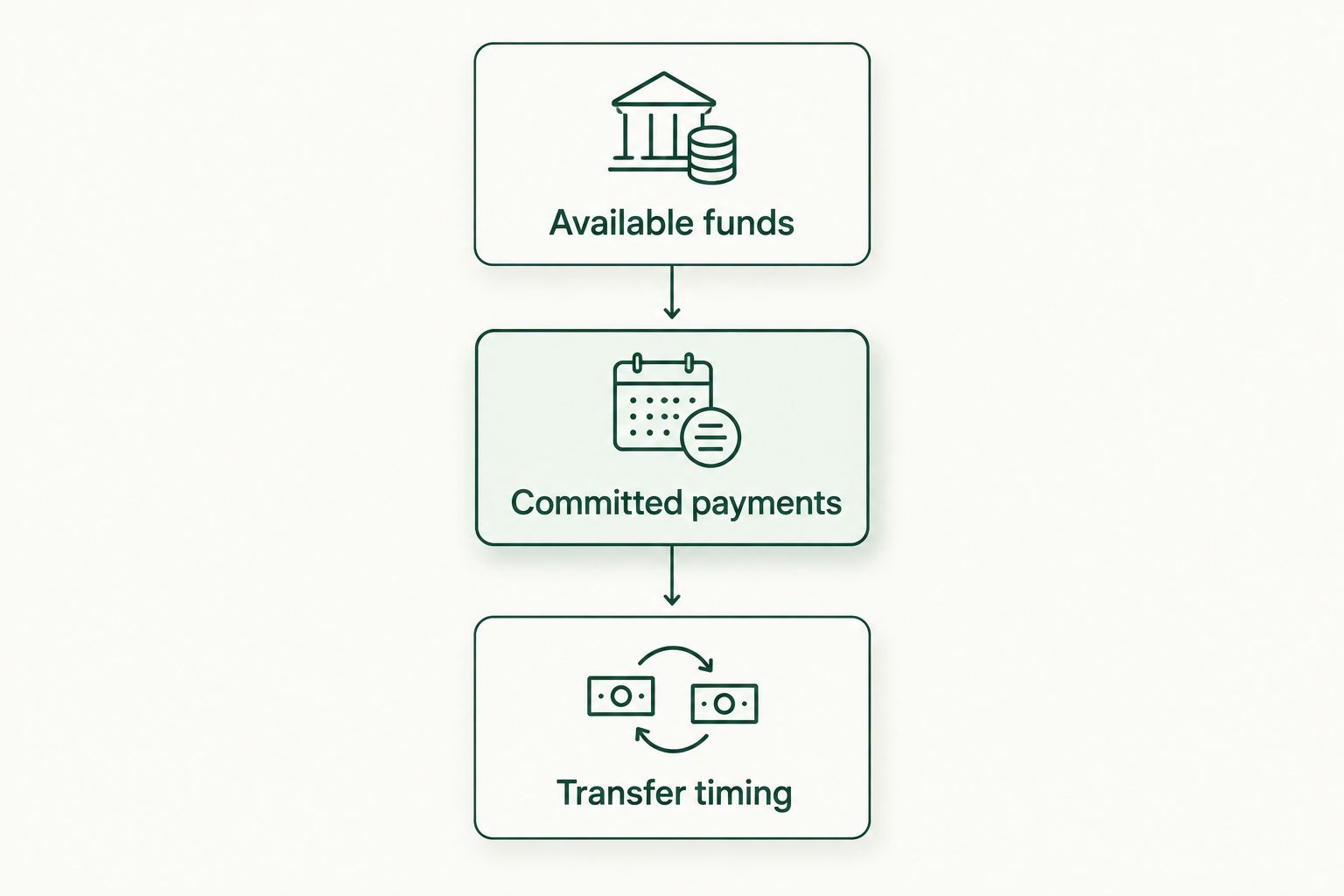
Use 3 checks before approving a transfer in 2026:
- Available funds: Is the money usable now, rather than pending or expected?
- Committed payments: Have you included payroll, taxes, suppliers, debt payments, and other scheduled debits?
- Transfer timing: Can money moved elsewhere return before the payroll funding deadline under the actual account terms?
A separate payroll account is one way to make earmarked money visible. It also creates another transfer to monitor, another account to reconcile, and another opportunity for funding to arrive after the required cutoff. Separation helps only when the process around it works.
Keeping payroll money in your operating account avoids that additional funding transfer. The trade-off is that the same account also handles other spending, so your internal cash record must clearly identify what is already committed.
| Approach | Best for | Practical benefit | Practical drawback |
|---|---|---|---|
| Earmark payroll within operating cash | Owners seeking fewer account transfers | Keeps funding in the account already used for operations | Requires discipline to prevent spending committed cash |
| Use a separate payroll account | Owners seeking clearer account-level separation | Makes the payroll allocation easier to identify | Adds transfer timing and reconciliation work |
Choose the structure your team can maintain consistently. Neither structure replaces a cash forecast, and neither guarantees that payroll will be funded.
For the broader reserve decision, use the guide to how much cash a small business should keep in reserve. A payroll allocation covers identified obligations; a reserve addresses uncertainty beyond those obligations.
Why payroll funding needs vary
Your payroll funding requirement changes with the business’s actual payment pattern. These factors belong in the forecast—not in assumptions carried forward indefinitely:
- Payroll composition. Bonuses, overtime, commissions, new hires, and departures change the amount due.
- Collection timing. Customer payment dates determine whether expected revenue becomes usable cash before funding is required.
- Provider requirements. Submission cutoffs, debit arrangements, and correction procedures determine when money must be ready.
- Bank availability. Deposit availability, transfer methods, holidays, and account restrictions affect access to cash.
- Competing withdrawals. Taxes, suppliers, loan payments, and owner distributions draw on the same operating resources.
- Approval coverage. An absent approver or incomplete authorization can interrupt an otherwise funded payroll process.
Review your 2026 calendar whenever one of these changes. Updating the annual calendar once does not account for an unexpected bonus run or a major customer paying later than planned.
What should you do when payroll funding looks short?
First, confirm the size and timing of the gap using available cash and the provider’s actual debit requirement. Separate a late receipt from a recurring operating deficit. The response is different when money is arriving after a cutoff than when the business consistently spends more cash than it collects.
Then work through the controllable decisions:
- Verify the forecast. Check for missing deposits, duplicate obligations, pending withdrawals, and payroll changes.
- Contact the provider. Ask what compliant processing options remain under your arrangement; do not assume a late submission will work.
- Review discretionary transfers. Reconsider owner distributions and nonessential cash movements before moving committed payroll funds.
- Address collections. Confirm payment status with customers whose receipts are included in the forecast.
- Document the outcome. Update the next cycle so the same timing assumption does not remain unchallenged.
Do not delay required wages, taxes, or other legal obligations based on a spreadsheet decision. Questions about payment deadlines and corrective action belong with your payroll provider and the appropriate tax or legal professional.
Treasury management identifies the gap and supports a response. It does not create cash, approve borrowing, or remove repayment obligations.
Who handles what in a payroll timing plan?
Your bank, payroll provider, bookkeeper, CPA, and financial advisor have different responsibilities. Assign the tasks explicitly instead of assuming that everyone sees the same information.
- You or your authorized manager: Approve payroll, spending decisions, account access, and escalation procedures.
- Payroll provider: Confirm processing instructions, funding requirements, submission procedures, and correction options.
- Bank: Confirm available balances, transfer instructions, account permissions, and banking cutoffs.
- Bookkeeper or accounting team: Maintain cash records, reconcile withdrawals, and update scheduled obligations.
- CPA: Address tax questions and coordinate the treatment and timing of applicable tax obligations.
- Financial advisor: Help connect treasury decisions with investment management, personal cash needs, and the wider financial plan.
VIMSmallBusiness is best for Northern Colorado owners seeking fee-only treasury management advice, not payroll processing. The firm is a fee-only fiduciary and SEC-registered RIA in Loveland. Its treasury management service belongs alongside your bank and payroll provider, not in place of their operating instructions.
For VIMSmallBusiness, the relevant planning connection is between business cash commitments and your broader financial decisions. Payroll funding must remain distinct from money you intend to invest or distribute personally. This article is educational, not personalized financial, tax, or legal advice.
Does treasury management replace payroll software?
Treasury management does not replace payroll software or your payroll provider. It organizes the cash and decision process around payroll, while payroll processing handles the work specified in your provider agreement.
A cash forecast is not evidence that payroll has been submitted. Keep submission confirmation and funding confirmation as separate checks.
Should you keep payroll cash invested until it is needed?
Payroll cash must be accessible before the funding deadline. Do not treat an investment account balance as equivalent to immediately available operating cash; withdrawal instructions, settlement, transfer timing, and investment risk all matter.
For your 2026 treasury plan, establish which money must remain available for operations before deciding what belongs in longer-term investments. Potential earnings are not a reason to ignore a known payroll commitment.
Can treasury management fix a recurring payroll shortfall?
Treasury management can expose a recurring payroll shortfall, but it cannot solve an operating deficit by rearranging payment dates alone. Compare cash collections with payroll and other required spending across the forecast.
If the gap keeps returning, examine collections, staffing commitments, owner withdrawals, and the business’s operating economics with your accounting team. Better timing is useful; a sustainable funding source is still necessary.
FAQ
Can treasury management help with payroll timing if customers pay late?
Yes—treasury management helps you identify whether late customer payments will leave payroll underfunded before the provider’s cutoff. It does not make an unpaid invoice available cash, so document a response that does not depend on an unconfirmed receipt.
How early should I fund my payroll account?
Fund your payroll account by the deadline your payroll provider and bank require. Confirm the debit date, submission cutoff, transfer availability, and holiday procedures directly rather than using a universal lead time.
Is a separate payroll account better than using my operating account?
A separate payroll account provides clearer account-level separation, while an operating account avoids an additional funding transfer. Choose based on your approval process and reconciliation discipline; both approaches still need an accurate cash forecast.
Should payroll reserves include payroll taxes?
Your cash plan should include payroll taxes and other payroll-related obligations, while tracking their actual withdrawal dates separately. Confirm which amounts your provider collects and which obligations your business must pay directly.
Can I automate transfers into my payroll account?
Automated transfers can support payroll funding when the accounts and provider arrangement permit them. Confirm the transfer schedule and available funds, assign someone to check completion, and document what happens when a transfer fails.
Can a financial advisor run payroll for my business?
Do not assume financial advisory services include payroll processing. Confirm each professional’s responsibilities and keep payroll submission, bank funding, tax coordination, and treasury planning assigned explicitly.
What should I review before each payroll run?
Review the expected payroll debit, available cash, competing withdrawals, submission deadline, and approval coverage. Reconcile the actual withdrawal afterward so the next forecast reflects what happened.
One last thing
The date to protect is the funding deadline, not just payday. Put the provider’s withdrawal and submission requirements on the calendar before adding employee payday. Then name a backup approver: cash in the right account still needs an authorized person to complete the process.