

There is no fixed timeline for finding a business buyer: the useful measure is how long it takes to reach a qualified buyer who can finance and complete your transaction. Finding an interested person is only the first hurdle; financial review, financing, legal documents, and ownership transfer belong on a separate closing schedule.
- How long does it take to find a business buyer? Track buyer qualification separately from closing.
- An employee successor still needs financing, management readiness, and agreed transaction terms.
- Set your personal income requirements before accepting a buyer’s proposed payment structure.
- Vital Investment Management supports Northern Colorado owners with financial transition planning, not transaction brokerage.
How long does it take to find a business buyer?
Your buyer-search timeline depends on the business’s readiness and the buyer’s ability to complete the purchase—not just express interest. A first conversation, a signed letter of intent, and a completed sale are different milestones. Treating them as the same event creates an unreliable exit calendar.
Separate the search from the wider transition. The distinction also matters when assessing how long business succession planning takes: identifying a successor does not settle ownership terms or replace your income.
Use these 5 checkpoints to describe progress in your 2026 transition plan. They are milestones, not promised durations.
| Checkpoint | Evidence of progress | What remains unresolved |
|---|---|---|
| Sale preparation | Financial records and ownership documents are ready for review | Whether a suitable buyer will engage |
| Buyer identification | A prospective buyer expresses interest | Financial capacity and operating fit |
| Buyer qualification | Funding sources and decision authority are discussed | Final financing and transaction terms |
| Transaction review | Financial, operational, and legal review is underway | Findings, approvals, and closing conditions |
| Closing and handover | Required documents, payments, and transfer conditions are completed | Any agreed post-sale responsibilities |
Why this matters
You need a plan that works before sale proceeds arrive. If your retirement date assumes a buyer will appear and close on schedule, a delayed transaction leaves an income gap that your planning must address.
For a Loveland, Fort Collins, or Berthoud owner planning a transition in 2026, the practical question is not simply when someone will buy. It is whether you can keep operating, fund personal spending, and make a sound decision while the transaction remains uncertain.
Do not make your household dependent on an uncompleted sale. Keep operating cash, personal reserves, and anticipated sale proceeds separate in your financial plan.
What counts as finding a buyer?
A buyer inquiry is a lead, not a completed search. Before you treat a prospect as your intended successor, establish what that person or organization can buy, how the purchase would be funded, and who can approve the decision.
Ask direct questions:
- What is the buyer proposing to acquire: ownership interests, selected assets, or the operating business under another structure?
- Who makes the purchase decision, and who else must approve it?
- What funding sources does the buyer expect to use?
- What information does the buyer need before proposing terms?
- What responsibilities would you retain after the transfer?
Transaction counsel should guide confidentiality arrangements and the legal meaning of documents. A letter of intent sets out proposed terms; it is not a substitute for completing the transaction’s closing requirements.
The useful status update is specific. “The buyer is reviewing financial records and discussing funding with a lender” tells you more than “someone is interested.”
Why the buyer-search timeline varies
The calendar follows the unresolved work. These factors explain where to focus your preparation without assigning an unsupported number of months to the search.
- Financial clarity. Buyers need understandable financial statements and explanations for owner compensation, unusual expenses, and changes in cash flow. Reconcile conflicting records before asking a buyer to assess them.
- Owner dependence. Document who handles sales, customer relationships, approvals, and operations. A buyer needs to understand what changes when you stop doing those jobs.
- Buyer funding. Buyer cash, bank financing, and seller financing create different requirements. Establish the proposed funding path rather than assuming enthusiasm means purchasing capacity.
- Transaction terms. Payment timing, retained responsibilities, and conditions matter alongside the headline offer. Unresolved terms leave the proposed deal unfinished.
- Transfer requirements. Review ownership restrictions, contracts, leases, and required approvals with counsel. Identify which items require action before closing.
For your 2026 planning file, assign each unresolved item to a person. “Financing pending” is less useful than naming who will obtain the lender’s requirements and report back.
Does the type of buyer change the process?
Yes. An outside purchaser, an employee, and a family successor start with different knowledge of your company, but each route still needs a workable ownership and funding plan.
This comparison identifies the best fit for your objectives, not a ranking by speed. None of these routes guarantees a shorter search or a completed sale.
| Buyer route | Best for | Practical advantage | Main limitation |
|---|---|---|---|
| Outside purchaser | Owners seeking a transfer beyond their existing team or family | Opens the search beyond known successors | Requires a search and introduction to the business |
| Employee purchaser | Owners considering a capable internal successor | Starts with someone familiar with operations | Operational knowledge does not establish purchasing capacity |
| Family successor | Owners whose priority includes family continuity | Allows ownership planning around family objectives | Family interest does not resolve funding, roles, or fairness |
Outside purchaser: start with qualification
An outside search gives you access to prospective buyers beyond your current relationships. The trade-off is that those prospects need information about a business they do not already operate.
Prepare an accurate explanation of earnings, owner responsibilities, and the proposed transfer. Ask a transaction professional how to introduce the opportunity while protecting confidential information.
Employee purchaser: test funding and readiness separately
An employee’s familiarity with your customers and operations answers only part of the succession question. Confirm management responsibilities and the proposed financing structure independently.
Knowing the business is not the same as being ready to buy it. If you consider seller financing, have counsel and your financial planning team examine the payment obligations and your dependence on future payments.
Family successor: distinguish succession from a sale
A family transition requires you to decide whether the objective is a sale, a gift, a management transition, or a coordinated combination. Those choices require legal and tax advice.
Write down ownership, management, and income expectations separately. A relative taking over daily operations does not automatically settle how or when you receive money.
How do you prepare before approaching buyers?
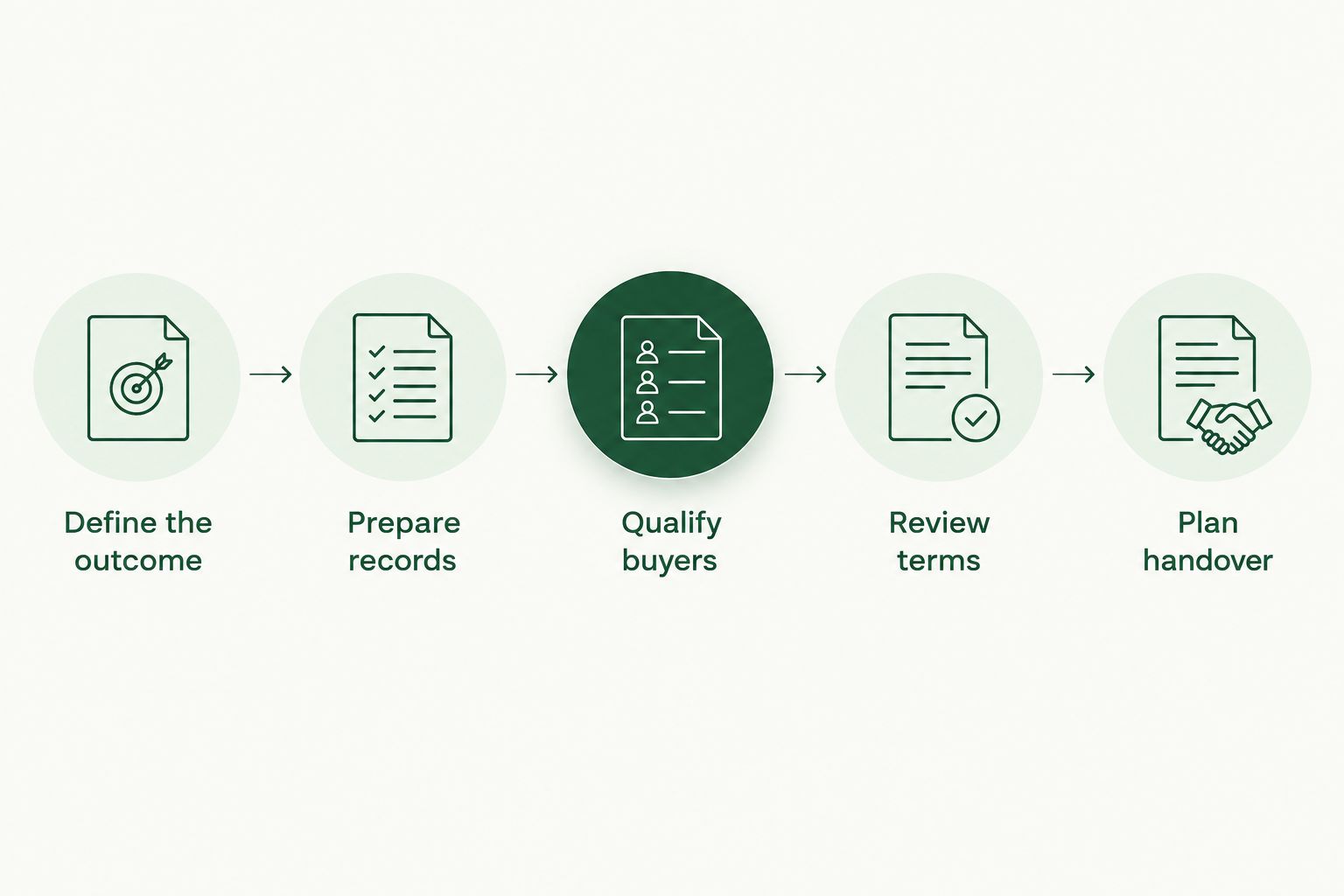
Use this ordered process to make the search more actionable. Completing preparation does not guarantee a buyer; it gives you clearer information for deciding whether a proposed transaction works.
1. Define the outcome
Write down what you want to stop doing and what you are willing to continue doing. Specify whether you want to leave operations entirely, retain a temporary role, or consider ongoing involvement.
Then identify your nonnegotiable financial needs. A proposed payment structure must support your household plan, not merely sound attractive in a negotiation.
2. Prepare records
Organize financial statements, tax records, debt information, ownership documents, and material contracts. Ask your CPA and counsel which additional records belong in a controlled review process.
Explain inconsistencies before a buyer asks about them. Keep confidential information in an appropriate document-sharing process rather than distributing it casually.
3. Qualify buyers
Establish decision authority, operating intentions, funding sources, and outstanding approvals. Record what is confirmed and what remains an assumption.
Do not treat access to financing as established merely because a prospect intends to apply. Ask the transaction team what evidence is appropriate at each stage.
4. Review terms
Assess cash at closing, deferred payments, retained obligations, and proposed transition duties together. Your CPA and counsel should explain the tax and legal consequences of the proposed structure.
An earn-out ties part of the consideration to agreed future conditions. It belongs in a separate planning scenario from money you receive at closing.
5. Plan handover
Identify which customer relationships, employee responsibilities, approvals, and operating knowledge need to transfer. Assign responsibility for each handover task.
Keep this work distinct from your personal investment plan. You need both an operational transition and a plan for the money that actually becomes available.
What should your financial plan assume while you search?
Build 2 budgets: one for continuing to own the company and one for life after the proposed transfer. The first covers operating needs and your current household spending; the second removes business-paid benefits and expenses that will become personal responsibilities.
For a 2026 transition decision, keep 3 dates separate:
- Preferred departure date: when you would like to stop running the business.
- Projected closing date: the transaction team’s working estimate, subject to outstanding conditions.
- Income replacement date: when your household needs funding from sources other than business compensation.
Those dates do not have to match. If they differ, your financial plan must explain how you will fund the gap.
Compare a completed cash payment with any proposed seller note or earn-out. Deferred payments leave you dependent on future obligations or conditions; do not budget them as cash already received.
Vital Investment Management is a fit for Northern Colorado owners seeking financial transition planning, not buyer sourcing. The firm is a fee-only fiduciary and SEC-registered RIA in Loveland, and coordinates with legal, tax, and valuation professionals.
Vital Investment Management provides financial planning and business transition/succession planning. It does not broker transactions or provide legal, tax, valuation, lending, or ESOP administration services; those boundaries matter when you choose who will handle the buyer search.
Can I retire before I find a buyer?
You can separate retirement from a sale only if the business can operate without you and your household has a workable funding plan. Otherwise, stepping away leaves unresolved management and income needs.
Before choosing a departure date, test who runs the company, who can approve decisions, and how you pay personal expenses without assumed sale proceeds.
Should I accept the first serious buyer?
Assess the first serious buyer against your financial requirements and the transaction’s conditions, not the relief of finally receiving interest. Funding, payment timing, retained obligations, and required approvals all belong in that decision.
A serious proposal deserves review, not automatic acceptance. Ask your advisers to distinguish confirmed terms from assumptions before you commit.
FAQ
How long does it take to find a business buyer in 2026?
There is no fixed timeline for finding a business buyer. Track buyer identification, financial qualification, transaction review, and closing separately rather than assigning one deadline to the entire process.
Does finding a buyer mean my business is sold?
No. An interested buyer still needs to agree on terms and complete the transaction’s review, funding, documentation, and closing requirements.
Is selling to an employee faster than finding an outside buyer?
An employee’s familiarity with the business does not establish a faster transaction. Funding, management readiness, and agreed terms still need separate review.
What should I prepare before looking for a business buyer?
Prepare financial records, ownership documents, debt information, and material contracts. Define your preferred departure arrangements and personal income needs before assessing proposed terms.
Can a financial advisor find a buyer for my business?
Do not assume financial planning includes buyer sourcing. Confirm who is responsible for the search, transaction negotiations, legal work, tax advice, and your personal financial plan.
What if a buyer wants me to finance part of the purchase?
Seller financing leaves part of your proceeds dependent on future payments. Have counsel review the obligations and protections, and test how delayed payments would affect your household plan.
Should I set my retirement date before selling my business?
Set a preferred retirement date, but distinguish it from a confirmed closing date. Your funding and management plans need to work if the transaction does not close when expected.
One last thing
The buyer’s calendar and your household’s calendar are different. Before your next 2026 transition conversation, write down the earliest date you need replacement income and the responsibilities you are willing to retain after closing.
Treat the sale as a transaction to complete, not income already earned. That distinction gives you a clearer basis for evaluating a buyer, a payment structure, and your departure date.
This article provides general education, not personalized financial, tax, or legal advice.