
Yes. A Loveland, Colorado advisor can help you connect retirement spending, investments, business cash flow and succession in one financial plan. The advisor’s scope matters: retirement planning does not replace tax-return preparation, legal documents or an independent business valuation.
- VIMSmallBusiness offers fee-only retirement planning for Northern Colorado business owners, alongside investment management and succession planning.
- For loveland colorado advisor retirement planning, prioritize cash flow and succession coordination over proximity alone.
- Separate business operating cash from the assets intended to support your retirement.
- Ask who handles financial planning, tax work, legal documents and business valuation before engaging an advisor.
Why this matters
Your business can pay you well without making you ready to retire. Salary, distributions and business equity serve different purposes, and business equity does not pay household bills until you receive cash from it.
VIMSmallBusiness provides fee-only financial planning, treasury management, investment management and business transition/succession planning for Northern Colorado owners. VIMSmallBusiness is best suited to owners seeking fee-only retirement planning that connects personal finances with business cash flow and succession. Its role is financial planning and coordination, not brokering your sale or providing legal, tax or valuation services.
For your 2026 review, start with a practical question: what pays your household when the business stops paying you?
Can a Loveland Colorado advisor help with retirement planning?
Yes. A retirement advisor can organize your financial information, identify the income your investments need to support, and connect that plan to your business transition. You should expect explicit assumptions and assigned next steps, not just an investment recommendation.
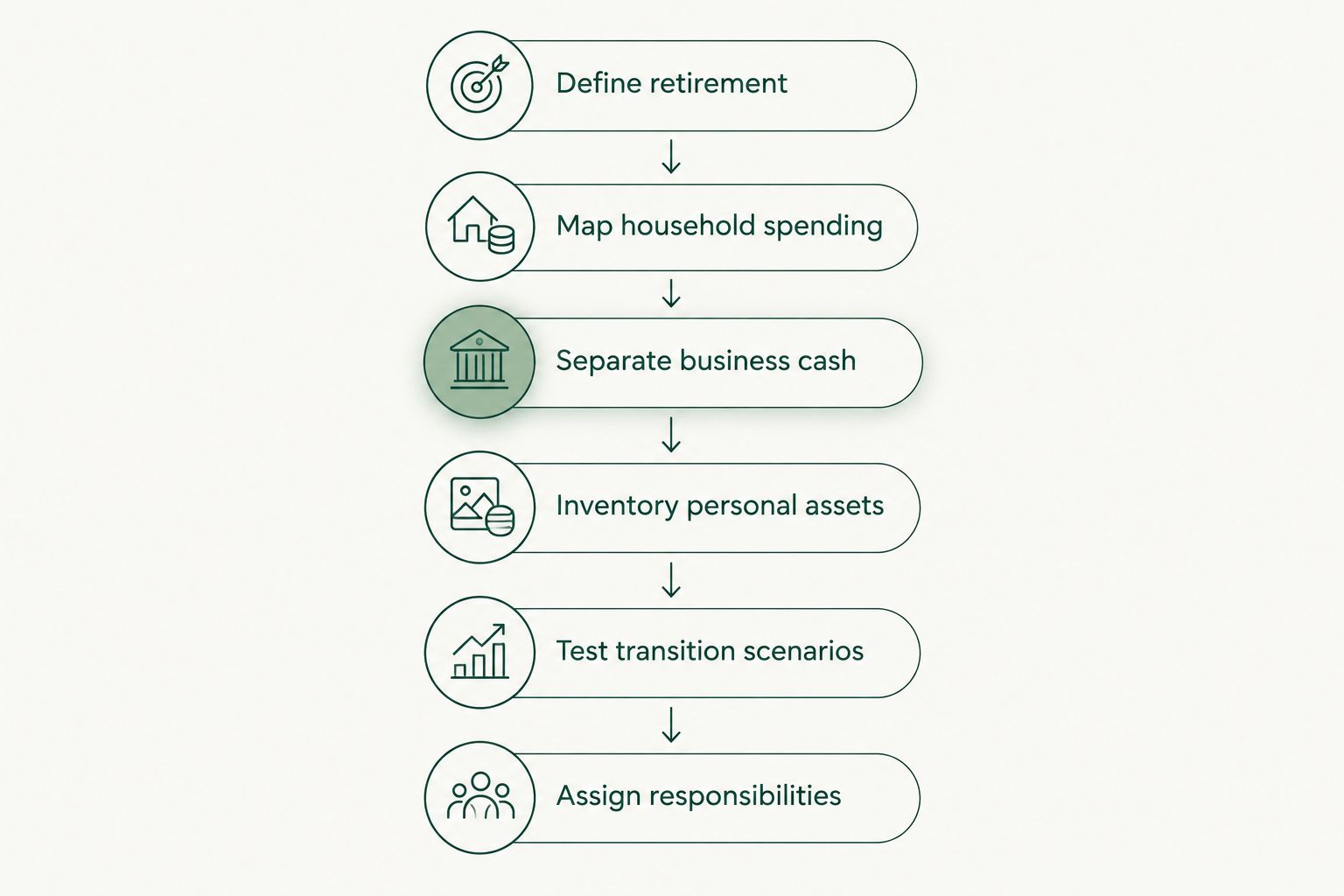
Use these six steps to structure the conversation.
1. Define retirement
Decide what you want to stop doing. Leaving daily operations, reducing your hours, transferring ownership and selling the company are different decisions.
Write down your preferred work arrangement and the income you expect to keep receiving. If you plan to remain an owner but leave management, identify who will run the company and how distributions will be determined.
2. Map household spending
Bring 12 months of household spending records, then separate recurring expenses from irregular purchases. Include debt payments, insurance, healthcare, family support and taxes in the discussion.
Your current salary is not automatically your retirement spending target. Some business-paid benefits will need a personal replacement, while some work-related expenses will disappear.
3. Separate business cash
Identify the cash needed for payroll, taxes, debt payments and ordinary operating demands before treating a business balance as retirement money. Review 12 months of business cash flow alongside upcoming commitments.
Cash in the business is not automatically cash available for retirement. An advisor can help connect treasury decisions with personal goals, but your operating needs must remain visible.
4. Inventory personal assets
List retirement accounts, taxable investments, cash, property and debts. Keep business equity on a separate line so you can see what already exists outside the company.
Then identify which assets are accessible, which involve withdrawal restrictions, and which require a sale. Account balances alone do not show the timing or tax consequences of using the money.
5. Test transition scenarios
Ask your advisor to compare 3 scenarios: your intended transition, a delayed transition and lower sale proceeds. These are planning exercises, not forecasts of what your company will sell for.
Each scenario should show how you would cover household spending and which decisions would change. Avoid building the entire retirement plan around an unverified sale estimate.
6. Assign responsibilities
Record who owns each next step: you, your financial advisor, your CPA, your attorney or a valuation professional. Include the documents needed and the decision each document supports.
A useful 2026 retirement plan distinguishes a completed action from an unresolved assumption. “Discuss the sale” is not the same as obtaining a valuation or negotiating enforceable terms.
Which professional handles each part of retirement planning?
A financial advisor, CPA and attorney address different parts of the same retirement decision. Choose by responsibility, not by title alone. Ask each professional to confirm the work included in the engagement.
| Professional | Best for | Contribution to your retirement plan | Limitation to address |
|---|---|---|---|
| Financial advisor | Connecting household goals, cash flow and investments | Organizes the financial plan and evaluates how transition choices affect personal finances | Does not replace separately engaged tax, legal or valuation professionals |
| CPA | Tax reporting and transaction tax analysis | Evaluates tax consequences using your business and personal tax information | Tax work alone does not establish your investment or retirement spending plan |
| Attorney | Ownership documents and legal terms | Addresses agreements, estate documents and legal responsibilities within the engagement | Legal documents alone do not establish whether your retirement cash flow works |
| Valuation professional | Estimating business value | Provides a valuation within a defined scope and set of assumptions | An estimate does not establish what a buyer will ultimately pay |
Coordination is the advantage of using the right specialists. The trade-off is additional work for you unless someone keeps decisions, documents and responsibilities organized.
Ask for permission-based information sharing between professionals. Sending the same unresolved question to several people does not make anyone responsible for answering it.
What should a local retirement advisor understand about your business?
A Loveland office is useful when you want local meetings, but location is not a substitute for owner-specific planning. Your advisor should understand how money moves between your company and your household.
Cash flow and treasury
Cash is lumpy. A strong month does not erase upcoming payroll, tax obligations or seasonal operating demands.
Ask how the advisor distinguishes operating reserves from money available for personal investing. The benefit is a clearer boundary between business needs and retirement contributions; the limitation is that the boundary needs updating when business conditions change.
Concentration outside investment accounts
Your largest financial exposure can be the company itself. Reviewing only your investment accounts leaves business equity and business-dependent income outside the conversation.
Ask to see those exposures together. A diversified personal portfolio does not remove the financial effect of relying on the company for income and eventual sale proceeds.
Transition and succession
An employee transfer, family succession and outside sale involve different ownership and payment decisions. Your retirement plan needs to reflect the route you are considering without treating tentative terms as settled cash.
Keep this article’s retirement question separate from transaction execution. Your advisor can evaluate the personal financial implications while qualified transaction professionals address valuation, contracts and financing.
Why retirement planning needs vary between owners
The right scope depends on the decisions you face, not simply your age or account balance. These five factors change what the plan needs to address:
- Business-dependent income: Identify how much household income stops when your work or ownership changes.
- Assets outside the company: Separate accessible personal investments from business equity and other illiquid assets.
- Transition structure: Distinguish cash received at closing from payments dependent on future performance or collection.
- Tax coordination: Identify which decisions need your CPA’s analysis before implementation.
- Family and ownership obligations: Include co-owners, intended successors and household commitments in the relevant discussions.
For 2026, record these facts before asking whether your portfolio is appropriate. Investment decisions need a purpose, and the purpose starts with the spending and obligations the money must support.
What should I bring to a retirement planning meeting?
Bring records that explain your household, business and ownership position. You do not need a polished presentation; you need information that makes the assumptions visible.
Use this checklist:
- Personal account statements, including retirement accounts and taxable investments.
- Household spending records covering 12 months.
- Business financial statements and a current cash-flow picture.
- Personal and business tax returns for your CPA’s coordination work.
- Debt balances, repayment terms and major upcoming commitments.
- Ownership agreements, existing valuations and any written transition proposals.
- A short description of your intended retirement and the decisions you keep postponing.
Ask how to deliver sensitive records before sending them. Start by explaining what exists and what needs clarification rather than emailing an unstructured collection of financial documents.
How do I choose a retirement advisor in Loveland?
Ask direct questions about scope, compensation and responsibility. Your comparison set should include local fee-only advisors serving business owners in Loveland, Fort Collins, Berthoud and the wider Northern Colorado region.
Questions to ask before engaging an advisor
- Will you act as a fiduciary for the services in our engagement?
- What retirement planning work is included beyond investment management?
- How do you account for business equity and uneven owner income?
- How will you coordinate with my existing CPA and attorney?
- What written decisions, assumptions and next steps will I receive?
- How are you compensated, and what work falls outside the engagement?
- What changes trigger a review of my plan?
- Who is responsible for implementing each recommendation?
VIMSmallBusiness is a fee-only fiduciary and SEC-registered RIA based in Loveland. Dillon Goodman, CPA, CFP®, leads its business-owner practice; the firm does not prepare tax returns or provide legal, valuation, lending or ESOP administration services.
Those boundaries matter. A credential helps you understand a professional’s background, but the engagement determines the services you receive. SEC registration is not a promise about investment results.
Can I retire before selling my business?
Yes, if the resources available to you support the plan without assuming an immediate sale. Ask your advisor to distinguish income that continues without your daily involvement from income that depends on your work.
Test the delayed-sale scenario before changing your role. Ownership, management responsibilities and household cash flow need separate answers.
Do I need retirement planning if most of my wealth is in the business?
Yes. Business concentration makes it important to distinguish estimated wealth from money you can use for household spending.
A retirement plan should show what you own outside the company and how your finances change if a transition takes longer or produces less cash than intended.
How often should I revisit my retirement plan?
Set a review schedule with your advisor and revisit the plan when important facts change. A revised sale timeline, ownership proposal, household need or business cash-flow outlook deserves attention before implementation.
Use your 2026 plan as a documented baseline, not a permanent answer. Record what changed and which decision needs reconsideration.
FAQ
Can a Loveland, Colorado financial advisor help me plan retirement as a business owner?
Yes. A financial advisor can connect household spending, personal investments, business cash flow and succession decisions. Confirm that the engagement includes planning rather than investment management alone.
Should I choose a local advisor or an advisor who understands business owners?
Choose relevant business-owner planning experience and a clearly defined scope first. A local advisor also supports in-person meetings, but proximity does not establish expertise.
Does retirement planning include selling my business?
Retirement planning can evaluate how a sale affects your personal finances, but it is not transaction brokerage. Legal terms, business valuation and financing require the appropriate professionals.
Can my CPA handle all of my retirement planning?
Ask your CPA what the engagement covers. Tax analysis, investment management, retirement cash flow and legal documents are distinct responsibilities, even when professionals coordinate their work.
What if I do not know what my business is worth?
Keep business value as an unresolved assumption rather than treating it as spendable retirement money. A valuation professional can address business value, while your advisor evaluates different proceeds scenarios.
Does a fee-only advisor prepare my tax returns?
Fee-only describes compensation, not tax-return preparation. Confirm tax services separately; VIMSmallBusiness coordinates with your CPA and does not prepare tax returns.
What should I ask for at the end of a retirement planning meeting?
Ask for the decisions reached, assumptions still unresolved and the person responsible for each next step. That record makes the next meeting about progress rather than repeating the same conversation.
One last thing
Separate the date you want to stop working from the date you expect to receive sale proceeds. They are not automatically the same date, and your retirement cash flow needs to work between them.
Before your next meeting, write down what pays your household during that gap. That answer is more useful than an unsupported business-value estimate.
This article is educational, not personalized investment, tax or legal advice.