

Fee-only financial planning is a better fit for entrepreneurs who want advice paid for by clients rather than product commissions, provided the advisor understands business-owner cash flow and acts as a fiduciary. The label removes a source of compensation conflicts; it does not prove competence, eliminate every conflict, or establish what services you receive. In 2026, choose the advisor by compensation, written scope, and experience with decisions that connect your company to your household.
- Is fee-only financial planning better for entrepreneurs? Yes, when commission-free advice comes with relevant business-owner planning.
- Fee-only compensation does not eliminate conflicts or prove expertise in treasury, concentration, or succession.
- Vital Investment Management offers fee-only financial planning for Northern Colorado business owners; tax returns and legal work remain separate.
- Compare written deliverables and responsibilities before choosing an advisor, not just compensation labels.
Is fee-only financial planning better for entrepreneurs?
Yes, if your priority is advice without product commissions and your advisor can connect business decisions to personal finances. Start with the difference between fee-only and fee-based advisors, then examine the actual engagement. Similar labels describe different compensation arrangements.
The comparison below separates payment structure from service quality. No compensation model, by itself, tells you whether an advisor can help with uneven distributions, business concentration, or a transition.
| Compensation model | Best for | Principal advantage | Limitation to examine |
|---|---|---|---|
| Fee-only | Owners seeking advice without product commissions | Advisor compensation comes from clients, not product sales | Asset-based billing and service boundaries still create questions |
| Fee-based | Owners considering a relationship that combines fees and commissions | Advice and product implementation can sit within one relationship | You must distinguish advisory work from commission-paid transactions |
| Commission-based | Owners seeking a defined product transaction | Compensation is connected to implementing a product | Product incentives require scrutiny; ongoing planning is not established by the transaction |
Ask each candidate to explain how compensation changes under the recommendation being discussed. An explanation that sounds clear in a brochure should remain clear when applied to your actual decision.
Why this matters when your business pays your household
Your company and your household share risks, even when their bank accounts are separate. A weak quarter can affect payroll, owner distributions, estimated taxes, and personal savings at the same time. Investment advice that ignores those connections leaves the central planning problem untouched.
For your 2026 review, separate 4 decisions: cash needed inside the business, money reserved for taxes, cash supporting your household, and assets intended for longer-term goals. These are planning categories, not prescribed allocations. Your obligations and timing determine the amounts.
An advisor should explain which of those decisions the engagement covers. If the service only manages an investment account, do not assume it includes treasury planning or succession coordination.
What fee-only financial planning improves—and what it does not
Fee-only compensation removes product commissions from the advisor’s compensation model. That makes one important question easier to answer: whether a recommended product generates a sales commission for the advisor. It does not make every recommendation conflict-free.
An asset-based arrangement, for example, creates a question when you compare investing money with paying down debt or keeping capital in the business. Ask how the advisor evaluates choices that leave fewer assets under management. Request the reasoning, not reassurance.
Fiduciary responsibility is a separate issue. Investment advisers owe fiduciary duties within their advisory relationships; the SEC’s investment adviser conduct interpretation describes duties of care and loyalty. Ask the candidate to explain those responsibilities and the boundaries of the relationship in writing.
Fee-only is a useful compensation filter, not a substitute for due diligence. Registration is not an endorsement of an advisor’s skill, and professional credentials do not expand the services promised in your agreement.
Why the better choice varies by entrepreneur
The right arrangement depends on the decisions you need help making. Review these factors before comparing proposals:
- Cash flow: Uneven customer payments and owner distributions call for coordination between business obligations and household spending.
- Concentration: Ownership in your company belongs in the financial picture, even when the advisor does not manage it.
- Taxes: Investment decisions need coordination with the professional responsible for your tax work.
- Transition: A planned sale, family transfer, or employee purchase changes the questions your financial plan must answer.
- Service scope: Treasury, investments, financial planning, and succession coordination are distinct responsibilities. Confirm which are included.
An entrepreneur with a narrow investment question does not need the same engagement as an owner preparing to leave the business. Neither should buy an undefined promise of ongoing support.
Use 8 questions to compare financial planners
Use the same 8 questions with every candidate. Written answers make the comparison useful because you can see where compensation, responsibilities, and implementation differ.
- Who pays you? Ask about client fees, commissions, referral compensation, and payments involving affiliated businesses. Request the relevant disclosures rather than relying on a verbal label.
- Will you acknowledge your fiduciary responsibility in writing? Ask when it applies and which activities fall outside the advisory engagement. Keep that explanation with your agreement.
- What will you deliver? Request named outputs, such as a cash-flow review, investment policy, or transition-planning analysis. An account statement is not the same thing as a financial plan.
- How will you treat my company in the plan? Ask how ownership, distributions, business debt, and reliance on the company enter the analysis. Clarify whether business valuation requires a separate professional.
- How will you coordinate with my CPA? Establish who supplies information, who reviews tax implications, and who authorizes implementation. Coordination should not leave you carrying conflicting instructions between professionals.
- What happens when keeping money outside managed accounts is appropriate? Ask how the advisor considers debt repayment, operating cash, and business reinvestment. This tests the process behind recommendations.
- Who implements each recommendation? Identify the work assigned to you, the advisor, your CPA, your attorney, or another specialist. Advice without an assigned next step is unfinished work.
- How do we review progress and end the engagement? Ask what triggers an update, how responsibilities are tracked, and what the agreement says about termination. Know the process before signing.
For a 2026 shortlist, record each answer in the same document. Look for specific responsibilities and clear exclusions; polished language does not resolve a vague scope.
Build the engagement around decisions, not accounts
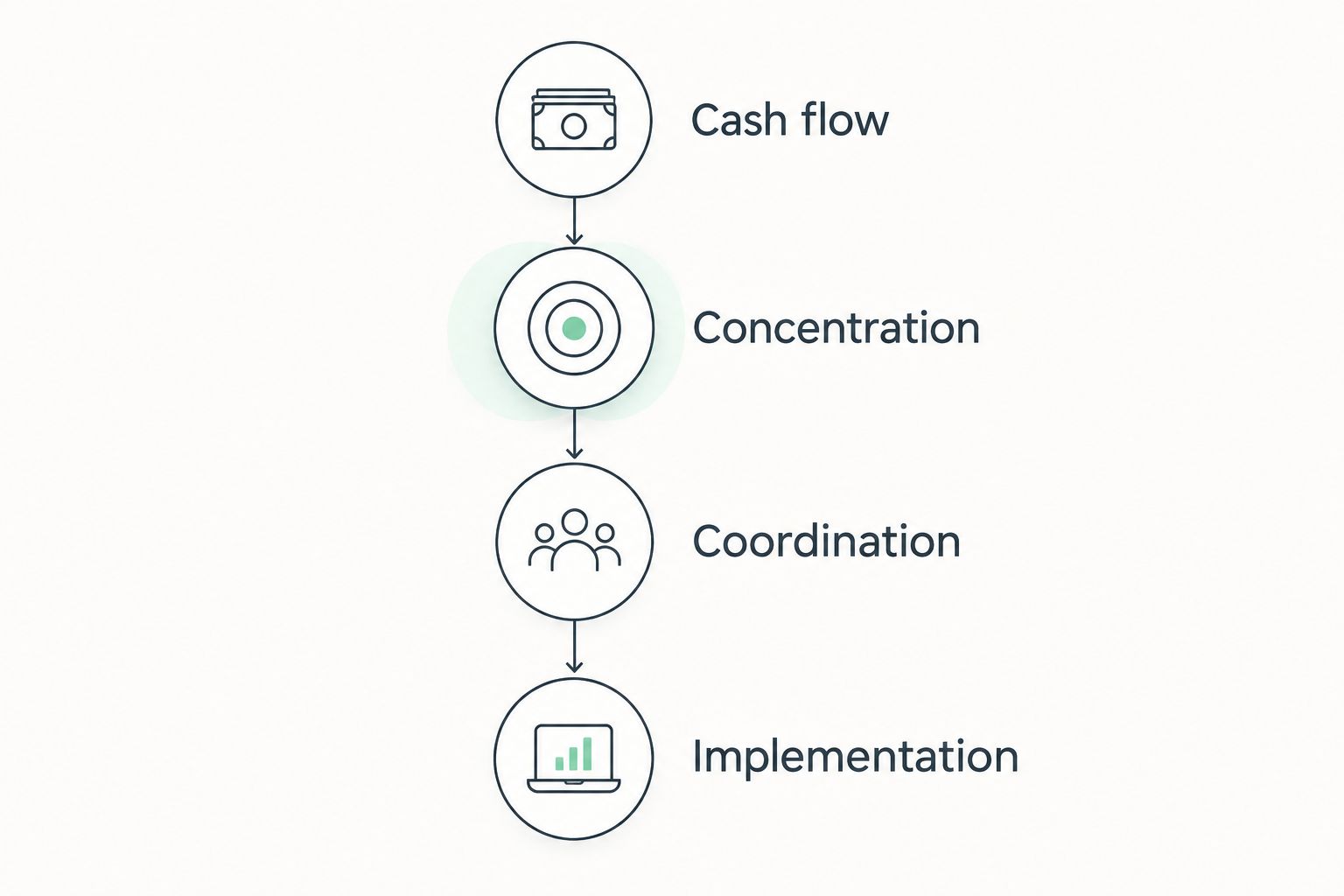
Start with the business problem, then work toward implementation. The sequence below keeps a planner from proposing an investment solution before understanding what the money must do.
- Cash flow: Identify business obligations, household needs, tax payments, and the timing of owner distributions.
- Concentration: Map company ownership alongside personal investments, debt, guarantees, and other financial exposures.
- Coordination: Assign the tax, legal, lending, and valuation questions to the appropriate professionals.
- Implementation: Document the agreed actions, responsible people, and conditions that require another review.
An investment recommendation belongs at the end of that reasoning, not the beginning. You should be able to trace it back to a need, a constraint, or a goal.
Cash flow comes before investment selection
Cash is lumpy. A balance that looks idle today can already be committed to payroll, inventory, debt service, or taxes. Ask the planner to distinguish money available for long-term investing from money with a nearer obligation.
The drawback is that this work requires information beyond investment statements. If you want treasury included, confirm what records the advisor needs and what analysis the engagement actually provides.
Concentration belongs in the household discussion
Your company can be both your income source and a major personal asset. Assessing only your investment accounts leaves that exposure outside the discussion. Ask how the advisor accounts for business ownership without pretending an informal estimate is a formal valuation.
A financial plan also needs to distinguish projected sale proceeds from money you already control. Buyer interest, financing, taxes, and transaction terms require separate work; an anticipated exit is not cash in the bank.
Coordination needs a named owner
Your CPA, attorney, and financial advisor have different responsibilities. Ask who initiates communication when an investment or transition decision raises tax or legal questions. Your consent and information-sharing arrangements should be clear.
For your 2026 planning review, ask for an action list that identifies the decision, responsible professional, and next step. This is more useful than receiving several recommendations that nobody has agreed to implement.
Where Vital Investment Management fits
Vital Investment Management is best for Northern Colorado owners seeking fee-only financial planning coordinated with treasury, investments, and business transition decisions. The firm is a fee-only fiduciary and SEC-registered RIA based in Loveland, serving owners in Fort Collins, Berthoud, and the surrounding region.
The advantage is the stated business-owner service scope: treasury management, investment management, financial planning, and transition/succession planning. The boundary matters equally. Vital Investment Management does not prepare tax returns, broker business transactions, or provide legal, valuation, lending, or ESOP administration services.
That makes coordination part of the relationship—not a replacement for your other professionals. Confirm which services your proposed engagement includes and which require separate specialists.
If that scope matches your needs, Vital Investment Management offers a confidential discovery call with Dillon Goodman, CPA, CFP®. The purpose is to discuss fit and responsibilities, not to treat an educational article as a personal recommendation.
Is fee-only planning still useful if most of my wealth is in my company?
Fee-only planning is relevant when company ownership dominates your finances because the planning question extends beyond managed investments. Your household depends on distributions, business value, and the timing of a transition. Ask whether the engagement addresses those connections.
The limitation is scope: an advisor offering investment management alone is not automatically providing business-owner planning. Get the distinction in writing.
Can my CPA replace a financial planner?
Your CPA replaces a financial planner only when the CPA’s engagement actually includes the planning services you need. Tax preparation and financial planning are different assignments, even when a professional holds credentials in both fields. Identify the work before comparing titles.
For your 2026 review, ask who handles investment decisions, household cash flow, and succession-related financial analysis. Keep tax and legal decisions with the professionals responsible for them.
FAQ
Is fee-only financial planning better for entrepreneurs with uneven income?
Fee-only planning is a strong fit when the engagement includes uneven owner distributions and business-to-household cash flow. Compensation alone does not establish that service, so request a written scope.
Does fee-only mean a financial advisor has no conflicts?
No. Fee-only removes product commissions from the advisor’s compensation model, but billing arrangements and other business relationships still require review. Ask how recommendations are evaluated when they reduce assets under management.
Is fee-based financial planning the same as fee-only?
No. Fee-based generally describes an arrangement involving fees and potential commissions, while fee-only compensation comes from clients rather than product commissions. Ask for the specific compensation disclosures.
What should I bring to a first financial-planning meeting?
Bring 3 document groups: business cash-flow records, personal financial statements, and existing planning agreements. Ask the advisor which tax, debt, ownership, and insurance records are needed before sending sensitive information.
Can a fee-only advisor help with selling my business?
A fee-only advisor can address the personal financial planning connected to a sale when that work is included in the engagement. Transaction brokerage, legal documents, taxes, and valuation require the appropriate separate professionals.
Does SEC registration prove an advisor is better?
No. SEC registration is not an endorsement of competence or service quality. Review the advisor’s disclosures, relevant experience, and proposed responsibilities.
Does Vital Investment Management prepare business tax returns?
No. Vital Investment Management does not prepare tax returns. Its planning work coordinates with the owner’s tax professional rather than replacing that professional’s responsibilities.
One last thing
Ask what the advisor would recommend if you did not move any investments. The answer reveals whether the conversation begins with your decisions or with an account transfer. It also gives you a practical way to test the proposed planning scope.
Before signing, request a plain-language description of the problem, the intended deliverable, and the person responsible for implementation. A clear compensation model is a good start; a clear assignment makes it useful.
This article is educational and is not personalized financial, tax, or legal advice.