

Yes, you can have both a 401(k) and a SEP IRA, but contributing to both depends on who sponsors the plans, whether the businesses are related, and which SEP document you use. For the same employer, opening another account does not create another contribution limit. Before funding both for 2026, have your plan administrator confirm the documents and calculate the combined contributions with your CPA.
- Can a small business owner have both a 401k and a SEP IRA? Yes, but contribution limits require coordination.
- IRS rules generally combine same-employer SEP IRA and 401(k) contributions under the annual additions limit.
- Form 5305-SEP generally cannot establish a SEP when the employer also maintains a qualified retirement plan.
- An unrelated employer’s 401(k) and your business’s SEP IRA can have separate employer contribution limits.
Why this matters
Owning both accounts and being allowed to fund both are different questions. You can keep an existing SEP IRA after establishing a 401(k); that does not establish how much your business can contribute this year.
For your 2026 planning, settle the contribution calculation before moving cash. Otherwise, your payroll records, retirement deposits, and tax deduction can tell different stories. The payroll-to-funded-solo-401(k) workflow explains the operational handoffs; the first decision here is whether the plans share an employer limit.
Can a small business owner have both a 401k and a SEP IRA?
Yes. The important distinction is between plans maintained by the same employer and plans sponsored by genuinely unrelated employers. Account ownership alone does not answer that question.
| Arrangement | Best for | What it permits | Main limitation |
|---|---|---|---|
| Same business sponsors both plans | Owners with a specific reason to maintain both arrangements | Contributions under compatible plan documents | Contributions generally share the same annual additions limit |
| Unrelated employer’s 401(k), plus your business’s SEP IRA | Employees who also earn income through a separate business | Workplace participation plus business-funded SEP contributions | Business earnings and employer relationships still determine eligibility and limits |
| Existing SEP IRA, new business 401(k) | Owners changing retirement arrangements | Keeping existing SEP assets while using the new plan | Holding an old account does not authorize new SEP contributions |
| Related businesses sponsor different plans | Owners with multiple business interests | Planning across the ownership structure | Related-employer rules can require combined treatment |
The IRS’s 2026 retirement-plan limits set the defined-contribution annual additions ceiling at $72,000, excluding eligible catch-up contributions. The applicable limit is generally the lesser of that dollar ceiling or 100% of compensation, with additional rules governing deductible employer contributions.
Source: IRS retirement-plan contribution-limit tables for 2026 and IRS Publication 560, which addresses retirement plans for small businesses. These are contribution ceilings, not amounts every owner qualifies to deposit.
Same business: $72,000 combined annual additions ceiling
When your business sponsors both arrangements, its SEP contributions and the annual additions to its 401(k) generally count together. Regular employee salary deferrals count toward that combined ceiling, as do employer contributions. Eligible catch-up contributions sit outside it.
For 2026, the regular employee 401(k) deferral limit is $24,500. That amount is part of, not an addition to, the $72,000 annual additions ceiling for plans of the same employer.
Do not treat the SEP IRA as extra contribution room after filling the same business’s 401(k). A second account does not reset the ceiling, and your compensation can impose a lower limit.
There is also a document problem to resolve. IRS Form 5305-SEP generally cannot be used by an employer that maintains another qualified retirement plan, other than the limited exception described in its instructions. A 401(k) is a qualified retirement plan.
A compatible prototype or individually designed SEP document can address coexistence, but the administrator must verify the arrangement. Opening an account at a custodian does not replace that review.
Unrelated employers: separate $72,000 ceilings can apply
If you work for an unrelated company and also operate your own business, the contribution analysis changes. The workplace 401(k) and your business’s SEP IRA can have separate annual additions limits because they belong to different employers.
Your business’s SEP contribution still depends on eligible compensation or net earnings from that business. Wages from your unrelated day job do not become compensation for your business’s SEP calculation.
Your personal employee-deferral limit also remains separate from the employer-limit analysis. For 2026, regular 401(k) employee deferrals generally share one $24,500 individual limit across your 401(k) plans; a standard SEP receives employer contributions rather than employee salary deferrals.
Separate employers can create separate employer contribution capacity, not duplicate salary-deferral allowances. Have your CPA confirm that the businesses are unrelated before relying on separate ceilings. Shared ownership and certain affiliated service arrangements can change the result.
Why your allowable contribution varies
The annual IRS ceiling is only the starting point. These factors determine what you can actually fund:
- Employer relationships. Common ownership and affiliated service-group rules can require businesses to be treated together for retirement-plan purposes.
- Plan documents. The SEP agreement and 401(k) document must support the arrangement; Form 5305-SEP carries restrictions.
- Compensation. Corporate wages and self-employment earnings follow different contribution calculations. Business distributions are not a substitute for eligible compensation.
- Employee coverage. Eligible employees affect contribution obligations, testing, and whether an owner-only 401(k) remains appropriate.
- Existing contributions. Payroll deferrals and employer deposits already made reduce remaining capacity under the applicable limits.
- Catch-up eligibility. Age and plan provisions determine whether additional employee contributions are available outside the annual additions ceiling.
Cash flow is another practical constraint, even when the legal contribution calculation is clear. Keep the amount you are allowed to contribute separate from the amount your business can fund without disrupting payroll, taxes, and operating reserves.
How do you check whether funding both is appropriate?
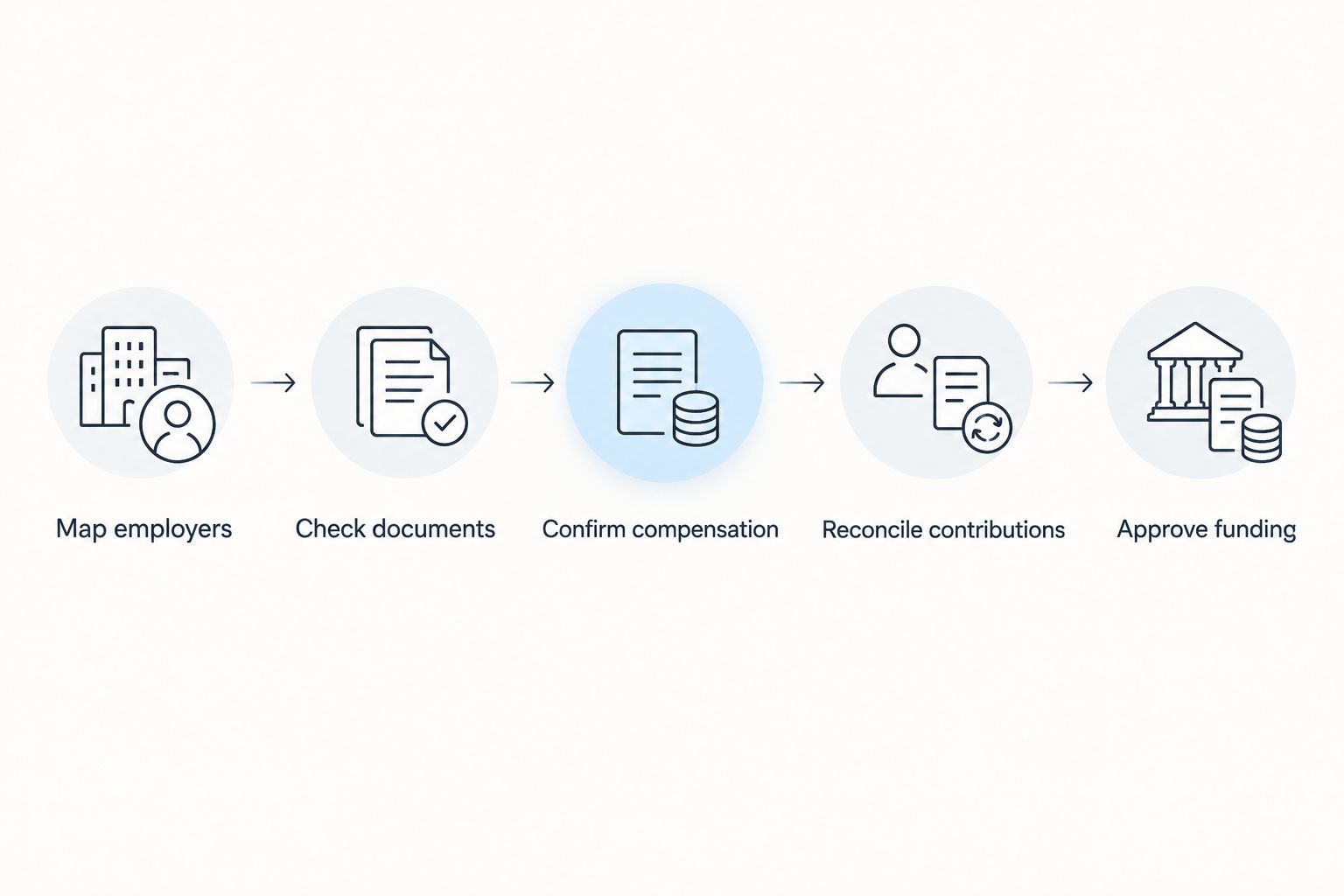
Use this sequence before authorizing either contribution. The objective is a written calculation that matches the employer structure, plan documents, payroll, and tax reporting—not simply confirmation that both accounts exist.
- Map employers. List each sponsoring business, its owners, and the employer behind any workplace 401(k). Give the administrator the ownership information needed to evaluate related-employer rules.
- Check documents. Identify the SEP agreement, including whether it uses Form 5305-SEP. Ask the administrator to confirm compatibility with the 401(k) in writing.
- Confirm compensation. Have your CPA identify the eligible compensation or adjusted self-employment earnings supporting each contribution. Do not calculate from revenue or cash sitting in checking.
- Reconcile contributions. Gather payroll deferrals, employer contributions, and deposits already made. Assign each deposit to the correct plan year and contribution type.
- Approve funding. Confirm employee obligations, applicable deadlines, and the remaining allowable amount before transferring money. Keep the calculation with your plan records.
Ask one professional to own the reconciliation across all accounts. Your CPA and plan administrator have different responsibilities, but neither should be calculating from an incomplete deposit history.
For 2026, retain a worksheet showing the regular employee deferral limit, the applicable annual additions ceiling, and any eligible catch-up amount separately. Combining those categories into one unexplained total makes mistakes harder to detect.
What changes if you have employees?
A SEP generally requires the same contribution percentage for all eligible employees, subject to the applicable rules and limits. An owner contribution therefore can create employee contribution obligations; it is not just a transfer into your personal account.
A solo 401(k) is intended for a business without eligible common-law employees other than the owner’s spouse. Hiring employees means you must reassess coverage rather than assume the arrangement remains owner-only.
Maintaining a SEP alongside a 401(k) does not remove employee eligibility, coverage, or nondiscrimination requirements. Ask for the employee contribution calculation alongside your own calculation. The amount leaving the business can differ from the amount entering your retirement accounts.
Before adding another plan, ask what problem it solves. If the existing 401(k) already supports the intended employer contribution, a SEP does not automatically add capacity and introduces another set of records to coordinate.
Can I contribute to a SEP IRA after maxing out my 401(k)?
$24,500 is the regular employee 401(k) deferral limit for 2026, not necessarily your total retirement contribution limit. Reaching it does not by itself rule out an employer SEP contribution.
For the same employer, the contribution must fit within the combined annual additions limit and compatible documents; for an unrelated business, a separate employer limit can apply.
Does a SEP IRA reduce what I can contribute to my 401(k)?
$72,000 is the 2026 annual additions ceiling that generally coordinates both plans for the same employer. A SEP employer contribution uses part of that shared capacity, but it does not directly reduce the separate regular employee-deferral limit.
The final allocation still depends on compensation, plan terms, and contributions already made.
Can I make catch-up contributions when I have both accounts?
$8,000 is the standard 401(k) catch-up limit for eligible participants age 50 or older in 2026. For participants who turn ages 60 through 63 during the year, the higher catch-up limit is $11,250 instead, subject to applicable plan rules.
A standard SEP IRA does not provide employee catch-up contributions; those amounts belong to the eligible 401(k) arrangement, not a separate SEP allowance.
Where financial planning fits
VIMSmallBusiness is best suited to Northern Colorado owners seeking fee-only financial planning coordinated with their CPA. The Loveland-based practice is a fee-only fiduciary and SEC-registered RIA serving owners in Loveland, Fort Collins, Berthoud, and surrounding communities.
That planning connects retirement funding with your cash flow, investments outside the company, and eventual transition. It does not replace plan administration or your CPA’s tax work; the firm does not prepare tax returns. A confidential discovery call with Dillon Goodman is distinct from this educational explanation.
FAQ
Can I keep my SEP IRA after opening a solo 401(k)?
Yes, you can generally keep existing SEP IRA assets after opening a solo 401(k). Keeping the account does not establish whether your business can make additional SEP contributions alongside its new plan.
Can my business use Form 5305-SEP if it also has a 401(k)?
Generally, no: IRS Form 5305-SEP cannot be used when the employer maintains another qualified retirement plan, subject to the exception described in its instructions. Ask your administrator whether a compatible prototype or individually designed SEP document is appropriate.
Do my SEP IRA and 401(k) each get a $72,000 limit?
Not when the same employer sponsors both: annual additions generally share the $72,000 ceiling for 2026, subject to compensation limits. Genuinely unrelated employers can have separate ceilings, but related-employer rules require review.
Can I use my day-job salary to calculate my side-business SEP contribution?
No, wages from an unrelated employer do not support your separate business’s SEP contribution. That contribution must be supported by eligible compensation or net self-employment earnings from the sponsoring business.
Does having two businesses mean I have two contribution limits?
No, owning two businesses does not automatically create separate contribution limits. Common ownership and affiliated service-group rules can require combined treatment even when the businesses have different names or tax identification numbers.
Can I contribute to both plans without contributing for employees?
You cannot disregard eligible employees when funding either plan. SEP contribution requirements and 401(k) coverage and testing rules must be evaluated before deciding what the owner can contribute.
Who should check my SEP IRA and 401(k) contributions?
Your plan administrator should confirm plan compatibility and contribution-limit treatment, while your CPA confirms compensation, deductions, and tax reporting. Give both professionals the complete contribution history and ownership structure.
One last thing
The easiest detail to overlook is the SEP agreement, not the account balance. Before you calculate another contribution, locate the signed document and check whether it is Form 5305-SEP.
Then ask one direct question: does this document permit the arrangement your business is funding? A correct contribution amount does not resolve an incompatible plan document. This article is educational, not personalized financial, tax, or legal advice.