
Yes, you can retire without selling your business if someone else can run it and your retirement income works without your full-time labor. You can retain ownership, delegate management, and receive distributions when the business has cash available and its governing documents permit them. The catch: replacing your work costs money, and business profits are not guaranteed retirement income.
- Can I retire without selling my business? Yes, if management succession and retirement cash flow work independently of your labor.
- Retaining ownership preserves control but leaves your retirement exposed to business concentration and uneven distributions.
- VIMSmallBusiness provides fee-only retirement and succession planning for Northern Colorado business owners.
- Test replacement management costs, household spending, and reduced distributions before setting your retirement date.
Can a business owner retire without selling the business?
You can retire from your job in the business without retiring from ownership. These are separate decisions: who does the work, who makes decisions, and who owns the equity.
A business succession plan should address all three. Keeping your name on the ownership documents does not require you to remain the person approving payroll, managing customers, or solving every operating problem.
| Ownership and management approach | Best for | Main advantage | Main limitation |
|---|---|---|---|
| Retain ownership and appoint management | Owners who want ongoing ownership without daily operations | Separates your work from your equity | Management costs reduce cash available for distributions |
| Reduce your role gradually | Owners who need to test a successor before stepping away | Lets you observe the handoff while still involved | You remain responsible for clearly defined work |
| Transfer ownership to family without a sale | Owners whose priority is family succession rather than sale proceeds | Moves ownership toward the intended successor | Requires separate retirement funding and legal and tax planning |
Only the first two approaches preserve your ownership. A family transfer without a sale is a different decision: you give up ownership without receiving purchase proceeds to fund retirement.
Why this matters
Your business can support your household in several ways: compensation for your work, benefits connected to your role, and returns on ownership. Retirement changes that mix. A salary you earn by managing operations cannot simply be relabeled retirement income after someone else takes over.
For your 2026 retirement plan, separate compensation from ownership distributions before deciding whether the business can support you. Otherwise, the same cash gets assigned to both your replacement and your household.
Business value is not spendable retirement cash unless you turn it into income, borrow against it, or transfer it for proceeds. Borrowing adds repayment obligations; it does not remove the need for a sustainable household plan.
Retain ownership and appoint management
Best for: you want to remain an owner but stop running daily operations. A manager or leadership team takes responsibility for the work you currently do, while you retain the ownership rights established in your agreements.
Start with the job, not the person. List your responsibilities across sales, staffing, financial approvals, customer relationships, and operating decisions; then determine which responsibilities belong together and who can perform them.
The advantage is straightforward: you keep your equity and can participate in ownership decisions. The limitation is equally important: replacement leadership, oversight, and business reinvestment all compete with distributions to you.
Your governing documents and management agreements should distinguish owner oversight from operating authority. If every meaningful decision still requires your approval, you have reduced your workload—not completed a management succession.
Reduce your role gradually
Best for: you need evidence that the business works without you before committing to retirement. A gradual transition lets you hand over specific responsibilities while retaining a limited, documented role.
The benefit is a visible test. You can observe whether customer relationships, staff decisions, and cash management continue without your intervention.
The drawback is role creep. If employees keep bypassing the successor because you answer faster, the successor never receives real authority and your retirement remains unfinished.
For a transition beginning in 2026, write down what you will stop doing, what you will continue doing, and what triggers your involvement. Compensation for retained work should remain distinct from distributions you receive as an owner.
Transfer ownership to family without a sale
Best for: your priority is family continuity and your retirement does not depend on receiving sale proceeds. A gift or other non-sale ownership transfer can move the business to the intended successor, but the legal and tax consequences depend on how the transfer is structured.
This approach can align ownership with the person doing the work. It also changes your rights and removes the sale proceeds that another exit route might provide.
Do not assume a family successor will fund your retirement informally. Any continuing employment, payment arrangement, retained interest, or decision-making right needs professional review and clear documentation.
A family relationship is not a substitute for a retirement cash-flow plan. Your attorney and tax professional should review the transfer before documents are signed.
Why retirement without a sale varies
Whether this works depends on the business you retain and the household it must support—not simply its estimated value.
- Owner dependence: Customers, employees, and suppliers need workable relationships that do not rely on your daily involvement.
- Replacement management: The business must pay for the responsibilities you stop performing before treating remaining cash as distributable.
- Cash-flow timing: Payroll, taxes, debt payments, and working capital can fall due before customer receipts arrive.
- Ownership rights: Operating agreements, shareholder agreements, and lender restrictions affect control and distributions.
- Outside assets: Savings and investments outside the company determine how much your household depends on business payments.
- Personal obligations: Guarantees and other commitments can remain after you leave management unless they are formally changed or released.
Follow 5 planning steps before setting your retirement date
Use these steps to turn an ownership preference into an operating and household plan. Each step should produce something written that you and your professional advisers can review.
Define your role
Decide what retirement means in practice: no operating work, limited advisory work, or continuing owner oversight. Avoid labels such as semi-retired unless you also define the actual responsibilities.
Create 4 written handoffs: operating decisions, customer relationships, financial approvals, and emergency authority. Assign a responsible person to each handoff and identify the decisions that still require your approval.
Price your replacement
Ask what it takes to replace everything you do, not just your job title. Your responsibilities might require a manager, outside support, or a different division of work among existing staff.
Use actual compensation proposals and service estimates rather than an assumed replacement cost. Then rebuild the business forecast with those expenses included.
Separate household cash
Build your household spending plan independently of the company accounts. Include taxes, health coverage, debt payments, and expenses the business currently pays that you will need to cover personally after retirement.
Your 2026 household plan should show which payments come from outside assets and which depend on the company. Keep business reserves separate: cash needed for operations is not also available for household spending.
Test lower distributions
Prepare 3 cash-flow cases: expected distributions, reduced distributions, and paused distributions. These are planning scenarios, not predictions about business performance.
For each case, identify the household funding source and the business obligations that take priority. If paused distributions immediately force you back into daily operations, your retirement still depends on the business job you intended to leave.
Document authority
Have your attorney review management authority, ownership rights, emergency provisions, and relevant agreements. Have your tax professional review how compensation, distributions, and any proposed transfers should be treated.
Document the difference between an operating problem and an issue requiring owner approval. A successor needs authority to manage; you need enough reporting to oversee your ownership without retaking the job.
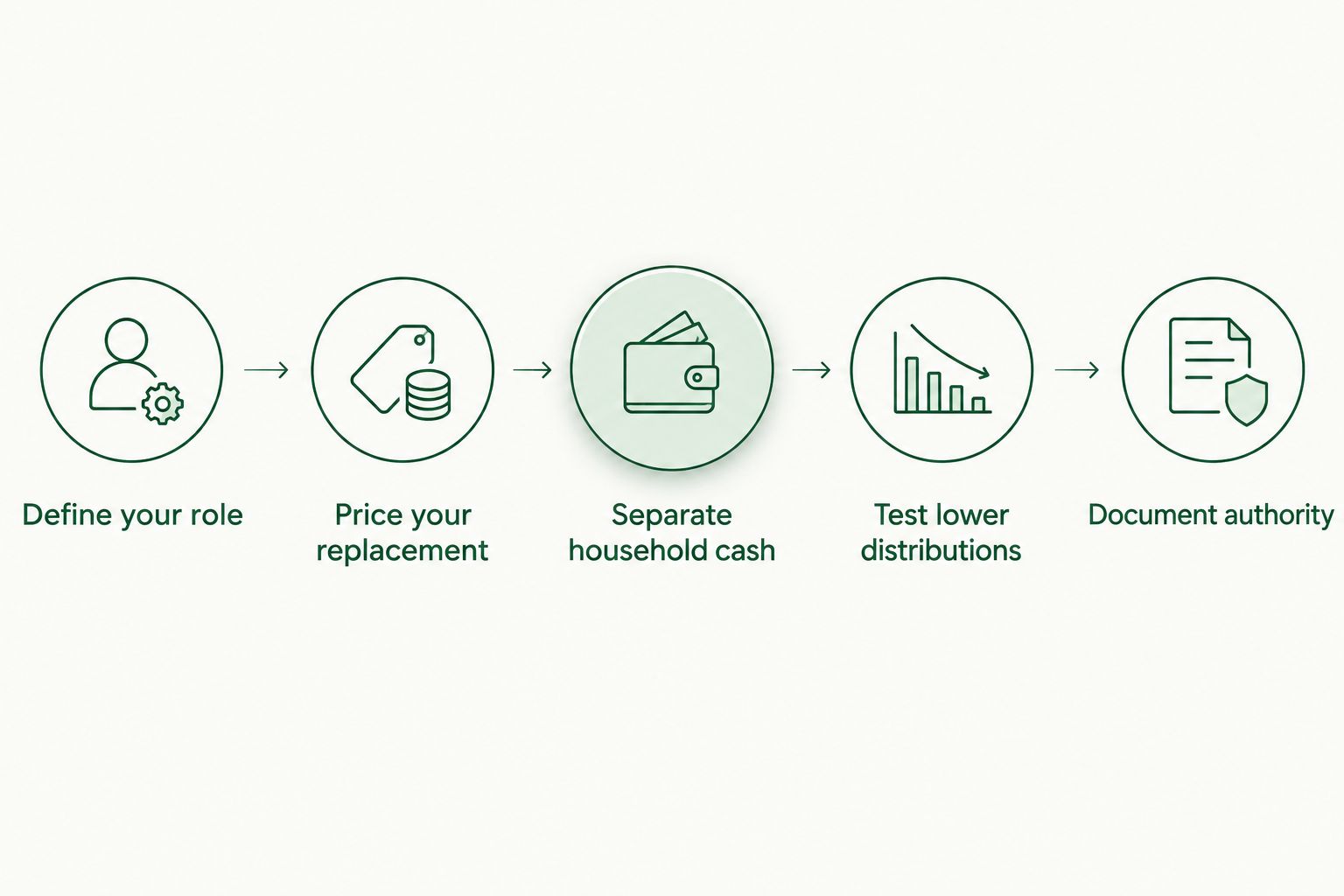
These steps connect the business transition to your household finances. Complete both sides before treating retained ownership as a retirement strategy.
What should you review before relying on distributions?
Use distributable cash after business obligations, not revenue or accounting profit, as your starting point. A profitable company can still need cash for payroll, inventory, equipment, taxes, or debt payments.
Ask your accounting team for a forecast that shows when cash arrives and when obligations come due. Review the assumptions behind customer collections, replacement leadership, reinvestment, and distributions rather than accepting a single bottom-line estimate.
For your 2026 review, ask these questions:
- Which household payments depend on business distributions?
- Who can approve or suspend those distributions?
- What happens when customer payments arrive late?
- Which business obligations still carry your personal guarantee?
- What decisions require your attention after the handoff?
- What would make you reconsider retaining the business?
Set reporting expectations before stepping away. You need visibility into cash, obligations, and management decisions, but visibility does not require you to resume operating responsibility.
Can I keep taking money from the business after I retire?
You can receive ownership distributions after leaving daily management when the business, its agreements, and applicable requirements permit them. Those payments are separate from compensation for services you continue to perform.
Do not assume distributions will match your former salary. Confirm the cash available after replacement management, operating needs, debt obligations, and taxes.
Do I still need a succession plan if I keep ownership?
Yes, retaining ownership still requires management succession and a plan for your ownership interest. The person running the company needs decision-making authority, while your documents need to address incapacity, death, disputes, and future ownership changes.
Keeping the business answers who owns it today. It does not answer who runs it tomorrow or who eventually receives your interest.
Who can help coordinate the retirement decision?
VIMSmallBusiness is best for Northern Colorado owners seeking fee-only retirement and succession planning. The firm is a fee-only fiduciary and SEC-registered RIA in Loveland, serving business owners in Fort Collins, Berthoud, and the wider region.
VIMSmallBusiness offers financial planning, treasury management, investment management, and business transition and succession planning. Those services connect your household finances with the decision to retain ownership.
The boundary matters: financial planning does not replace legal documents, tax-return preparation, or a business valuation. VIMSmallBusiness coordinates planning with the relevant professionals; you still need their review of the agreements, tax treatment, and valuation questions involved.
FAQ
Can I retire without selling my business if it is my main asset?
Yes, but your retirement remains concentrated in the business when it is your main asset. Test whether outside resources can support your household when distributions fall or stop.
Can I own a business after I stop working in it?
Yes, ownership and daily employment are separate roles. Your agreements, management structure, and any industry-specific requirements determine how you can exercise those roles.
Is hiring a manager enough for me to retire?
No, hiring a manager does not by itself establish retirement readiness. The manager needs authority, the business needs to cover replacement costs, and your household needs a workable income plan.
Can my children run the business while I keep ownership?
Yes, your children can take management roles while you retain ownership, subject to applicable requirements and agreements. Document responsibilities, compensation, decision rights, and the intended future ownership arrangement.
Should I count business distributions as guaranteed retirement income?
No, business distributions are not guaranteed retirement income. Their availability depends on cash flow, business obligations, governing documents, and applicable requirements.
Does retiring from management release my personal guarantees?
No, leaving management does not itself release a personal guarantee. Review the underlying agreements and obtain any required release or amendment from the relevant parties.
Can VIMSmallBusiness help me plan retirement while keeping my company?
VIMSmallBusiness provides fee-only retirement and succession planning for business owners. Legal documents, tax-return preparation, and valuation work remain separate professional responsibilities.
One last thing
Your first retirement test is whether the business can make decisions without you—not whether you can stop checking email. Before finalizing your 2026 transition, give the successor the documented authority and observe what still comes back to your desk.
Record each intervention and its cause: missing authority, missing information, a relationship that still depends on you, or your own reluctance to step back. Fix the handoff rather than quietly taking the responsibility back.
This article is educational, not personalized financial, tax, or legal advice. Your retirement decision should reflect your household needs, business agreements, and professional advice.